
Jonathan Chait's Blog, page 41
June 22, 2011
Obama: Bad Negotiator, Or Clever Moderate?
I've been noting the negotiating blunders that have left President Obama in the position of surrendering to Republican policy demands or risk the full faith and credit of the U.S. Treasury. Kevin Drum says it's not a blunder:
I continue to think that this probably wasn't a bungle. More likely, during his first two years in office Obama had gotten enough deficit religion from the likes of Peter Orszag and Tim Geithner that he actually welcomed the opportunity to put in place some long-term spending cuts. He couldn't very well admit that publicly, of course, since his base would go bananas, so instead he punted on the debt ceiling, knowing that Republicans would then use it to "force" spending concessions out of him. Mission accomplished: long-term spending is reduced, and Republicans get all the blame. Democrats mostly forgive him because everyone knows Republicans are crazy, and as a bonus, Republicans don't even get much of a boost from their own base out of this since any real-world spending cut won't come close to the demands of the tea party crowd.
How sure am I of this? Not very. Maybe 60%. But think of it this way: the kind of negotiating position Matt is talking about isn't rocket science. It's not even Negotiation 101. It's more like the fifth grade version. There's just no way that Obama and Reid and the rest of the Democratic brain trust were literally so stupid that they didn't understand this.
Greg Sargent agrees:
I continue to maintain that the explanation for Obama’s conduct is right out there on the public record. His advisers have made his thinking on these matters very clear. Right after the 2010 “shellacking,” they concluded that their number one political task was to win back independents. How? As the Post reported at the time, “they think he must forge partnerships with Republicans on key issues and make noticeable progress on his oft-repeated campaign pledge to change the ways of Washington.”
David Axelrod recently spelled this out, claiming that after the midterms Obama and his advisers decided they needed to return to what’s been “central to Barack Obama’s public life and outlook.” Axelrod defined that this way: “you don’t have to agree on everything, or even most things, to work together on some things.”
Here's why I disagree. First, to address Sargent's point, Obama certainly wanted to negotiate with Republicans and make bipartisan agreements. But he did not want to spook the financial markets. And, while he may not sure the policy goals of the modal Daily Kos contributor, he is fundamentally left of center. I don't think he wants to be negotiating with a gun to the head of the economy, or contemplating cuts to Medicaid or slashing the domestic discretionary budget. He could have negotiated a budget deal with Republicans the way Bill Clinton did -- by negotiating over the budget, with the threat being a government shutdown that would probably benefit him politically, rather than a debt default that could blow up his own election.
As for Drum, "they couldn't possibly be that stupid" is a classic error. I've made it myself. One of my general rules of interpreting human behavior is never to assume a complicated plan is at work when incompetence is available as an explanation. Incompetence can involve many factors, and often rank stupidity is at work. I agree that Obama is not stupid, but how many memoirs of presidential decision making have we seen that emphasize bureaucratic inertia, lack of good information, panic, exhaustion, distraction, and so on?
If Obama wanted a bipartisan deal on the budget, then almost certainly he and his advisers were looking at the proximate historical example of Bill Clinton. That would cause them to overlook the debt ceiling as a leverage point, as not even the Gingrich revolutionaries thought to use it to jack up the administration for concessions. It wouldn't have caused them to set up the debt ceiling as a trap for themselves.


June 21, 2011
Metcalf vs. The Libertarians
[image error]Stephen Metcalf's essay on libertarianism and Robert Nozick, which I linked, has naturally provoked libertarian pushback. Reason editor Matt Welch publishes a rebuttal consisting entirely of pointing out that Ann Coulter also dislikes libertarianism, therefore Slate agrees with Coulter. (And you know who hated communism? Hitler! So anybody who hates communism agrees with Hitler.)
Cato's Jason Kuznicki easily clears the "more persuasive than Matt Welch" bar in his Metcalf reply, though this rebuttal isn't terribly strong:
Of the many errors in a long and error-ridden article, I think the worst has to be the idea that libertarians hold all concentrations of wealth to be good. As long, I infer, as we gather it in sufficiently large heaps. Metcalf writes:
But being a star athlete isn’t the only way to make money. In addition to earning a wage, one can garnish a wage, collect a fee, levy a toll, cash in a dividend, take a kickback, collect a monopoly rent, hit the superfecta, inherit Tara, insider trade, or stumble on Texas tea. For each way of conceiving wealth, there is at least one way of moralizing its distribution. The Wilt Chamberlain example is designed to corner us—quite cynically, in my view—into moralizing all of them as if they were recompense for a unique talent that gives pleasure; and to tax each of them, and regulate each of them, according to the same principle of radical noninterference suggested by a black ballplayer finally getting his due.
This is simply wrong. For a libertarian, it’s only Wilt Chamberlain’s particular type of wealth that is morally blameless, not all the rest. Which kind is his? The kind acquired through voluntary transactions, without coercion or fraud. The kind that comes from Nozick called capitalist acts between consenting adults.
Some wealth is blameless. Some isn’t. And yes, some cases are truly hard to judge: Is Wal-Mart a free-market success story? Wellll…. kind of. But what about all those special tax privileges? What about that eminent domain abuse?
Wilt Chamberlain makes a good example not because he’s a black man struggling sympathetically in a white man’s world. His example is useful because it strips away every possibility of force, fraud, corporate welfare, and government favoritism. When we do that, we can see that it’s still possible to grow wealthy through honest, voluntary methods.
No, that wasn't Metcalf's point. Metcalf's point was that Nozick was seizing upon an unusual and deeply atypical example of wealth, and used it draw draw up rules to presumptively apply to all wealth. It's like using the example of a man stealing a loaf of bread to feed his starving children as the basis for our laws about property and theft. To object to such an exercise is not to deny that morally justifiable theft can exist. It's just a bad model to build an absolute moral defense of capitalism
Should We Take Huntsman Seriously?
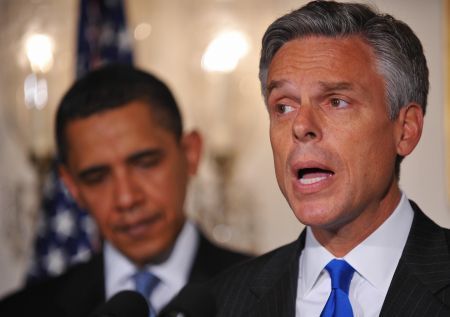
Much of the discussion of the Jon Huntsman candidacy revolves around whether the news media should treat him as a top-tier presidential candidate. The divide on this question is a divide between people who have a handle on the state of the Republican Party and those who don't. The reasons why Huntsman can't win are legion -- he's polling within the margin of error of zero; he's taken numerous moderate positions Republicans can't tolerate; he has worked for, praised and been praised by Obama; there's already another mainstream competent Mormon former governor competing for the same limited slice of the primary electorate; and Huntsman's own recognition that he's too moderate for the current GOP.
But the main obstacle is that Huntsman differs with the entire Republican Party on the party's most fundamental strategic question, which is how to respond to Obama. Here's Huntsman early in 2009:
In dozens of interviews over the past few weeks, he has characterized Republicans as "devoid of ideas" and "gasping for air," decrying the GOP's "gratuitous partisanship," comparing it to "a very narrow party of angry people," and describing its strategy as "obstruct and obfuscate … grousing and complaining." When I ask him who he sees as potential leaders for the party, he says with a mischievous grin, "I don't know that we have one."
So you had the Republicans assuming a posture of maximal opposition vis a vis Obama in early 2009. A few murmerings of dissent could be found, mainly among Republicans who subsequently left or were driven out of the party, like Charlie Crist or Arlen Specter. Huntsman was the most forceful dissenter, and he recognized that his dissent put him so far out of step with the party that he shelved his presidential ambitions and accepted an overseas post working for Obama. Since then, there has been absolutely no dissent whatsoever on the question of Obama. No Republicans is saying they should have cut a deal on stimulus, or health care, or anything. The posture of maximal opposition to Obama is the one single thing upon which the entire party agrees.
The notion that a dissenter against that consensus might win the presidential nomination is not merely a longshot but totally absurd. Political reporters take Huntsman seriously because, apart from having some impressive governing accomplishments, his ideological deviations place him closer to their own views. But Huntsman is much farther from the party center of gravity than Michelle Bachmann, Herman Cain, or Ron Paul. Republicans nominating Huntsman would be as if the Democrats in 2000 had nominated someone who had crusaded for the impeachment of Bill Clinton.
JONATHAN CHAIT >>
Obama's Bargaining Blunder
I try to avoid simply repeating things that other people blog, but this excerpt of President Obama's news conference from December, via Mike Konczal, is pretty incredible:
THE PRESIDENT: …Marc Ambinder.
Q Mr. President, thank you. How do these negotiations affect negotiations or talks with Republicans about raising the debt limit? Because it would seem that they have a significant amount of leverage over the White House now, going in. Was there ever any attempt by the White House to include raising the debt limit as a part of this package?
THE PRESIDENT: When you say it would seem they’ll have a significant amount of leverage over the White House, what do you mean?
Q Just in the sense that they’ll say essentially we’re not going to raise the — we’re not going to agree to it unless the White House is able to or willing to agree to significant spending cuts across the board that probably go deeper and further than what you’re willing to do. I mean, what leverage would you have –
THE PRESIDENT: Look, here’s my expectation — and I’ll take John Boehner at his word — that nobody, Democrat or Republican, is willing to see the full faith and credit of the United States government collapse, that that would not be a good thing to happen. And so I think that there will be significant discussions about the debt limit vote. That’s something that nobody ever likes to vote on. But once John Boehner is sworn in as Speaker, then he’s going to have responsibilities to govern. You can’t just stand on the sidelines and be a bomb thrower.
And so my expectation is, is that we will have tough negotiations around the budget, but that ultimately we can arrive at a position that is keeping the government open, keeping Social Security checks going out, keeping veterans services being provided, but at the same time is prudent when it comes to taxpayer dollars. A shockingly poor calculation.
Now, in the administration's defense, no Congressional party had ever previously used the debt ceiling to jack up the president for substantive concessions. Still, it was clear that the time that Republicans were committed to pushing the boundaries of their formal powers as far as they would go, and Obama utterly failed to anticipate this. Obama could easily have thrown in an agreement to raise the debt ceiling as part of a deal to implement Republican-demanded proposals to increase the deficit. But the Democrats seemed to think the debt ceiling would make the Republicans more responsible and bipartisan.
A Marine Sgt. Major On Gays In The Military
This is what social progress looks like:
Sgt. Maj. Barrett also tackled questions on the repeal of “Don’t Ask, Don’t Tell,” the military’s ban on gays serving openly in uniform. The Department of Defense is preparing to implement repeal, and Sgt. Maj. Barrett addressed that issue directly.
“Article 1, Section 8 of the Constitution is pretty simple,” he told a group of Marines at a base in South Korea. “It says, ‘Raise an army.’ It says absolutely nothing about race, color, creed, sexual orientation.
“You all joined for a reason: to serve,” he continued. “To protect our nation, right?”
“Yes, sergeant major,” Marines replied.
“How dare we, then, exclude a group of people who want to do the same thing you do right now, something that is honorable and noble?” Sgt. Maj. Barrett continued, raising his voice just a notch. “Right?”
Sgt. Maj. Barrett then described conversations with U.K. troops, who saw a similar ban lifted a decade ago, with little disruption. And to drive the point home, he produced a pocket copy of the Constitution.
“Get over it,” he said. “We’re magnificent, we’re going to continue to be. … Let’s just move on, treat everybody with firmness, fairness, dignity, compassion and respect. Let’s be Marines.”
Debt Ceiling Hostage Update
 The Obama administration has been expressing supreme confidence that it will get an agreement to raise the debt ceiling. That confidence seems hard to square with what Republicans are saying. They're expressing strong resistance to cutting defense:
Although Republicans are demanding deep cuts in domestic programs, they are resisting sharp reductions at the Pentagon in the Biden talks, a key demand for many Democrats. Senior GOP aides said it would be hard to sell defense cuts to their skeptical troops.
“Guys like me, I’ll just say no,” said Rep. Duncan Hunter (R-Calif.), a veteran of Iraq and Afghanistan who argues that any reduction in military spending must be accompanied by a detailed analysis of the impact on national security. “Republicans, if they’re not careful, are going to saw off the third leg of the Republican stool. The leg of national security is going to get chopped off.”
Moreover, despite Senate Republicans having voted to repeal the ethanol subsidy, House Republicans still apparently refuse to budge:
Revenue is another major obstacle. Many Democrats say they could never vote to gut programs that help low- and middle-income families unless the wealthy are also forced to sacrifice. Democrats argue that Republicans should at least join them in eliminating corporate tax breaks that benefit major oil and gas companies and chief executives with private jets.
Senate Republicans have shown some openness to that approach, voting last week to eliminate tax breaks for ethanol blenders. But House leaders remain opposed to targeting credits and deductions without also overhauling the tax code and lowering rates. In the Biden talks, Republicans have so far declined to consider eliminating even certain temporary tax breaks, such as those for Puerto Rican rum and NASCAR tracks, that have been repeatedly lampooned by watchdog groups.
Meanwhile, GOP Senate Whip Jon Kyl is backing to citing the authority of voodoo economics:
Kyl used his time on the floor to argue that raising taxes is not necessarily the way to increase government revenues, and said a study by Alan Reynolds of the Cato Institute shows that historically, more revenue is generated by lower taxes. Kyl argued that this is because taxes are a tax on economic activity, which is stunted when taxes rise.
Well, that's great.
We'll see what these negotiations produce -- rhetoric is not necessarily a perfect indicator of the actual state of play. But I suspect the entire concept of harnessing deficit negotiations to a debt ceiling vote is utterly misguided in ways that neither party really grasps. Mitch McConnell has called the debt ceiling the "moment of maximum leverage," the best point to get a deal for his party. The Washington Post editorial page endorses the logic of brinksmanship:
We diverge from Mr. Bernanke on whether it is appropriate to use the debt ceiling as a forcing mechanism for fiscal action. Nothing else seems to have been able to persuade leaders to get serious about the long-term fiscal threat to the nation’s health. The debt-ceiling deadline should serve to focus their attention and induce them to outline at least the beginning of a deal.
Here is what I'm afraid is the miscalculation here. The debt ceiling is inherently a difficult vote for members of Congress -- their constituents don't understand it, and nobody wants to do it. Republicans and deficit hawks seem to think that attaching it to deficit reduction makes the vote easier. But that's only true if the deficit vote gets to be entirely on their terms. And it can't be -- it also requires approval by the majority-Democratic Senate and the Obama administration.
So the end result is that the deficit reduction winds up as an unpopular compromise, and you're simply adding one unpopular vote to another. If the negotiations fail, the Republicans have talked themselves into a position where the leadership can't fall back on just raising the debt ceiling or else it risks a revolt. And the Obama administration enabled this, first by failing to include a debt ceiling hike in last year's tax deal, and second by opening themselves up to an unprecedented hostage negotiation. The markets currently seem assured on the understanding that people in power are responsible and know what they're doing. I'm far less assured.
JONATHAN CHAIT >>
June 20, 2011
Amity Shlaes Still Partying Like It's 1979
I've seen some bad arguments that we must fear inflation, but possibly nothing as unpersuasive as the one Amity Shlaes mounts today:
Is our economy headed back into a recession? A look at a past double-dip, the recessions of 1980 and of 1981-1982, suggests we are due. That double-dip also suggests the Federal Reserve should raise interest rates earlier and faster than you might think.
In fact, the 1980s experience points to something horrible: We need a recession to get a true recovery....
Inflation hasn't dominated our headlines yet. But this moment resembles the old days because the Fed has made clear it's willing to tolerate inflation out of concern over a recession. No one today can imagine Fed Chairman Ben Bernanke raising rates to even the levels of the Burns era.
The first takeaway message from the early 1980s is that creeping inflation gallops before experts catch it. The second takeaway is that postponing the commitment to tighten hard ensures yet higher interest rates later.
A monetary recession lurks ahead. How high will the rates be? Higher than you think.
I've quoted the beginning and the end of Shlaes' column, which is also the only part that contains anything approximating an argument. In between is a recollection of how the Federal Reserve raised interest rates in 1979, crushed inflation, and everybody lived happily ever after. is the current moment like 1979, where we're looking at a cycle of workers demanding higher wages to keep up with rising prices, causing an inflationary cycle that spins out of control? I would have to say no:
[image error]
The peak so see on the left pf the chart is what we were looking at when Paul Volcker raised rates. You kind of understand why he was concerned about inflation, which was over 13%. The part on the right, with core inflation well under 2%, not so much.
Why should we worry? Because, Shlaes argues, the fed is demonstrating that it will "tolerate" inflation. How is it demonstrating that? Because "No one today can imagine Fed Chairman Ben Bernanke raising rates to even the levels of the Burns era." But isn't that because inflation is so low? Why would he need to raise rates to 1979 levels?
Because, Shlaes instructs, "creeping inflation gallops before experts catch it." But, first of all, "creeping" inflation (she's referring to 1975-1979) was a five year period in which core inflation began in the double digits and never fell below 6%. We'd have to triple the current rate before we could be "creeping," which in turn could become galloping.
Shlaes argument here is kind of like Niall Ferguson's fear of a resurgent Ottomann Empire. If Ferguson wanted to make his same argument less persuasively, he could tell the story of the rise of the Ottomann Empire, and then conclude that the first step to the Turks controlling a huge empire is for them to control Turkey, so we need to stop them now before they reach Vienna. After all, no one today can imagine President Obama going to war to stop Turkish militarism. (I certainly don't envision this.) That's the kind of weakness the Turks have been waiting for.
Predictions I Wish I Could Bet Against
 Niall Ferguson
On one issue the Republican contenders and the president they wish to replace are in agreement: the United States should reduce its military presence in the Greater Middle East. The preferred arguments are that America cannot afford to be engaged in combat operations in far-flung countries and that such operations are futile anyway.
The question no one wants to answer is what will come after the United States departs. The “happily ever after” scenario is that one country after another will embrace Western democracy. The nightmare scenario is either civil war or Islamist revolution. But a third possible outcome is a revived Ottoman Empire...
Perhaps we should guard against the possibility by cultivating an alliance with Mongolia.
Robert Nozick, Wilt Chamberlin, And the Reality Of Inequality
 Stephen Metcalf has a must-read essay in Slate about Robert Nozick and the libertarian idea that market outcomes are morally inviolable:
Nozick writes:
"Wilt Chamberlain is greatly in demand by basketball teams, being a great gate attraction. (Also suppose contracts run only for a year, with players being free agents.) He signs the following sort of contract with a team: In each home game twenty-five cents from the price of each ticket of admission goes to him. (We ignore the question of whether he is "gouging" the owners, letting them look out for themselves.) … Let us suppose that in one season one million persons attend his home games, and Wilt Chamberlain ends up with $250,000, a much larger sum than the average income and larger even than anyone else has. Is he entitled to his income? Is this new distribution D2 unjust?"...
[W]hile clever, the Wilt Chamberlain argument is maybe a little too clever—i.e., what seems on first blush to be a simple case of freedom from interference is in fact a kind of connivance. Anarchy not only purports to be a defense of capitalism, but a proud defense of capitalism. And yet if Anarchywould defend capitalism unashamedly, why does its most famous argument include almost none of the defining features of capitalism—i.e., no risk capital, no capital markets, no financier? Why does it feature a basketball player and not, say, a captain of industry, a CEO, a visionary entrepreneur? The example as Nozick sets it out includes a gifted athlete (Wilt Chamberlain), paying customers (those with a dollar to see Wilt play)—and yet, other than a passing reference to the team's "owners," no capitalist!
In Nozick's example, we know what portion of every ticket (25 cents) represents the monetary equivalent of every paying customer's desire to see not the game itself but Wilt Chamberlain play in it. Bearing in mind that all thought experiments beg our indulgence without requiring our stupidity, notice that, in order to abstract out this allegiance from allegiance to the team, to the sport, etc., and give it a dollar figure, Nozick has assigned what amounts to a market price to Wilt's talents while also suggesting the price was achieved by negotiation between Wilt and the owner. Now, here we must pause, and note that "price" is not an incidental feature of a libertarian belief system—it is what obviates the need, beyond enforcing the basic rule of law, for government. To a libertarian, price is, in effect, the conscience of society finding its highest expression in every swipe of the debit card. Just as the thought experiment, "If there were purple cows on the moon, they would certainly be purple" tells us nothing about the moon, cows, or the color purple, assuming a world in which labor and management arrive at gentleman's agreements—and in which those agreements capture the precise value, down to the penny, of labor's marginal product—tells us very little about justice.
Put another way, Nozick is cornering us into answering a ridiculously loaded question: If every person were a capitalist, and every capitalist a human capitalist, and every human capitalist was compensated in exact proportion to the pleasure he or she provided others, would a world without progressive taxation be just? To arrive at this question, Nozick vanishes most of the known features of capitalism (capital, owners, means of production, labor, collective bargaining) while maximizing one feature of capitalism—its ability to funnel money to the uniquely talented. In the example, "liberty" is all but cognate with a system that efficiently compensates the superstar.
As it happens, Peter Whoriskey has written an excellent report in the Washington Post nicely complementing Metcalf's point. Woriskey, citing a detailed examination of tax records, shows that superstar athletes, media personalities, and other Chamberlin-like figures account for just a tiny share of the richest 0.1%. Overwhelmingly, the rise in inequality is a phenomenon of rising executive pay. Whoriskey details what the rise in inequality actually does look like:
It was the 1970s, and the chief executive of a leading U.S. dairy company, Kenneth J. Douglas, lived the good life. He earned the equivalent of about $1 million today. He and his family moved from a three-bedroom home to a four-bedroom home, about a half-mile away, in River Forest, Ill., an upscale Chicago suburb. He joined a country club. The company gave him a Cadillac. The money was good enough, in fact, that he sometimes turned down raises. He said making too much was bad for morale.
Forty years later, the trappings at the top of Dean Foods, as at most U.S. big companies, are more lavish. The current chief executive, Gregg L. Engles, averages 10 times as much in compensation as Douglas did, or about $10 million in a typical year. He owns a $6 million home in an elite suburb of Dallas and 64 acres near Vail, Colo., an area he frequently visits. He belongs to as many as four golf clubs at a time — two in Texas and two in Colorado. While Douglas’s office sat on the second floor of a milk distribution center, Engles’s stylish new headquarters occupies the top nine floors of a 41-story Dallas office tower. When Engles leaves town, he takes the company’s $10 million Challenger 604 jet, which is largely dedicated to his needs, both business and personal. ...
Dean Foods offers a better comparison than most because fundamentally it hasn’t changed.
The dairy business is still the root of the company; it was on the Fortune 500 by the late ’70s and remains there today. It grew then and more recently through acquisition.
Moreover, both chief executives — Douglas and Engles — could boast records of growing the company and profits.
From 1970 to 1979, while Douglas was the chief executive, sales at Dean Foods tripled and profits increased tenfold, to $9.8 million, according to company records. Similarly, from 2000 to 2009, sales at what would be Dean Foods had roughly doubled, and so had profits, to $228 million. (Engles became chief executive after the company he led bought Dean Foods in 2001 and adopted its name.)
Yet there are vast differences in the way the two men were paid, even when you adjust for the effects of inflation.
In the late 70s — 1977, 1978 and 1979 — Douglas made about $1 million annually in today’s dollars. The largest part of that was a salary; some came from a long-term incentive based on the stock price that would not mature until he retired.
By contrast, in the late 2000s — 2007, 2008 and 2009 — Engles averaged $10.5 million annually, most of it in stock and options awards and other incentive pay, according to proxy statements. After ’09, which was a particularly bad year, Engles’s compensation dropped to $4 million in 2010.
If one wants to mount a Nozickian moral defense of unvarnished inequality, these are the sorts of facts one ought to explain. Why is Gregg L. Engles that much more worthy than Kenneth J. Douglass, despite having presided over less impressive growth?
The Overhyped Rise Of GOP Anti-Interventionism
Jonathan Martin and Ross Douthat both have excellent pieces today about the Republican Party's growing skepticism of neoconservative foreign policy. Douthat writes:
Among conservatism’s foreign policy elite, Rubio’s worldview commands more support. But in the grass roots, it’s a different story. A recent Pew poll found that the share of conservative Republicans agreeing that the U.S. should “pay less attention to problems overseas” has risen from 36 percent in 2004 to 55 percent today. In the debate over Libya, Tea Party icons like Michele Bachmann and Sarah Palin have sounded more like Paul than Rubio, and a large group of House Republican backbenchers recently voted for a resolution that would have brought the intervention screeching to a halt.
This is all true, but it tells you very little about the foreign policy of the next Republican president, because it ignores partisanship. Republicans have a hawkish faction that supports every military intervention, and Democrats have a liberal faction that opposes every military intervention. But large numbers of both parties make their decision about any particular intervention based on whether they trust the president -- which means whether he's in their party or not.
It's true that some Republicans are sounding anti-interventionist notes now. George W. Bush himself ran in 2000 as an anti-interventionist, attacking the Clinton administration for its nation-building and promising a more "humble" foreign policy. The Republican fear of reckless American intervention disappeared as soon as Clinton did, and it will disappear again as soon as a Republican takes the oath of office.
This is, to be sure, a bipartisan phenomenon. Barack Obama and many other Democrats sounded far more anti-war while running for office than Obama has governed. The point is that campaign rhetoric about foreign policy, while interesting in its own right, does not provide an accurate guide to how a party would contact foreign policy from the White House.
Jonathan Chait's Blog

- Jonathan Chait's profile
- 35 followers

