
Jonathan Chait's Blog, page 37
June 29, 2011
Federal Court Upholds Individual Mandate
[image error]
The merits of the constitutional challenge to the Affordable Care Act have always been silly, but we've been waiting for a Republican-appointed judge to acknowledge that they're silly. Today one did.
More analysis to come.


Give Coburn And Lieberman A Chance
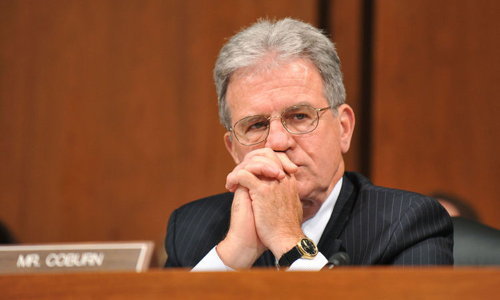
Tom Coburn and Joe Lieberman's bipartisan plan to cut Medicare is one of those notions whose every word ("Coburn," "Lieberman," "bipartisan," etc.) seems designed to provoke liberal antagonism. Talking Points Memo calls it "Ryan Plan 2.0." Joan McCarter and Greg Sargent are attacking it as well. I think they're making a mistake.
First, it's just not accurate to conflate this proposal with Ryancare. Paul Ryan's Medicare plan has two huge problems. First, it privatizes Medicare, fragmenting the system into an inefficient private insurance market. Second, it provides grossly and increasingly inadequate subsidies for insurance within that system. Describing that proposal as "ending Medicare" is contestable but fair.
Coburn and Lieberman's proposal does neither of these things. It may not be perfect, but it's basically a standard package of trimming Medicare while leaving the basic structure in place. Here's Kate Pickert's handy thumbnail description:
* Raise the Medicare eligibility age from 65 to 67, which the senators acknowledge is only feasible because the Affordable Care Act makes it easier for 65 and 66-year-olds to buy private insurance.
* Institute a single Medicare deductible of $550, ask seniors to pay coinsurance for services from 5% to 20%, and set a new annual “out-of-pocket” maximum of $7,500, which will protect seniors from medical bankruptcy. (Higher income seniors will face higher “out-of-pocket” maximums, up to $22,500 for individuals earning $160-$213,000 per year.)
* Limit supplemental insurance coverage so that seniors can’t purchase Medigap policies to cover all of their out of pocket expenses. Studies show this change could reduce over-utilization without harming health.
* Stop paying hospitals for debts incurred, but not paid, by Medicare beneficiaries.
* Increase Medicare Part B premiums for all enrollees, but especially high-income earners. Increase Part D premiums for high-income earners.
* Fix the SGR for three years. This would prevent Congress from having to constantly vote to prevent Medicare reimbursements from falling dramatically.
* Combat Medicaid Medicare fraud. See here for more on this provision.
The irony here is that comparing this to Ryancare plays into Ryan's intellectual sleight of hand. Ryan argues that Medicare as it's currently structured can't continue. The only alternatives are to do nothing and watch it disappear, impose draconian bureaucratic rationing, or try his proposal. The truth is that Medicare is in trouble, and the cost-saving measures in the Affordable Care Act are an important step toward controlling health care cost inflation but probably not enough to solve the problem on their own. Over the very long run we need to build on its cost-control devices. In the medium-run, we probably need to impose some straightforward cost saving. Coburn/Lieberman is a way to do that while preserving the traditional Medicare system. It's proof that Ryan is wrong.
Conflating Ryan's radical plan with standard Medicare cuts is essentially to endorse his argument from the other direction. Ryan paints his proposal as merely a way to bring Medicare's financing into line, while the most ardent critics of Coburn/Lieberman paint a plan to bring Medicare's financing into line as Ryancare. It's not only wrong, it concedes Ryan's argument for him.
Now McCarter and Sargent make a more sophisticated political argument. Democrats have won the Medicare debate and have Republicans on the run over Ryancare, they argue. Why let Republicans off the ropes? Here's Sargent:
Dems have successfully cast the battle over Medicare as one between those who would save the program and those who would destroy it — or at least transform it so fundamentally that it would cease to exist.
As this ad shows, the GOP’s response is to muddy the waters by claiming that both sides agree Medicare needs to be cut and that the only difference is over the details — indeed, the GOP is now claiming that the Dem plan is more extreme than the Ryan plan. Cutting Medicare is now “extreme”; Dems have already proven themselves willing to take that step; Republicans won’t let Dems get away with it.
The question now is whether Dems will take this sort of thing as a sign that they maintain an advantage on Medicare that would be badly undermined if they agree to any significant Medicare benefits cuts. If they do, it will only give Republicans more grist to keep attacking them from the left in exactly this fashion, and muddle the contrast between the parties on a popular entitlement program that has been a pillar of the Democratic Party’s identity for decades.
I don't really understand this. As Sargent notes, Republicans are already attacking Democrats for cutting Medicare. The waters have been muddied, and Democrats are winning anyway. They're winning because there's a fundamental divide between trimming Medicare and ending Medicare. That will continue to exist even if both parties agree to Coburn/Lieberman.
Now, it's true that a bipartisan deal on Medicare will help Republicans present the Ryan plan as just a conversation starter they don't really want to, you know, happen. But everybody still knows this is what Republicans would like to pass if they actually had the power to do so, and Democrats should be able to make this case to the voters. Meanwhile, the deficit is an actual problem, and Democrats need to find politically feasible ways to help solve it. There are bright lines to draw: slashing the already-lean Medicaid program, starving the long-starved domestic discretionary budget, and failing to require any sacrifice from the affluent. "No cuts to Social Security and Medicare" is the wrong place to draw the line.
Pawlenty Ponders Whether Reagan Could Make A Rock So Big He Couldn't Lift It
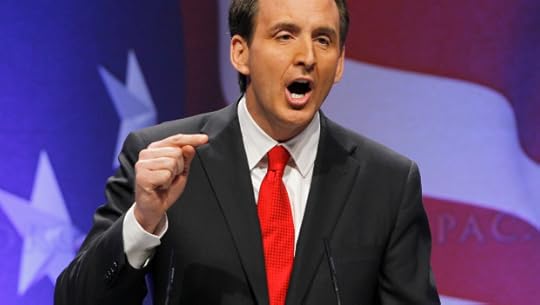
Tim Pawlenty has staked out the maximal hawkish position within the Republican primary field. At the same time, he and every Republican candidate must maintain maximal Ronald Reagan fealty. Jeffrey Goldberg interviews Pawlenty and watches the brain circuits fry:
Lately, some conservatives have taken to praising President Ronald Reagan’s decision to withdraw from Lebanon after the fatal Marine-barracks bombing in 1983. ...
I asked Pawlenty if he thought Reagan’s decision to withdraw from Lebanon was wrong. He went silent.
“Am I putting you in the uniquely uncomfortable position of criticizing Ronald Reagan?” I asked.
“I guess I would go back and say that my view, without referencing a particular president, is that once the United States commits to a mission, it’s really important that we prevail. Because when you don’t, it diminishes the respect and credibility and awe that other people view the United States with. And our goal here is to avoid as many future conflicts as possible by having our relative position be so strong and so unquestioned and so certain that nobody dare challenge us.”
I believe the correct answer is: Reagan withdrew the Marines from Lebanon in order to demonstrate the importance of American resolve.
What Lisa Baron Really Exposed
 Former Republican press aid Lisa Baron has a mildly funny, deeply pathetic "tell all" memoir. Michelle Goldberg's sharp review zeroes in on Baron's personal ambition:
As a liberal, I've often wondered about the motivations of Republicans who work on behalf of a social agenda that they have no intention of abiding by in their own lives. Why would a hard-partying socially liberal woman devote herself to electing men like Reed, or like Georgia Senator Saxby Chambliss? The answer, it turns out, is distressingly simple. Because she's kind of a terrible person.
Okay, that may be going too far. Baron is often quite funny, and would probably be amusing to go drinking with. Still, I doubt the most jaded critic of our political class could imagine a character quite so craven and cynical. Here, laid bare, is the soul of an unrepentant, avaricious hack, a person with lots of ambition but few ideals and even less self-awareness. If it were a satire, it would be brilliant. ...
Above all, Baron nurtures the rather tragic dream of becoming White House Press Secretary—there's a long reverie about the designer outfits she'd wear while speaking to the nation. She aspires—literally—to one day sit next to Thomas Friedman at a dinner party. Reed may have built his career pushing policies she opposes, but through him, she gains access to the dazzling world of cable TV bookers. "I was Ralph Reed's right-hand woman, and I loved that as well as traveling first class, Chris Matthews' and Larry King's producers were calling me, wanting to set up interviews with Ralph," she writes.
This is pathetic, but hardly atypical. A lot of political operatives are attracted not so much to any worldview as to the glamour, or perceived glamour, of political life. They want to be big shots, wear nice clothing, hobnob with famous people, and date rich, famous, and/or attractive people. Once they pick a team, they tend to stick with it. But for many -- not all, but many -- changing policy is purely secondary.
Obama, The Jews, And September
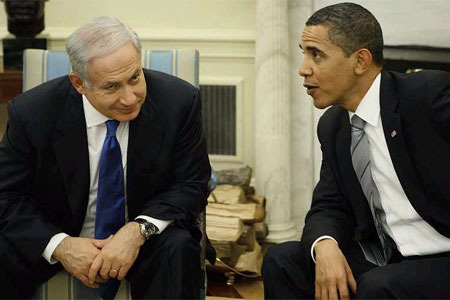
Ben Smith has some strong reporting to show that the concerns about President Obama's policy toward Israel among American Jews -- specifically liberal, non-single-issue pro-Israel Democrats -- are real:
One said he had the sense that Obama “took the opportunity to throw Israel under the bus.” Another, who swore he wasn’t getting his information from the mutually despised Fox News, admitted he’d lost faith in the president.
If several dozen interviews with POLITICO are any indication, a similar conversation is taking place in Jewish communities across the country. Obama’s speech last month seems to have crystallized the doubts many pro-Israel Democrats had about Obama in 2008 in a way that could, on the margins, cost the president votes and money in 2012 and will not be easy to repair.
“It’s less something specific than that these incidents keep on coming,” said Ainsman.
Smith also quotes DNC chairman Debbie Wasserman Schultz, who provides a quote supporting Obama while signalling that the existence of voter concern is real.
On the other hand, it's worth keeping in mind that some sequencing is going to alter the dynamic. In September, the Palestinian Authority is going to unilaterally push for statehood. The United States plans to oppose that. So, starting in a few months, Obama's administration will be in the position of standing with Israel and against most of the world. That should significantly alter the perception that Obama is constantly needling Israel.
Now, the reality is that the two aspects of Obama's Middle East policy are complementary. Obama is pushing the Israeli government to demonstrate its reasonableness toward negotiation so as to establish a negotiated peace as an alternative to unilateral Palestinian statehood. (That push also helps established American credibility to support Israel in the U.N.) Benjamin Netanyahu has stupidly refused to concede a reasonable negotiating posture, and will thus go into the vital fall showdown unnecessarily isolated.
But, in any case, the sequencing of the Middle East diplomacy is going to work pretty well for Obama's domestic political needs.
June 28, 2011
Life In Ohio, A Continuing Series
Eww:
DELAWARE, Ohio — A woman faces several charges after she allegedly sprayed deputies with breast milk as they tried to detain her over the weekend.
The incident occurred early Saturday morning near the Bridgewater Banquet & Conference Center on Sawmill Parkway.
According to the Delaware County Sheriff's Office, deputies were called to the area after receiving calls about a domestic dispute. When they arrived, a man told them that he had been attending a wedding at the facility with his wife, who had gotten drunk and struck him several times before locking herself in a car.
How To Stop Bachmann
 The Michele Bachmann surge (confirmed most recently by the latest PPP poll) suggests the question is not whether Bachmann is a legitimate contender for the Republican nomination but what it will take to stop her from winning. As I'll explain, I do think Bachmann can be stopped. But the general advance of conservatism within the Republican Party over the last three decades has been a repeated pattern of the unthinkable becoming thinkable, and the trend has sharply accelerated over the last two years. Moderation simply lacks any legitimacy within the GOP. It exists, but -- unlike the Democratic Party, where moderation is a frequent boast -- it's undertaken almost entirely in secret. Since Barack Obama's inauguration, virtually every quarrel within the Republican Party between moderates and maximalist partisans has been resolved in favor of the latter. Bachmann has positioned herself as a mainstream, serious figure who has also outflanked the other as-yet announced candidates. They will have a hard time attacking her without seeming to attack conservatism itself.
So, what could defeat her? One thing could be the entry of another candidate who can match her conservatism while appearing more electable. Rick Perry is the leading candidate here. Paul Ryan would be another.
A second possibility is that Republican insiders could spill the beans on why she so freaks them out. Here, for instance, is Bachmann's former chief of staff:
Having seen the two of them, up close and over a long period of time, it is clear to me that while Tim Pawlenty possesses the judgment, the demeanor, and the readiness to serve as president, Michele Bachmann decidedly does not.
The Bachmann campaign and congressional offices I inherited were wildly out of control. Stacks upon stacks of unopened contributions filled the campaign office while thousands of communications from citizens waited for an answer. If she is unable, or unwilling, to handle the basic duties of a campaign or congressional office, how could she possibly manage the magnitude of the presidency?...
I know Michele Bachmann very well. She is a faithful conservative with great oratory skills, but without any leadership experience or real results from her years in office. She is not prepared to assume the White House in 2013.
More of this -- forthrightly making the case that she's completely unqualified to serve as president -- would help disqualify her among voters who would otherwise be receptive to her ideological arguments.
And then the third possibility is that Bachmann makes more gaffes that make her seem like, well, a flake. Posing as a victim of the sexist media can inflame supporters, but it only takes you so far. Bachmann probably does face a higher standard of scrutiny than her rivals (imagine what would happen if she launched an extended discussion of Iraq policy referring to the country as "Iran" and "Iranians"?) A few more gaffes would play into factor number two.
That's a lot of ways to beat her. All that said, at the moment Bachmann has money, charisma, and holds the ideological high ground.
The Drawback Of The McConnell Method
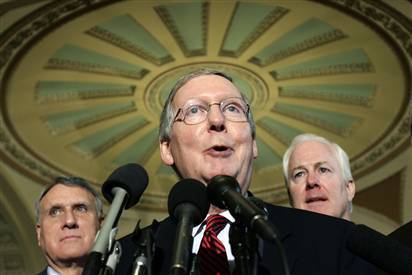
In the middle of a generally persuasive column about Mitch McConnell, Ezra Klein makes a point I disagree with:
Withholding minority-party votes forces the majority party to hand its most moderate members — and the most moderate members of the other party — an effective veto, which drags the legislation substantively to the center, and in the current situation, to the right.
Health-care reform was more conservative than it would have been if more Republicans had been willing to support it.
I actually think McConnell's tactic of blanket opposition caused health care reform to be more liberal. McConnell successfully persuaded his entire caucus not to negotiate, and moderate Democrats, who were desperate for bipartisan cover, spent months fruitlessly pursuing bipartisanship anyway. After the Massachusetts special election, huge swaths of the Democratic caucus were ready to take half a loaf, or perhaps just a slice. Republicans wouldn't offer even a token gesture like expanded coverage for children. McConnell kept jacking up the stakes and making it an all-or-nothing choice.
Politically, that choice worked very well. The health care legislative process dragged out for a year and its public image drowned in a procedural morass. The GOP gained a lot of eats in the midterms. McConnell could have taken a much smaller substantive defeat by cutting a deal with Democratic moderates, at the cost of minimizing his political gain. He chose otherwise.
JONATHAN CHAIT >>
Chris Christie's Gay Marriage Blather
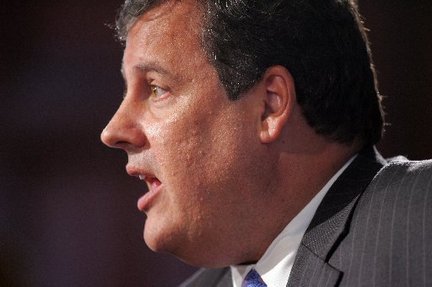
Here's the unabridged transcript of Chris Christie, appearing on "Meet the Press" last Sunday, explaining his position on gay marriage:
Let's--I'll tell you, in New Jersey we have a civil union law. And we had a very vigorous debate in late 2009, early 2010--before I became governor--about same-sex marriage, and it failed in the state legislature under a Democratic legislature with Democratic Governor Jon Corzine. And so my view on it is, in our state we're going to continue to pursue civil unions. I am not a fan of same-sex marriage. It's not something that I support. I believe marriage should be between one man and one woman. That's my view, and that'll be the view of our state because I wouldn't sign a bill that--like the one that was in New York.
This is a very typical expression of opposition to gay marriage. It's a simple restatement of a position -- I oppose gay marriage -- without even a fig leaf of a justification. In place of any attempt to justify his opposition, Christie simply restates it over and over. Christie argues, in order, that there's a civil union law, that gay marriage failed before, that civil unions will continue, that he's "not a fan," that it's not something he supports, that he believes in one man-one-woman, that it's his view, and that he won't sign a gay marriage bill.
I wrote about this tendency in a TRB column a couple years ago:
Gay-marriage opponents have made that formulation their mantra. It's a really strange way for them to summarize their argument, because it's not an argument at all. If we're debating health care, one side will have a line about big government, and the other will have a line about the uninsured or spiraling costs. If we're debating torture, advocates will mention the need to make terrorists talk, and opponents will invoke American values. Soundbites, by their nature, can't express much logical nuance, but they do tend to give you a reason to agree with the position.
The anti-gay-marriage soundbite, by contrast, makes no attempt at persuasion. It's like saying you oppose the Bush tax cuts because "I believe the top tax rate should be 39.6 percent." You believe that marriage should be between a man and a woman? OK! But why?
The ubiquity of this hollow formulation tells us something about the state of anti-gay-marriage thought. It's a body of opinion held largely by people who either don't know why they oppose gay marriage or don't feel comfortable explicating their case.
The inability of opponents to articulate a rationale, or even a pseudo-rationale, is both a cause and a symptom of the gay marriage's shockingly rapid progress.
Living Specimen Of Liberal Caricature Found
Call me naive, but I have never before seen the kind of unvarnished East Coast snobbery displayed by New York Times media reporter David Carr here:
That's actually repugnant. I don't actually think the sentiment reflects the general view of the Times, but I do think the Times deserves to be held accountable. If the newspaper lets reporter pop off on a talk show, then his opinions are going to represent the Times.
Jonathan Chait's Blog

- Jonathan Chait's profile
- 35 followers

