
Jonathan Chait's Blog, page 39
June 24, 2011
&c
-- Bachmann’s mad money machine
-- The budget deal Cantor walked away from
-- Will Wilkinson turns out to be a terrific campaign reporter. Who knew?
-- Whoops... Rick Perry never fixed Texas.


Pawlenty's Scam
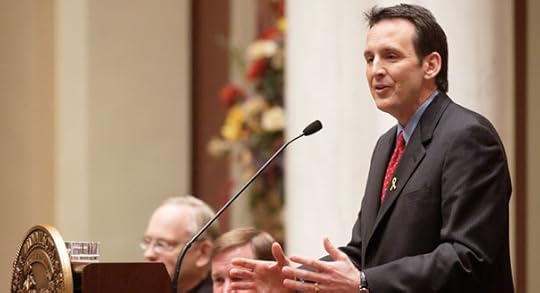
Coral Davenport has a thorough account of the very sad tale of Tim Pawlenty's embrace and subsequent abandonment of cap and trade. Pawlenty initially took up the cause with a fervor that was quite literally religious:
Pawlenty also had a personal motivation. As an evangelical Christian, he had been brought to believe in the urgency of climate change by his pastor, Leith Anderson, who earlier in 2006 had banded with a group of other evangelical leaders to challenge the Bush administration on global warming. In a letter to the president, they argued that there was no longer a legitimate scientific debate on the merits of climate science and that evangelicals had a moral obligation to solve a problem that threatened the world’s most vulnerable inhabitants. (Anderson is now president of the National Association of Evangelicals.)
In December 2006, Pawlenty rolled out his sweeping and ambitious Next Generation Energy Initiative, which called on Minnesotans to enact the strongest renewable-energy law in the country. The plan would require the state’s utilities to generate 25 percent of their electricity from sources such as wind and solar by 2025. It also called for slashing statewide fossil-fuel consumption 15 percent by 2015 and enrolling Minnesota in a regional cap-and-trade program.
Now Pawlenty speaks of cap and trade with pure disdain ("mistake... flawed science... throw it out the window.") Then level of cynicism toward an issue he once viewed as a transcendent moral calling is not terribly surprising. It's politics. But it does make me wonder about Pawlenty's political skill.
Pawlenty, after all, managed to keep his head above water politically in blue-state Minnesota because he was doing things like embrace cap and trade, which garnered him all kinds of bipartisan support and editorial accolades. Surely this contributed to an image of moderation that prompted some moderates to approve of his governorship. Pawlenty has cited his popularity in Minnesota -- exaggerated, but not totally fictitious -- as a prime credential. But now he's abandoning the main thing he did to obtain that moderate support.
Isn't this kind of a scam? It seems like the game is to move to the center to win the governorship of a state opposed to your party, then renounce your centrism while holding up the fruits of your since-renounced centrism as evidence of your skill. Mitt Romney has been playing the same game.
Obama, The Deficit, And The Long Game
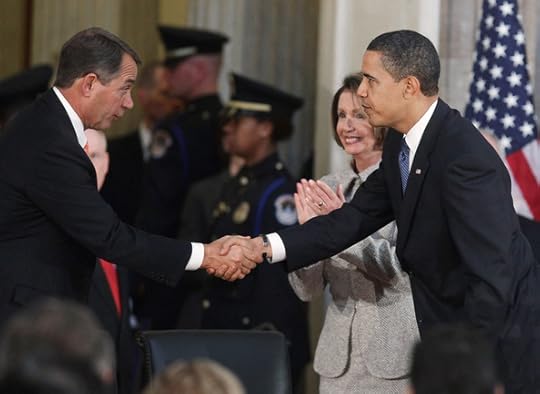
Ross Douthat argues that a budget deal that leans heavily on spending cuts vis a vis revenue is fine for President Obama, because he has a big tax hike in his back pocket:
if they do work out a deal — and this is the crucial part — it doesn’t have to include nearly as much in the way of revenue increases as a liberal president would normally prefer, because taxes are already scheduled to go up. Republicans are being intransigent on taxes in these negotiations for ideological reasons, but also because they know that if Obama is re-elected (which is more likely than not), they won’t be able to block tax increases: With a non-stroke of the pen, he can just let the Bush tax cuts expire — for the rich, or even for the middle class as well.
This is the trump card that liberals carry into all these negotiations. If we just do nothing on taxes except let the “current law baseline” run its course, their preferred vision wins.
I agree with this, but with two important caveats. First, letting the Bush tax cuts expire. I've been advocating this course of action for months. If Obama wins reelection, he can refuse to extend any tax cuts on income over $250,000. That will prompt Republicans to refuse to extend tax cuts on any income under $250,000 (as they signaled last December, and in keeping with their longstanding priorities, which deem the middle class tax cuts mere sweetener to get the tax cuts for the rich they really want.) Then the tax cuts expire while Obama blames Republicans for holding the (popular) universal tax cuts hostage to the (unpopular) tax cuts that only benefit the rich.
A combination of spending cuts now, gaining bipartisan credibility, winning reelection, then a tax cut showdown would be the ideal scenario. However, it depends on Obama winning reelection, which is far from assured. More importantly, it depends on Obama actually carrying out this plan. Will he? He should, and it's the best and easiest way to fulfill the administration's policy goals. And if it is the plan, the administration clearly shouldn't signal its intentions (why admit that you secretly want Republicans to block middle class tax cuts when you need to credibly pin the blame on them)? Still, my confidence in Obama's ability to execute aggressive political strategies is diminishing.
Second, the spending cuts in the budget agreement will probably involve a lot of bad policy. One potential source of savings is Medicaid, a lean program that provides bare-bones coverage to people who are in a bad way. Another is tight caps on domestic discretionary spending. As David Leonhardt recently noted, discretionary spending already has an unrealistically low baseline, and a deficit deal that cuts the baseline even lower would have terrible consequences:
According to the government’s official forecasts, discretionary spending is already slated to shrink significantly. Military spending will fall by 25 percent, as a share of the economy, over the next decade. Domestic programs will shrink even more, and by 2021 they will account for their smallest share of the economy since the 1950s.
I’m guessing you haven’t heard of these plans, however. That’s probably because plans is a bit of an exaggeration. Assumptions is a better word: per Congress’s orders, the baseline budget numbers unrealistically assume that future discretionary spending will grow only with inflation, rather than with population growth and economic growth, too.
As a result, Vice President Joe Biden, Republican leaders and the other deficit negotiators not only have to cut discretionary spending to make progress. They have to cut it even more than the Congressional Budget Office, the keeper of the official numbers, already assumes that spending will be cut.
And the scale of the cuts could do real damage. They could jeopardize food safety, highway quality and F.B.I. investigations. They could hurt the poor at a time when unemployment remains near a three-decade high. They could undermine education and scientific research, the best hopes for future prosperity.
Now, you can certainly find programs within the domestic discretionary budget that should be eliminated. But, overall, domestic discretionary spending ought to go up, not down.
I understand that Democrats aren't likely to have the opportunity to restore fiscal integrity entirely on their own terms. They wouldn't be able to do it even if they regained control of the House and a filibuster-proof Senate majority -- their caucus is just too fractious and risk-averse to do it without bipartisan cover. At the same time, the risk of Obama acceding to some dreadful policy choices is real and worrisome. Negotiating a bargain that does only minimal policy damage would be a feat.
Republicans, Taxes, And The 1982 Mistake
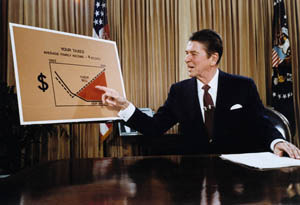 The Republican fiscal position holds that immediate fiscal contraction will accelerate economic growth. But, this odd view holds, this is only true is the contraction comes in the form of spending cuts. Any increase in tax revenue will have a devastating impact on the recovery.
Bruce Bartlett notes that Republicans made the exact same argument in 1982, and it didn't turn out so well:
Back in 1982, Ronald Reagan was persuaded that the deficit was such a severe impediment to growth that a tax increase to reduce it would be economically beneficial. Many in his party strenuously objected, citing research by Republican economists. For example, on August 12, 1982, U.S. Chamber of Commerce president Richard Lesher sent to Congress an analysis of the proposed tax increase. Said Lesher:
“If H.R. 4961 is passed in these troublesome economic times, we have no doubt that it will curb the economic recovery everyone wants. It will mean a lower cash flow as more businesses pay more taxes, with a depressing effect on stock prices. It will reduce incentives for the increased savings and investment so badly needed to improve productivity and create more jobs. It will mean higher prices for many products and services. It will increase government costs in caring for those who, because the economy is held down, cannot find employment.”
It would be hard to find an economic forecast that was more wrong in every respect. Looking at real gross domestic product, it grew 4.5 percent in 1983 and 7.2 percent in 1984 – an exceptionally strong performance. The stock market had one of its best years ever in 1983 – both the Dow Jones Industrial Average and the S&P 500 Index rose 35 percent. There was no increase in the rate of inflation, which was exactly the same in 1983 and 1984 as it was in 1982. The unemployment rate fell from 10.6 percent in December 1982 to 8.1 percent by December 1983 and 7.1 percent in December 1984.
The Chamber was not an outlier. Virtually every Republican economist made similar dire predictions. Economist Arthur Laffer told his clients on July 26, 1982, that the Tax Equity and Fiscal Responsibility Act, which raised taxes by about one percent of GDP, “will stifle economic recovery,” “retard economic growth,” and undercut “the economy’s ability to enter into a period of expansion.” On August 20, 1982, he told his clients that TEFRA “will tend to lengthen and deepen the recession.” Writing in the New York Times on September 12, 1982, economist Norman Ture said the administration’s claim that TEFRA would promote economic growth was “bizarre.” He said it would “weaken the impetus for economic growth” and make the economic recovery “less certain and less vigorous.”
Despite these erroneous predictions, Republican economists said pretty much the same thing when Bill Clinton proposed a tax increase in 1993.
The 1993 example is telling because it has been disproven twice: First when the economy accelerated after conservatives predicted the higher marginal rates would kill it, and then when George W. Bush reduced the top rate and then saw a historically weak recovery as a result. Total net impact of all these examples upon Republican economic thinking about the efficacy of tax cuts: zero.
To be sure, I'd prefer to delay any revenue increases, especially those primarily affecting moderate earners with a higher propensity to spend. But the combination of insisting on immediate deficit reduction, but no additional revenue, is not only incoherent but historically repudiated.
The Lottery That Made Some Boomer Men Liberal
Via John Sides, a paper finds that Vietnam war-era males with low draft lottery numbers tended to become more liberal and more Democratic than those with higher draft lottery numbers:
Among college-bound men—the group most affected by the institution of the lottery in 1969—those with lower draft numbers had more negative views of the Vietnam War when they were interviewed in a 1973 survey. This is not due to actual military service, but seems to reflect a general emotional reaction to the prospect of service.
Lower draft numbers also made these men more liberal and more Democratic. This trend was driven by men who up to that point had leaned Republican but, because of Nixon’s policy, fled to the Democratic Party.
That the effects of the lottery show up 4 years after it was instituted is notable. Truly remarkable, however, is that some of these effects show up years and years later:
The shift toward the Democratic Party was permanent. As Erikson and Stoker write, “A prominent effect of getting a poor outcome in the draft was to cause reevaluations of party loyalties.
Finally, those with lower draft numbers had less favorable opinions of the Vietnam War even when interviewed in 1982 and 1997. That is to say, the effect of draft lottery status was evident almost 30 years after the draft itself.
It's a telling window into the effects of self-interest upon ideology. It's also interesting to consider in light of the way young voters have taken up liberal views on virtually everything, and voted heavily Democratic, the last few election cycles. This is more research showing that youthful political habits tend to persist over time. The impact of such a strongly Democratic age cohort could impact American politics for a long time.
"Politifact" Unfairly Attacks The GOP
Republicans have been slamming Democrats for their vote to cut $500 billion out of Medicare as part of the Affordable Care Act:
The NRSC revised and reissued a three-day-old news release that targeted virtually identical statements at Brown, of Ohio, and four other senators who all are Democrats up for re-election next year: Claire McCaskill of Missouri, Jon Tester of Montana, Ben Cardin of Maryland and Bill Nelson of Florida.
"Despite Sherrod Brown's transparent political strategy to mislead Ohio seniors and demagogue Medicare, this serves as another reminder he is the only candidate in Ohio who has voted to cut Medicare by over $500 billion in order to fund government-run health care," said NRSC spokesman Jahan Wilcox.
Politifact slams the Republicans:
The important point in each examination is that $500 billion -- the figure confirmed by the NRSC's citations -- are not taken out of the current Medicare budget and are not actual cuts. Nowhere in the bill are benefits actually eliminated, experts said.
The $500 billion are reductions to future spending. The health care law attempts to slow the projected growth in Medicare spending by that amount over 10 years.
Medicare spending will still increase. The Congressional Budget Office estimated it will reach $929 billion in 2020, up from $499 billion in actual spending in 2009....
The NRSC’s claim cites a real figure -- $500 billion -- that is part of the health reform debate. But it incorrectly describes it as $500 billion in Medicare cuts, rather than as decreases in the rate of growth of future spending.
Sorry, this is just wrong. Indeed, it's ridiculous, and nobody should listen to Politifact on this topic.
Politifact makes two claims here. The first is that the $500 billion isn't a "cut" because benefits are not eliminated. But that's a matter of opinion, not fact. The biggest benefit eliminated is the subsidy for Medicare Advantage, which costs the government 20% more than traditional Medicare. The other savings likewise trim away excessive costs, and ought to have minimal impact on beneficiaries. But obviously things are being eliminated, and the impact this will have is a question of interpretation.
Politifact's second claim is that it's not a cut because the nominal cost of Medicare will still increase. In other words, we're spending $499 billion a year on Medicare now, and as long as we keep that up, we're not cutting it. It's only a cut if we go below $499 billion. Clearly, that an implausible definition of what a cut constitutes. Keeping Medicare at a fixed dollar value would require staggering decreases in the services provided. Indeed, this definition of what a 'cut" constitutes runs directly contrary to the previous definition, which defines a cut as the elimination of actual benefits. You could easily increase the dollar cost of Medicare to the government while slashing actual benefits.
Politifact's crazy position here ought to be seen within the context of its staunch support for cutting entitlements. It's a pro-entitlement cut group -- which is fine, but its views on the subject have nothing to do with what is the "facts."
June 23, 2011
Romney Death Watch Reconsidered
[image error]
My constant premonitions about the death of the Mitt Romney presidential campaign have yet to come true, so perhaps now -- given Nate Silver's handicapping of the GOP field -- is a good time to revisit my analysis. It's certainly true that the last month has been berry, berry good to Mitt Romney. The candidate best positioned to disqualify him ideologically while still garnering establishment support, Tim Pawlenty, bombed his introduction to the party electorate in the Republican debate. Better still, Michelle Bachmann has shot up in the polls, setting up exactly the showdown Romney desires. Huge chunks of the party establishment oppose Romney, but many of them might support him if the alternative is a politically toxic rival like Bachmann.
But the fundamentals have not changed very much. To wit: There is a powerful case to be made against Romney, which will disqualify him in the eyes of most Republicans. There are numerous, well-funded groups ready to make that case. They have not made the case yet, nor have any of the opposing candidates really begun to press it. I have a hard time understanding how Romney survives that process.
Still, the case for the death of the Romney campaign does require some kind of reasonable opposition to emerge. I think it will. Given the failure of that to happen thus far, and Romney's resulting rise in the polls, I am upgrading his condition to mostly dead.
&c
-- What Tim Pawlenty learned about health care in Minnesota.
-- Just a flesh wound! "Popular Crime" really has only two insurmountable problems: the way the author uses numbers and the way he uses words."
-- Why we never have to balance the budget.
-- How our Afghanistan policy is shifting.
-- What if all of America were as dense as New Jersey?
-- In light of the capture of Whitey Bulger, this looks even more misguided.
When Paul Ryan Favored Government Bureaucrats Rationing Health Care
The Republican position on Medicare, which is Paul Ryan's position, holds that ideally we should transform the program into limited subsidies for private insurance. Failing that, we should keep Medicare as wasteful as possible -- any proposal to impose more efficient use of Medicare resources is "rationing." That is the basis for Ryan's argument for his Medicare plan. The whipping boy is the Independent Payment Advisory Board, which would try to steer Medicare away from ineffective procedures. Ryan says this will create a hellish dystopia of price controls and diminished quality. Here is is explaining his position:
Except Ryan himself proposed an even stronger version of IPAB way back in 2009. Health care economist Don Taylor wrote this last month -- I just saw it today via Kate Pickert:
Rep. Ryan has undergone quite a change of heart from May 2009 to May 2011. Don’t take my word for it, lets look at the details of the PCA that he co-sponsored in May, 2009.
Title VIII of the PCA created two boards: a Health Services Commission, and a Quality Forum. Following are key portions of the bill text with line numbers removed (but the full section is relatively short , so you can read the entire section for yourself in just a few minutes)
Purpose, sec. 801 (b), p. 207
(b) PURPOSE.—The purpose of the Commission is to enhance the quality, appropriateness, and effectiveness of health care services, and access to such services, through the establishment of a broad base of scientific research and through the promotion of improvements in clinical practice and in the organization, financing, and delivery of health care services.Duties, sec. 802 (a), p. 207-08
(a) IN GENERAL.—In carrying out section 801(b), the Commissioners shall conduct and support research, demonstration projects, evaluations, training, guideline development, and the dissemination of information, on health care services and on systems for the delivery of such services, including activities with respect to—(1) the effectiveness, efficiency, and quality of health care services; (2) the outcomes of health care services and procedures; (3) clinical practice, including primary care and practice-oriented research; (4) health care technologies, facilities, and equipment; (5) health care costs, productivity, and market forces; (6) health promotion and disease prevention; (7) health statistics and epidemiology; and (8) medical liability....
Obviously Rep. Ryan can change his mind, and seems to have done so. However, going from proposing what could be thought of as IPAB-on-steroids to deriding the general approach as rationing-that-is-harmful is quite a big change.
Taylor's post includes much more detail about the similarities between Ryan's plan and IPAB, the main differences being that Ryan's plan is even stronger. At the time it was proposed, Taylor supported Ryan's measure:
Any such effort will undoubtedly be called rationing by those wanting to kill it, and quality improvement and cost-effectiveness by those arguing for it. Whatever we call it, we must begin to look at inflation in the health care system generally and in Medicare in particular.
I can't emphasize strongly enough how powerfully this undercuts Ryan's argument. The whole claim is premised on attacking IPAB as bound to fail and a massive imposition upon freedom. Of course, the argument that it's big government for the government to try to cut wasteful spending is itself pretty silly. But Ryan isn't even consistent about this. Why is he treated as a serious figure?
The Key to the Debt Ceiling Deal
[image error]
Gaming out the debt ceiling talks, it seems to me that the most important power dynamic is whether the business community can and will pressure Republicans in Congress to cut a deal. Without business pressure, the GOP has zero incentive to agree. Agreeing means making substantive concessions that enrage the base and potentially end the career of anybody who votes for it. Not agreeing probably means precipitating some kind of financial crisis that harms the economy and thus improves the party's prospects in 2012. Hike taxes or beat Obama? That's a very easy call for Republicans.
The only thing that changes the calculation is if the business lobby, which would sustain enormous collateral damage in the default scenario, intervenes. The extent to which this occurs is far from certain. But we probably need to reach a point where default appears likely before business reacts and forces Republicans to bargain. Otherwise, the incentive isn't there.
JONATHAN CHAIT >>
Jonathan Chait's Blog

- Jonathan Chait's profile
- 35 followers

