
Jonathan Chait's Blog, page 38
June 28, 2011
Bernie Sanders, Left-Wing Madman
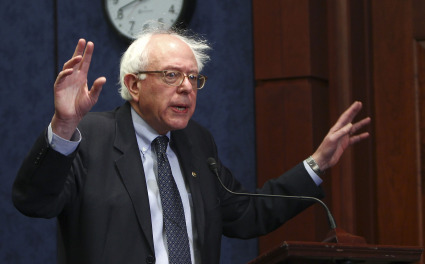
If you want a short encapsulation of how far right the economic debate has moved, check out this passage from the Washington Post:
Sen. Bernard Sanders, a Vermont independent with socialist leanings, delivered a 90-minute address Monday outlining his plan calling for 50 percent of all savings to come from tax increases. “The wealthiest Americans and the most profitable corporations in this country must pay their fair share,” Sanders wrote Monday in a letter to Obama.
Such a proposal has no chance of passing because Republicans and many Democrats believe steep tax increases are both politically unpopular and potentially harmful to the struggling domestic economy.
So the socialist plan for one of the lowest-taxed advanced economies on Earth -- a country that could balance its budget entirely through tax hikes and still have a tax burden that ranks in the lowest third among the OECD -- is to cut the deficit with a plan consisting of half spending cuts. And that plan is immediately dismissed as so wildly unrealistic it stands no chance of passage. Cut hundreds of billions of dollars of spending and also raise taxes to cut the deficit, during a massive economic crisis? Go back to Russia, you crazy socialist!


Obama's Noble, Doomed Ransom Offer

What kinds of tax increases are Democrats demanding in the debt ceiling negotiations? Some pretty low-hanging fruit:
Among Democrats' revenue proposals is a change to a common method for valuing businesses' inventories called last-in-first-out, or LIFO.
Under this method, manufacturers can estimate the cost of the goods they've sold at their most recent market prices, even if they purchased the goods at lower prices. An oil company could value the oil it sells at roughly $100 a barrel, for example, rather than $80 a barrel as it may have cost several years earlier. Being able to calculate higher expenses makes a company's taxable income smaller.
Democrats are proposing to increase the amount of income subject to tax, a move fiercely resisted by many businesses.
Another Democratic proposal would limit the itemized deductions that wealthier Americans can claim on their tax returns to a certain percent of their income. Depending on how strict the limit is, that could generate $300 billion more revenue over 10 years.
Democrats are also pushing to end oil company subsidies and ethanol tax breaks, though the ethanol subsidy is already scheduled to end this year.
Democratic leaders also are targeting repeal of the carried-interest break for investment-fund managers, despite repeated failures to eliminate it in recent years. The break allows managers of hedge funds, private-equity funds, venture-capital funds and some others to pay the 15% income tax rate applied to investment income, rather than higher income tax rates. This time around, in order to maximize the issue's political appeal, Democrats are likely to target hedge-fund managers, while sparing other beneficiaries.
This all sounds like good policy, and the trade-off is a no-brainer when you consider the alternatives on the table. But I really don't understand how the Obama administration thinks it's going to get GOP sign-off here. It's true, their plan does not raise marginal tax rates. And if you take conservative economic rhetoric at face value, Republicans should be fine with proposals that reduce market distortions and reduce the deficit without increasing the disincentive to work.
But taking that rhetoric at face value is crazy. The Republicans are going to oppose any plan that makes rich people pay more money, regardless of the economic merits. They've been defending tax loopholes for a very long time.
It's great that the administration is proposing to close these tax loopholes. Given that Republicans would almost certainly never voluntarily accede to close them, though, what's plan B?
June 27, 2011
&c
-- The European war on cars.
-- Matthew Yglesias reads story about women using coordinated sex denial to secure the repair of a road, deems interesting takeaway to be that “it’s very inefficient to have local government units shouldering the financial responsibility for infrastructure construction.”
-- How fellow Black Panthers helped lock away Geronimo Pratt for a crime he did not commit.
-- A really big tax break.
-- National Review contributor George Weigel compares gay marriage supporters to Bull Connor. National Review exile David Frum says "I was wrong about gay marriage."
Bipartisanship 101 For Mitch McConnell
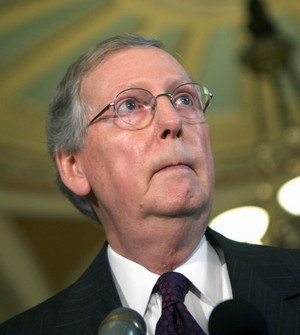 Mitch McConnell's latest talking point about how the budget deal can't include tax hikes is especially strange:
“Those who are calling for tax hikes as a part of these debt discussions either have amnesia about the fate of similar votes just six months ago — when Democrats controlled both chambers of Congress as well as the White House — or they’re acting in bad faith, since we all know that including massive, job-killing tax hikes would be a poison pill,” said McConnell on Monday from the Senate floor.
It's true -- Democrats don't have the votes to pass a tax hike on the rich. By the same token, Republicans lack the votes to pass a huge Medicare cut. So why does this mean negotiators should rule out the Democrats' deficit-reducing proposal that can't pass and instead agree on the Republicans' deficit-reducing proposal that can't pass? I don't even see an argument. The whole concept of a bipartisan deficit deal is that each party supports some element of the other side's deficit-reducing proposals, so that plans to reduce the deficit that couldn't pass on their own can pass together.
Meanwhile, the Obama administration says the tax hikes on the rich it's talking about don't mean restoring Clinton-era tax rates:
President Obama, seeking a Republican agreement to raise the nation's $14.3 trillion debt ceiling by Aug 2, will not insist that any deal include an end of President Bush's controversial tax rates on the wealthy.
Obama's tactics are coming into clearer focus: they involve seeking higher taxes not on a broad swath of high income earners but on a narrower band of the super rich, such as owners of private jets. This means that those who earn $250,000 have got a reprieve.
That sounds like a retreat, but it's actually good. The Bush tax cuts are scheduled to expire. They can't be extended without Democratic support. It would require Republican control of the White House, House and Senate in 2012 to extend the tax cuts on income over $250,000, which means it's unlikely. Obama shouldn't bargain for something he can probably get for free.
The 80s Were Weird
Via Eli Lake, an ABC commercial from 1987 that promoted the network's fall lineup with an extended montage of cowboys, pies to the face, the Washington metro, fighter jets, dancing, boats, farms, sunsets, toddlers, marching bands, and a whole lot of patriotism:
Possibly the most anachronistic part is a woman (at 1:42) saying, "There's two things I can't stand. One of them's NBC, and the other one's CBS." There really was a time when it was considered normal to have a loyalty to a television network. Were you supposed to watch your network's shows even if you didn't like them as much as the programming on other networks? Root for your network to finish first in the ratings? It all seems vaguely familiar yet utterly bizarre.
Will Bachmann Bury Iowa, Or Save It?
[image error]
Bachmann also poses a real threat to the future of the caucuses: A victory for her in Iowa would cement the impression that the state is reserved for tea party activists and hard-core social conservatives, and make it easier for establishment types to take a pass in 2016
Unless Bachmann wins Iowa and then wins the nomination, right? Is that happens, then skipping Iowa will be seen as a disastrous mistake, one that allows competitors to win a heavily-covered event and use the momentum to gain an advantage in subsequent primaries. It seems to me that the media is still not internalizing the prospect that Bachmann could actually win the nomination.
The Most Important Part Of Bachmann's Announcement Speech
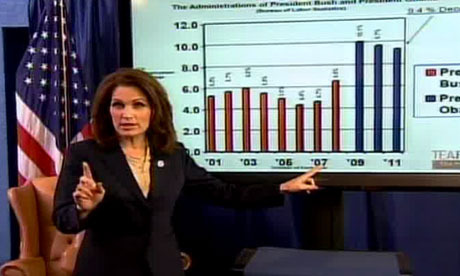
Is this:
We can win in 2012 and we will. Our voice has been growing louder and stronger. And it is made up of Americans from all walks of life like a three-legged stool. It's the peace through strength Republicans, and I'm one of them, it's fiscal conservatives, and I'm one of them, and it's social conservatives, and I'm one of them. It's the Tea Party movement and I'm one of them.
In this section, Bachmann is trying to break out of the box of the social conservative movement candidate and define herself as a mainstream Republican. First, she declares she can win. Then she pledges her fealty to all three issue families of conservatism, leaving social conservatism for last.
One reason commentators have so grossly underestimated her chances is that they have an antiquated model of the Republican Party in their minds. In that model, religious conservatives are a faction set off from the rest of the party. Pat Robertson could finish a strong second in the 1988 Iowa Caucus, but his appeal was completely limited to right-wing Christians brought into politics by social issues. But the religious right has changed -- its power to bend the party to its will has decreased, and its focus has largely merged with that of the GOP as a whole, so that the religious right is almost as concerned with economics and foreign policy as with social issues.
Bachmann represents that transformation. She came into politics through Christianity, but has broadened that style of apocalyptic thinking to economics and foreign policy. There is hardly any difference in the way Bachmann warns that Obama's policies will destroy the traditional family and the way she warns his economic policies will destroy the economy, or that his foreign policy will lead to the triumph of our enemies. And there's hardly any difference in the way she discusses these issues and the way most other Republicans do. They are all speaking the same apocalyptic language now.
Grover Norquist Will Be Very Reasonable With Jon Huntsman
Jon Huntsman is the one Republican presidential candidate who has refused to sign Grover Norquist's anti-tax pledge. I really like the understated, sinister tone of Grover Norquist takes here about their upcoming meeting:
The ATR pledge has evolved into something of a standard for GOP presidential candidates; former Massachusetts Gov. Mitt Romney (R) announced Thursday that he'd sign it, and Norquist said that all the other presidential candidates have either signed it already, or intend to sign it. (Former Minnesota Gov. Tim Pawlenty and Rep. Michele Bachmann, Minn., haven't signed, but Norquist said they've indicated to him that they'll do so.)
Norquist said he's arranged a meeting soon with Huntsman and his team, which the ATR president said might soothe the former Utah governor's concerns about the pledge.
Yes, Norquist is such a soothing guy:
House Democrats And The Debt Ceiling
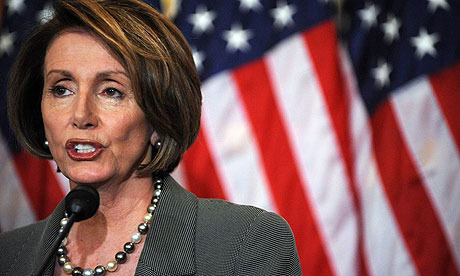
Nobody has paid much attention to what House Democrats think about the debt ceiling vote. But, given that large chunks of the GOP caucus will not support any debt ceiling increase, Democratic votes will be needed. And it's not necessarily safe to assume that House Democrats will line up behind whatever deal President Obama cuts. For one thing, they might not like the deal. For another, their political incentive structure is very different than Obama's. Pay close attention to a pair of recent comments by Nancy Pelosi. Here she is saying that the Republicans will bear the brunt of public economic frustration:
It is very hard historically it is –- you can see the charge. When the jobs are –- the unemployment rate is high, it's hard for the incumbent to win. I remind you, though, we're not the incumbent. The Republicans are the incumbents.
And here she is casually playing the kind of chicken on the debt ceiling that Obama won't play:
On Sunday, Pelosi indicated in an appearance on CNN’s “State of the Union” that Republicans shouldn’t count on support from her caucus for the legislation — which must pass by early August to avoid a default on the nation’s debt — unless they are willing to consider boosting taxes as well as cutting spending.
“We’ve all said we would vote for the full faith and credit of the United States to be honored by voting for this increase in the debt ceiling,” the Democratic leader said. “If they don’t want to do taxes, maybe they don’t want to do anything.”
Think through what happens if the government defaults on its debt. You have an economic crisis. People get mad at House Republicans, which helps Obama, but the economy also teeters, which ultimately hurts Obama but does not hurt House Democrats very much. Indeed, a default crisis would seem to increase the chances of the 2012 elections producing a Republican president and a Democratic House. I suspect Pelosi knows that.
The Gay Marriage Vote And The Power Of Money
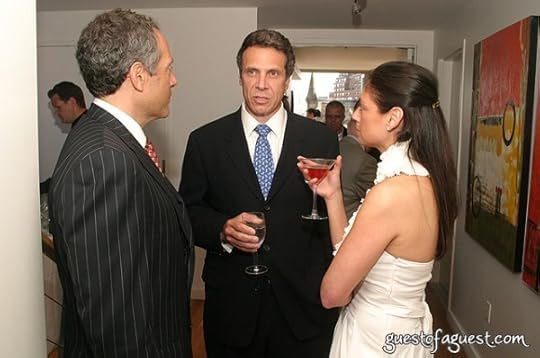
Michael Barbaro reports on the powerful influence Republican donors had in helping pass gay marriage in New York:
In the 35th-floor conference room of a Manhattan high-rise, two of Gov. Andrew M. Cuomo’s most trusted advisers held a secret meeting a few weeks ago with a group of super-rich Republican donors.
Over tuna and turkey sandwiches, the advisers explained that New York’s Democratic governor was determined to legalize same-sex marriage and would deliver every possible Senate vote from his own party.
Would the donors win over the deciding Senate Republicans? It sounded improbable: top Republican moneymen helping a Democratic rival with one of his biggest legislative goals.
But the donors in the room — the billionaire Paul Singer, whose son is gay, joined by the hedge fund managers Cliff Asness and Dan Loeb — had the influence and the money to insulate nervous senators from conservative backlash if they supported the marriage measure. And they were inclined to see the issue as one of personal freedom, consistent with their more libertarian views.
Within days, the wealthy Republicans sent back word: They were on board. Each of them cut six-figure checks to the lobbying campaign that eventually totaled more than $1 million.
Nate Silver argues that one lesson of the gay marriage law is that Andrew Cuomo exerted stronger and more decisive leadership than President Obama has on his key issues. I think the lesson here is that wealthy people exert massively disproportionate influence over American politics. Donors in both parties tend to be more socially liberal and economically conservative than the party's voters. A large share of Republican voters favor higher taxes on the rich and oppose cutting Medicare, but those positions have zero GOP representation at the national elected level. Likewise, national Democrats are also far more pro-business than are Democratic voters. If Obama's agenda attracted the support of a large chunk of the Republican donor base, he'd probably attract more Republican support in Congress, which in turn would make moderate Democrats less skittish.
Ben Smith publishes a Republican operative's takeaway from the gay marriage vote:
You can't be too socially conservative and really get the donor class lit up to raise the 100m or so to win a prez primary. (Frankly,this holds for a lot of other things. In both parties the donor class pulls the presidential nominees to the center) And the values of the donor class really do differ.
And of course the flipside is that you can be extremely economically conservative. And for Democrats, the donor class means you can't be too economically liberal, but donors do reward social liberalism. (All this certainly does help explain why libertarians, even aside from their general distrust of regulation, are so sanguine about the power of campaign donors.) The gay marriage vote is a reminder that the disproportionate influence of donors may be offense as a matter of principle, and its impact may very often be illiberal, but sometimes it has a positive effect, too. If Michelle Bachmann wins the 2012 election, the power of Republican donors will help restrain her rampant theocratic impulses.
Jonathan Chait's Blog

- Jonathan Chait's profile
- 35 followers

