
Jonathan Chait's Blog, page 35
July 1, 2011
Reductio ad Biniendam
[Guest post by Alex Klein]
Everyone’s up in arms about John Binienda, the Massachusetts state representative who makes creative comparisons: namely, between forcing poor defenseless lobbyists to wear laminated badges and tattooing imprisoned Jews.
"The idea of the badge by lobbyists to me, I kind of find that revolting. Hitler during the concentration camps tattooed all of the Jewish people so he would know who was Jew and who wasn't — and that's something that I just don't go along with."
But why would he back down and apologize for such a flattering simile? Members of the tribe like me were happy to see Binienda remind us all that Jews, like lobbyists, are people too. Thankfully, Binienda will weather this storm. The outspoken chairman of the House Rules committee has been living large on Beacon Hill for 24 years now: a whopping 12 terms, each more memorable than the last.
The early years: In 1992, the Worcester wunderkind was arrested and charged with assault and battery for beating up his wife. Then his campaign manager also got arrested for beating up his wife (his own wife, that is). Then his son got arrested for assaulting a pizza parlor owner with a broken beer bottle.
Beyond brawling, Binienda’s pre-reductio-ad-Hitlerum career has produced lots of great puns. The man has a poet’s eye. On the nation’s thirst for Saudi Arabian oil, he commented, “They have us over a barrel.” On a new law to combat litter: “The bottle bill as I see the bottle bill, has a lot of holes in it.”
Of course, there are the serious days. In the wake of 9/11, Binienda proposed giving radiation pills to all Plymouth residents. Since then, he’s introduced groundbreaking legislation to stop Republicans from buying websites. He’s also got a weird obsession with lotteries: he’s tried to start not one, but two new ones. And in 2004 he introduced a bill that would keep a winsome 18-year-old girl’s lottery ticket from expiring. In his free time, he sparred with Mitt Romney over an airport access road.
Even before his Holocaust comparison, Rep. Binienda was “noncommittal at best” on the new house ethics rules. In the next few months, I’m sure we’ll find out why. But until then, we need to come up with something to which we can compare Binienda himself. I nominate a cartoonish parody of a Massachusetts state rep.


Independence Day Weekend
I'm planning to spend more time grilling and less time blogging until Tuesday, but we may have an item or two before then. meanwhile, enjoy your Independence Day weekend. And to all those I've tussled with, left and right, bright and not-so-bright, let me take this occasion to toast our common love of country and opposition to monarchy.
Congress Really Could Not Stop Obama From Ignoring The Debt Ceiling
[Guest post by Matthew Zeitlin]
Ryan Grim has been doing a great job at the Huffington Post tracking how Senate Democrats are starting to consider the constitutional option when it comes to the debt ceiling. The constitutional option, what Chait calls the “Zeitlin Option,” is for Obama to instruct Treasury to ignore the debt ceiling and continue to honor the government’s obligations to creditors and to fund appropriations and entitlements, arguing that the debt ceiling is unconstitutional under the 14th amendment. In a piece from today, Grim writes that Chuck Schumer thinks this option “is a strategy worth considering should a debt-ceiling deal remain elusive.”
Grim then explains the legal issues surrounding a possible suit to stop the President from exceeding the debt limit:
Legal scholars, however, argue that the courts couldn’t get involved because no party would have standing to sue. In order to have standing, a plaintiff needs to demonstrate that they have been harmed. Only Congress would have a plausible complaint, and the Senate would not agree to go along with such a suit.
Individual members of Congress, however, may be able to gain standing and challenge the president. But it is difficult to imagine that the current Supreme Court, one of the most pro-business in the past century, would hand down a ruling that dramatically harms Wall Street.
The first paragraph is right and largely follows what I learned talking to several law professors and experts about the issue. However, Grim’s contention that “Individual members of Congress, however, may be able to gain standing and challenge the president” is off-base. Of course, anything can happen, but it is extremely unlikely that individual members could get standing.
As I discussed in my piece, past attempts by individual members of Congress to argue that an executive action violated their constitutional prerogatives as Congressmen have failed because the Court ruled they lack standing. Louis Fisher, who is perhaps the leading expert of separation of powers, put it very bluntly: “case law is quite clear that a member of Congress, even if joined by a dozen or two colleagues, cannot get standing in court to contest a constitutional issue.”
The biggest risk for exercising the constitutional option remains political; the actual or likely legal barriers to it are almost nonexistent.
Romney's Endearing Lies
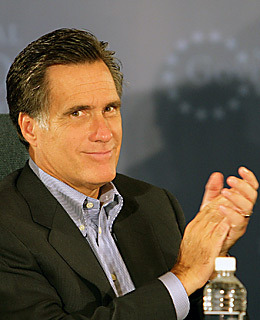 I've always harbored a strange affinity for Mitt Romney, and his hilarious lies about how he's described the economy oddly help illuminate why:
Over the last few weeks, Republican presidential hopeful Mitt Romney has argued that President Obama's policies have made the economy worse.
Here was Romney in New Hampshire on Monday:
The people of New Hampshire have waited long enough. They want to see good jobs. They want to see rising incomes. They want to see an economy that's growing again, and the president's failed. He did not cause this recession, but he made it worse.
And he said something similar at the New Hampshire debate earlier this month:
He didn't create the recession, but he made it worse and longer.
But at his press conference today in Allentown, PA -- where he was highlighting a company that had closed, after President Obama touted it benefitting from the stimulus -- Romney backtracked on the he-made-it-worse line.
When NBC producer Sue Kroll asked the former Massachusetts governor why he believes that Obama's policies have made the economy worse -- when the economy is now growing (and not shrinking like it was in 2009), when the Dow is climbing (and no longer in a free-fall like it was in '09), and when the unemployment rate is down a full percentage point from where it was in Oct. '09 -- Romney gave this answer:
I didn't say that things are worse.
Imagine George W. Bush in this situation. If confronted with a reporter touting statistics undercutting his economic claim, Bush would simply give a non-quantifiable answer. People are hurtin'. Democrats want to raise yer taxes. Or whatever. Dodging a question like that is not tricky.
But Romney does not, instinctively, want to dodge a question like that. He's not a natural bullshitter. His instinct is to align his position with the facts. Presented with facts demonstrating that the economy is clearly better than it was when Obama took office, he chooses instead to refine his critique.
The result is utterly dishonest, but the instinct underlying the result springs from a desire to engage intellectually rather than deflect the question with nonsensical talking points. I prefer straight-up dishonesty over bullshit. It's evidence of a logical mind at work.
Corporate Jets And Demosclerosis
The Obama administration's decision to single out the subsidy for corporate jets may strike conservatives as class warfare, but it's actually an apt illustration of why it's so hard to fix public policy. To varying degrees, the budget, the regulatory code, and the tax code get encrusted with special favors for businesses with political sway. The special tax treatment for corporate jets is one example. It has no public policy justification -- when you give corporate jets more favorable tax treatment than commercial jets, then you artificially create more corporate jets than market forces would dictate.
But what happens if you target the loophole for elimination? Well, one result is that conservative think-tanks will concoct phony claims to muddy the waters. (The Heritage Foundation falsely conflates the corporate jet loophole with a different tax stimulus program from 2008.)
Another thing that happens is that corporate jet manufacturers are complaining that killing their subsidy will destroy jobs:
Almost immediately, however, business leaders and some union officials criticized the president, saying such a move could jeopardize the executive-aircraft sector's still-fragile recovery.
Mr. Obama's corporate-jet challenge drew scoffs from deficit hawks for its tiny budgetary impact. But the mini-backlash from the aviation industry showed how discussion of even small, largely symbolic tax increases can provoke angst among those directly affected, complicating efforts by the White House and congressional Republicans to reach agreement on cutting the deficit and raising the federal debt ceiling....
"While such talk may appear to some as good politics, the reality is that it hurts one of the leading manufacturing and exporting industries in the United States," said a letter sent jointly to the White House on Wednesday by Peter Bunce, president of the General Aviation Manufacturers Association, and Thomas Buffenbarger, president of the International Association of Machinists and Aerospace Workers.
Now, the owners and workers in this industry make a phony comparison. They invoke a 1990 tax on expensive yachts that may or may not have hurt the yacht industry. It's not a fair comparison, because the 1990 tax was a higher levy, while what Obama proposes is merely the removal of a subsidy.
On the other hand, it is true that eliminating a subsidy for corporate jets will probably hurt the industry. That is an inevitable part of any market reform. Making the tax code neutral will mean capital is directed where markets dictate rather than where the government dictates. That decreases employment in previously-favored segments, and increases employment elsewhere. Unfortunately, it's impossible to identify where "elsewhere" might be. The losers from eliminating this subsidy know who they are, while the winners don't. And when the benefits are relatively small -- $3 billion in savings over a decade -- you can see why elected officials wouldn't bother.
Jonathan Rauch called this problem "Demosclerosis" -- the process by which special interests cumulatively overtake the government's ability to safeguard the public interest. The corporate jet saga is a depressing case study.
Lindsay Lohan's Right-Wing Monetary Views
Lindsay Lohan turns out to be a hard money crank:
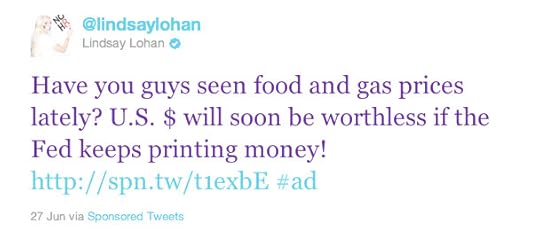
With a vacant Federal Reserve Board spot open and Peter Diamond still unqualified, I wonder if Richard Shelby would consider appointing her. She has sound conservative views on monetary policy, a successful entrepreneur, and she appeals to the youth vote Republicans badly need. And she has appropriately skeptical views of labor:

I also believe a Federal Reserve appointment would give Lohan the structure she needs to keep her life on track. It's win-win!
The Balanced Budget Amendment And The GOP's Secret Fear
California has a requirement that any tax increase obtain support of two-thirds of the legislature. This has made California a complete fiscal basket case. Congressional Republicans have decided to import this model to the federal government:
Republicans have plenty of ways to push a constitutional amendment to balance the budget.
One option contains hard spending caps and a two-thirds supermajority vote for any tax increases. This version is embraced by the right but has little chance of passing.
Another option would drop those provisions, have roughly a dozen Democratic co-sponsors and stick to a straight majority rule for tax increases. This one actually would have a shot at getting the two-thirds vote needed to clear the House.
But nothing in this Congress comes easily, and Republicans have decided to go with the version that’s almost certain to fail but is beloved by the conservative base.
It's fortunate Republicans are so resistant to compromise, because the "moderate" version of the balanced budget amendment is also a terrible idea. The fixation on the two-thirds requirement is also pretty revealing. If you think the public agrees with you, why would you need a supermajority requirement? You don't see Democrats trying to impose a two-thirds requirement to cut Medicare or Social Security.
The answer, I suspect, is that Republicans understand that most Americans don't share their priorities. People may prefer lower taxes and smaller government in the abstract, but at the programmatic level they prefer actual government spending over low taxes. The danger of a balanced budget requirement is that it would force lawmakers to make specific, actual choices between competing priorities, and Republicans suspect, correctly, voters would choose higher taxes over slashing entitlements. hence the need to pair the balanced budget amendment with a requirement designed to thwart the majority will.
Marco Rubio's Class Warfare Paranoia
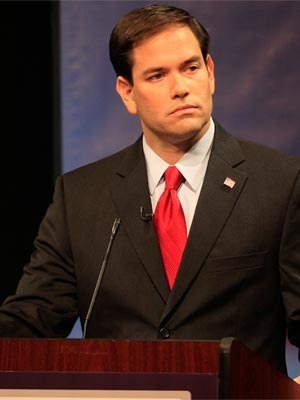 Marco Rubio is delivering a speech that neatly demonstrates the right-wing mentality toward the question of distributional justice:
Rubio tells us that he will respond to Obama’s recent press conference, where the president reveled in class-warfare bluster. “Quite frankly, I am both disappointed for our country and shocked at some of the rhetoric,” he says. “It was rhetoric, I thought, that was more appropriate for some left-wing strong man than for the president of the United States.”
“Talking about corporate jets and oil companies,” Rubio says, missed the point. “Everybody here agrees that our tax code is broken,” he says, and he is open to discussing tax reform. “But don’t go around telling people that the reason you are not doing well is because some rich guy is in a corporate jet or some oil company is making too much money."
Where in his remarks did Obama say that people are struggling because some rich guy gets a corporate jet? Nowhere. Obama argued that reducing the budget deficit ought to be done in a way that some shared sacrifice:
The tax cuts I’m proposing we get rid of are tax breaks for millionaires and billionaires; tax breaks for oil companies and hedge fund managers and corporate jet owners.
It would be nice if we could keep every tax break there is, but we’ve got to make some tough choices here if we want to reduce our deficit. And if we choose to keep those tax breaks for millionaires and billionaires, if we choose to keep a tax break for corporate jet owners, if we choose to keep tax breaks for oil and gas companies that are making hundreds of billions of dollars, then that means we’ve got to cut some kids off from getting a college scholarship. That means we’ve got to stop funding certain grants for medical research. That means that food safety may be compromised. That means that Medicare has to bear a greater part of the burden. Those are the choices we have to make.
So the bottom line is this: Any agreement to reduce our deficit is going to require tough decisions and balanced solutions. And before we ask our seniors to pay more for health care, before we cut our children’s education, before we sacrifice our commitment to the research and innovation that will help create more jobs in the economy, I think it’s only fair to ask an oil company or a corporate jet owner that has done so well to give up a tax break that no other business enjoys.
Does Obama say that corporate jets are causing people to struggle? No. Does he say he wants to confiscate corporate jets? No. He says he wants to eliminate special subsidies for corporate jets:
If you are a wealthy CEO or a health -- hedge fund manager in America right now, your taxes are lower than they have ever been. They’re lower than they’ve been since the 1950s. And you can afford it. You’ll still be able to ride on your corporate jet; you’re just going to have to pay a little more.
Rubio's demagoguery is very reflective of conservative thought on these questions. Conservatives frequently assert that "class warfare doesn't work in America." But they obviously believe otherwise -- indeed, they assign class warfare far more power than do any liberals. Conservatives believe that any public discussion of wealth differences or the disparate impact of different policies opens the door to raging envy, the consequences of which are hard for me to grasp but which strike right-wingers with terror.
Taiwanese Baseball Is Awesome
Patrick Dubuque uses Google Chrome translation to look at the statistics from the Taiwanese baseball league. They suggest a game vastly more entertaining than the American version:
Dan Reichert is and always has been a trendsetter. ...
The 34 year-old righty, who hasn’t been in the majors since 2003, signed a contract with the Uni-Presdient 7-Eleven Lions of the Chinese Professional Baseball League of Taiwan (league motto: Nice Play)....
The CPBL, in an effort to acclimate foreign-born players to the local fan base, provide these gentlemen with new monikers on the back of their jerseys. Reichert, for reasons that do not officially exist, goes by “Robert 38”.
I searched for Robert 38’s performance on the CPBL website, enlisting the feckless aid of the Google Chrome translation feature. Doing so provided me with the greatest box score of all time:

Based on these statistics, I can declare in complete candor that Taiwanese baseball is my kind of baseball. Any sport that features garrison opportunities, assassinations, lost markets, failed rescues, and complete votes can only be amazing. It reads like the script of a Jerry Bruckheimer movie. What, one must ask, is a “pirate of the base resistance kill?” Is it something that gets you extradited?
I appreciate the subtle rendering of what we call "win-loss record" as "victory" or "failure." It just makes the stakes that much more dramatic,
June 30, 2011
Section 4 Of The 14th Amendment Was Designed To Stop Boehner

Kevin Drum is skeptical that the Obama administration would really be within its rights to ignore the debt ceiling:
Maybe I'm missing something here, but it strikes me that this doesn't come close to implying that the debt ceiling is unconstitutional. What it really suggests is merely that the public debt is the only untouchable part of the federal budget.
Jack Balkin delves into the legislative history and shows why the 14th Amendment has a provision guaranteeing the debt in the first place. the sponsor of the provision, Benjamin Wade, wrote at the time:
[The proposed amendment] puts the debt incurred in the civil war on our part under the guardianship of the Constitution of the United States, so that a Congress cannot repudiate it. I believe that to do this wil give great confidence to capitalists and will be of incalculable pecuniary benefit to the United States, for I have no doubt that every man who has property in the public funds will feel safer when he sees that the national debt is withdrawn from the power of a Congress to repudiate it and placed under the guardianship of the Constitution than he would feel if it were left at loose ends and subject to the varying majorities which may arise in Congress.
Balkin explains:
If Wade's speech offers the central rationale for Section Four, the goal was to remove threats of default on federal debts from partisan struggle. Reconstruction Republicans feared that Democrats, once admitted to Congress would use their majorities to default on obligations they did disliked politically. More generally, as Wade explained, "every man who has property in the public funds will feel safer when he sees that the national debt is withdrawn from the power of a Congress to repudiate it and placed under the guardianship of the Constitution than he would feel if it were left at loose ends and subject to the varying majorities which may arise in Congress."
Like most inquiries into original understanding, this one does not resolve many of the most interesting questions. What it does suggest is an important structural principle. The threat of defaulting on government obligations is a powerful weapon, especially in a complex, interconnected world economy. Devoted partisans can use it to disrupt government, to roil ordinary politics, to undermine policies they do not like, even to seek political revenge. Section Four was placed in the Constitution to remove this weapon from ordinary politics.
In other words, it's in the 14th Amendment to guard against exactly what Congressional Republicans are doing right now.
Balkin does not suggest, nor do I, that the legal merits are open and shut. It's certainly risky to take a flyer in the middle of a debt crisis. But if we do reach h-hour, we're probably better off if the Treasury simply announces it's going to continue to pay the bills and dares Republicans to take them to court than repudiating the debt, right?
argues that the Supreme Court would likely side with the Treasury:
If there's one thing we've learned in the past 11 years, it is that the Supreme Court's decisions on critical issues are very strongly influenced by political pressure. In a situation where the entire weight of world bond markets was bearing down on Anthony Kennedy's head, would he really vote to crash the economy and destroy the credit rating of the United States? Would any individual do that? I don't think even Eric Cantor would, if he were solely and publicly responsible for the decision. The ability of the GOP to push the government to the brink of default, and possibly ultimately over it, depends on the diffusion of responsibility: Republicans can only do it because they can hold Democrats to blame. It's also driven by political vulnerability: Republicans have gotten themselves into a spiraling tea-party-driven political dynamic where they seem, on issue after issue, to be incapable of voting for any proposals that a Democrat might be able to accept, for fear of the consequences from their base. Anthony Kennedy does not have to fear a primary challenge, and if the United States' ability to pay its debts comes down to his single vote, he'll have no excuse. Maybe I have no idea how these things work. But I can't see a Republican Supreme Court going toe to toe with the entire massed forces of Wall Street and not blinking.
A point that I think is worth drawing out here is that it's not even clear the GOP leadership wants the power to take the credit of the Treasury hostage, or -- more likely -- if it's simply been forced into this position by a financially uneducated base. Republicans in Congress might be relieved to have a deux ex machina absolve them of the need to walk a fine line between the demands of the base and the demands of their business constituency.
Jonathan Chait's Blog

- Jonathan Chait's profile
- 35 followers

