
Jonathan Chait's Blog, page 43
June 17, 2011
The Budget Deal Emerges

Reports on the budget negotiations between President Obama and Congress are starting to leak out faster and faster. (See this morning's stories here and here.) Columnist Michael Gerson seems to actually have a scoop about the deal's contents:
For the first time, Senate Republicans describe to me the outlines of a possible deal: a package of immediate and specific budget cuts; budget caps reaching out five years to reassure conservatives that tough budget decisions will be made in the future; Medicare reforms short of the House approach; no tax increases — a Republican red line — but perhaps additional revenue from the elimination of tax expenditures.
The key conceptual breakthrough here seems to be Republicans agreeing to define the reduction of tax deductions as not constituting a tax increase. That's the point that Tom Coburn's fight with Grover Norquist was about.
A major part of the GOP's motivation seems to be protecting its members from the Paul Ryan plan to end Medicare:
Senate Minority Leader Mitch McConnell seems particularly intent on reaching a Medicare agreement different from Rep. Paul Ryan’s proposal. An incremental approach would allow Republican senators to say they confronted the problem, while allowing them to distance themselves from the unpopular House plan.
Unpopular? I guess Republicans aren't buying the furious efforts of conservative pundits (see Yuval Levin and John McCormack) to convince them that Ryan's plan isn't actually a political liability.


June 16, 2011
Conservative Legal Luminaries Concede The Individual Mandate Is No Unique Threat To Freedom, After All
[Guest post by Simon Lazarus]
As summarized one month ago in a post here on Jonathan Chait’s blog, conservatives reacted with fury to an article I wrote for Slate in which I pointed out that two major components of House Budget Committee Chair Paul Ryan’s Roadmap for America’s Future closely resemble the much-demonized “individual mandate” in the Affordable Care Act. In particular, I noted that the ACA provision requiring health insurance has precisely the same kind of impact on individual purchasing decisions as Ryan’s roadmap, and is, if anything, less coercive than the Roadmap proposal to provide a tax credit to individuals who purchase health insurance, as a replacement for the current exclusion from income of employer-sponsored health insurance. The ACA imposes a tax penalty on individuals who choose not to purchase health insurance. The Ryan Roadmap, on the other hand, provides a tax credit to individuals who choose to purchase health insurance—a technical distinction, I suggested, without an economic or other real-world difference.
National Review, the Weekly Standard, and Hot Air raised various objections to this point, which was seconded by Ezra Klein in the Washington Post and by Jonathan in TNR. But recent oral arguments before federal appeals courts hearing legal challenges to the ACA should quiet such protests once and for all. In these arguments, two of the most celebrated members of the Right’s legal elite acknowledged that there is no daylight between the ACA mandate-plus-penalty and a Ryan-type tax credit universally conceded to be constitutional.
The first instance of this occurred on June 1, when Sixth Circuit Judge Jeffrey Sutton, sitting on a three-judge panel in Cincinnati in a case brought by the conservative advocacy group Thomas More Law Center, floated the hypothetical idea of a tax credit alternative to the ACA approach. The Law Center’s attorney, Robert Muise, acknowledged that “you could provide a credit for health insurance, there’s no prohibition on that.” To which Judge Sutton responded:
You think it would be just as coercive to say to people, everybody pays the same additional tax, it’s a health care tax, everybody pays it and the only people that don’t pay it, i.e. get a credit, are those with insurance, you think that would be as coercive?
Muise contended that a tax credit was different because it encouraged activity—namely the purchase of health insurance—whereas the ACA provision penalized a “failure to act.” But Sutton didn’t buy it:
If that’s your view, then just pay the penalty, pay the penalty, don’t get insurance, don’t be forced to do anything, in that sense, if you think they’re equivalent, in that sense, no one is forced to do anything, because the economic incentives are the same in both settings, you can’t say the law requires you to buy it, the law just penalizes you if you don’t.
Judge Sutton is not the first person to observe that the ACA’s allegedly freedom-destroying mandate is operationally indistinguishable from commonplace tax incentive provisions. But, apart from having actual decisional authority on the matter, Sutton enters this space with formidable ideological and professional credentials. One of the first batch of appeals court nominees picked by President George W. Bush, Sutton, though only 42 years old, earned his front rank position as the energizer bunny of the Rehnquist Court’s late 1990’s drive to shrink Congress’ domestic regulatory authority in the name of “federalism.” As a lawyer, Sutton argued and won, usually by bitterly contested 5-4 margins, a raft of decisions striking or narrowing provisions of the Age Discrimination in Employment Act, the Americans with Disabilities Act, the Violence Against Women Act, the Clean Water Act, and regulations implementing the 1964 Civil Rights Act, among others. He famously once told Legal Times, “I really believe in this federalism stuff.” Sutton’s professional standing was unquestioned; appointed by the Supreme Court in 2001 to represent a prison inmate, Sutton won a unanimous decision and unusually explicit praise from its author, Justice Ruth Ginsburg, for “his able representation.”
Of course, Sutton’s verbal acknowledgement that the ACA individual mandate is not uniquely coercive, emphatic though it appeared, is no guarantee that he will not strike down a law that Republican orthodoxy demonizes as a drastic expansion of federal power. Nevertheless, his on-the-record statement leaves the case against the ACA mandate resting at best on a hypertechnical foundation lacking in substance.
The second acknowledgement of the ACA mandate’s kinship with uncontroversial tax incentives occurred a week later in Atlanta, at the June 8 argument before a panel of the Eleventh Circuit Court of Appeals in the case against ACA brought by 26 Republican state attorneys general and governors. During the argument, the Republicans’ counsel, Paul Clement, attempted to sound a reasonable note. He said, “There’s lots of different ways that Congress could incentivize people to get to the exact same result. They could have passed a new tax and called it a tax, and then they could have given people a tax credit for paying for qualifying insurance.”
Again, Clement’s observation was not original. But in addition to being the Republican opponents’ lawyer, Clement also served—with universally acknowledged distinction—as George W. Bush’s Solicitor General. Recently, he made headlines by resigning his 7 figure-per-year partnership in the Atlanta-based firm, King & Spalding, when the firm precipitously withdrew from representing his client, the House of Representatives, to defend the federal Defense of Marriage Act, aka DOMA.
The significance of Clement’s functional equivalence concession was not lost on Eleventh Circuit Judge Stanley Marcus. Marcus, originally named a district judge by President Ronald Reagan and subsequently to his current appellate position by President Bill Clinton, drew a logical implication subtly different from Judge Sutton’s observation that the ACA mandate is not uniquely coercive, but one that is potentially even more troublesome for the ACA opponents’ case. “Isn’t that just another way,” he asked rhetorically:
“[O]f saying they [Congress] could have done what they did better? More efficaciously, more directly, and they regulated perhaps inefficaciously, maybe even foolishly, but if it’s rational, doesn’t my job stop at the water’s edge? Isn’t it for the legislative branch to make those kinds of calculations and determinations?”
No constitutional lawyer could mistake where Judge Marcus was heading. How is it possible, he was saying, for courts to dictate which of two methods Congress must choose to implement its constitutionally enumerated powers, when both methods generate “the exact same result?” Judicial micro-managing on such a granular level, Marcus knows, violates the fundamental, black-letter standard established nearly two centuries ago by Chief Justice John Marshall. In his iconic 1819 decision, McCulloch v. Maryland, Marshall broadly interpreted the constitutional grant of authority to Congress “to make all laws which shall be necessary and proper for carrying into execution” its enumerated powers: “Let the end be legitimate,” he wrote in words memorized by first-year law students, “let it be within the scope of the constitution, all means which are appropriate, which are plainly adapted to that end, which are not prohibited, but consist with the letter and spirit of the constitution, are constitutional.”
To be sure, no one who listened to this Eleventh Circuit argument could predict the panels’ outcome any more confidently than could those who heard the previous week’s Sixth Circuit argument. But these unequivocal statements, by two of conservativism’s most eminent legal luminaries, that the ACA individual mandate is not a unique threat to Americans’ liberty after all, surely drain much of the juice from opponents’ legal case, and, ultimately, from their political case as well.
Simon Lazarus is Public Policy Counsel to the National Senior Citizens Law Center.
&c
-- Brad Plumer charts the history of a ludicrous political phrase.
-- Suzy Khimm on the Democratic plan B for Medicare
-- Rick Perry is not much more popular in Texas than Barack Obama.
Grover Norquist vs. Tom Coburn
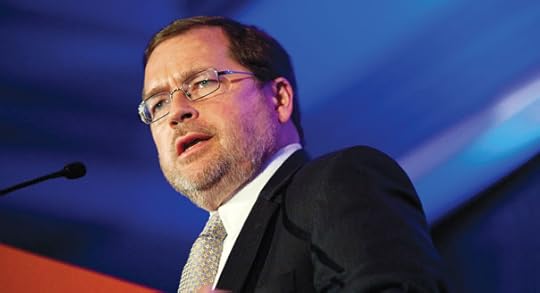
Andrew Stiles has some good reporting on the feud:
Norquist accuses Coburn of trying to trick colleagues into supporting a tax increase in order to undermine the Republican position in the ongoing debt negotiations. “He’s trying to screw the rest of the Republican party because he is so mad at the world,” Norquist tells NRO. “He didn’t want to get rid of the ethanol tax credit without raising taxes. The important thing in his life was raising taxes.”
In fact, Norquist has been at odds with Coburn ever since the senator voted in support of the Bowles-Simpson deficit commission’s final report, which Norquist describes as “a massive $2 trillion tax hike” and a blatant violation of the ATR pledge. He has constantly criticized Coburn’s involvement in the “Gang of Six” talks, as well as his stated willingness to negotiate when it comes to taxes. Norquist says Coburn’s statements after the vote make it clear that his amendment had nothing to do with ethanol subsidies and everything to do with forcing Republicans to go on record supporting a tax increase — essentially a gateway drug that would inevitably lead to additional increases down the road. “He said, ‘Ha ha, popped your cherry, lost your virginity. Now give me $2 trillion in tax increases,’” Norquist says. “As soon as they voted, he turned around and called them sluts. Guys like that didn’t get second dates in high school.”
Huh. Speaking of getting dates in high school, let us take a look at the young Grover Norquist:
As early as the sixth grade, Norquist, now 47, remembers arguing with classmates over the Vietnam War. "Suzy somebody thought Nixon was a fascist and [Alger] Hiss was a good guy," he says. Thanks to a fire sale at his local public library in Weston, Massachusetts, he picked up several books by J. Edgar Hoover and Whittaker Chambers on the communist threat. At 12, he was volunteering for Richard Nixon's 1968 presidential campaign. After church, his father would buy him and his three younger siblings ice-cream cones and then steal bites, announcing with each chomp, "Oops, income tax. Oops, sales tax."
These are the anecdotes Norquist offers up to explain how his obsession took hold. Politics hit him like puberty, and he has never looked back. "From the moment he gets up to the moment he gets to bed, he thinks, 'How am I going to hurt the other team?'" says Stephen Moore, the president of the anti-tax group, the Club for Growth. "One time I was telling Grover about this woman I met. Most guys would say, 'Oh, is she really good-looking?' or something like that. Grover said, 'Is she good on guns?' He was being totally serious."
I'm guessing Norquist didn't get a lot of second dates in high school, either. Or first dates. (And no, I'm not in a strong position to impugn anybody's high school romantic success, either.)
The Reasonable Mitt Romney
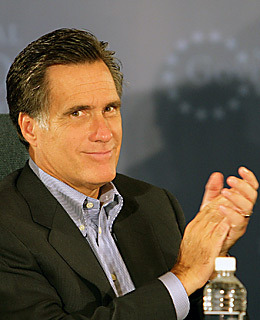 Joe Klein, writing in Time, divides the Republican field between sensible moderates like Mitt Romney and nutty outsiders. Here's Mitt Romney being sane and wonky, according to Klein:
"Barack Obama has failed America," Mitt Romney said unequivocally at his first New Hampshire town meeting, repeating the signature line of his presidential-campaign announcement speech a day earlier. Unequivocal is not a word that traditionally has been associated with the former Massachusetts governor, but that was then, and the retooled edition of candidate Romney is much improved. He proceeded to lay out the economic case against Obama: 16 million out of work, home values collapsed, higher gas and food prices.
In other words, Obama is the grandson of Herbert Hoover and the son of Jimmy Carter. "He's tried," Romney said sorrowfully, a lock of his less-slick-than-last-time hair falling over his forehead. "[But] what he did simply was wrong. He extended the downturn and made it deeper ... How is it that President Obama was so wrong? I happen to think that in part he took his inspiration from Europe," Romney continued, citing a litany of Obama's proposals like deficit spending and "federalizing" health care. "He has been awfully European. [But] you know what? European policies don't work there. They sure as heck aren't going to work here. I believe in America! I believe in free enterprise. I believe in capitalism. I believe in the Constitution."
Well, O.K. It wasn't exactly exhilarating, but it was the best of all possible Mitt Romneys.
If this is "the best of all possible Romneys," then Romney is an ignorant demagogue. First of all, it's not correct that Obama "took his inspiration from Europe." He took his inspiration for his health care plan from Mitt Romney. He took his inspiration for the stimulus from a combination of Franklin Roosevelt and standard economics textbooks. As a pure analytic frame, the Europe charge is pure nonsense.
And it's an ugly, Nativist form of nonsense. Suppose it were true that Obama had taken inspiration from Europe. There are a lot of prosperous countries in Europe. Romney offers no argument as to why everything in Europe is bad other than U-S-A! U-S-A! Indeed, conservatives point to what they perceive as successful models in Europe and other countries all the time -- Chile, Russia, Singapore, Ireland, Estonia have all enjoyed star turns as American right-wing social models. Romney is exploiting cheap sentiment and playing upon fears of Obama as foreign, un-American, and working to undermine free enterprise. (Oddly enough, Obama's attack on free enterprise has resulted in record corporate profits.)
And this is the part of Romney's address that Klein was able to pluck out as evidence of his reasonableness!
I agree that somewhere, in his heart of hearts, Romney is an intelligent technocrat who's better than his campaign. But the plain fact is that the Mitt Romney who's running for president is sane and rational only by the standards of his crazed opposition -- which is to say, he isn't one.
Live Chat with Jamie Holmes
Please join us at 3 pm EDT today for a live discussion of Jamie Holmes's online cover story on poverty and the theory of depleting willpower, featuring Jamie and Richard Just, at TNR's Livestream channel. Readers can submit questions to TNRSociety@tnr.com, at facebook.com/thenewrepublic, and on Twitter by tweeting @tnr.
TNR EXCLUSIVE >>
The House GOP Post-Ryan Survival Plan

I've said the best way for House Republicans to minimize the political damage of their Huge Mistake of voting for the Paul Ryan is to cut a deficit deal with President Obama. Yuval Levin agrees:
If Obama now makes a deal that involves some step, however small, toward transforming Medicare into a premium-support system, he would make a campaign of Medicare demagoguery far more difficult for the congressional Democrats, leaving them nothing to run on, unless they want to run against their own president.
But you can also see why this might appeal to both Obama and congressional Republicans. Even if the Medicare component of a debt-ceiling deal (a deal that would presumably also include serious discretionary cuts and statutory spending caps) was by no means a comprehensive reform, it could easily be enough for Republicans to try to run on building on a first step and for Obama to try to run on having done something to address the problem. More important, it offers each the prospect of taking some of the edge off of the other side’s chief political argument—the Republicans’ spending and debt crisis argument against Obama, and the Democrats’ Mediscare arguments against Republicans—while also actually doing something (however small) to begin to address the main driver of our fiscal problems.
The upside is probably larger for Republicans. If the economy remains in the doldrums, the party that, as DNC chair Debbie Wasserman Schultz said yesterday, “owns the economy” will be in very serious trouble, and having made some modest start toward a Medicare reform will not be enough to save the president. For the GOP, though, neutralizing the Democrats’ Medicare attacks while not taking Medicare reform off the table (indeed, while endorsing the key premise of the Republican reform proposals) would be immensely helpful.
Obviously I agree that Republicans would benefit from a deal that included Medicare. I'm not sure it would be "immensely helpful," though. The fact that Republicans voted to transform Medicare into coupons good for a discount off private insurance isn't the main problem. The main problem is that they voted to make those coupons radically and increasingly inadequate while also voting to cut taxes for the rich. That's an extremely unpopular policy tradeoff.
A Medicare deal wouldn't entirely or even mostly eliminate the liability. It would allow some moderate Republicans to edge away from the Ryan plan, by taking the view that they've solved the problem now and the radical plan they voted for will no longer be needed. That would help muddy the waters but it wouldn't completely shield them. Still, if I were a potentially vulnerable House Republican, I'd be looking for whatever cover I could get.
Movie Studio Unfamiliar With Definition Of "Glacial"
There actually seems to be an action movie coming out about people fleeing in terror from a glacier:
If they can make this movie, they can make an action movie about continental drift.
Oh my God. It's... [shriek] Pangea! Run for your lives!
How Much Trouble Does Obama Face In 2012?

Here's Jay Cost's latest Weekly Standard column about why Republicans are winning:
The president can visit as many green companies as he likes. His team can put out as many strategy videos as it likes. It can organize its ground game in Virginia all day and all night. None of this is going to change the fundamentals of this upcoming election, which are:
1. The economy is substantially weaker for Obama than for other previous presidents who won reelection.
2. The deficit is now substantially higher than before.
3. His major domestic reform--Obamacare--is substantially more unpopular.
4. The American people are substantially more pessimistic.
That's the state of the nation at this point. Nothing the Obama campaign can do at this point will affect any of these fundamentals--the hope is that its efforts will alter the public's perceptions of these fundamentals, but it won't. If we've learned anything in the last 50 years of the modern campaign, it's that the billion dollar efforts of campaign technocrats, who now dominate our politics, cannot convince people that the sun rises in the west.
So, when we peel back the spin, the boasting, and the partisan hyperbole, we get the following: The president is going to need real improvement on at least one of those four items, or he is going to lose next year, and the race will be over before midnight on the East Coast.
Okay, so Cost argues that Obama needs major improvement in the fundamentals or else he's going to lose badly. Funny enough, there was an NBC poll last night testing various matchups:
Obama’s job-approval rating in the poll sits at 49 percent who approve to 46 percent who disapprove, which is down from 52 percent to 41 percent after Osama bin Laden was killed in early May.
In addition, he leads Romney — the early GOP front-runner — by six points in a hypothetical general-election match up, 49 percent to 43 percent. And he’s ahead of Pawlenty by 13 points, 50 percent to 37 percent.
Huh. That seems to suggest that Obama is... winning. Indeed, it shows just the opposite of what Cost argues. And what about the terrible economy? Well, the poll says more about that, too:
Hart, the Democratic pollster, cites three reasons why Obama is staying afloat. One is his personal popularity, with this poll showing him with a 49 percent to 37 percent favorable/unfavorable rating. (That’s compared with 27 percent to 26 percent for Romney, 14 percent to 15 percent for Pawlenty, 24 percent to 54 percent for Palin and a record-setting 16 percent to 48 percent for former House Speaker Gingrich.)
According to Hart, a second advantage is Congress, whose approval rating in the poll is a dismal 18 percent.
A third reason is that the American public isn’t blaming Obama for the current economy, with more than six in 10 respondents still saying he inherited the country’s economic problems from his Oval Office predecessor.
Also, while a combined 47 percent believe George W. Bush and his administration are “solely responsible” or “mainly responsible” for the current economy, just 34 percent in the poll say the same of Obama and his administration.
So, the public likes Obama and blames the bad economy more on Bush.
Now, to be sure, none of this suggests that Obama is a shoo-in. His popularity seems to defy political gravity, allowing him to levitate above economic conditions that would sink most presidents. His political skills and the continued unpopularity of the Republican Party seems to keep him ahead of the competition. But it's entirely possible that 16 months from now, people will assign him more blame for economic conditions, or that the economy will worsen.
Nevertheless, it seems clear that at the moment, Obama does not need "real improvement." He needs to avoid deterioration.
Glenn Beck To Provide Bipartisan Voice Of Reason In Middle East

So now it turns out that not even Mike Huckabee or Michelle Bachmann are willing to attend Glenn Beck's Jerusalem rally. Who will attend? Herman Cain, still vigilant against the possibility that his own potential Muslim Cabinet appointee might try to kill him, and... Joe Lieberman:
None of the major 2012 GOP presidential candidates currently plan to attend an August rally in Israel being held by conservative firebrand and outgoing Fox news host Glenn Beck.
But Sen. Joseph I. Lieberman (I-Conn.), a former Democratic vice presidential contender, signaled he might show up. And former Godfather’s Pizza CEO Herman Cain, a long shot in the 2012 nomination fight to face President Obama, said he would like to attend. Lieberman and Cain are the only two politicians listed on the event’s Facebook page.
“I’ve been approached by [Beck] to go,” Lieberman said in an interview Wednesday. “Actually, by clergy both Christian and Jewish, and I spoke to Glenn Beck. I’d love to participate. . . . He’s very committed to making it nonpartisan, non-ideological. It’s just going to be a rally to support Israel and the U.S.- Israel relationship.”
Obviously, it's completely insane to describe a Glenn Back rally as "non-ideological." But I think I understand Lieberman's thought process here. In his mind, he's a liberal Democrat who makes common cause with Republicans on foreign policy. If Lieberman is involved, the event is by definition non-partisan and non-ideological -- see, there are Democrats and Republicans! Taking this logic to its endpoint, there is literally no right-wing bound on a Lieberman foreign policy stance. Without realizing it, Lieberman is act as the reductio ad absurdum of his own worldview.
Jonathan Chait's Blog

- Jonathan Chait's profile
- 35 followers

