
Jonathan Chait's Blog, page 42
June 20, 2011
Coffee Is For Epistemic Closers
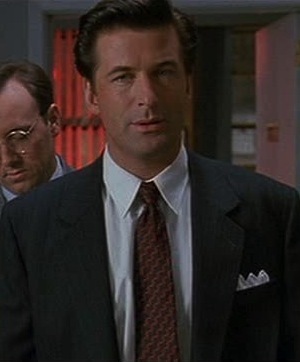 Christopher Hitchens deftly skewers David Mamet, the playwright who has converted to the Republican Party with the fervency of, well a convert:
This is an extraordinarily irritating book, written by one of those people who smugly believe that, having lost their faith, they must ipso facto have found their reason. In order to be persuaded by it, you would have to be open to propositions like this:
“Part of the left’s savage animus against Sarah Palin is attributable to her status not as a woman, neither as a Conservative, but as a Worker.”
Or this:
“America is a Christian country. Its Constitution is the distillation of the wisdom and experience of Christian men, in a tradition whose codification is the Bible.”
Some of David Mamet’s unqualified declarations are made even more tersely. On one page affirmative action is described as being “as injust as chattel slavery”; on another as being comparable to the Japanese internment and the Dred Scott decision. We learn that 1973 was the year the United States “won” the Vietnam War, and that Karl Marx — who on the evidence was somewhat more industrious than Sarah Palin — “never worked a day in his life.”
Hitchens' entertaining review does not concern itself with the question of just how so such a skilled observer of the human condition became such a mindless follower of cant. For that, you have to read Andrew Ferguson's profile of Mamet, which is intended as a laudatory profile welcoming the convert int the fold, but is actually a disturbing case study in the operation of conservative epistemic cloture. Mamet is seen being introduced into the right-wing world, where he's given a series of conservative texts to absorb. Mamet accepts these as gospel, while shutting off all contact with information sources that might challenge his new dogma:
He told me he doesn’t read political blogs or magazines. “I drive around and listen to the talk show guys,” he said. “Beck, Prager, Hugh Hewitt, Michael Medved.”
This is reflected in Mamet's cartoonish understanding of liberalism. Here is Hitchens again:
Unfortunately, though, [Mamet] shows himself tone-deaf to irony and unable to render a fair picture of what his opponents (and, sometimes, his preferred authorities, like Hayek) really believe. Quoting Deepak Chopra, of all people, as saying, “Our thinking and our behavior are always in anticipation of a response. It [sic] is therefore fear-based,” he seizes the chance to ask, “Is it too much to suggest that this quote contains the most basic prescription of liberalism, ‘Stop Thinking’?” On that evidence, yes, it would be a bit much.
To explain the thinking of American liberals, Mamet reaches to Deepak Chopra who is not, in fact, an important influence on American liberal political thought. And almost certainly Mamet did not find the Chopra quote by reading Chopra directly, but was fed it by one of the counselors at his ideological education camp. He has entered a hermetically sealed world in which not a particle of independent thought can enter.
*I altered the headline after my brother suggested the current one, which I find irresistible.


Groupon's Cheesy Origins
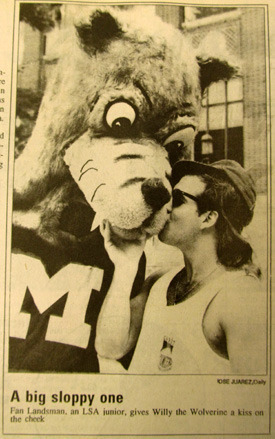 Groupon co-founder Eric Lefkofsky got his start in business with a failed scheme to create and market a mascot to the University of Michigan:
Then in the late 1980s a group of University of Michigan students, Adam Blumenkranz, Eric Lefkofsky and David Kaufman, attempted to create a mascot on the university's behalf, a lovable creature known as Willy the Wolverine.
Willy was the result of six rounds of market research, Blumenkranz told the Michigan Daily at the time. What resulted was a friendly-looking mix of a bear and a wolf who wore a Block M sweater.
Administrators had little interest in a mascot, Fielding Yost's live-wolverine experiment be damned. Then-athletic director Jack Weidenbach refused to take meetings with pro-Willy students and told the Michigan Daily that U-M wasn't interested, period.
Undeterred, the entrepreneurs obtained trademarks for Willy the Wolverine and started selling paraphernalia with the mascot's likeness.
Expanding the Michigan tradition wasn't the students' only motivation: they were in it for the money, which is why they invested in the trademark and in market research. Their plan was to sell merchandise in the short-term, building a fanbase for Willy before selling him to the University to serve as the official, on-the-field mascot.
Willy didn't take long to rise to an impressive stature on campus. Blumenkranz and company arranged it so that Willy served as the grand marshal of the 1989 homecoming parade in Bo Schembechler's last as head coach. The 1990 Campus Directory was released under Willy's name, and the mascot posed on the front cover alongside the cheerleading squad.
"Don't be silly, work with Willy" read classified ads that appeared in the Michigan Daily, seeking student account executives.
Luckily, the thing was too cheeseball to ever take off. But Groupon seems to be doing fine.
Mankiw's Misleading Defense Of Paul Ryan
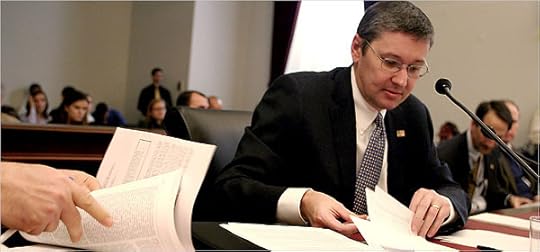
Former Bush economic advisor Greg Mankiw, writing in the New York Times, picks up the GOP talking point that Paul Ryan's plan to radically alter Medicare is really a pretty familiar bipartisan idea being blown out of propotion:
Representative Paul D. Ryan, Republican of Wisconsin, has attracted much attention with his plan to reform Medicare. He proposes replacing the current fee-for-service program, in which the government picks up the bill for medical expenses, with a “premium-support” system in which seniors use federal dollars to choose among competing private insurance plans.
Democratic critics of the plan suggest that enacting it would be akin to pushing Grandma over a cliff. But they rarely point out that the premium-support model is in some ways similar to the system set up under President Obama’s health care law. If choosing among competing private plans on a government-regulated exchange is a good idea for someone at age 50, why is it so horrific for someone who is 70?
This is deeply misleading. Ryan's plan does two things to Medicare that liberals find objectionable. The first is that it transforms it from a single-payer system into subsidies for private insurance. Liberal object to this because that transformation would, as the Congressional Budget Office projects, increase the cost of health insurance. It would interject a costly insurance bureaucracy into the system, and decrease the leverage of the insurer, by fragmenting the market into private insurers who lack Medicare's bargaining power.
Now, it's certainly true that liberals, who couldn't pass universal single payer health care, prefer giving people medical coverage through regulated private insurance subsidies than letting them go without coverage at all. That's why liberals support the Affordable Care Act vis a vis the status quo. But that is not the same thing as liberals agreeing that private insurance is better than single payer health care. Thus Mankiw's claim that the ACA demonstrates "agreement about the value of private competition" is clearly false.
Second, the subsidies in Ryan's plan, unlike the subsidies in the Affordable Care Act, would fall far below the value of private insurance. This is a major part of the objection, but Mankiw treats it as though it doesn't exist. Even if liberals did prefer to turn Medicare into a private insurance voucher, they would strongly object to his plan to make the vouchers grossly and increasingly inadequate to the cost of a plan. Likewise, conservatives agree that the rich should pay some taxes, but they would object to making them pay a 98% tax rate. Mankiw's logic would present this objection as hysterical partisanship -- we all agree the rich should pay taxes, so what's the problem?
Ryan has been hitting Mankiw's second point hard, pretending the only thing he does is to transform Medicare into private insurance subsidies, rather than to privatize Medicare and radically slash its value. Mankiw may share Ryan's ideological values and thus have reasons to wish to discredit critics of his program, but he should refrain from misleading people about the criticism.
June 17, 2011
Bachmann: Obama Hates... Socialism?
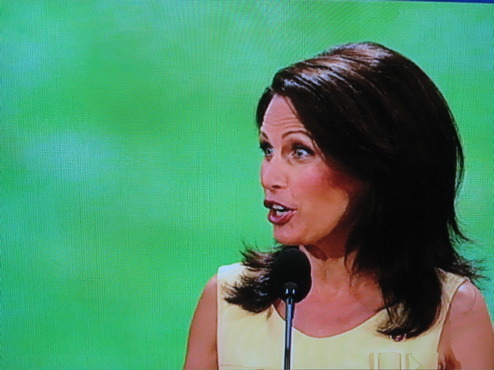
Michele Bachmann is onto President Obama's secret plot:
“This hasn’t been talked about very much – the president’s plan for senior citizens is Obamacare,” Ms. Bachmann told party activists here. She added, “I think very likely what the president intends is that Medicare will go broke and ultimately that answer will be Obamacare for senior citizens.”
Medicare is a single-payer program -- the kind liberals have always wanted for the non-elderly, but didn't get. Turning Medicare into something like the Affordable Care Act would be to move them off single-payer health care and onto a regulated system of private insurance. That would be a conservative plot. I don't think Obama is planning it, and if he were, it would prove he's far more right wing than anybody imagined.
I'm trying to think where Bachmann dreamed up this notion. The essence of Tea Party ideology is that Medicare is virtuous and American as apple pie with Obamacare is a socialist plot. In that way, Bachmann's fevered accusation makes sense.
Romney Hugs Pawlenty-nomics
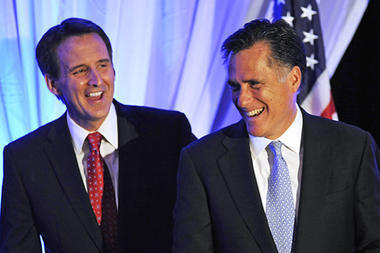
Speaking of the current level of crazy within the GOP, Mitt Romney has not yet released his economic plan. But he doesn't sound like a candidate who plans to let Tim Pawlenty out-crazy him:
Romney, though, praised the plan as displaying “the right instincts,” and no one on stage demurred. That exchange signaled that all of the GOP contenders will likely advance proposals for retrenching Washington that vastly exceed those that Republicans offered in earlier races. “The exchange over the Pawlenty economic plan was very telling; there was no disagreement on the principles,” said Eric Fehrnstrom, a top Romney adviser. “On economic policy, I don’t see any great disagreement among the Republican candidates.”
Huntsman As GOP Litmus Test
[image error]
Matt Bai insists that Jon Huntsman is a serious candidate with a strong chance at winning the Republican nomination, and that anybody who thinks otherwise is just a blinkered Republican-hater:
But most Democrats and some of my fellow media types seem to regard Mr. Huntsman more as this year’s Wes Clark or Fred Thompson, a guy who looks good on paper but is going precisely nowhere. Among other things, they point to a recent Washington Post-ABC poll that found that only 35 percent of Republicans had even heard of Mr. Huntsman — and 36 percent of those voters said there was no chance they would vote for him. At that rate, Herman Cain should mop the floor with the guy.
So what to believe?
The disagreement, I think, is in large part about how you view the Republican Party at the moment. Republicans who are intrigued by Mr. Huntsman are thinking that an electable, articulate guy like him might be compelling to all those mainstream Republican voters who don’t consider themselves Tea Partiers.
But let’s face it: Democrats and some commentators tend to see the Republican Party right now as a kind of wild, barren land where nothing thoughtful ever grows. If you start from the premise that the Republican grass-roots is made up mostly of stereotypical birther types with pictures of Sarah Palin on their refrigerators and nothing but Bibles on their bookshelves, then sure, Mr. Huntsman’s candidacy would seem to be a little laughable.
The bit about Palin pictures and bibles is obvious hyperbole designed to reduce all opposition to an untenable left-wing stereotype. But I do consider the "wild, barren land where nothing thoughtful ever grows" analysis of the contemporary Republican Party to be reasonably accurate, and I'd consider the most recent GOP Presidential debate fairly strong evidence.
But rather than trust my judgment, let's listen to the judgment of a man Bai would trust as an authority on the subject: Jon Huntsman. Governor Huntsman, are you too moderate to win the 2012 GOP Presidential nomination?
During our conversations last month in Utah, Huntsman had already begun to realize that perhaps the Republican Party was not ready for him. "You cannot have a successful party based upon a very narrow band, demographically," he tells me. "You've gotta broaden it to include more young people, more people of color, more people who are urban-dwellers, more who are the intelligentsia in America, many who have jettisoned the party. … And that's ultimately I think how it's going to play out. We're just not there yet." Two years was probably not enough time for the party to change. "He realized he'd just be beating his head against the wall with these guys, which made him open to the phone call [from Obama]," says another source close to Huntsman. "If he thought he had a real chance to be the standard-bearer and savior of the party, obviously he would have said no." ...
Huntsman is perfectly content to bide his time. Quoting political historian Theodore White, he told me when we spoke last month that he was happy to defer "to the inevitable cycles of history. Some of them are so inexorable you can't fight against them." In deciding to go to China, he seemed to be conceding that he wasn't going to win the battle for the GOP's soul this time around. Better to wait for the cycles of history to align in your favor.
That's from Zvika Kriger's great 2009 profile of Huntsman. I think it pretty well answers the question about whether Huntsman can get his party's nomination in 2012. And keep in mind, it was written just a few months into Obama's presidency, and already Huntsman was lambasting the excessive partisanship and opposition of the Congressional Republicans:
Emboldened, he started taking on the national party, excoriating GOP leaders for their knee-jerk obstructionism and narrow social conservatism. "I don't even know the [Republican] congressional leadership--I have not met them, I don't listen or read whatever it is they say because it is inconsequential, completely," he told The Washington Times in a scathing February interview. "Our moral soapbox was completely taken away from us because of our behavior in the last few years."
In dozens of interviews over the past few weeks, he has characterized Republicans as "devoid of ideas" and "gasping for air," decrying the GOP's "gratuitous partisanship," comparing it to "a very narrow party of angry people," and describing its strategy as "obstruct and obfuscate … grousing and complaining."
It's not like the GOP has moved to the center since then, either. So why is he running now? Almost certainly, Huntsman is hoping to raise his name recognition, run a credible campaign, and then, if and when a prospective Obama reelection prompts the party to move to the center, set himself up as an acceptable candidate for 2016.
In any case, someone here is clearly deluded about the current mentality of the Republican Party. But it's not those of us who discount Huntsman's 2012 prospects.
The Anti-IPAB Jihad
The conservative position on government-subsidized health care for seniors is that it should be rationed into vouchers worth far less than the cost of private health insurance. The second-best option, if that privatization doesn't occur, is for traditional government to spend wantonly, on the grounds that any attempt to make the system more efficient is "rationing by government bureaucrats." So, the best option is to eviscerate Medicare, but failing that it must be as wasteful as possible. Thus the conservative jihad against the Independent Payment Advisory Board, which is tasked with restricting wasteful Medicare spending.
Without directly challenging the logic, Josh Barro notes that these preferences don't even make factual sense:
IPAB and RyanCare are not substitutes. Ryan’s proposal does not even begin shifting seniors off of traditional Medicare until 2021, and people who turn 65 before that year will be allowed to stay on traditional Medicare until they die. Therefore, premium support produces no savings within the next decade and fairly limited savings in the following one. That’s not going to cut it alone; we also need to achieve near-term savings within the traditional Medicare program.
Recognizing that need, Paul Ryan’s budget proposal assumes $389 billion in Medicare savings, relative to President’s budget, before 2021. Unfortunately, Ryan has not identified the mechanismthat these savings will come from. But the only ways to save money in traditional Medicare are to pay less for things or to pay for fewer things; which is to say, you can only hit that target if you have IPAB or something that looks an awful lot like IPAB.
The [National Review] Editors are right to note that IPAB, despite all the Democrats’ denials, is a rationing measure. But rationing should not be a dirty word. The alternative to rationing is uncontrolled expenditure. Ryan himself described the situation correctly: “Rationing happens today! The question is who will do it?” If you moved to a premium-support model, the answer would be “consumers and private insurers.” But since single-payer Medicare is going to be around for decades to come (if not forever) some of that rationing will have to be done by the government.
Of course, another factor here is that, to the extent that IPAB and other reforms in the Affordable Care Act slow health care inflation, they reduce the pressure on Medicare's financing, and make it harder for Republicans to present Paul Ryan's solution as the only alternative to collapse.
Annals Of Bad Driving
Among the latest allegations in the lawsuit pending in Fairfax County Circuit Court:
Paragraph 10. “At the time of the collision, Defendant was going 85 miles per hour.”
Paragraph 12. “At the time of the collision, Defendant was having sex with a female.”
Paragraph13. “At the time of the collision, Defendant was driving admittedly drunk.”
Paragraph 14. “At the time of the accident, Defendant was partially or totally in the backseat of the car.”
But the defendant's apparent ability to operate the car at all while drunk, having sex and being partially in the backseat is a pretty amazing feat of multitasking.
The Special Election The Liberal Media Doesn't Want You To Know About
California's 36th district recently held a special election to replace retiring Rep. Jane Harman. The district hed a "jungle primary," in which candidates from both parties all run on the same ballot. Wall Street Journal opinion columnist Kimberly Strassel wants to know why nobody is investing this with the same significance as Kathy Hochul's surprise win in the New York special election:
In May, when Democrats pulled out a surprise victory in a special House election in New York, all the talk was about Medicare lessons for Republicans. Now on to California.
That's where another high-stakes special election will take place on July 12, to fill the seat of former Democratic Rep. Jane Harman. Lacking a sexy Mediscare plot, it isn't getting much national play. But the bottom line is that Democrats are struggling to hold on to a blue seat, offering a vivid preview of the extraordinary economic vulnerabilities the party faces going into a presidential election. There are lessons here, just as potent as those from New York. ...
When the dust settled on May 17, Ms. Hahn had claimed 24% of the vote. In second place, with 22%, and claiming the runoff spot, was a GOP candidate that most of the media had never mentioned: Craig Huey. A businessman, Mr. Huey had poured personal resources into a strong mail, TV and radio strategy, and garnered the endorsements of respected California Republicans.
But what really resonated with voters was Mr. Huey's laserlike focus on the economy and jobs. As Ms. Hahn and Ms. Bowen competed on who had a more progressive environmental record, Mr. Huey banged relentlessly on California's 12% unemployment rate, job-killing regulations, and record deficits. As the two Democratic heavyweights traded barbs over who had taken more "oil money," Mr. Huey touted his plans for reviving growth.
Let me suggest an alternate interpretation. In a jungle primary where you have many candidates from the majority party, it's possible for a candidate from the minority party to finish high in the running without necessarily commanding a major share of support within the electorate. In this case, the Republican's 24% of the vote does not in any way prove that his pro-growth message "resonated," nor that the result is in any way similar to the New York special election.
The alternative explanation is that the Republican's 24% total reflects a massive groundswell of support that's being covered up by the liberal media. You choose!
The State Of Public Opinion In One Chart
I think this chart, by Greg Ip, says a lot about the state of public opinion right now:
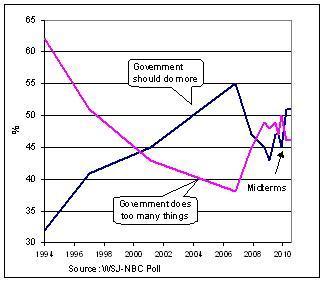
We had a huge swing to the left in 2006-2008. Then a large swing back to the right in 2010. Now the pendulum has swung back a bit to the left, and public opinion is sitting about halfway between 2008 and 2010.
Jonathan Chait's Blog
- Jonathan Chait's profile
- 35 followers

