
Jonathan Chait's Blog, page 32
July 7, 2011
&c
-- Newest frontier of television news: designated commentator for missing child stories.
-- Fred Thompson on DSK: “You can be sure of one thing: This never would have happened if Arthur Branch were still running things.”
-- Rupert Murdoch and the “reverse ferret.”
-- “Easy ways” to balance the budget are not actually so easy.
-- Good American basketball jobs might flee to Turkey.
-- The debt ceiling cat.


House Republicans Meet Small Government, Recoil
This last passage from a Politico story about debt ceiling negotiations is too funny:
But not all was calm in the meeting, which took place in the Capitol basement.
Boehner announced that Republicans were seeking to further cut office allowances as part of the Legislative Branch appropriations bills, sparking anger from several Republicans. GOP leadership already imposed an across the board cut earlier this year.
It takes a real lack of intellect and moral imagination not to be able to generalize from this experience to the broader ramifications of your plans to slash the domestic discretionary budget.
Checking In On Old Friends
I've been taking a bit of a vacation from enjoying the comic stylings of Peter Wehner, but I decided to check in on the former Bush administration Minister of Propaganda to see if he was still sounding his daily triumphant declarations of the demise of Barack Obama. Turns out he is:
[B]y this point in the Clinton presidency the prospects for Democrats were looking up, and in fact, Clinton was well on his way to winning a comfortable re-election. That doesn’t appear to be the case for Obama, who is turning the Democratic Party into a pre-Clinton party, one characterized by unalloyed liberalism.
It turns out that in almost every respect, Clinton was a more formidable political figure than Obama, and certainly more competent. And as we get closer to 2012, it wouldn’t be surprising to hear Democrats speak longingly of the Clinton Era, as glory days compared to the dangerous, even ruinous, prospects they now face.
Longtime readers of this blog, to the extent that a two-year-old blog can have longtime readers, will not be surprised to learn that Wehner's statements once again bear no relationship to measurable reality. At this point in his presidency (July 1995), Bill Clinton's approval ratings were in the mid-forties, exactly the same as Obama's now.
Was Clinton "well on his way to winning a comfortable re-election"? Well, he did win reelection comfortably. But in the summer of 1995, Clinton was trailing a generic Republican presidential candidate, and running slightly behind Bob Dole in a head-to-head matchup. (Clinton's polling against Dole from June through August of 1995 went, in order, -5, -1, +4, -2, tied.)
Obama currently is running 2.7% ahead of a generic republican, 4.6% ahead of Mitt Romney, and leads by double digits against every other Republican. Obviously, the race is far away. But the claim that Obama is clearly weaker than Clinton bears no relation to reality.
In any case, I look forward to another 16 months of Wehner proclaiming Obama is doomed, doomed to lose reelection, and then either four years of Wehner triumphalism or four years of Wehner proclaiming that Obama is doomed, doomed to go down in history as the worst two-term president ever.
Why the News of the World Shutdown Could Be a Bad Thing
[Guest post by Alex Klein]
Rupert Murdoch just drove the final nail into his News of the World coffin, shoving it unceremoniously out to sea like a recently deceased Al Qaeda boss. Its editor Rebecca Brooks gets to keep her post as chief executive of all News International while its reporters mill around outside of the building, levying vague threats. It’s fair to say good riddance, and rejoice that a newspaper that hacked 4,000 and bribed £100,000 will soon be moldering in the trash heap.
But the fall of News of the World isn’t all good news. In fact, it could do a lot of damage to the tabloid’s more dignified News Corps neighbor at 3 Thomas More Square: England’s thunderer, The Times of London. The closure of Murdoch’s cash cow will make it much harder for him to prop up his legitimate outlet, a paper with fine journalism, but little money.
The Times (full disclosure: I have worked there) has long been considered the UK’s newspaper of record. Walk a few yards (or meters) from the Sun’s Page Three girls and the NoTW’s Nazi hookers and you’ll find yourself in the land of Kipling and Russell, a paper which broke key WikiLeaks stories last summer and uncovered the recent World Cup bribing scandal.
But the staid newspaper hemorrhages money. The Times and Sunday Times lost £87.7 million in 2009 and £50.2 million in 2008. Murdoch bought The Times as a prestige paper in 1981 for tens of millions, and as he puts it, “[My] only paper that’s in loss is the London Times. And that’s always been the case.” To his credit, the paper might have failed otherwise. The Times is still a loss leader with half a million or so readers, propped up by the gangbuster revenues of other News Corps outlets like the Sun and News of the World, which boast about 2 and a half million readers apiece. News of the World alone makes over £150 million a year in sales and ads.
With that revenue stream gone, News Corps papers are going to come under a lot of pressure. We’re going to see the expansion of the odious Sun (read: thesunonsunday.co.uk). Worse, the company has already announced it will move The Times and Sunday Times to seven-day working. Given Murdoch’s uncanny bottom-lining ability to turn news into a sideshow, there’s good reason to fear that a lot of what makes The Times great is about to come under the chopping block. Last summer, the paper lost 60 staffers amid budget cuts.
Not all British journalism is bad. The problem is, one of its best parts has found itself chained to one of its worst, thanks to the encircling grip of the Murdoch conglomerate. News of the World deserves to go down the drain — but it might pull down some good journalists along with it.
Reductio Ad Absurdum
Former Republican aid turned lobbyist John Feehery has one of those "pox on both houses" repudiations of ideological extremism that inadvertently reveals the whole fallacy of the thing:
Reduced to the absurd.
Ideologues on both sides of the philosophical divide fall dangerously into this trap.
Conservatives who believe that government does not need to exist are every bit as wrong as liberals who believe that the private market must be completely controlled by the government.
The truth is not somewhere in the middle. It is exactly in the middle.
There is literally no such thing as "liberals who believe that the private market must be completely controlled by the government." There are people who believe the private market should be completely controlled by the government, but those people by definition are not liberals. They're socialists. Very few of them can be found.
Feehery is no doubt reacting to the constant, sweeping attacks on government he hears from fellow conservatives, and assuming an equally sweeping view exists on the left. It doesn't. The fundamental asymmetry between conservative and liberalism is that the former has strong, a priori philosophical views about government while the latter does not.
Right-thinking people everywhere believe that a neutral position on government -- for it where it works, against it where it doesn't -- places them between liberalism and conservatism. But that is the fallacy.
The Non-Grand Bargain That Might Pass
 I've had two discussions with Obama administration officials who have expressed eerie optimism that they can get Republicans to accept a deal with higher revenue. It never made sense to me. But this outline of a potential deal, from Jay Newton-Small, actually makes perfect sense:
a more modest package for roughly $1.7 trillion to $2.3 trillion in cuts with upwards of $500 billion in revenue increases, including $40 billion to $60 billion from ending tax breaks for corporate jets, yachts and race horses (and, possibly, a proposal to stop taxing hedge fund managers’ income as capital gains, thus subjecting it to a higher rate); plus $150 billion to $200 billion in increased revenues from requiring more pension contributions from federal employees, broadcast frequency auctions and getting rid of farm subsidies; and another several hundred billion dollars from pegging inflation to the Consumer Price Index. All of the new revenues would be offset by a permanent or long-term Alternative Minimum Tax fix, a popular bipartisan move, thus satisfying the Grover Norquists of the world. This deal would include modest Medicare cuts, but to providers only, and could also include some short term stimulus such as an employer payroll tax holiday.
Let me try to explain what this means. The "Alternative Minimum Tax" is kind of a parallel tax rate, created in 1969, designed to ensure that very rich taxpayers didn't amass so many deductions that they could avoid paying any taxes. If your tax rate falls below your "alternative minimum tax rate," then you have to pay the AMT rate instead. It's sort of a failsafe tax rate.
The AMT has, over the decades, inadvertently grown to a point where it hits non-rich taxpayers, especially ones in high-tax states. Congress has responded by continually passing "patches" that keep the AMT from growing. Since these patches are passed generally a year or two at a time, the law assumes that the AMT will continue to grow in size and raise taxes at lower and lower income levels. The AMT is one of the differences between the budget baseline that assumes current law, and which shows the deficit falling to a modest level -- and the budget projections that assume current policy.
So according to Newton-Small, one possible deal will raise a lot of taxes, but offset the revenue by permanently fixing the AMT. That way, conservatives can say that they didn't vote for a net tax hike -- they just voted to close some loopholes and plow the revenue back into other tax reductions. This allows them to avoid contradicting their sacred pledge to Grover Norquist never to support a revenue increase.
But wait, you ask! How does this help the deficit problem?
The answer is that if you assume that Congress will continue to patch the AMT year after year anyway, then the revenue loss from that "tax cut" isn't real. You're just accounting for revenue that would be lost anyway, but paying for it rather than financing it with debt. In other words, you're turning a future assumed debt-financed tax cut into a future paid-for tax cut. That's genuine budget savings.
I still think that a grand bargain probably can't pass the House. But this kind of agreement may have a real chance.
If I had to guess right now, I'd guess that this is what Obama and Boehner are going to try to do. Obama's leaks last night about supporting a grand bargain may reflect a genuine willingness to pass a deal like that, but Obama knows full well it won't happen. He's just demonstrating that the reason the deal doesn't do more is that Republicans, not the administration, refuse to go higher. It's positioning. If there's a deal, I expect it to be something like this.
Why The House Will Kill The Grand Bargain
 Every time somebody suggests there might be a big deficit deal, and every time I catch myself thinking it could happen, I return to one basic question: How does this pass the House of Representatives? I've never heard a remotely persuasive answer to this question.
To understand the obstacles in place here, you need to return to the 1990 budget agreement. That was a deal between George Bush and Congress that ran along roughly similar lines to the agreement being floated in the press today: mostly spending cuts, with some tax hikes along with it. When presented with this deal, House Republicans, led by Newt Gingrich, revolted. Even with a Republican president lobbying for it, all but ten House Republicans opposed the deal. In the conservative mind, the 1990 budget deal was a gigantic failure -- "the fiscal equivalent of Yalta," as some conservatives put it. Indeed, the current Republican party can in many ways be traced back to the revolt against this deal, and the structure of the conservative movement is designed in large part to prevent a recurrence.
Now, in actual fact, the 1990 budget deal -- along with the 1993 deficit reduction program passed under Bill Clinton with exclusively Democratic support -- was literally the only successful example of shrinking government in the last three decades. Note the sharp, anomalous decline in spending beginning in 1990:

But never mind that. The reality doesn't matter for our purposes. The point is that, in the conservative mind, Republicans in 1990 were hoodwinked into accepting real tax hikes in return for spending cuts that never materialized.
1990 is a good baseline for comparison to any prospective budget deal today. What is different now? It's true that President Obama will probably offer a more favorable ratio of spending cuts to tax hikes than Bush got, and that the tax increases will come in the form of reducing tax expenditures rather than raising rates. On the other hand, the House GOP's voting base has grown far more conservative since 1990. Conservatives have instituted the systematic practice, largely unfamiliar in 1990, of deploying primary challenges against members who stray even slightly to the center.
What else? The current budget deal is attached to another measure, raising the debt ceiling, that is itself highly unpopular among Republicans. (Michelle Bachmann's first ad pledges never to vote to raise the debt ceiling, a position other Republican presidential candidates will feel pressure to emulate.) The president who will be the chief beneficiary of any deal, and bear the economic costs of failure, is a Democrat rather than a Republican. And where in 1990 it was possible to pass the deal through the House relying almost entirely on Democratic votes, the House GOP leadership now understands it needs to carry most Republicans:
McConnell and Boehner — but especially the speaker — can only back a proposal that does not alienate their rebellious, tea-party-inspired freshmen. Any deal has to be a significant change in government spending patterns, now and in the future, big enough to convince junior lawmakers and the conservative base back home that GOP leaders are serious about ending the recent flood of federal red ink.
“It’s harder to get a majority of the [freshman] class on board for something that isn’t revolutionary,” said Rep. Tim Scott (R-S.C.), a freshman who is a member of leadership.
Boehner also has to watch his own flanks. He cannot, and will not, support a deal with Obama that isn’t backed by Cantor and House Majority Whip Kevin McCarthy (R-Calif.).
If there was [an agreement] that got 75 Republicans and 150 Democrats, he’d have huge problems,” one GOP leadership aide said of Boehner. “He’s not going to do that.”
Guh.
Anyway, so far, the conservative reaction to a potential budget deal seems to be total apoplexy. (For a sense of the gap between the centrist and conservative understanding of the situation, here's Rep. Paul Broun urging Congress to lower the debt ceiling.)
One voice we haven't heard from yet is Paul Ryan, and Ryan may be the one figure with the prestige to bring conservatives along to any deal. He's been quiet so far. But he voted against the Bowles-Simpson plan, and there's little indication he actually wants a grand bargain. James Capretta, who has Ryan's ear, fulminates against a budget deal. Capretta repeats the trope that Democrats hoodwinked Republicans in 1990, and proceeds to argue that a deal now would help Obama and hurt the GOP:
A $2 trillion or $3 trillion package, heavy on tax hikes and the usual assortment of Medicare and Medicaid regulatory tinkering, should be the Republicans’ worst nightmare. It will hand the president a huge political victory, leave the entitlement monolith just as it is, further entrench central government management of the health sector, and burden taxpayers even more.
This argument is probably correct, at least on its own terms. If you're dead set on implementing Paul Ryan's vision of government, then a budget deal is the last thing you want. You need the national debt to reach and stay at crisis levels, so that you can persuade voters that your otherwise-unacceptable budget is the only alternative to total fiscal destruction. And you need a Republican in the White House, which is probably harder if Obama has positioned himself in the center with a successful budget deal.
A lot is happening behind closed doors, so I can't draw any firm conclusions. But the evidence I see makes it hard to imagine any big budget deal passing the House.
JONATHAN CHAIT >>
Karl Rove Being The Best Karl Rove He Can Be
Every writer has his own natural métier. For Karl Rove, it's taunting:
Begala’s piece was amusing because he said he’s invoking my name to raise money from rich (and terrified) Democrats to help President Obama. “Even the most disenchanted Democrat gets motivated to fight back” when told Karl Rove is active on the other side, Begala crows. Problem is, the early results of his strategy aren’t so good.
Begala’s group, Priorities USA, says it will respond to our $20 million blitz with (wait for it)… $750,000 in ads. As of Friday, the group had placed less than $490,000 in five states. On some level, I guess I should be flattered that Begala thinks I’m a big help to his efforts for Mr. Obama, but aren’t the results sort of pathetic?
He is a sublime practitioner of the form.
Will The GOP Message Machine Oppose Bachmann?
One of the arguments for skepticism of the Michelle Bachmann campaign is that the party establishment opposes her. That isn't totally wrong, but I don't think that frames the issue quite right, either. It certainly doesn't help Bachmann if Washington Republicans fervently hope for her defeat in the primaries. But if that worrying is confined to quiet hand-wringing, that doesn't doom her. What matters is the message conveyed to Republican voters. Do the news outlets they trust portray Bachmann as a plausible nominee or as a dangerously unqualified sure loser?
Right now, we don't know. Bachmann has enjoyed laudatory cover stories in National Review and the Weekly Standard. Rush Limbaugh has fiercely defended her against establishment criticism. Even George Will is edging away from his previous dismissal of her.
But of course, the biggest player here is Fox News. It's noteworthy to see Brit Hume portray Bachmann as unelectable:
More commentary like this would hurt Bachmann. But I don't take it for granted that such a systematic messaging campaign will develop.
July 6, 2011
What Obama Can Give Away, And What He Can't
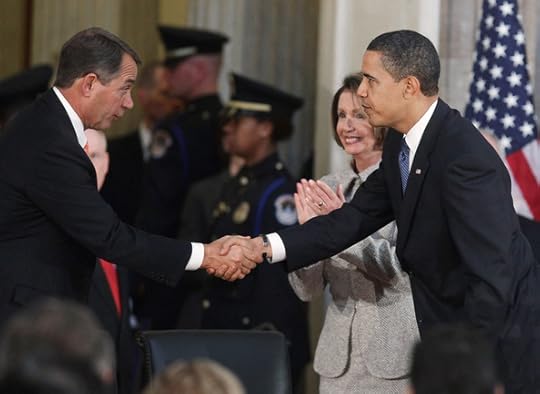
Several news stories broke last night suggesting that President Obama wants to broaden the debt ceiling deal with Congress, reducing deficits by $4 trillion over a decade, rather than the $2 trillion previously believed. Here's Politico, here's the New York Times, and here's the Washington Post. The reports all suggest Obama will agree to cut Social Security and Medicare in return for higher revenue.
When assessing any possible deal, it's important to recognize the parameters of the possible. "Perfect" was never going to happen, even given filibuster-proof Democratic majorities. "Good" left the station last November, and now that Obama has blundered into a debt ceiling hostage negotiation, we're looking to cling to the bottom rung of "acceptable."
What are the conditions of acceptability? My premise is that, while wasteful spending exists, it would be desirable to make up the entire medium-term fiscal gap with higher revenue, which would still leave the United States a low-tax country by international standards. However, the prospects for obtaining the votes for such a policy border on zero. The goal ought to be making it through the debt ceiling hostage crisis with minimal damage to the possibility of functioning government.
Unlike many other liberals, I don't rule out cuts to Medicare and Social Security. I care more about avoiding draconian cuts to programs for the poor and to the domestic discretionary budget, the massive squeeze upon which is already resulting in the negligence of core government functions.
Obviously, higher revenue and shared sacrifice are vital criteria. But even more important than securing higher revenue in this agreement is preserving the chance for Obama, should he win, to end the Bush tax cuts. As I've argued repeatedly, the easiest way for Obama to achieve his policy aims is to fight the Republicans to a standoff over the tax cuts. Republicans won't accept any tax cuts that only apply to income under $250,000. If Obama wins reelection and refuses to extend tax cuts on income over that level, then the whole thing will disappear. This is the only politically plausible scenario by which the government will have adequate revenue over the next decade. That leverage is vital. It's therefore a little disconcerting to read in the Times that the Bush tax cuts may be part of the deal:
Officials said Mr. Boehner suggested that he was open to the possibility of $1 trillion or more in new revenue that would be generated by addressing tax issues already raised in the talks, like killing breaks for the oil and gas industry, eliminating ethanol subsidies and ending preferential treatment for corporate jets.
But those changes would fall far short of the revenue goal, and the source of the rest of the money would, under what they described as Mr. Boehner’s proposal, be decided by Congress through a review of tax law changes. One official said some revenue could be generated by allowing Bush-era tax cuts for affluent Americans to expire at the end of 2012, which would produce hundreds of billions of dollars, though those savings would be offset by the costs of retaining lower rates for those below the income threshold.
I'm not freaking out, because this is a hazy description of a possible element of fluid negotiations. But I can't emphasize strongly enough that Obama cannot agree to anything that locks in any part of the Bush tax cuts. To do so is to abandon the only leverage he could obtain and guarantee either the starvation of government or continuing massive deficits. If Obama wins election, he needs the ability to use the GOP's opposition to any middle class tax cut extension without an extension for the rich as leverage to let Republicans kill the whole thing for him. And if he loses reelection, then the Republican who beats him will just reinstate the tax cuts. Either way, negotiating a partial end to the Bush tax cuts harms Obama. It's the red line.
Despite Obama's debt ceiling blundering, even a budget deal heavily tilted toward spending cuts could be justified if it is the first step of a larger plan. The plan would be to first cut a deficit deal that eliminates the Republican threat to torpedo the economy and establishes his centrist bona fides, which would help him win reelection, after which he'd have full leverage to face down the Republicans on the tax cuts. I don't know if that's the plan, and I won't know until 2013. But the overriding imperative is to maintain flexibility on the tax cuts.
JONATHAN CHAIT >>
Jonathan Chait's Blog

- Jonathan Chait's profile
- 35 followers

