
Jonathan Chait's Blog, page 28
July 14, 2011
Conservative Activists vs. Business
[image error]
One hardy perennial theme of American political commentary is "tension between the GOP's right-wing base and business elite." The story is almost always overblown. The interests of the conservative activists and the rich folks is often orthogonal (say, one wants to ban gay marriage, the other wants to cut the capital gains tax.) Sometimes there's an asymmetry of passion (activists care way more about impeaching Clinton, business elites care a lot more about a free trade deal.)
But almost never do you see a straight, head-on collision between the two. Indeed, one of the functions of the conservative movement is to channel the passions of conservative activism into business-friendly ways. But now you're seeing a full, head-on collision:
The Republican coalition of business and tea party supporters that spurred the party to nearly unprecedented gains in 2010 is breaking down over the debt limit debate.
At the center of the breakdown is Senate Minority Leader Mitch McConnell (R-Ky.), whose plan to hand responsibility for raising the debt limit to President Obama has proved a complete non-starter among both tea party backers and the conservative base, groups that want the GOP to reject any increase.
Meanwhile, business interests are pushing hard for Congress to raise the limit, for fear of economic consequences. The Chamber of Commerce, the Business Roundtable and other like-minded groups say the debt limit needs to be raised to avoid economic calamity, and the conservative Wall Street Journal editorial board has embraced McConnell’s controversial plan.
Who will win? I usually bet on the people with the money. But I don't have total confidence -- I can't think of an example of conservative activists so directly opposing business. And the current paralysis of the debt ceiling negotiations seems to reflect the fact that the House GOP caucus is simply to torn between competing impulses to do anything.


McConnell's "$2 Billion Spending Cut"
 Mitch McConnell, as part of his red-meat pretext for abandoning the debt ceiling hostage strategy, has accused the Obama administration of really only offering $2 billion in spending cuts:
Earlier this week, I asked an administration official point blank what the cuts they were proposing as part of their so-called bipartisan deal would amount to next year. He said they amounted to about $2 billion, total. Washington will borrow $4 billion dollars today alone. Two billion dollars when Washington borrows more than that every day.
“This is what they were planning to spin as more than $1 trillion over 10 years.
“It was at that point that I realized the White House simply was not serious about cutting spending or debt.
The $2 billion talking point has been picked up by, among others, Washington Post conservative blogger Jennifer Rubin, who is also the leak recipient of, and passionate advocate for, McConnell's plan:
The White House offered a paltry $2 billion in actual, immediate cuts...If no one likes the plan we can go back to the main ring, where Obama is offering only $2 billion in real spending cuts.
There are a couple of huge problems here. First, McConnell is assuming that the only "real" spending cuts are those that take place in this year's budget. Of course, that's silly. You don't want to impose very large cuts during an economic crisis. Now, Republicans may deny economic principles advocated by such left-wing radicals as Ben Bernanke and Goldman Sachs, but the administration does believe this. So obviously, if the administration accedes to spending cuts, it's going to want to backload them for macroeconomic reasons.
This does not mean the spending cuts are not "real." Indeed, Paul Ryan's budget imposed enormous cuts over a very long period of time. His most high-profile spending cut did not even begin to accrue savings until after ten years. You didn't see Republicans denying those savings were real.
Second, a Democratic official familiar with the budget talks assures me that McConnell's account is numerically false. McConnell simply took the fiscal year 2011 discretionary budget, $1.050 trillion, and compared it with the number discussed in the negotiations, $1.048 trillion. But of course, budget baselines account for inflation and higher costs. The Congressional Budget Office baseline for 2012, excluding war costs, was $1,111 trillion, which would make the first year savings $63 billion.
This official showed me a spreadsheet of a CBO baseline which was provided to the negotiators but hasn't been published. I didn't independently confirm its veracity, but I have no reason to doubt it. In any case, McConnell's line here is not just conceptually silly but seems to be factually incorrect as well.
JONATHAN CHAIT >>
Life In Ohio, A Continuing Series
Owner Of Killer Bear Chokes To Death On Sex Toy:
An exotic-animal owner who made headlines last summer when one of his bears mauled a woman to death has died after apparently choking on a sex toy, authorities said.
Apply to Be a TNR Web Intern!
The New Republic Online is looking for college students and recent graduates for its fall 2011 Web internship program. Internships are unpaid but offer substantial experience in the production of a daily online publication. Interns must be able to work in our Washington, D.C. office. Responsibilities include:
Preparing and updating TNR's homepage
Helping to maintain TNR's blogs and other aspects of the site
Research projects
Writing articles and blog posts, and helping to create multimedia content
Participating in TNR staff meetings
Helping update and maintain TNR's online archives
Political journalism experience is preferred, but not imperative; some familiarity with HTML is helpful, but not crucial; and fluency in search techniques like LexisNexis is mandatory. A full-time commitment is preferred.
Applications for our fall internship (August/September through December/January) will be accepted until Friday, August 5. To apply for the Web internship program, please e-mail a cover letter and résumé to Seyward Darby and Jesse Zwick.
The Secret Issue At The Heart Of the Budget Fight
David Rogers pulls out an under-reported point about what killed the deficit bargain between President Obama and John Boehner:
For many observers, tax reform remains the last, best bet — even now — to bridge the revenue differences between Republicans and Obama and craft an effective deficit-reduction package. But there’s resistance from wealthy interests who fear the president will gain too much leverage to impose tougher standards of progressivity in the tax code — and thereby crimp their capital gains tax breaks.
The White House and Boehner admit the progressivity fight contributed to the breakdown in their talks Saturday. And it may help explain why The Wall Street Journal’s editorial pages — a major force for the GOP and big proponent of favorable capital gains rates — so strongly attacked Boehner on Saturday and then came out Wednesday in defense of McConnell’s attempts to kick the debt fight past next year’s elections.
Let me explain this one to laypeople. Obama's deal on taxes was that he proposed to start with the revenue levels we'd have if the Bush tax cuts only on income over $250,000 phased out. But, to assuage Republican concerns about higher tax rates, he agreed to tax reform that would drop the rates back down to Bush-era levels, and make up the lost revenue by closing tax preferences.
Now, here is where things broke down. To do that in a way that means the progressivity of the tax code, you'd almost be required to reduce or eliminate the tax preference for capital gains. That's how the Reagan administration and Democrats did it when they reformed taxes in 1986 -- they dropped the top tax rate from 50% to 28%, but the rich wound up paying more because they ended the preference for capital gains.
This, however, is a a huge bugaboo to the right. Since 1986, the GOP has obsessively and successfully crusaded to re-open the capital gains tax preference. Most of the very, very rich get the bulk of their money from capital gains. There's nothing they'd like less than ending that preference.
The broader problem here is that Obama seems to be taking Republicans at their word. He wants shared sacrifice, and they say they want to avoid high rates. Tax reform is a way t accomplish both. But Republicans don't just want to avoid high marginal tax rates. They want rich people to pay low taxes, period. It's not clear Obama understands that.
July 13, 2011
Obama Still Wants To Cut A Terrible Deal
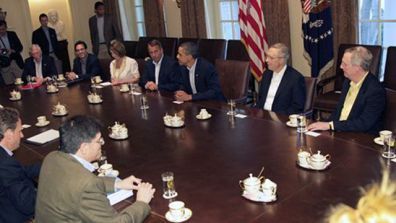
Chuck Todd reports that President Obama still wants to make the Grand Bargain:
Boehner and Obama are, essentially, the lone voices in the room still advocating for the “grand bargain” (both believe it’ll be easier to pass, and they may have a point)...
The president desperately wants the big deal. How much so? When Boehner informed the president last Saturday night that he had to publicly pull out of the “grand bargain” talks, the conversation took more than 30 minutes to wrap up. While neither side has given reporters the details of that conversation, draw your own conclusions as to why a call like that, initiated by Boehner to essentially “break up” from the grand bargain talks, took more than 30 minutes to conclude. The president needs a real deal as much if not more than congressional Republicans.
The contours of the $4 trillion Grand Bargain leaked publicly at the same time it leaked that Republicans wouldn't cut the deal, so it largely managed to escape the attention of liberals that Obama was prepared to cut a really terrible deal. I'm actually okay with the entitlement cuts I've heard as part of the bargain -- it's not what I'd do if I were king, but as far as the list of concessions to political reality, it's bearable. I'd like to see a plausible target for domestic discretionary spending, which seems to be getting squeezed to ludicrously low levels.
Obama apparently is demanding that Republicans accede to the phase-out of the Bush tax cuts on income over $250,000. In return for that $800 billion in revenue, Obama has reportedly offered multiple times that amount in spending cuts. This sounds like a massively asymmetrical bargain. To begin with, Obama is trading for tax increases that, unlike the spending cuts he proposes to support, are scheduled to happen anyway at the end of 2013 unless the House, Senate, and President agree to extend them.
What's more, as Nate Silver argues, Obama's position -- that deficit reduction should consist of mostly spending cuts with some tax hikes -- places him roughly equivalent to the median Republican voter, while the GOP no-tax position is off the charts. And if you move beyond taxes versus spending in the abstract, which is always the most conservative friendly way to frame a budget question, the imbalance grows even more stark. Entitlement cuts are massively unpopular, higher taxes for the rich are extremely popular. If the budget debate were a presidential election, it would be a contest between Republican Michelle Bachmann and Democrat Rick Perry.
The deal floated earlier to close loopholes in return for an extension of the Alternative Minimum Tax patch, plus spending cuts, seems decent. (Explanation here.) The Grand Bargain sounds like a disaster in the making. It's fortunate that Republicans are crazy enough to kill it, and distressing that Obama keeps trying to revive it.
JONATHAN CHAIT >>
&c
-- Michele Bachmann isn’t too worried about the debt ceiling
-- A look at the fiercest rivalry in Major League Soccer
-- Eliot Spitzer: “If the department fails to open an immediate investigation into News Corp.'s violations of the FCPA, there will have been a major breach of enforcement at Justice”
-- William Galston thinks that the sorry state of housing lies at the heart of our economic woes
Would McConnell's Debt Ceiling 'Escape Hatch' Actually Work?
[Guest post by Kara Brandeisky]
The Mitch McConnell plan is pure politicking. The mechanism—a “resolution of disapproval”—sounds like a parody of Congressional proceedings. But Republicans get to run ads suggesting they voted against raising the debt ceiling. And President Obama gets to prevent default and economic catastrophe. Everybody wins.
But if the purpose is to score political points, will it work? A Gallup poll released today suggests it may be too late. While most people are still opposed to raising the debt ceiling, support for raising the debt ceiling has risen to 37 percent, from just 17 percent in May, indicating increased public awareness about the consequences of default. Most importantly, among people who are following the debate "very closely”—the people who heard Obama threaten that Social Security checks may not go out August 2—there are far more who fear raising the debt ceiling without spending cuts than those who fear an actual default on the debt.

This seems like a sign that the McConnell plan would not successfully stick Obama with responsibility for the squabble come 2012. Republicans have convinced the public that we need to make big cuts before raising the debt ceiling, so now voters are hungry for a deal. McConnell's attempt to drop the issue entirely seems more likely to backfire on the Republican Party than on Obama.
Political scientist John Sides wrote recently about how the recent focus on the deficit is an example of “agenda-setting.” He explained,
The idea is straightforward: the more news coverage of an issue, the more the public thinks that issue is important. The news coverage can be driven by salient real-life events, by the media’s own agenda, or by the agenda of politicians, which is typically reported in the media. In this case, media coverage largely reflects the attention given to the deficit by politicians […] In short, if you want to know what the public cares about, listen to what politicians and news outlets are talking about.
Public opinion has already conformed to the political agenda. Republicans demanded spending cuts before raising the debt ceiling, and Obama responded in turn. The public has adopted the Republican’s sense of urgency on this issue. At this point, voters are more likely to punish Republicans for abandoning ship.
The debt ceiling used to just represent a chance for the minority party to embarrass the majority party. Republicans made it something much more—an opportunity to extract large concessions on spending while holding the economy hostage. Now the public is riled up about government spending. The agenda has been set. It may be too late to change it.
Does McConnell's "Escape Hatch" Come Too Late?
[Guest post by Kara Brandeisky]
The Mitch McConnell plan is pure politicking. The mechanism—a “resolution of disapproval”—sounds like a parody of Congressional proceedings. But Republicans get to run ads suggesting they voted against raising the debt ceiling. And President Obama gets to prevent default and economic catastrophe. Everybody wins.
But if the purpose is to score political points, will it work? A Gallup poll released today suggests it may be too late. While most people are still opposed to raising the debt ceiling, support for raising the debt ceiling has risen to 37 percent, from just 17 percent in May, indicating increased public awareness about the consequences of default. Most importantly, among people who are following the debate "very closely”—the people who heard Obama threaten that Social Security checks may not go out August 2—there are far more who fear raising the debt ceiling without spending cuts than those who fear an actual default on the debt.
This seems like a sign that the McConnell plan would not successfully stick Obama with responsibility for the squabble come 2012. Republicans have convinced the public that we need to make big cuts before raising the debt ceiling, so now voters are hungry for a deal. McConnell's attempt to drop the issue entirely seems more likely to backfire on the Republican Party than on Obama.
Political scientist John Sides wrote recently about how the recent focus on the deficit is an example of “agenda-setting.” He explained,
The idea is straightforward: the more news coverage of an issue, the more the public thinks that issue is important. The news coverage can be driven by salient real-life events, by the media’s own agenda, or by the agenda of politicians, which is typically reported in the media. In this case, media coverage largely reflects the attention given to the deficit by politicians […] In short, if you want to know what the public cares about, listen to what politicians and news outlets are talking about.
Public opinion has already conformed to the political agenda. Republicans demanded spending cuts before raising the debt ceiling, and Obama responded in turn. The public has adopted the Republican’s sense of urgency on this issue. At this point, voters are more likely to punish Republicans for abandoning ship.
The debt ceiling used to just represent a chance for the minority party to embarrass the majority party. Republicans made it something much more—an opportunity to extract large concessions on spending while holding the economy hostage. Now the public is riled up about government spending. The agenda has been set. It may be too late to change it.
Grover Norquist Has Thought Of Everything. Well, Almost Everything.

Jason Horowitz reports about how Grover Norquist safeguards his no taxes pledge:
The sacred texts from which Grover Norquist draws his political power are hidden in a secret fireproof safe.
“I keep the originals in a vault, in case D.C. burns down,” said Norquist, referring to the pledge that his organization asks politicians to sign, vowing to “oppose any and all efforts” to raise taxes. “When someone takes the pledge, you don’t want it tampered with; you don’t want it destroyed.”...
He said it is an immutable covenant with voters, regardless of the mundane demands of governance, one so serious it must be co-signed by two witnesses.
Question: What if a Republican signed the pledge, but then Washington was engulfed in a nuclear holocaust that incinerated the safe and killed the two witnesses? Would it then be okay for him to support a tax increase? Or is there a third safety mechanism to enforce the pledge?
I'm thinking Norquist might need another failsafe mechanism, like a DNA-encrypted pledge that would be stored in Antarctica, to guard against my nuclear holocaust scenario. Because otherwise, in my scenario, there might be a lot of pressure to approve a tax hike -- you know, to fund the rebuilding of destroyed American cities and maybe to wage a war against whoever destroyed them -- and no pledge to keep Republicans in line.
Jonathan Chait's Blog

- Jonathan Chait's profile
- 35 followers

