
Jonathan Chait's Blog, page 26
July 19, 2011
Why Obama Should Think Medium
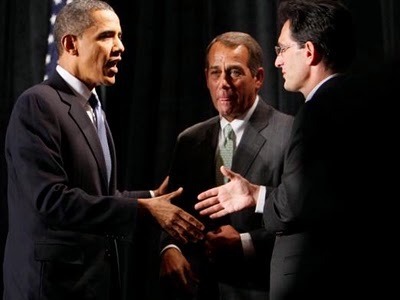
I have returned from my beach vacation to discover that we're still using dollars as currency rather than sea shells (drat!), the most likely debt ceiling scenario involves $1.5 trillion in spending cuts, and Ezra Klein thinks this is far worse for the White House than a $4 trillion Grand Bargain:
For Republicans, this plan is something close to the best of all possible worlds (sorry, but I do not consider a world in which "Cut, Cap, and Balance" passes to be a possible one): It's all spending cuts and no revenues. It's a little plan that denies the Obama administration the political and substantive benefits of a big plan. It's a multi-part plan -- which is more important than people realize -- that forces Democrats to take three hard votes between now and the election, and almost ensures that deficit reduction will be an issue in 2013 and beyond. It's a plan that smartly pockets more than a trillion dollars in spending cuts Democrats can sort-of accept and only then begins a grand bargain process, ensuring that if there's a grand bargain later, it will cut far deeper into the bone of Democratic priorities.
Is this really worse than a Grand Bargain? I'm sure the Obama administration thinks so, but I disagree. Let's consider both the politics and the policy in order.
First, politics. Klein argues that a Grand Bargain would means deficit reduction is no longer an issue in 2013 and beyond. If that's true, it means that the main issue will be the economy, right? That's not a good thing for Obama. What Obama wants is for the election to focus on policy contrast. If he signs a $1.5 trillion domestic spending cut, he can pretty convincingly position himself in the center. From that position, he can argue that we now have two choices going forward -- a balanced program with defense spending cuts and higher taxes on the rich, or the radical Paul Ryan plan. Alternatively, if deficit reduction really were off the table, it would be far easier for Republicans to portray their vote for the Ryan budget as some kind of bold statement or youthful indiscretion or post-college prank than a governing agenda for voters to endorse or reject.
Second, and more important, policy. The single largest impediment to good public policy over the next decade is that there's simply not enough revenue to fund the government at adequate levels. Budgets that assign insufficient outlays to social programs can be changed, because spending programs tend to command the support of the public and/or interest groups. But ginning up more revenue is extremely hard. Middle-class tax hikes are unpopular, and upper-class tax hikes run into determined elite opposition. The Grand Bargain would lock in revenue levels that just won't work. Obama may think that a big deficit deal will revive the possibilities for new spending initiatives, but it won't conjure up the money to pay for it.
The only chance Obama has to escape this trap is to maneuver the Republicans into killing off the middle-class tax cuts, by refusing to compromise on tax cuts for the rich. Failing that, the only two fiscal options are high deficits or insufficient outlay.
The Grand Bargain would restore the revenue from the Bush tax cuts on taxable income over $250,000. That's not really enough revenue. What's more, it's revenue Obama can get any if he wins re-election, be refusing to sign a tax cut extension. And if he loses, the next Republican president will almost certainly pass another tax cut for the rich. Indeed, a Grand Bargain will simply free up more fiscal headroom for such a tax cut, just as Bill Clinton's fiscal responsibility enabled George W. Bush to enact a slew of debt-financed tax and spending initiatives. Either way, securing Republican agreement to capture the revenue from the expiring Bush tax cuts for the rich is worth very little to Obama. It would deprive him of an election issue where he can draw a strong and popular contrast, and furnish him with little actual policy benefit.


The Gang Of Six In Winter
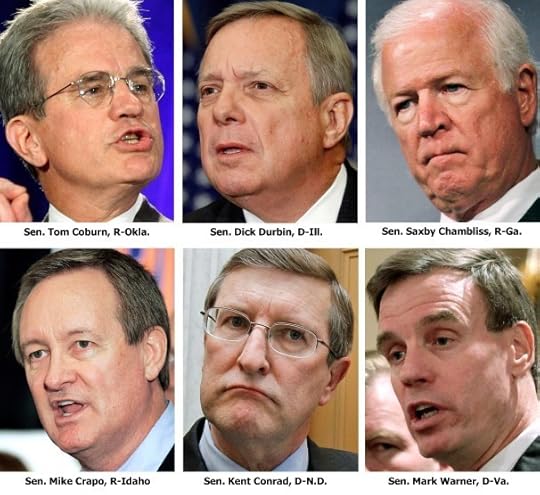
Despite months of media hype, I've expressed long-standing, deep skepticism that the Senate "Gang of Six" would ever succeed in getting a deficit agreement passed into law. The final stages of the group are just plain sad:
In a last-ditch effort to make their deficit-cutting ideas relevant to the debt ceiling debate, the remnants of the Gang of Six will give a presentation on their plan to a bipartisan group of about 50 senators on Tuesday morning, according to several congressional sources.
Sens. Mark Warner (D-Va.), Saxby Chambliss (R-Ga.), Kent Conrad (D-N.D.) and Mike Crapo (R-Idaho) plan to go over the broad outlines of a finished proposal that would cut roughly $3.6 trillion in spending over 10 years from the federal budget.
The Gang of Six — now actually just five senators — has held a series of small-group discussions in recent weeks to try to build new support for their approach. But Republicans Chambliss and Crapo have withheld their public support for the deal because fellow Republican Tom Coburn (R-Okla.) walked away from the deal in May over a failure to cut discretionary spending and Medicare as deeply as he would like.
How predictable was this failure? The exact same thing happened in health care. Six Senators, evenly divided between the parties, started negotiating on a bipartisan plan. They called themselves the "Gang of Six." Then the most conservative Republican bolted. Then the other republicans started backing away from the deal, ultimately indicating they wouldn't support it even if it reflected their own proposal.
Senators remain strongly attached to the folklore of bipartisanship. But no amount of meetings, charm, pleas, and dealing can get Republicans to break loose from their party's caucus discipline. The modern Republican Party is a parliamentary party. Maybe you can still forge bipartisan deals on minor issues. But on major policy questions in which party activists and pressure groups take an interest, forget about bipartisan wise man deals. If you think that can still work, you're living in the past.
July 18, 2011
Bond Market Underestimating Nut Factor
The widespread assumption in the bond market that the debt ceiling showdown will, somehow, some way, end well strikes me as a classic underestimation of risk. We quietly assume that something terrible and pointless won't happen because it's never happened before, even if the potential causes of disaster are blindingly obvious. Jonathan Allen and Jake Sherman have a good story about the craziness of the Republican caucus. How crazy are these people? So crazy that the current House plan -- to tie a debt ceiling hike to a Constitutional amendment to balance the budget every year and impose a California-style supermajority to increase taxes -- is running into GOP dissent from the right:
Even some rock-ribbed conservatives believe it doesn’t go far enough: Rep. Steve King (R-Iowa) told POLITICO Monday night that he was leaning “no.”
How crazy are they? So crazy they're using the metaphors of a crazy man:
The senior House GOP aide said “the only reason” McConnell’s plan isn’t dead on arrival in the House is “because there are so few outs” to avoid a default.
“They’re in punt formation. If they’re in punt formation, we’re going to blitz,” said Chaffetz, a former college football kicker.
What does that even mean? You don't blitz against a punt formation -- you either try to block the kick or return it. You blitz when the opponent is running a play from scrimmage. Is Chaffetz saying the House GOP wants to to go after the Senate GOP? That the House GOP wants to confuse the opposition by doing something that makes no sense?
Most Republican voters believe that failing to lift the debt ceiling will not cause any major economic harm. In their view, lifting the debt ceiling is a massive policy compromise, one that allows harmful deficit spending. It's certainly not something they think their party should do in return for another compromise (like tax increases.) And most Republicans in Congress may know better, but it's unclear what is going to make them risk their careers over it.
Another point to keep in mind is that the Obama administration, and especially the Treasury Department, has been making soothing noises for months about the inevitability of lifting the debt ceiling. Financial markets probably interpreted this as the expression of a secret understanding with the Republicans that this whole debt ceiling process was a charade. I suspect the administration has simply been saying whatever it needs to say to forestall a market freakout.
I do think they'll probably make a deal. But the state of the financial markets seems to be pricing in a likelihood of a deal way higher than "probably."
Tom Coburn Will Rock the Deficit Away
[Guest post by Alex Klein]
Senator Tom Coburn just kicked down the door into the debt ceiling debate packing serious heat: a $9 trillion caliber plan to cut the deficit by attacking every special interest group in the United States. Farmers, old folks, teachers, unions, students, corporations, and even veterans: nobody is safe from the Coburn cuts. By fusing almost every unpopular proposal in the debate thus far—from raising the Medicare age to flaunting Grover Norquist and his tax apostles—the senator is probably trying some kind of sum-of-all-fears strategy. Perhaps he hopes to provide the stalled Congress with a dramatic kick in the pants; tough compromises might seem more palatable in comparison to his Mad-Max-esque proposal.
The problem is, with the GOP now falling in line behind a crazy Balanced Budget Amendment, Coburn looks less like a go-it-alone maverick than the latest in a parade of horribles. He’s at risk of being lumped in with loonies. This is unfortunate, because unlike the rest of his party, he probably isn’t just using the debt ceiling for political hostage holding. The man has always been a genuine deficit hawk. He voted against the war in Iraq, co-sponsored anti-earmark legislation with Obama and McCain, and, in 2010, took on defense spending and ethanol subsidies. He may be wrong to gum up the debt ceiling debate with his dystopian proposal — but at least he’s honestly, sincerely, non-cravenly wrong.
And his plan also has the most hard rockin’, show stoppin’, heart breakin’ name ever proposed for a piece of budget legislation: “Back in Black.” See below for video from Coburn’s press conference announcing the plan.
Senator Coburn's message is clear: "I'm back on the track and I'm leadin' the pack ... don't try to push your luck, just get out of my way."
&c
Bruce Bartlett on the silliness of cut, cap and balance.
And CAP's telling infographic on the proposal
Keith Hennessey has a strong summary of all the horses in the budget race.
Donald Marron rails against the debt limit.
Bachmann and the Tea Partiers think default is a minor concern.
Last but not least, Rapper Ja Rule gets convicted on tax evasion.
Least Convincing Advocate Ever
[Guest post by Matthew Zeitlin]
An under-remarked upon aspect of the debt ceiling debate is the so-called “carried interest” loophole. The way this works is that the managers of a private equity, hedge, venture capital, or private real estate fund pay the capital gains rate on the income they accrue from the profits of an investment, even from the money that other people or organizations or people put into the fund. Typically, the fee structure for an investment fund is “two and twenty,” so that, if Jonathan Chait gives me $100 and I then produce a 100 percent return on this $100, I, the investment manager, would get $2 for managing the fund and then $20 of “carried interest” on the gains of the fund. On the $20, I would then pay the capital gains rate, not the income rate, even though it is not my own capital—it is my management of other people’s—that is generating the investment gains (investment managers also contribute to these funds in order to have “skin in the game,” though that’s immaterial to the carried-interest question). At one point, it seems, the White House supporting treating carried interest as normal income as part of a debt ceiling deal.
By way of Ben Smith (who describes the carried-interest tax treatment as capital gains rates on “bonuses,” which does not strike me as quite right) comes the not-exactly-surprising news that two House Democrats, Mike Quigley and Jared Polis, have come out against adjusting the taxation of carried interest so that it is taxed at the normal income rate instead of the capital gains rate. Putting aside the policy merits, it is hard to imagine a worse representative for the Democratic opposition to adjusting carried-interest taxation than Jared Polis. That’s because he’s incredibly rich. According to 2009 data from the Center for Responsive Politics (CPR), his net worth is somewhere between $36 million and $285 million. Moreover, over Polis’s career, three of the top-five sources of donations have been “Securities & Investment,” what the CPR calls “Miscellaneous Finance” and “Real Estate,” all of which are affected by the capital gains treatment for carried interest.

Not only does it seem as though Polis is protecting his contributors; it also seems he is an incredibly rich individual going out of his way to protect other incredibly rich individuals. For example, according to research done by Steven Kaplan and Joshua Rauh, “the top 25 individual hedge fund managers in the U.S. earned a combined total of $5.2 billion, $6.3 billion and over $9 billion, respectively, in 2003, 2004 and 2005”and that “nine times as many Wall Street investors earned in excess of $100 million as public company CEOs. In fact, the top 25 hedge fund managers combined appear to have earned more than all 500 S&P 500 CEOs combined.”
There may very well be good reasons to tax carried interest at the capital gains rate, but Jared Polis’s open support for maintaining the tax preference sure looks like protecting his own.
News Corp vs. Its Critics
[Guest post by Alex Klein.]
Today’s Wall Street Journal editorial has the title “News and its Critics”—obviously, it’s missing a word. The piece’s real title should be “News Corp and its Critics,” or even better, “News Corp vs. its Critics.” It’s a piece by News Corp, for News Corp. The problem is, the ugly 1044-word attack on the company’s “competitor-critics” alternates between catty defensiveness, a drunk beat poet, and utter incomprehensibility. One can only stand in awe of a conglomerate that would mass print an “aw-shucks” apology across one country while sending the Journal to do its dirty work in another. Some of the editorial's phrases are almost self-parodying:
The overnight turn toward righteous independence recalls an eternal truth: Never trust a politician.
The Schadenfreude is so thick you can’t cut it with a chainsaw.
Especially redolent are lectures about journalistic standards from publications that give Julian Assange and WikiLeaks their moral imprimatur.
But, beyond redolence, imprimaturs, chainsaws, and Schadenfreude, the editorial’s argument—insofar as one is discernible—is so dishonest that it has the opposite of its intended effect. You come out of the piece trusting News Corp and the Journal far less than you might have before.
The first “point”:
Phone-hacking is illegal, and it is up to British authorities to enforce their laws. If Scotland Yard failed to do so adequately when the hacking was first uncovered several years ago, then that is more troubling than the hacking itself.
Of course, when “the hacking was first uncovered several years ago,” News Corp did a more than adequate job of bribing British authorities to keep them at bay. As David Carr pointed out yesterday, the company’s fondness of drowning legal problems in hush money has been pervasive, far from the domain of a single tabloid. “We didn’t get caught” is about as bad an excuse as they come, especially with the tactful omission of “…because we bribed the police.”
The second point is a dicey defense of resigned Journal publisher Les Hinton, which fails to mention the reason for his resignation: ostensibly, the two times he stood before the Houses of Parliament and said that only one News International journalist had ever hacked a phone.
The piece then moves inexplicably into self-defense mode, claiming that, well, even if News Corp is a bit unsavory, the company has improved the Wall Street Journal. Of course, a revitalized Journal must be of great consolation to hacking victims, who must also “shudder to think what the Journal would look like” under the dreary Bancrofts. And so we breeze right along to find the paper arguing for the legality of paying sources for information. But “the Wall Street Journal doesn’t pay sources for information.” So who does? Other News Corp outlets?
Again, we move on too fast to find out, and close with the same shoddy reasoning that Murdoch himself has already aired out in the Journal’s pages. Namely, that News of the World’s behavior constituted nothing more than journalistic overreach, and that cracking down on News Corp means inhibiting freedom of the press:
Do our media brethren really want to invite Congress and prosecutors to regulate how journalists gather the news?
News Corp outlets broke the law. And yet, the word “crime” is not mentioned once in the editorial. The Journal goes for a brazen euphemism, instead claiming that the tabloid’s “excesses” do not damage the reputation of its sister outlets:
The News of the World's offense—fatal, as it turned out—was to violate the trust of its readers by not coming about its news honestly. We realize how precious that reader trust is, and our obligation is to re-earn it every day.
The News of the World’s “offense” was to commit crimes, then lie and bribe to cover them up. “Trust” is a convenient, slippery term for the Journal to use. But surely, a paper of such clout must realize that its readers know the difference between breaking trust and breaking the law. At any rate, it’s likely that News Corp is soon to find out for itself.
If We Eliminate the Debt Ceiling, Then What Will We Hold for Ransom?
[Guest post by Kara Brandeisky]
Today, Moody’s rating agency came out and said what Hill observers have been privately muttering for weeks: Just get rid of the debt limit! Moody’s analyst Steven Hess wrote in a recent report that, since the debt ceiling causes “periodic uncertainty,” Moody’s “would reduce [its] assessment of event risk if the government changed its framework for managing government debt to lessen or eliminate that uncertainty.” As Dylan Matthews pointed out this morning, only Denmark has a similar limit. From a policy point of view, the debt ceiling seems unnecessary.
Jonathan Tobin of Commentary was less thrilled in his reply to Moody’s, entitled “There’s a Reason We Have a Debt Ceiling”:
It is also true that up until now forcing a vote on the debt ceiling has not impeded the growth of the government’s arrears since the Congress has always dutifully voted an increase to avoid trouble. The threat of default may be more theoretical than anything else, but even the hint that such a thing may be possible has brought the Democrats to the negotiating table and forced them to concede spending cuts that were heretofore unimaginable.
Right, and then what happened? Republicans still didn’t take the $4 trillion deal. Instead, they’re posed to pick the deal that inflicts maximum political pain on the Democrats with the fewest policy sacrifices for themselves. Ezra Klein predicted this morning that Republicans will eventually agree to a revised McConnell deal: The debt ceiling will be raised in three parts, with three “resolutions of disapproval,” $1.5 trillion in cuts, and no new revenues.
But what if, after all this, congressional leaders (Republicans and Democrats) can’t even scrounge up enough votes to get that deal through? We default, ratings agencies downgrade Treasury bonds to AA, interest rates skyrocket—and that, in turn, increases the deficit, since higher interest rates would force the government to pay more interest on its existing debt. In the words of Ben Bernanke, defaulting would be a “self-inflicted wound.”
Simply put, if conservatives are really concerned about the size of the debt, they shouldn’t be playing this game of chicken. Then again, even without a debt limit, given their track reord, I’m sure Republicans can find something else to hold for ransom.
The Republican Theory of Our Current Economic Woes
[Guest post by Matthew Zeitlin]
According to both Republican politicians and conservative opinion-writers, the problem with our economy is not a shortfall of demand. If they thought this was the problem, you would not see the calls for massive reductions in spending right now, you would not see Paul Ryan describing a payroll tax holiday as a “sugar high,” and you would not see Fred Barnes totally dismissing stimulus as a way to grow the economy.
Problem being, as Jon has pointed out before, everyone from Ben Bernanke to Goldman Sachs thinks that large, immediate cuts would retard growth. Even all the conservative folks on the Bipartisan Policy Center debt reduction task force signed on to a plan that includes a one year payroll tax holiday. And now, the Wall Street Journal has a story, the lede of which is, “The main reason U.S. companies are reluctant to step up hiring is scant demand, rather than uncertainty over government policies, according to a majority of economists in a new Wall Street Journal survey.” The Journal notes, “31 [of the surveyed economists] cited lack of demand (65%) and 14 (27%) cited uncertainty about government policy.”
It’s not just economists, either, who are largely concerned with demand: In a survey conducted in June by the National Federation of Independent Business, the plurality response from small businesses about their “biggest problem” was “poor sales,” which beat out both taxes and “government regulations and red tape.” The Journal points out that this percentage is “above highs seen in the recessions of the 1990s and early 2000s.”
Of course, it’s possible that Fred Barnes and Paul Ryan are right and everyone else is wrong—but, well, that’s highly unlikely. And the problem stemming from the Republican insistence that demand doesn’t matter is that it makes their opposition to eliminating tax expenditures in order to reduce the deficit hard to understand. As Ramesh Ponnuru points out, tax expenditures have nothing to do with marginal tax rates; reducing spending in the tax code would not have a supply-side effect. There is, however, the possibility that getting rid of tax expenditures “would reduce disposable income, therefore aggregate demand, and therefore the size of the economy.” But Republicans have made it clear that they don’t think aggregate demand is a problem. In other words, Republicans have an analysis of what is wrong with the economy, but, when it comes to protecting inefficiency in the tax code, that analysis is implicitly abandoned.
July 16, 2011
Quote of the Day, Overwriting Edition
[Guest Post by Isaac Chotiner]
From Charles Blow in today's New York Times, recounting a trip to the south where he spent time with blue-collar workers (the title of the column, 'They, Too, Sing America,' was admittedly fair warning):
They are honest people who do honest work — crack-the-bones work; lift-it, chop-it, empty-it, glide-it-in-smooth work; feel-the-flames-up-close work; crawl-down-in-there work — things that no one wants to do but that someone must.
They are women whose skin glistens from steam and sweat, whose hands stay damp from being dipped in buckets and dried on aprons. They are men who work in boots with steel toes, the kind that don’t take shining, the kind that lean over and tell stories when you take them off.
Get a hold of yourself man!
Jonathan Chait's Blog

- Jonathan Chait's profile
- 35 followers

