
Jonathan Chait's Blog, page 25
July 20, 2011
Conservatives Care About Workplace Liberty
 The Washington Examiner has an editorial demanding that the National Labor Relations Board "crack down" on union thuggery. Here are a few of the Examiner's examples of the union tactics the NLRB should crack down upon:
Stage regular mass visits or sit-ins...
Organize constant telephone calls...
Use friends and allies in government to generate costly legal and regulatory pressure
Plant negative stories about the union and its officials with local media...
Promise informants protection from retaliation for providing "dirt"...
leafleting outside meetings where [executives] are speaking, their homes, or events sponsored by community organizations they are tied to are some ways to make sure their friends, neighbors, and associates are aware of the controversy
Now, obviously the Examiner casts every one of these activities in the most sinister possible terms. But they're all, in fact, what most people would consider the exercise of basic political rights. The Examiner is actually calling on the federal government to stop things like providing information to reporters, distributing leaflets, petitioning the government to alter regulations, and organizing public protests:
The more important controversy will come if the NLRB does nothing to crack down on this kind of activity by a union that spent millions of dollars to elect President Obama.
Freedom!


Do Privately Negotiated Budget Deals Count?
The Republican party has made a lot of hay blaming the Obama administration for the deficit it inherited in 2009. That line of attack has become more difficult to sustain since President Obama offered Republicans a $4 trillion deficit-cutting deal tilted overwhelmingly toward spending cuts -- indeed, if we assume that the Bush tax cuts on income over $250,000 expire, it consists entirely of net spending cuts. And so, to sustain their position, Republicans have leaned heavily on the concept that budget cuts offered in private negotiations don't count. They're not real. (Charles Krauthammer has been doing yeoman's work toting this line.)
The Cato Institute's Michael Tanner hits the "budget cuts offered in private negotiations don't count" talking point:
President Obama has now announced that he will veto the “Cut, Cap, and Balance” bill to raise the federal debt ceiling that passed the House of Representatives yesterday. In its place, the president offers . . . nothing.
With the clock ticking down toward what the administration calls “fiscal Armageddon,” the president still has not put an actual plan for increasing the debt ceiling on the table. True, he has held innumerable press conferences and briefings at which he has declared his willingness to compromise and “make difficult choices,” and even angered his own base by suggesting entitlement reform. But when it comes to actually spelling out what those compromises, choices, and reforms would be, the president is suddenly absent.
What makes this so funny is that Tanner immediately juxtaposes Obama's phony deficit plan with the House Republicans' "real" one. that real plan consists of... a Constitutional amendment capping spending, which Tanner proceeds to extol in his column. You know, picking a number and demanding that future Congresses not exceed it isn't terribly specific.
One aspect of this argument entails a kind of game of telephone, re-telling versions of Obama's offer so that it grows smaller and smaller with every iteration. Wall Street Journal editorial page editor Paul Gigot today offers the latest bid, presenting Obama's deal as a spending increase:
One of President Obama's advantages in the debt-limit talks has been his ability to sound like a born-again spending cutter in public while the details of what he's willing to accept remain secret. The reality is that the White House offer on spending reforms was much less than publicly advertised, and by the end it even included $136 billion in new spending proposals over 10 years.
A source in the talks laid out for us on Monday the increases that were part of the final White House offer before the talks led by Vice President Joe Biden broke down:
-$15 billion in new general spending that would come from the $30 billion expected to be raised from spectrum auctions;
-$8 billion to bail out the Post Office;
-$33 billion to extend Pell grants for college, as the money for the expanded grants under the stimulus runs out;
-$43 billion to extend unemployment benefits for another 99 weeks;
-$10 billion more for research at the National Institutes of Health;
-And $27 billion over two years for the Medicare "doc fix," to avoid a reduction in payments to doctors that is scheduled to take effect under current law.
Gigot presents this information as if it contradicts Obama's public position. (It "contradict[s] the public pose that Mr. Obama is taking as he tries to break his reputation as a spendthrift.") Uh, no, it doesn't. You can favor a net spending cut while also favoring increasing in certain programs you deem valuable.
The proliferation of this line on the right is interesting, because it reveals the extent to which Republicans feel uncomfortable defending their party's actual budget position of rejecting revenue increases of any kind. That's an unpopular position. So instead they have to deny the possibility of a deficit bargain that cuts spending and increases revenue.
Obama Losing Policy, Winning Politics Of Debt Ceiling Fight
[image error]
I've been pretty critical of President Obama's strategy on the debt ceiling negotiations, and the whole saga could well end in economic disaster, bad long-term policy, or both. That said, I must concede that Obama has, largely through ideological retreat, maneuvered the debate onto terrain where he holds the public opinion high ground. Consider this question from the latest WSJ/NBC poll:
Which of the following approaches being considered in Congress to deal with the Federal debt ceiling are you more likely to support? (ROTATE)
A proposal by President Obama which would reduce the Federal deficit by four TRILLION dollars over the next decade by cutting federal spending, increasing taxes on corporations and the wealthy, and reducing the level of spending on Medicare
…Or…
A proposal by Republicans in Congress which would reduce the Federal deficit by two and a half TRILLION dollars over the next decade by cutting Federal spending and would not raise taxes on corporations or the wealthy
President Obama's proposal........................ 58
Republicans in Congress proposal............... 36
Either (VOL)................................................ -
Neither (VOL) ............................................. 2
Not sure...................................................... 4
That question wording actually stacks the deck a bit in the GOP's favor, by identifying Obama's position as reducing spending on Medicare while, oddly, failing to say the same about the Republican budget. Yet Obama's position still commands a twenty point margin. The two subsequent questions ask whether Democrats in Congress should compromise on their unwillingness to "make cuts and changes" in Social Security and Medicare in return for lifting the debt ceiling, and then whether Republicans in Congress should agree to raise taxes. By a 52-38 margin, people say Democrats should not compromise on that issue, and by a 62-27 margin, they say Republicans should compromise.
Obama has narrowed the terms of debate to the Republican Party's position that it will risk economic catastrophe by refusing to lift the debt ceiling because it won't accept closing tax expenditures for the rich, even in exchange for much larger spending cuts. A Washington Post/ABC poll also has some striking data:
While Republicans in Congress have remained united in their opposition to any tax increases, the poll finds GOP majorities favoring some of the specific changes advocated by the president, including higher income tax rates for the wealthiest Americans. ...
A majority view the president as more committed to protecting the interests of the middle class and small businesses, while large majorities see Republicans as defending the economic interests of big corporations and Wall Street financial institutions.
Exposing the GOP's obsession with preserving Bush-era tax cuts for the rich has framed the debate in overwhelmingly positive terms for Obama.
How isolated in the Republican party's position here? This isolated:
A few wealthy donors have called Cantor to tell him they wouldn’t mind if their taxes are raised. During two closed meetings this week — one with vote-counting lawmakers, and another with the entire conference — Cantor told colleagues that some well-heeled givers have told them they’re willing to pay more taxes. Cantor, according to an aide, has responded that House Republicans aren’t standing up for the wealthy, but rather for the middle class, who want to see their taxes stay low.
Of course, that's totally false.
In the big picture, this isn't terrific news for liberals. It's another case of a now-familiar Democratic tactic -- cooperating with a massive rightward shift in the terms of debate, and eking out a political victory by occupying right-of-center ground while Republicans occupy the lunatic fringe. That said, the pure politics of this episode appear to be a rout.
July 19, 2011
Boehner Goes Bargain Shopping
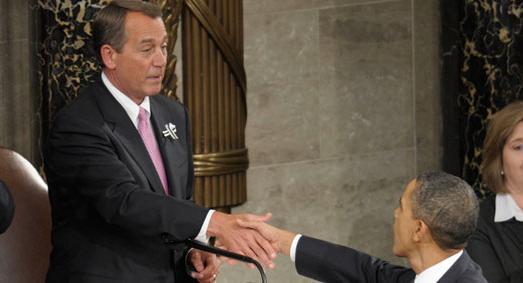
John Boehner says the Gang of Six deficit plan is like the deal he walked away from with President Obama, but worse:
Speaker John Boehner's (R-Ohio) office said Tuesday that a $3.7 trillion deficit-reduction plan from the Senate's Gang of Six appears to fall short of goals set by House Republicans.
"This plan shares many similarities with the framework the Speaker discussed with the president, but also appears to fall short in some important areas. The House is voting today on our 'cut, cap, and balance' plan, and we hope the Senate will take it up soon. That remains our focus,” a Boehner spokesman said.
One difference is that the Gang of Six plan raises more revenue. As Robert Greenstein explains, that's because the Gang of Six started from a baseline level of the Bush tax cuts on income over $250,000 a year expiring, and the Obama-Boehner deal didn't:
The Gang of Six plan calls for $1 trillion in higher revenues over ten years. But the magnitude of any revenue increase or decrease depends on the baseline against which the change in revenues is measured.
The Gang of Six used the same revenue baseline concept as the Bowles-Simpson commission (and as President Obama’s 2012 budget and his April budget framework). This is the so-called “plausible” baseline, which assumes the President and Congress make permanent the Bush tax cuts for people with incomes under $250,000, while letting the tax cuts for people over $250,000 expire on schedule at the end of 2012.
One trillion dollars in added revenue over the “plausible baseline” is very different from $1 trillion in added revenue relative to a baseline that assumes all of the Bush tax cuts become permanent — including those for people who make over $250,000 a year. The $1 trillion in revenues in the $4 trillion deficit-reduction plan that Speaker Boehner walked away from used this lower revenue baseline. Thus, the $1 trillion in revenue increases in that plan would not produce the same overall level of revenue as the $1 trillion in the Gang of Six plan. Measured against the same baseline as the Gang of Six, Bowles-Simpson, and Obama budget, the failed $4 trillion plan would generate only about $300 billion in added revenue (because $700 billion in “savings” from letting the upper-income tax cuts expire was already in the baseline).
Conclusions? Obama negotiated a really crappy deal with Boehner, but Republicans, thankfully, still refused to take it. They're not going to take this deal, either.
&c
-- Allen West's horrible attack on Debbie Wasserman-Schultz, via Ben Smith at Politico
-- People want a debt compromise. People and voters. And Republicans.
-- Evgeny Morozov's cover story on Google's fall from grace
-- Rick Hertzberg on how the debt ceiling debate is confused by shoddy terminology
Gang Of Six Has Last Gasp
The Senate "Gang Of Six" today made a final push for its deficit reduction proposal, announcing that apostate gang member Tom Coburn had rejoined the group, releasing its plan, and unveiling numerous Senatorial endorsements. President Obama praised the group and its plan at his press conference today.
The question I have here is the same question I've had all along: How do they think this plan will get through the House of Representatives? Every article I've read over the last half a year asserting that there's a strong desire among members of Congress to pass a bipartisan deficit bill focuses entirely on the Senate. And, indeed, there do seem to be quite a few Senators interested in bipartisan compromise on the deficit. I have yet to see any evidence of such a desire on the House side, save John Boehner's brief hypnotic spell from which he was rudely awakened with the discovery that no members of his caucus would support him.
The thing to understand about the House Republican caucus is that it's riven between anti-government fanatics and anti-tax fanatics. The anti-government fanatics either oppose any increase in the debt ceiling, or will only do so in return for President Obama offering complete and unconditional surrender in the form of accepting the Paul Ryan budget or a Cut, Cap and Balance constitutional amendment. This faction wants to hold the debt ceiling hostage until its demands are met, and tends to express skepticism toward warnings that a failure to raise the debt ceiling might have adverse economic effects.
The opposing faction is the anti-tax fanatics. This group favors the Mitch McConnell plan to raise the debt ceiling without a deficit agreement, because it fears that any such agreement will include tax hikes. That those tax hikes would come in the form of closing tax expenditures, with the cost offset by lower tax rates, mollifies them not one iota. That's why the McConnell plan has the support of such normally staunch partisans as the Wall Street Journal editorial page and Grover Norquist.
Neither of these factions is a plausible candidate to support a Grand Bargain. In theory, you could image a minority of the House GOP caucus supporting such a plan along with a strong majority of Democrats. But remember that John Boehner needs the support of most House Republicans to keep his job. I suppose it's possible to imagine a sequence of events in which Boehner supports a Gang of Six-style Grand Bargain, it passes over the objection of most House Republicans, and then Boehner quickly discovers a burning desire to help humanity via a private sector job.
Barring such a scenario, I don't see how this goes anywhere.
Top 10 Moments from the 'News of the World' Hearings
[Guest post by Gabriel Debenedetti]
This morning’s News Corp parliamentary hearing in London boasted more than its fair share of explosive moments, from the absurd to the slightly frightening. As Rupert Murdoch appeared old and occasionally hard-of-hearing, his son James seemed both shrewd and uncompromising. Up next was the reviled Rebekah Brooks, who came across as fatigued and unsympathetic. With the hearings fresh in our minds, TNR brings you the top ten moments from the proceedings:
10. Rupert deflects: The hearings were rife with opportunities for Rupert and James Murdoch to accept responsibility for News Corps’s indiscretions, but they chose to deflect instead. One prime example: MP Tom Watson asked Rupert “at what point did you discover that criminality was endemic” at News International, and Rupert responded by telling Watson, “endemic is a very hard word."
9. Piers Morgan tweets: CNN host and former News of the World editor Piers Morgan got involved when MP Louise Mensch mentioned that Morgan’s book contained admissions of phone-hacking. Morgan quickly responded via Twitter, saying, among other things, “Complete nonsense. Just read the book.”
8. Brooks calls NotW’s actions “horrific” and “abhorrent”: Though she did not to accept culpability for criminal activity, Brooks did call The News of the World’s phone hacking both “horrific” and “abhorrent,” and she apologized for the paper’s actions.
7. Deny, deny, deny: This one isn’t a single event, precisely because the Murdochs and Brooks spent the bulk of the hearing denying any knowledge of any wrongdoing whatsoever—“willful ignorance” became a key term of the hearings quickly. The strategy of consistent denial was obvious, but the MPs were unable to prove the News Corp trio wrong.
6. Rupert says he’s out of touch: A prime example of the “I don’t know what’s going on” excuse, Murdoch maintained that he is “not really in touch,” and that most of his time with newspapers is spent at the Wall Street Journal, not his British properties. He employs 53,000 people, he insisted, so it is impossible for him to know what they are doing at all times (or, it seems, at any time).
5. Rupert defends Singapore: While riffing on the “openness” of various countries, Murdoch turned to Singapore, a nation with notoriously brutal disciplinary and censorship practices, and called it “the most open and clear society in the world.”
4. Rupert defends British “openness”: Explaining that British investigative journalism is more effective than its counterpart across the pond, Murdoch insisted, investigative journalism “does lead to a more transparent society, and I believe we are a better society because of that, and we are an even more open society than the United States.”
3. Brooks plays the victim: Former News International head Rebekah Brooks, who was arrested on Sunday, apparently tried to play the sympathy card by reminding the MPs grilling her that her phone, too, had been hacked by private investigator Glen Mulcaire. Needless to say, the pity play didn’t work.
2. Rupert goes humble: During the early stages of the hearings, the elder Murdoch interrupted his son to tell the audience that “this is the most humble day of my life”—which was not difficult for many commentators to believe, given the unapologetic history of the “genocidal tyrant.” Murdoch reiterated this sentiment at the end of the hearing.
1. Rupert almost gets creamed: As the hearings dragged on well past the scheduled ending point, and both James and Rupert had repeated the party line (“we know nothing”) exhaustively, an intruder (British comedian Jonnie Marbles, it seems) hopped up and tried to hit the patriarch with a paper plate full of shaving cream. He was quickly tackled, as both James and—more impressively—Wendi Murdoch jumped to the patriarch’s defense. The hearings were suspended, and Rupert walked away looking far more sympathetic than he had just minutes before. When they got back, MP Tom Watson’s response was to praise Wendi’s “very good left hook.”
MURDOCH SCANDAL >>
Cut Cap & Balance And The New Frontiers of Kookery
A scant few months after the Paul Ryan budget redefined the boundaries of conservative fanaticism, the Republican Party's new "Cut, Cap, and Balance" Constitutional Amendment makes that document seem quaintly reasonable. Ezra Klein sums up the policy:
Ronald Reagan's entire presidency would've been unconstitutional under CC&B. Same for George W. Bush's. Paul Ryan's budget wouldn't pass muster. The only budget that might work for this policy -- if you could implement it -- would be the proposal produced by the ultra-conservative Republican Study Committee. But that proposal was so extreme and unworkable that a majority of Republicans voted it down.
37 House Republicans and 12 Senate Republicans have pledged not to support a debt ceiling increase unless the CC&B Constitutional Amendment passes. Mitt Romney has signed this insane pledge. Ramesh Ponnuru has some gentle questions:
Representative Mick Mulvaney, a freshman Republican from South Carolina who is a leading supporter of the amendment, said in an interview that if “the president wants this debt-ceiling increase, he’s going to help us get the votes.” He argued that Obama should deliver 50 Democratic votes in the House and 20 to 30 in the Senate. “That’s a good compromise for both sides.”
Does the congressman think that 50 Republicans would vote for a constitutional amendment that contradicts everything they stand for if President Romney asked them to?
What a congressman who pledges to increase the debt limit only if a spending-limit amendment passes is really saying is that he opposes increasing the debt limit. Because there is no way that two-thirds of Congress is going to pass this amendment now, or ever.
Perhaps the most remarkable thing about the CC&B amendment is the casual way in which it attempts to enshrine specific spending levels and to freeze current taxes into the Constitution. I would like to see its advocates explain why it is necessary for the Constitution to require their agenda. What is keeping the public from electing officials who will enact this agenda? If people want to enact policies like this, why not just let them do it? And if they don't, why force these policies upon them?
Romney Death Watch
 PPP now has him trailing Michelle Bachmann in a national head-to-head matchup. Check out this part about Romney's support for the individual mandate:
Only 17% of Republican voters say they'd be willing to vote for someone who had supported an individual health insurance mandate at the state level, compared to 66% who say they would not be willing to support such a candidate. The funny thing about that is Romney's getting 17% right now with that latter group of voters and his favorability with them is 49/33. Your average primary voter isn't tuned in enough to the race right now to know the specifics of Romney's record.
I don't think the wording of this finding should be taken literally. When 66% of Republican primary voters say they wouldn't be willing to support a candidate who had supported the individual mandate, I wouldn't take it to mean they'd never vote for such a candidate under any circumstances. It does, however, signal a serious vulnerability. And, as PPP says, Romney's opponents haven't begun to exploit that vulnerability yet.
It's also worth noting that, as Benjy Sarlin reports, 70% of Romney's funds have come from maxed-out donors, while only 6% of Bachmann's donors have maxed out. She's building a large-scale small donor base like Barack Obama had in 2007-2008, and Romney is not.
I am waiting to see what happens with Rick Perry's apparently-likely entry into the race. To be honest, I have zero sense of how he'd perform.
The Debt Default Enablers
Want to know why we're on the verge of a debt ceiling crisis? Things like this column today from William Cohan:
Combs worries, though, because of how inherently more difficult it is for people to understand the machinations of the bond market than those of the stock market, that the message this time is not getting through to the politicians in Washington, who seem intent on taking a nonchalant approach to the potential Aug. 2 deadline for raising the debt ceiling. (Some politicians -- hello, Michele Bachmann -- have actually claimed that defaulting on our obligations would be good for the country.)...
His concern is that politicians don’t understand how intimately tied transactions are on a worldwide basis to U.S. Treasury securities, and that if Treasuries were no longer accepted as collateral, the resulting market turmoil would make the “collapse of Lehman Brothers look like a walk in the park.”
It's not "the politicians in Washington" who don't understand the risks of failing to raise the debt ceiling. It's the Republican Party. It was the Republican Party's idea to turn the debt ceiling vote from a symbolic opportunity for the opposition party to posture against deficits into a high-stakes negotiation over budget policy. It's the Republican Party, and only the Republican Party, which has numerous elected officials dismissing the dangers of failing to lift the debt ceiling, and it's only the Republican Party whose elected officials who do understand the dangers are cowed by an angry default-denialist base. The Democrats are willing, and have been willing from day one, to pass a clean debt ceiling increase. That's a partisan account, but it's completely true.
The problem is that various reporters, pundits, and business types appear intent on blurring that reality. That's an important reason why Republicans are playing debt ceiling chicken. If the Republicans believe that the blame for a debt default will be aimed at the diffuse "politicians in Washington," they have little incentive to avoid it. If faced with the threat of specific, partisan blame for such a fiasco, they would act differently. In the absence of such, they'll respond instead to the one source of focused lobbying pressure, which is conservatives determined to stop a clean debt ceiling hike.
Jonathan Chait's Blog

- Jonathan Chait's profile
- 35 followers

