
Jonathan Chait's Blog, page 23
July 22, 2011
Getting To No
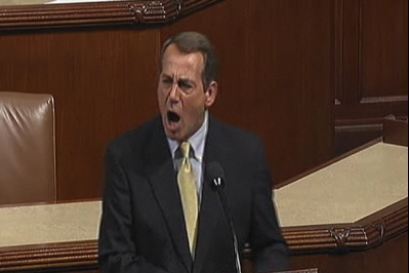
Michael Tomasky underscores an underrated impediment to any debt ceiling or deficit deal -- large segments of the Republican Party will automatically oppose anything that President Obama supports:
The fight is partly about legitimate ideological differences, and it’s partly about the Republicans seeing a rare opportunity to use the occasion to win some big cuts to the domestic budget and maybe entitlements if they’re lucky. But let’s be real. It’s also about not giving Obama a victory. In fact, on a deep emotional and psychological level, it’s chiefly about that. Now that’s not what Republicans go on cable television and say. But it’s quite obviously been the whole strategy since the stimulus bill: Obama gets nothing from us. And every so often, someone slips, and the truth is revealed. The other day, after the Gang of Six released its new plan, a Senate leadership aide tweeted the following to Politico’s morning Playbook, which gets read by every Washington insider: “Background guidance: The President killed any chance of its success by 1) Embracing it. 2) Hailing the fact that it increases taxes. 3) Saying it mirrors his own plan.”
There are a couple elements to this. One is a simple policy heuristic: If Obama is a mortal socialist threat to capitalism, then anything he supports must advance the cause of threatening capitalism, and therefore must be bad. Persuading Republicans to vote for an Obama-supported plan therefore requires them to follow their (generally hazy) beliefs about the policy merits of the deal in question over their strongly-defined beliefs about Obama.
Second, any deficit-reducing deal with Obama means conceding that Obama actually wants to reduce the deficit. Charles Krauthammer has been assailing Obama as a spendthrift. When reports began to surface that Obama was offering up significant spending cuts, necessarily in private negotiations, Krauthammer was apoplectic. Here he is two weeks ago insisting that it's all a political ploy:
Obama has run disastrous annual deficits of around $1.5 trillion while insisting for months on a “clean” debt-ceiling increase, i.e., with no budget cuts at all. Yet suddenly he now rises to champion major long-term debt reduction, scorning any suggestions of a short-term debt-limit deal as can-kicking.
The flip-flop is transparently political. A short-term deal means another debt-ceiling fight before Election Day, a debate that would put Obama on the defensive and distract from the Mediscare campaign to which the Democrats are clinging to save them in 2012.
And here he is, a week later, insisting that such cuts could not exist because they are being proffered in private negotiations:
All of a sudden he’s a born-again budget balancer prepared to bravely take on his own party by making deep cuts in entitlements. Really? Name one. He’s been saying forever that he’s prepared to discuss, engage, converse about entitlement cuts. But never once has he publicly proposed a single structural change to any entitlement.
Hasn’t the White House leaked that he’s prepared to raise the Medicare age or change the cost-of-living calculation?
Anonymous talk is cheap. Leaks are designed to manipulate. Offers are floated and disappear.
We could find out if the cuts are real if Obama and the Republicans arrive at and announce their agreement. But Krauthammer today urges Republicans not to allow any such thing to happen by insisting they only extend the debt ceiling into next year and adopt small cuts instead of large ones:
In my view, the Half-Trillion is best: It is clean, straightforward, yields real cuts, averts the current crisis and provides until year-end to negotiate a bigger deal. At the same time, it punctures President Obama’s thus far politically successful strategy of proposing nothing in public, nothing in writing, nothing with numbers, while leaking through a pliant press supposed offers of surpassing scope and reasonableness.
So Krauthammer's view is that the cuts Obama is reported to be offering are all fake, and therefore Republicans should refuse to make a deficit deal with him, therefore allowing them to continue denying that Obama offered any real cuts. The emotional impetus at work here is pretty transparent.


The Mysterious Dr. Coburn
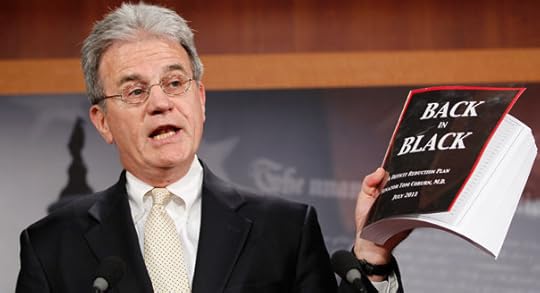
Sen. Tom Coburn is known for his "unpredictable style," as Politico has delicately put it. The right-wing Senator spent months painstakingly crafting a deficit bargain with the bipartisan Gang of Six. Then, as it neared agreement, he suddenly jacked up his demands and then bolted the negotiations. On Tuesday, he suddenly returned, endorsing the Gang of Six plan.
The best way to understand Coburn is a kind of one-man banana republic, with various violently-opposed factions vying for control. Yesterday, the right-wing absolutist Coburn faction took power and announced that the easiest path to a lower deficit lay in adopting a Constitutional Amendment permanently locking in spending levels far lower than the Paul Ryan levels Obama had previously denounced as morally unacceptable:
"This is the only viable plan, right now, that will do that," said Sen. Tom Coburn (R-Okla.) "And I will bet you a porterhouse steak that, if it lands on his desk, he'll sign that puppy."
But wait! This morning the bipartisan wise man Coburn faction has risen up, seized control of the radio station and announced a new policy:
Sen. Tom Coburn (R-Okla.) on Friday said it's "stupid and naive" to think that a grand bargain on reducing the federal deficit can be reached without tax increases.
"I think it's terrible that we would have to raise more taxes," Coburn said on C-SPAN's "Washington Journal." "But if we're going to get an agreement in Washington to fix our problems, when those of us that don't want to raise taxes control the House of Representatives, don't control the Senate, don't control the White House — I think it's pretty stupid and naive to think you're going to win that battle."
For those confused citizens, that "stupid and naive" plan was the failed program under Generalissimo Coburn, who has been driven into exile, but is rumored to be gathering loyal insurgents in the countryside. I am just waiting to see if perhaps some Maoist faction rises up to steer Coburn to denounce Obama as an imperialist stooge and perhaps try to whip up Senate support for a program of forced collectivized agriculture. Coburn could even start a new Gang.
Why The British Media Drives On the Wrong Side Of The Road

I've never thought of it this way before, but Dan Balz pithily explains that the culture of newspapers versus television news in the U.K. is essentially the reverse of the American arrangement:
Unlike in the United States, newspapers in Britain still wield enormous power. Television networks are constrained by law in what they can do and say. The BBC is required by charter to ensure balance. There is no cable television culture, as there is here, that sorts out viewers by ideology and feeds red meat daily to the participants in the political dialogue.
Instead, that role is left to newspapers. British papers are national in scope and therefore central in setting the political agenda. Papers there, especially tabloids, are, as one British journalist put it gently, less “fastidious” in their ethics and reporting standards than are the best of the U.S. papers.
They are also noisily partisan, and news coverage follows a paper’s editorial slant in ways it does not here. The Labor Party has its backers, the tabloid Mirror and broadsheet Guardian among them. But many more British papers lean toward the Conservative Party, with Murdoch’s Sun the most powerful of them.
In other words, in Britain, the New York Times is a television station, and Fox News is a newspaper. I find that a little odd, because print is a medium much better adapted to high levels of discourse, and video is a medium better adapted to salaciousness and propaganda.
Obama Should Give Up On Revenue And Sign An All-Cuts Deal
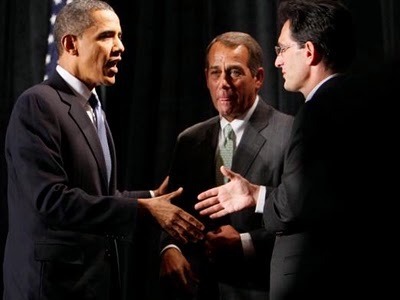
The news that Republicans are demanding that the expiration of the individual mandate be used as a trigger to require tax reform does not necessarily tell us what will be in the final agreement. But it does convey one vital piece of information -- namely, the negotiating price of getting Republicans to accept tax hikes is simply too high.
Anti-tax theology is the core of the modern Republican Party. If the GOP leadership cuts a deal that includes higher taxes, that deal will either exert an unbearable price in return or provoke a conservative revolt that kills it, or possibly both. Meanwhile, the Bush tax cuts expire at the end of 2012, and Obama has no need to raise revenue before then. (Indeed, he'd rather postpone any revenue increases until the economy has recovered.) What's more, as Paul Krugman notes, it's a fantasy to assume that any Grand Bargain would bind Republicans should they regain a working majority. If Obama wins the election, the Bush tax cuts on the rich will expire (and then he can negotiate a tax reform from a position of strength.) If Republicans win, they'll pass a big tax cut for the rich, because that's what Republicans do. Either way, getting agreement on a tax hike on the rich right now won't matter.
The incentive Obama has to negotiate on revenue is to get higher revenue on the non-rich. Obama promised during his campaign to avoid tax hikes on income under $250,000, but the fiscal deterioration resulting from the economic collapse has made that untenable, even after the economy recovers. If Republicans will give him cover to get around that pledge, by supporting a tax reform that eliminates subsidies that are regressive but don't exclusively benefit the very rich, then that's worth trading some entitlement cuts for. (The gang of Six Plan does this.) If he can't get more out of them then he'd get by vetoing the extension of the Bush tax cuts on the rich, he's not getting anything worthwhile. Indeed, he's making dear negotiating concessions to obtain something of little value.
And, of course, there are lots of other things Obama wants out of these negotiations. protection for domestic discretionary programs he especially supports. Backloaded cuts that don't impose a fiscal drag while the economy is struggling. A temporary payroll tax cut, unemployment benefits, or other forms of stimulus. The point is, not putting Republicans in a position to accede to tax cuts would give Obama enormous leverage over other aspects of the deal. That's where he should invest his energies.
An all-cuts deal sounds bad, but it contains some real advantages. It clearly positions Obama in the center, and assuages centrist fears that he's a big government liberal (fears I don't share, but the political power of which I concede.) It makes a large step toward medium-term fiscal correction without taking the choices off the table. Having taken a large step, voters in 2012 will decide the next one -- higher taxes on the rich, or deep cuts to Medicare and Medicaid? That's a good set-up for Obama. If he think he can "take the deficit issue off the table," then he's also taking off the table the priority contrast that offers the strongest basis for his reelection. And he ensures the discussion moves off of priorities and onto the state of the economy, which is a discussion he's likely to lose.
July 21, 2011
Paul Ryan Exposes Himself
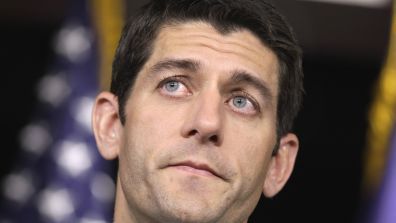
One little-noticed effect of the debt ceiling impasse is that Paul Ryan, that Paul Revere of fiscal calamity, darling of the anti-deficit lobby, has been exposed as a fraud. Technically, I guess he hasn't been exposed if nobody pays attention to it, in the same sense that a person walking naked down a deserted street might as well be at home in the bedroom. But if you care to pay close attention, Ryan's fraudulence is perfectly clear.
Ryan has carefully nurtured his deficit hawk image by expressing his Randian ideology in the high-minded language of the establishment. His favorite attacks on President Obama have revolved around failure to lead and a refusal to openly embrace the fiscal commission report (a report Ryan voted against, but never mind). Now, the work of that fiscal commission has passed into the hands of the Gang of Six, which has commanded strong Senate support and might have a chance in the House if its deficit-cutting recommendations were embraced by a figure with the right-wing fiscal credentials of Ryan. Instead Ryan "dropped what one Republican Senate adviser called a 'bomb' on the Gang of Six," snuffing out any chance of success.
And it's not just the mere fact of Ryan's opposition that's telling, it's the basis of it. Ryan's budget plan always relied upon a strategy of obscuring his priorities -- Ryan wants to cut entitlement spending in order to preserve low tax rates on the rich, while the public overwhelmingly prefers the exact opposite. And so he has carefully obscured his choices. Does Ryan's plan cut taxes for the rich? No, no, he says -- he simply "reforms" the tax code, just like the fiscal commission does:
[W]e’re not talking about cutting taxes. We’re just not agreeing with the President’s tax increases. I guess that’s the new definition of tax cuts. We’re saying keep tax rates where they are right now. And get rid of all those loopholes and deductions, which by the way are mostly enjoyed by wealthy people so you can lower tax rates. We’re basically taking a page out of the play book of the Fiscal Commission, the President’s Fiscal Commission supported by a majority of Democrats said the same thing--broaden the tax base lower the tax rates for economic growth, a simpler, flatter fair tax code more internationally competitive so we can create jobs. That’s what we’re proposing. This isn’t tax cuts. It’s tax reform targeting our revenues at where they are right now.
When pressed why he refuses to accept any increase in revenue, Ryan insists he only opposes higher tax rates because they create an economic distortion.
The economics profession has been really clear about this – higher marginal tax rates create a drag on economic growth.
So here comes the Gang of Six with a plan that does everything Ryan proclaims to love. It reduces tax rates. It removes loopholes. It follows the fiscal commission model. Ryan's reaction?
The plan claims to increase revenues by $1.2 trillion relative to a “plausible baseline.” It also claims to provide $1.5 trillion in tax relief relative to the CBO March baseline. The CBO baseline assumes the expiration of tax relief, resulting in a $3.5 trillion revenue increase. As a result, the plan appears to include a $2 trillion revenue increase relative to a current policy baseline.
In other words: Ryan doesn't really care if nominal tax rates are lower and that all the savings come from closing tax expenditures. He just wants rich people to pay less money to the government, and whether that lower tax bill comes in the form of lower rates or bigger loopholes is the secondary consideration.
This Deal Is Getting Worse All the Time
A colleague emailed me about this, and I honestly thought it was a joke. But no, this is in the New York Times:
But the president and Mr. Boehner were moving ahead with their plan, aides said, trying to agree on matters like how much new revenue would be raised, how much would go to deficit reduction, how much to lower tax rates and, perhaps most critical, how to enforce the requirement for new tax revenue through painful consequences for both parties should they be unable to overhaul the tax code in 2012.
The White House wants a trigger that would raise taxes on the wealthy; Mr. Boehner wants the potential penalty for inaction to include repeal of the Obama health care law’s mandate that all individuals purchase health insurance after 2014.
Okay, let's review here. Boehner is getting Obama to give him cover for extremely unpopular cuts to Medicare and Social Security that Republicans have no chance of enacting otherwise. Obama is getting Boehner to agree to higher taxes on the rich, which are wildly popular and scheduled to occur anyway. On top of that, Obama is agreeing to get this revenue not by restoring Clinton-era tax rates but by reforming the tax code, something Republicans claim to favor anyway.
And then, on top of that, Boehner is demanding that the penalty for failing to institute this reform include a completely unrelated demand to repeal the individual mandate. What kind of incentive is that?
I would say that Boehner is throwing out maximalist demands he knows will never be accepted in order to make his other extreme demands appear comparatively reasonable. But it's getting harder and harder to identify a demand so extreme Obama can be assured of ruling it out of hand.
&c
-- The adventures of utilitarian superman.
-- What’s in the latest Greek bailout.
-- A poorly lit room, Doug Holtz Eakin, and a dry-erase board.
-- We have math, and then we have the awful things Heritage does to numbers.
What Is The Secret Budget Deal?

Numerous hazy, ill-defined descriptions of a possible deficit deal have been floating around this afternoon. All parties have denied that they've struck an agreement. It's possible they have a tentative deal they've agreed to float to their caucuses, and it's also possible that somebody is leaking something short of a full deal in order to gin up a backlash.
That said, something clearly is happening, and it seems to involve President Obama giving ground on taxes. Here's the Washington Post's description:
According to congressional sources, Obama has apparently offered to forgo any tax increases in the initial deal, postponing an overhaul of the tax code until next year.
That was also the shape of the old deal, but with one significant exception: Obama had been pressing Republicans to extend the Bush-era tax cuts for middle-class households now, allowing the cuts that benefit the wealthiest households to expire next year. If that part of the bargain were taken off the table, the aides said, Democrats would be left with no guarantee that Republicans would actually follow through with tax reform in the future.
Here's Brian Beutler's:
In early negotiations that ultimately collapsed, Obama and Boehner considered passing a package of spending cuts with a promise to tackle tax reform in the coming months. But -- this is key -- a failsafe written in to the grand bargain would have decoupled most of the Bush tax cuts from those cuts benefiting only top earners. If comprehensive tax reform failed to pass this Congress, those top bracket cuts would expire.
Now, the aide says, Democrats are concerned that the White House might abandon that failsafe.
And Jay Newton-Small's:
In another major concession, no revenue increases would be included in the deal, and George W. Bush’s middle class tax cuts would not be decoupled from higher income cuts, as called for in the earlier “grand bargain” worked out by Obama and Boehner. Instead, all revenues would be handled in a second bill, a sweeping overhaul of the U.S. tax code, to be passed before the end of the year.
I can't say exactly what all this means. Newton-Small's account suggests we'll have no new revenue, and Obama and Boehner would support some kind of tax reform based on current tax levels by the end of the year. That would be a complete disaster, a total surrender by Obama.
On the other hand, it's also possible that something more subtle is going on. There's a basic asymmetry in the bargaining: all the Bush tax cuts expire at the end of 2012. And so, in the absence of agreement by Congress and Obama, the result will be a deficit-reducing package consisting entirely of higher taxes.
The negotiations thus far have involved varying levels of compromise between current tax rates and the tax rates we'd have if all the Bush tax cuts expire. Republicans have refused to accept even compromises that assume expiration of just a small portion of the Bush tax cuts. Perhaps the two sides are trying to construct a deal that locks in spending cuts while leaving the question of tax rates to be determined by the 2012 election. That's very different than locking in current tax rates.
In one sense, prying revenue out of Boehner may simply not be worth the price to Obama. Boehner either can't give ground on taxes, or the ground he gives is so meager it's not worth bargaining for if Obama can do as well or better just by winning re-election and refusing to extend tax cuts on income over $250,000. (And if Obama loses, the Republican president would probably just pass a big debt-financed tax cut.) So why not just agree to step one, and leave the debate over step two (cut entitlements or raise taxes on the rich) to the voters. That might meet Obama's desire to reposition himself for 2012 and Boehner's need to avoid agreeing to a tax hike. Obama can be the candidate who moved to the center, reduced the deficit and cut spending, and now wants wealthy Americans to share in the sacrifice. Boehner can be the guy who forced Obama to knuckle under and cut spending with no tax hikes.
Of course, that's pure speculation. It would make sense of the leaks without assuming a capitulation of historic magnitude by Obama. It's also entirely possible Obama just folded completely. We should find out the answer relatively soon.
Noemie Emery Crushes Straw Man, Basks in Victory
Noemie Emery's latest story for the Weekly Standard offers a fairly useful summary of the state of conservative thought about liberalism and the welfare state. Here are the first two sentences:
The intentions of Democrats are only the best. They want all of the old to have lavish retirements, all of the young to have scholarships, verse-penning cowboys to have festivals funded by government, and everyone to have access to all the best health care, at no cost to himself.
Let's take these three claims in order:
1) Democrats want "all the old to have lavish retirements." In fact, the average Social Security beneficiary collects about $14,000 a year, a sum that few would describe as "lavish." What's more, President Obama and numerous Senate Democrats have agreed to cut Social Security benefits, while seeking to preserve the program's role in preserving minimal standards of retirement that keep the elderly out of poverty.
2) Democrats want cowboy poets to have government-financed poetry festivals. Obviously, a Democrat, Harry Reid, supports this particular program. But to generalize from Reid's parochial belief in a small program to the general core beliefs of "Democrats" is exactly as accurate as concluding from the support for Tea Party Republicans for various earmarked projects that support for pork barrel spending is a core value of the Tea Party. In other words, it is completely inaccurate.
3) Democrats "want everyone to have access to all the best health care, at no cost to himself." There are numerous odd things about this claim. Start with the end, "no cost to himself." Medicare in fact charges premiums. The Affordable Care Act likewise uses subsidies and regulation to make individual private insurance affordable, but it sets up regulated exchanges where customers have to pay for their insurance plan. What's more, Emery's belief that Democrats want to give everybody "all the best health care" runs directly counter to her previous accusations that Democrats want to reduce the quality of the health care system by rationing. ("Everyone fears a system that could give them the wrong doctor instead of the right one at just the wrong moment, and everyone, no matter how rich, strong, well-connected, or seemingly healthy, knows that an accident or a bad diagnosis can come any day.") Indeed, it runs counter to years of right-wing cant, which deems the goal of Democratic health care reform to be the installation of mediocre European or Canadian-style care lacking the lavish fdeatures of the "best health care system in the world."
In sum, I didn't bother to read the rest of Emery's piece, but I did receive another useful lesson in the state of conservative thought.
Obama's Mysteriously High Approval Ratings
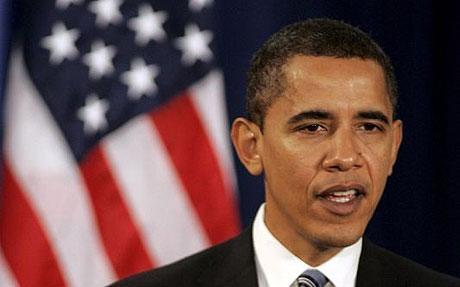
Gallup editor Frank Newport has a nice, pithy analysis of President Obama's ability to defy political gravity:
Newport says he's crunched the numbers as far back as they go in Gallup's polling archive and found that no one's done as well as Obama when the public is as unhappy with the economy.
"Based on where every president has been, his approval rating now is higher than we would predict it would be based on satisfaction [with how the country is doing]," Newport said.
Obama's ability to defy the economic fundamentals is one of the most significant facts of the current landscape. It doesn't command a lot of attention because Obama's approval ratings aren't all that great. But considering the state of the economy they are actually unbelievably great -- sort of like a baseball player who hits 20 home runs a year while playing in a stadium with a 450 foot deep fence.
Newport suggests two possible explanations:
"The two major threads of theories are something about the personality of the man, and the other is the nature of coalition politics today," Newport said. "[They have] become such that he has a strong coalition of certain types of voters who are going to support him no matter what and that props up his approval rating."
The hypothesis about political polarization makes sense until you consider George W. Bush, a polarizing president whose support base collapsed during his second term.
I'd suggest that the economic fundamentals may be dragging down Obama less than expected in part because the economic crisis began before he took office. That distinguishes Obama from most other presidents who have seen recessions drag down their popularity. As for how long it lasts, we're in uncharted waters.
That aside, I think it's also clear that Obama is a very skilled politician, an effective communicator who people like and want to succeed.
Jonathan Chait's Blog

- Jonathan Chait's profile
- 35 followers

