
Jonathan Chait's Blog, page 20
July 27, 2011
Tooth Fairy Bonuses Dropping
Another sign of economic distress:
According to a Visa survey, the Tooth Fairy is not immune to the slowed economy. With less money to go around, she's doling out an average of just $2.60 per tooth this year, compared to $3 in 2010.
Clearly this is a prime expenditure to cut back when you're feeling strapped. But $2.60 seems really high to me. My kids each lost a tooth the other night -- actually within seconds of each other, strangely enough -- and I gave them each a dollar. I thought it seemed high. When I was a kid I got a coin -- either a dime or a quarter, I can't recall which.


Boehner Uses Partisanship To Defeat Tactical Radicalism
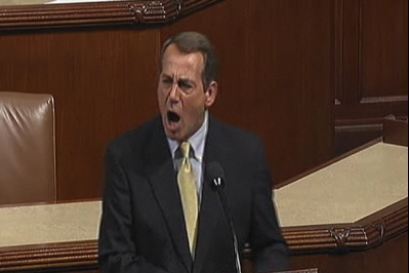
The passage of John Boehner's debt ceiling bill appears to mark the crossing of a certain intellectual threshold for ultra-conservative House Republicans. Until very recently, they've been proclaiming that failing to raise the debt ceiling would not have important drawbacks, and/or that the 2010 elections afforded the Republican Party the right to impose its agenda without compromise. Now, suddenly, almost nobody is saying those things. Consider this quote from one right-winger:
“At the end of the day, it’s nowhere near what I want. It’s not even close to the numbers we want. It’s not perfect. But when we only control one-half of one-third of government, we can’t expect to be perfect,” said New York Rep. Michael Grimm
Or this:
One of those members, Rep. Blake Farenthold (R., Texas) told reporters that while he would like to “snap my fingers and change the world like ‘I Dream of Genie’ of Samantha on ‘Bewitched,’” Republicans “need to take what we can get.”
What explains the sudden onset of sweet reason? it seems that Boehner successfully appealed to the GOP's sense of partisanship. Selling a compromise with Obama as a necessary step toward the fulfillment of one's agenda in a power-sharing arrangement is hard. Selling an attack on Obama in those terms -- even one that does far less to reduce the size of government -- turns out to be pretty easy. Here's the Weekly Standard:
To vote against John Boehner on the House floor this week in the biggest showdown of the current Congress is to choose to vote with Nancy Pelosi. To vote against Boehner is to choose to support Barack Obama.
Not very subtle! And here's right-wing frosh Allen West:
Boehner Plan is not a perfect bill. However, the fact Pelosi, Reid and Obama hate it doggone makes it perfect enough- where is their plan?
Now, for reasons I'll explain in a follow-up post, the Boehner plan is totally unsupportable. But once you've gotten the right to cross the philosophic threshold Boehner has, the next step is a lot easier. Boehner will lose plenty of conservatives if and when he cuts a final deal, but he'll gain Democrats. The key step was breaking down the right's default denialism and sense of entitlement to total victory. That's achieved.
THE DEBT CEILING >>
Hot Republican-On-Republican Action

The internecine fighting among conservatives over the Boehner plan has much of the same ideological and stylistic feel of a late 1960's feud pitting left-wing factions that favor immediate violence against those seeking more time to radicalize the masses. The less-extreme faction clearly has the better of the argument, yet the overwhelming impression is the sheer fanaticism of the whole political subculture. Here's the Heritage Foundation, led by Dick Cheney's former chief of staff David Addington pressing the case for the burn-it-down faction:
Americans sent a message in the election of 2010 — cut the size and cost of government. Conservatives must act now to drive down spending on the way to a balanced budget, while protecting America, and without raising taxes. Forget the McConnell, McConnell-Reid, Coburn, Gang-of-Six, Boehner, and Reid plans. Go with the American plan — cut government spending, deeply and right now, for the good of the country.
How will this happen? The theory seems to be that inflicting enough pain on the economy will force Democrats to buckle and accept a Constitutional limitation locking in Eisenhower-levels of domestic spending. It's madness, of course. But Boehner's "moderate" proposal rests on an only slightly weaker version of this same operating theory:
Boehner also predicted Senate Majority Leader Harry Reid (Nev.) and Senate Democrats will have to pass his proposal once the House does. Reid has an alternate plan to cut $2.7 trillion while raising the debt limit. White House officials warned on Tuesday that they will recommend President Barack Obama veto the Boehner plan if it gets to the Oval Office. The U.S. government is set to default on Aug. 2 on its $14.3 trillion debt if the borrowing limit is not raised.
“If this gets chaotic, they [the Senate] will fold like a cheap suit,” Boehner said, according to GOP sources.
Possibly true, though one has to be concerned about the use of a political strategy dependent on the threat, or actual existence, of political and financial chaos. It's not the ideal disposition one would like to see in one's national leadership.
The primary culture difference between left-wing radicals and right-wing radicals is that the latter have a deep individualistic streak. (It's shared by libertarians, and both tend to react to differences by splintering into sub-factions.) Right-wingers, by contrast, are moved by appeals to unity and authority. Thus Boehner is instructing his troops to fall in line:
Speaker John Boehner bluntly told wavering GOP lawmakers Wednesday morning to “get your ass in line” behind his debt ceiling bill. ...
“This is the bill,” Boehner informed a closed-door meeting of House Republicans on Wedneday morning. “I can’t do this job unless you’re behind me.”
The leadership also tried to fire up restive members with an open appeal to subsume any moral considerations to group loyalty, showing them this film clip:
And members of Congress today were chanting for the firing of a staffer working against Boehner:
House Republicans on Wednesday morning were calling for the firing of the Republican Study Committee top staffer after he was caught sending e-mails to conservative groups urging them to pressure GOP lawmakers to vote against a debt proposal from Speaker John Boehner (R-Ohio).
Infuriated by the e-mails from Paul Teller, the executive director of the RSC, members started chanting “Fire him, fire him!” while Teller stood silently at a closed-door meetings of House Republicans.
This is all the work of the party's less-crazy faction.
Lucas Sues Man For Stealing Idea Lucas Stole From Hitler

The prop designer who created the stormtrooper uniforms for "Star Wars" has been selling replicas, and George Lucas has tried to stop him:
It was in 2002, when struggling to pay school fees, that he first sold a helmet and "bits and pieces" gathering dust on top of his wardrobe....
The hard core fans recognised them as the real thing, he recalls, but by the time he had sold 19 or so to the US, so did Lucas.
Lucasfilm sued for $20m in 2004, arguing Mr Ainsworth did not hold the intellectual property rights and had no right to sell them - a point upheld by a US court.
But the judgement could not be enforced because the designer held no assets in the US, so the battle moved to the UK.
If Lucas can sue his prop designer for stealing the stormtrooper concept from him, can Germany sue Lucas?
Would Future Dems Take The Debt Ceiling Hostage?

Fred Bauer warns Republicans that the new method they've pioneered -- using the debt ceiling as a hostage to force policy concessions -- could just as easily be turned against them under a Democratic House and a Republican president:
In passing the Ryan budget, Congress also upped the debt ceiling by a trillion or so, but perpetual deficits mean that the ceiling is coming awfully close, and federal spending is due to break it in early August 2015. So now, in May, the president must go on bended knee to Speaker Pelosi, who demands tax increases as the price for her caucus supporting an increase in the debt ceiling. ...
And what could Republicans say to this?
I appreciate the spirit of the thought experiment. And Bauer is certainly right that Republicans would have no legitimate procedural argument against this tactic, though you can always whip one up if needed.
But is this really a plausible scenario? I don't actually think it is. I could imagine a Democratic Party holding the debt ceiling hostage, but not this Democratic party. It would have to be a far more left-wing party, in which activists have gained greater control and which has largely severed itself from any business influence. The current democratic party lacks anything like the will to power to threaten economic catastrophe in order to force a government mostly controlled by elected members of the opposition to accept its contested policy agenda. And it would require a substantial coterie susceptible to the argument of the default denialists -- a natural fit for the party of supply-siders and climate change deniers, but not a good fit for the moderate coalition that forms the current Democratic party.
James Surowiecki argues that the debt ceiling specifically favors a certain kind of politician:
[B]y turning dealmaking into a game of chicken, the debt ceiling favors fanaticism. As the economist Thomas Schelling showed many years ago, “It does not always help to be, or to be believed to be, fully rational, coolheaded, and in control of oneself” when it comes to brinksmanship. It doesn’t, in short, help to be President Obama. That may be why all the deals that have been taken seriously this season rely much more heavily on spending cuts than on tax increases: the deals represent Republican priorities, because the Republicans seem to be more willing than the Democrats to let the country default.
There's only one party in American politics today willing to try this sort of thing. If history had run a different course, and the Democratic Party had been captured by the ideological descendants of Tom Hayden, and the GOP by the descendants of Nelson Rockefeller, the situation would probably be reversed.
Think Of The Children, President Obama
I was not especially impressed with the reasoning in David Brooks's column yesterday. But I left plenty of meat on the bones for , whose take is worth a read even with my noticing it a day later:
On Mr Brooks' telling, Mr Obama scolded Congressional leaders like a bunch of teenagers. They responded by beginning negotiations with each other which, he thinks, are more likely to produce a deal. He scolded them, and they started doing their jobs. This "unintended consequence" of Mr Obama's actions proves that his scolding was a grave mistake. ...
The driving factors in the debt-ceiling negotiations are fanatical Republican opposition to tax increases and the determination by tea-party Republicans to defeat Barack Obama, with whom no deal can ever be done. These are the reasons why we're having a clash over raising the debt ceiling, and they're the reasons why an agreement remains out of reach. But it's worth noting that Mr Brooks's "Saved by the Bell" theory of the negotiations, in which Mr Obama's scolding tone is the problem because it's driving congressional leaders to negotiate seriously with each other, doesn't even make any sense on its own terms.
Another way to put this is that the new prevailing theory among conservatives who want a debt ceiling deal holds that Obama has screwed everything up by posing as the only adult and treating Republicans like children. His leaving the negotiations, and allowing Congress to convene the deal, will allow the deal to get made.
Which is to say, Republicans are willing to risk massive financial chaos because they're annoyed at the president's tone. In other words, they're like children.
Domestic Spending And The Road To Nowhere
[image error]
Last Spring, Republicans threatened to shut down the federal government in order to force domestic spending cuts. House Speaker John Boehner managed to pass a bill. But a subsequent CBO analysis found the immediate savings were quite small. Conservatives went ballistic and vowed they won't get fooled again.
That's the background to the current debt ceiling impasse. Boehner is again trying to round up distrustful right-wingers. Last evening, he suffered a setback when the Congressional Budget Office analyzed Boehner's plan, and found that it cuts spending by about $150 billion less than Boehner claims. Boehner has pulled his bill and is frantically reworking it. No doubt this only deepens the suspicions of the right that any cuts in the deal must be phony.
In reality, the reason Boehner's bill fell short is that the cuts in the last budget deal were, in fact, quite deep. They didn't have a huge immediate effect, but they lowered the long-term spending baseline. As a result, Boehner's new bill saves less money compared to the new, lower baseline that he created. So the reality of the situation is that spending is getting lower and lower. To the right-wing mind, it appears to be a situation in which conservatives keep getting fooled into accepting spending cuts that don't materialize.
I find Boehner's reaction pretty revealing. Here he has discovered that his plan will reduce spending on domestic discretionary programs by less than he expected because it was already scheduled to spend less than he expected. One reaction might be to conclude that the level of cuts needed to domestic discretionary spending was therefore less than he had previously believed. I suspect that line of thinking received not a moment's consideration. Instead Boehner followed his party's consistent impulse to simply ratchet down domestic discretionary spending more.
The larger question here is, what level of domestic discretionary spending do Republicans find appropriate? I'm familiar with the party's thinking on defense spending (more!), Social Security and Medicare (privatize and cut!), as well as taxes and regulation. But, despite following conservative thought quite closely, I'm fairly unclear as to whether the party thinks we're spending way too much on non-entitlement programs -- whether there's any defined endpoint, or simply a goal of cutting as much as politically feasible forever. The actual impact of Republican budgets here is things like slashing funding on transportation infrastructure or food inspectors. Yet you almost never see conservative argue for slashing those programs.
Conservatives believe in general that the federal budget is filled with waste. But do they think this is the waste? Do they think the waste is elsewhere but Republicans just cut worthwhile programs instead? Or (this is the answer I suspect to be the closest to reality) do the vast majority of even movement conservative figures simply pay no attention to the details of the Republican domestic budgets?
The deeper problem here is the degree to which the domestic discretionary spending budget has been progressively squeezed:
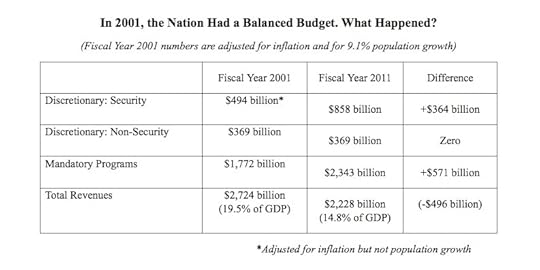
It's the most vulnerable part of the federal budget simply because it's a catch-all category of everything that isn't entitlements and defense. The individual programs within it may be popular, but there are so many of them it is hard to mobilize support for it. Liberals have drawn their line at defending entitlement spending. As a result, the argument is between one side that wants to cut this category, and another that wants to eviscerate it.
THE DEBT CEILING >>
July 26, 2011
&c
-- I implore my readers to chip in funds to buy this place for me as the new Jonathan Chait blog west coast headquarters. The rug really ties it together.
-- The White House's snazzy national debt infographic.
-- Nation's poorest spend 42% of income on transportation.
-- WaPost: Bachmann shacked up with Uncle Sam for federal home loans.
-- Poor John Boehner, everyone wants his plan to fail.
-- The Congressional Hellenic Caucus doesn't have much to say about Greece, or anything else.
p.p1 {margin: 0.0px 0.0px 0.0px 0.0px; font: 13.0px Arial; color: #071980}
Trump Not Using Crisis To Rise To Statesman Role

I expected more from The Donald:
On Monday, Donald Trump urged Republicans to reject any deal with Democrats to raise the debt ceiling and let the country risk default. Economists and administration officials have warned that defaulting on our debt would have dire economic consequences, but for Trump there is an upside: the crisis would prevent President Barack Obama from being reelected.
"Frankly the Republicans would be crazy unless they get 100 percent of the deal that they want right now to make any deal,” Trump said on "Fox and Friends" Monday. "If this happens, for instance if this stuff is going on prior to an election, he can’t get reelected. He possibly can’t get elected anyway. … The fact is, unless the Republicans get 100% of what they want, and that may include getting rid of Obamacare, which is a total disaster, then they should not make a deal other than a minor extension which would take you before the election which would ensure Obama doesn’t get elected, which would be a great thing."
The Lines Are Jammed!
After President Obama urged Americans last night to call their member of Congress, the capitol switchboard has been flooded with calls:
The Capitol switchboard was on the verge of being overloaded with calls from across the country Tuesday morning after President Obama called on Americans in an address to the nation Monday evening to contact their members of Congress about the high-stakes debt battle playing out in Washington.
“Due to the high volume of external calls, House telephone circuits serving 202-225-XXXX phone numbers are near capacity resulting in outside callers occasionally getting busy signals,” read an e-mail sent from the House Chief Administrative Officer’s Technology Call Center to members’ offices Tuesday morning. “Outbound calls are unaffected.”
How flooded? Ehh, not that flooded:
Reports from members’ offices Tuesday morning were mixed.
The office of Sen. Chris Coons (D-Del.) said that the volume of calls to its Washington office had been “noticeably higher than normal.”
A spokeswoman for Rep. David Schweikert said that the level of phone calls received at the Arizona Republican’s office was “comparable to that during the ‘continuing resolution’ debate of several months ago.”
I wonder if the switchboard jammed because perhaps the capacity isn't all that high.
Jonathan Chait's Blog

- Jonathan Chait's profile
- 35 followers

