
Jonathan Chait's Blog, page 17
August 1, 2011
&c
-- What's the deal with Norwegian sentencing?
-- How the Super Committee can raise taxes.
-- Why left-of-center parties all over the world are having problems.
-- Matthew Yglesias's five books that influenced him.
-- You won't like William Gale when he's angry.


The Bright Side Of The Debt Ceiling Deal
Nate Silver, upon reflection, decides that the debt ceiling agreement isn't really so bad for liberals:
given that Democrats were willing to accede to the constraints demanded by Republicans, they were able to exert a lot of control over the substance of the cuts. In particular, the first round of cuts will include $350 billion in defense savings, while the second round would include between $500 and $600 billion in defense cuts if no bipartisan agreement is reached. ...
If you’re a Democrat and you must accede to $1.5 trillion in cuts — and that’s literally the situation that Democrats will find themselves in if the deal passes through Congress — it’s going to be hard to do better than this $1.5 trillion in cuts. They are very heavily loaded with defense cuts, while containing few changes to entitlement programs or to programs which benefit the poor.
So Democrats will have very little incentive to vote for the panel’s recommendations unless they include tax increases.
I agree with this. Obama should have avoided the hostage scenario, but once he blundered into it, he managed to escape on relatively favorable terms. My argument was that Obama should forget about trying to get Republicans to agree to higher revenue, and simply sign the best all-cuts deal he could. He (eventually) did so.
Why did I advocate this? Because tax revenue is scheduled to increase anyway. The kind of revenue Obama was offering Republicans was actually a sop to Republicans. Obama was saying, in effect, I'm going to veto any extension of tax cuts on income over $250,000, which will raise $800 billion. But instead we can agree right now to raise that revenue by closing loopholes and avoiding any increase in rates. It was a shockingly generous offer.
But the reason Republicans couldn't accept that deal is that it would require them to concede that taxes would go up. Imagine you're John Boehner. Which is a better scenario for you -- the tax cuts for the rich expire in 2013 over your objections, or they expire as a result of a deal you cut with Obama? The former is obviously way better. It's the difference between conservative hating Obama for being a tax hiker and conservatives hating Boehner for being a tax hiker. It's true that a deal with Obama would be vastly better for conservative policy -- because it comes attached to entitlement cuts, and because the higher revenue would come with lower (or at least not higher) tax rates.
But the pathology of conservative anti-tax absolutism made it impossible for Boehner to cut the deal that's best for conservatives. One result is a deal that's better for liberals. Higher revenue is such a sacred taboo for Republicans that Obama couldn't get them to sign off on it even by giving them almost everything else. But the flip-side is that, by shelving that demand, he was able to win a lot of concessions.
Smearing Norah O'Donnell
Andrew Breitbart has clipped an exchange from today's press at conference at the White House. In the exchange, reporter Norah O'Donnell press Jay Carney by asking, "Democrats are saying, 'You gave them everything they wanted and we got nothing." Commentary has picked up the story, giving it the headline, "CBS's O'Donnell to Carney: We got nothing."
CBS’s Norah O’Donnell peppered Carney with terse, accusatory questions about the lack of tax revenue (read: tax increases) in the debt ceiling deal. O’Donnell complained about how many GOP demands were met by the deal, and then said to Carney: “You gave them everything they wanted and we got nothing.” That “we” is very telling. ...
O’Donnell, meanwhile, may have to answer to her bosses at CBS for peeling back the veneer of impartiality to reveal the liberal advocacy sitting just beneath the surface of the mainstream networks.
Amazing. They simply lopped off the part where O'Donnell was describing the position of a party and passed it off as O'Donnell talking about herself and liberal Democrats in the first person plural.
After some reporters objected, Commentary updated the story to emphasize O'Donnell's "tone" as the issue, while editor John Podhoretz took to Twitter to defend the plainly misleading story. Here's the update emphasizing "tone":
Some readers are objecting that O’Donnell was relaying to Carney what liberals are saying about the deal. If you watch the whole clip, she asks a question before this statement that is clearly in her voice, not that of agitated liberals: “Two weeks ago the president talked about shared sacrifice, and he talked about ending subsidies for oil companies and he talked about ending tax breaks for corporate jet owners. He talked about that this was a very fair deal where he was offering three-to-one, spending cuts for one in tax revenues. Where are the tax revenues?” She then asks the question where her defenders insist she is quoting others. Watch the delivery of her question–it’s both hostile and dramatic, and was made only after questioning Carney along the same lines in which there is no contention that she is speaking for anyone other than herself. Viewers can decide.
First of all, the update fails to include the full quote, and fails to inform readers that the original story misleadingly truncated O'Donnell's question. It merely switches to a less damning accusation without acknowledging it's doing so.
Second, the new accusation is itself silly. Reporters ask questions from the perspective of politicians ("They're saying...") all the time. They ask question in an impassioned, loud or aggressive tone all the time. Making o'Donnell's tone an issue is a transparent attempt by Commentary to cover for the way it smeared her.
Who "Owns" the Economy?
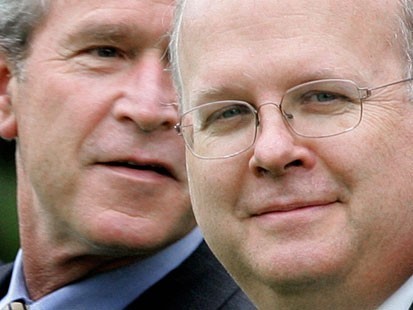
One of the cliches bouncing around constantly is that President Obama "owns the economy." Pay attention to the way Karl Rove uses the phrase here, seguing from a weird description of a bakery closing to blaming it on Obama:
when the restaurant closes Sunday, 14 people will lose their jobs. Its patrons will lose a favorite joint, and the neighborhood will lose some sense of community.
There are worse hardship cases in America, but this one is bad enough. It is in large part the result of the economy that Mr. Obama owns.
"Owns" is a political term. It means that the consequences of the 2008 economic crisis now drag down Obama, because as a simple political fact, many voters hold the president responsible for the state of the economy. Rove is using the term to suggest that Obama has actually caused mass unemployment. That, of course, is absurd. The 2008 economic crisis caused massive havoc across the world.
Yet there's a slippery way in which discussions of the perception of Obama's responsibility for high unemployment meld into suggestions that he actually does hold responsibility. It's not clear that Rove is capable of understanding the distinction between political perception and actual reality. But his conflation of the two concepts is merely a more extreme manifestation of a general habit in political commentary, lazily avoiding any clear distinction between perception and reality. The phrase "owns the economy" has become one of the most banal expressions of the dysfunction of political discourse.
The Deal Isn't So Bad, But The Rationale For It Is
[image error]
The nickel summary of the debt ceiling deal is this: We don't know whether it's a good deal or a bad one until we see how President Obama handles the Bush tax cut expiration. The deal itself does not limit Obama's ability to secure a positive outcome if he plays his tax hand strongly, but it does diminish one's confidence that he'll do it. Here's Matthew Yglesias:
the president’s description of his own thinking was disturbing. He complained that Republicans had held the national economy hostage to their extreme demands. And he decided, in essence, that he was going to give in to the hostage-taking.
This raised a question in my mind not so much about that deal as about the next hostage go-round. And what we saw this weekend was another hostage scenario. And we saw an administration that didn’t really do anything in the intervening months between that frigid evening and yesterday’s torrid heat to solve their hostage problem. So now I’m of course left to wonder “what’s next?”
And moderate conservative Josh Barro makes essentially the same point:
I would note that the president called for a “balanced” approach to fiscal adjustment, and this is one. We now have $2.5 trillion in automatic, scheduled spending cuts* over the next 10 years. That comes on top of $2.8 trillion in automatic tax increases that are already scheduled through the year 2022, due to the expiration of the Bush tax cuts at the end of 2012. Indeed, Republicans have a good case that the automatic deficit reduction plan is not balanced but a bit tax-heavy.
I brought this up on Twitter today, and I got a lot of harrumphing from Democrats. There’s no way President Obama will ever let the Bush tax cuts expire, they say—he’ll get rolled again, just like he did in 2010.
To that, I have two responses. First, it’s not our fault you nominated this guy. Second, I’m not sure what good a balanced trigger as part of this compromise—one that included automatic tax increases, not just spending cuts—would have done, under this view. President Obama already has an automatic tax trigger that liberals believe he is afraid to use. What good would giving him a second trigger do?
I, personally, believe that Obama will play hardball on the Bush tax cuts in late 2012, assuming he gets reelected.
I think that's correct, because it makes political and policy sense for Obama to play hardball. But the inability to believe this with any confidence is unnerving. The Obama administration says it wants the committee to report out balanced deficit reduction:
If the Committee does not succeed in meaningful balanced deficit reduction with revenue-raising tax reform on the most well-off by the end of 2012, the President can use his veto pen to raise nearly $1 trillion from the most well-off by vetoing any extension of the Bush high income tax cuts.
That's from a fact sheet designed to reassure liberals. It doesn't reassure me. Obama's position has always been that he wants to end the Bush tax cuts on income over $250,000. After agreeing to extend those tax cuts last December, he swore he would block any subsequent extension. Now he's presenting the decision to block them as something he'll do only if the commission doesn't offer up other revenue. In other words, he's willing to trade that revenue for other revenue the commission can produce.
Why make that trade? Why offer spending cuts that are not scheduled to occur in return for revenue increases that will, in the absence of action, occur anyway? The administration's apparent eagerness to cut this deal -- the same deal John Boehner couldn't say yes to -- offers real reason for worry. Barro's analysis is shrewd, but its assumption that Obama is rationally pursuing the long-term interests of the center-left policy agenda may or may not be correct.
Debating Obama's Ransom
My evaluation of the debt ceiling deal is decidedly mixed, and many liberals are deeply unhappy. Dave Weigel wittily captures the spirit in his liberal denunciation mad lib:
I am [outraged/fed up/fixin’ to vomit] at the news of this [sellout/betrayal/Chekovian drama of political adultery]. While I have yet to see all the details of this plan, it may be the worst piece of legislation since [the Kansas/Nebraska compromise/the Enabling Act/the one that renamed a rest stop in New Jersey after Howard Stern]. We all agree that the deficit needs to be reduced, but it should not be done [on the backs of our seniors/in the dead of night/until we reach 4 percent unemployment again]. Instead, we Democrats are being asked to support a [Satan sandwich/Hitler hoagie/bin Laden banh mi], with a [mayonnaise of betrayal/chipotle glaze of mistrust/pesto of austerity]. If this is passed, our president – whom I [supported/strongly supported/had to suck it up and support, even though I liked Hillary Clinton and saw all this crap coming, because if I didn’t the Daily Kos comment section would have made me out to be a racist, and I’m totally not] – risks becoming a new [Jimmy Carter/Grover Cleveland/Emperor Palpatine]. Let’s [go back to the drawing board/head back to the table/find some new sand, draw a line in it, and borrow a can from my friend Bruce that we can kick around]. America can do [better than/slightly better than/not quite as terrible as] this.
Political scientist Matthew Dickinson, in the same general spirit, argues that disappointed liberals fail to understand the constraints Obama has been operating under:
Predictably, although the ink is not yet dry on the debt agreement – indeed, there’s no ink even on the legislation – Obama is getting crucified on left-leaning blogs, amid headlines suggesting the Right won (see also comments here), with charges that he was outmaneuvered – that he caved. I will have much more to say about these criticisms in a lengthier post tomorrow, but for now let me briefly take issue with the prevailing political sentiment among Obama’s Democratic base. Since the day Obama was elected (indeed, even before he was elected!) I’ve detected what I believe to be a completely unrealistic, emotion-driven faith among his hard-core supporters that he was different from other politicians – that he could somehow overcome the political constraints and institutional barriers that have limited the power of all his presidential predecessors. I saw it in the debate regarding Guantanamo, military commissions, the public option, Afghanistan, extending the Bush tax hikes and now this. This sentiment was perhaps never more manifest than in the fervent belief among some that he was playing a “deep” game during these negotiations, maneuvering to a position where he could cut the Gordian knot of budget impasse with a master stroke (14th amendment anyone?) And in this latest occurrence, when he failed to fulfill these outlandish expectations, his erstwhile supporters proceeded to blame it on a character defect – a lack of fortitude, an absence of courage, or perhaps simple political naivety.
The reality is that this budget outcome had nothing to do with personal weakness, and everything to do with political weakness. ...
maybe some of you can tell me why so many very smart people have, since the day Obama was inaugurated, deluded themselves into thinking that this admittedly very smart man, albeit one with limited political experience at the national level, was somehow going to step into office and proceed to rewrite the political laws that have governed presidential politics for the last two centuries?
I agree that this dynamic has been generally true, especially of Obama's wildly under-appreciated achievements from his first two years. I also think it's mostly true of the current debt ceiling deal, but I think Dickinson offers Obama a bit too much slack here. He argues that the deal had nothing to do with Obama's personal weakness. I certainly understand that Obama was not going to force republicans to accept revenue increases on the rich when the party is organized around preventing such an outcome. I also understand that making the Republicans swallow more stimulus, which would run directly counter to both its political interests and recently-adopted inflation-phobia, would be tricky.
But if you think Obama's negotiating strength played zero role here, ask yourself why no previous president has ever been jacked up over a debt ceiling hike before. Indeed, why have Republicans successfully adopted a tactic I don't believe either party has ever used before -- forcing concessions by threatening consequences that they themselves agree would be disastrous to the country? It's common for parties to support policy changes the opposition thinks will destroy the economy, but it's highly unusual to threaten to do something your own side says would have such a result. That's a negotiating tactic used by kidnappers and terrorists but rarely by political parties vying for the support of the public they are threatening to harm.
Now, you might say no president has been jacked up this way before because no other president faced an opposition party quite as crazy as the current Republican Party. Possibly so. But it seems to me that the stronger play would have been to sue the threat to expose the GOP's craziness, and drive a wedge between it and its business base. Dickinson invokes "the political laws that have governed presidential politics for the last two centuries," but those rules tell us little about the domestic use of hostage tactics. Indeed, while the public might not have supported raising the debt ceiling, this opinion seems to derive from a lack of understanding. Obama had an opportunity to frame the issue in such a way as to eliminate the GOP's leverage, or even to force the gambit to blow up in the opposition's face. I think it's fair to consider his failure to do so a failure of nerve.
July 31, 2011
Did Obama Get Rolled?
The debt ceiling agreement is a horrible piece of legislation. It ratchets down already too-low domestic discretionary spending caps and imposes painful sacrifice on the middle class with little asked of the rich. Obviously, though, you can’t assess any deal without asking “compared to what?” Did President Obama get a worse deal than he had to, given the circumstances? And the answer to that question, in turn, depends on when you start the clock, and more importantly, when you stop it. Let me explain.
Going back to December, the Democrats committed a massive blunder by failing to push for a debt ceiling increase. At the time, observers like Ezra Klein were noting how absurd it would be to let Republicans force through a deficit-increasing policy (extending the Bush tax cuts) and then let Republicans stick Democrats with the blame for the debt ceiling. A reporter even asked him about the Republican Party’s ability to use this vote as leverage, and Obama seemed not to grasp the point at all. Obama has implied that he couldn’t have received a debt ceiling hike, but I don’t think that’s correct.
Then, last spring, Obama committed blunder number two. Republicans began voicing opposition to raising the debt ceiling, or insisting on massive concessions in order to do so. The correct response here was to refuse to negotiate. Obama simply needed to say, we’re raising the debt ceiling the way we always have, because the alternative is catastrophe. We can negotiate any policy change you want, but not with a gun to the head of the American economy. Eventually, the business community would have pressured Republicans to relent. Instead, once Obama ascented to broadening the scope of the debate, business simply wanted a deal to get done, and it pressured both sides to compromise. (It is true that the complicity of the anti-deficit lobby in the Republican hostage gambit made it harder for Obama to insist on keeping the deficit and the debt ceiling separate.)
The third mistake lay in assuming Republicans would agree to raise tax revenue. I spoke several times with administration officials who asserted with total confidence that Republicans would simply have to acknowledge the need for more revenue. They betrayed a complete misunderstanding of the party they’re dealing with.
Once it had agreed to negotiate a ransom payment, the administration was left with a series of bad options. I think the current deal on offer is about as non-bad as it could have gotten. It managed to backload the timing of spending cuts to minimize damage to the recovery and protect programs for the most vulnerable beneficiaries (which also happen to be the most vulnerable programs.) I’ve argued that Obama should give up on trying to get Republicans to accept higher revenue and just sign an all-cuts agreement.
Furthermore, unlike many other liberals, I agree with a key element of the administration’s political calculation. The thinking is that Obama lost the support of a key centrist element of his coalition due to the perception that he’s an out-of-control spender who created big deficits. The perception is wrong, but that doesn’t really matter. Signing onto a major deficit reduction deal helps rebuild Obama’s image. That the deal consists entirely of spending cuts probably only helps. What’s more, recognizing that Democrats will never obtain a fiscal readjustment entirely on their own terms, I’m willing to swallow some cuts to Medicare and Social Security in the pursuit of deficit control.
My red line is revenue. It has become clear that Obama’s pledge not to raise taxes at all on anybody earning less than $250,000 a year is no longer compatible with even the minimal demands of government over the next decade. Just expiring that portion of the Bush tax cuts is not enough. The Bowles-Simpson commission required more revenue, and the Gang of Six required more revenue. Obama has tried repeatedly to lure Republicans to sign a deficit reduction deal, offering them a pact with lower revenue targets than either of those. How does Obama make that paltry revenue target work? By assuming he can get away with slashing domestic discretionary spending. The White House oddly boasts that it reduces domestic discretionary spending to the lowest level since the Eisenhower administration. That’s a plan that either will be broken or will result in shortchanging vital priorities.
Obama has one golden ticket out of the revenue dilemma. As I’ve written multiple times, the expiration of the Bush tax cuts gives him enormous leverage over the GOP. Republicans signaled last year they’d rather kill off the entire Bush tax cuts than sacrifice the portion that only benefits the rich. Holding firm on the Bush tax cuts would let Obama maneuver Republicans into the position of killing off all the Bush tax cuts. That would provide all the revenue he needs – some $4 trillion over a decade, as opposed to the $800 billion he’d raise merely by ending tax cuts for the rich.
What’s more, going to the mat over the Bush tax cuts would provide Obama with a strong political message for 2012. He can’t run on the economy. He needs a contrast election. Republicans will try to pass some version of the Paul Ryan budget, cutting taxes for the most affluent and laying waste to Medicare and Medicaid. Obama can run as the candidate insisting on shared sacrifice – and having already agreed to $3 trillion in spending cuts would give him credible to draw that line.
The problem, though, is that we can’t be sure Obama really intends to draw that line. There’s a limit to how much faith one can place in a man who has so badly misjudged his political opponents time and time again. The debt ceiling ransom may be a shrewd strategic retreat, or it may be the largest in a series of historic capitulations. We won’t know until the fight over the Bush tax cuts has been settled.
JONATHAN CHAIT >>
July 29, 2011
The Debt Ceiling Crisis And The Failure Of The Establishment
Megan McArdle writes about Wall Street's confidence that a debt ceiling deal will be reached:
The core fact is that markets haven't sold off nearly as much as you'd expect if Wall Street were really freaking out. This is not because Washington pols have told their Wall Street paymasters about a secret deal that just hasn't reached the ears of those of us reporting from down here. Nor are they calm because they think that a failure to raise the debt ceiling will be no big deal. They certainly don't believe that a forced spending cut of 40% will somehow make us extra-super-more-likely to make us pay off our debt.
No, they're relatively calm because they simply cannot bring themselves to believe that we're not, in the end, going to raise the ceiling. It's too outlandish that we would, through the collective action of our congressmen, suddenly and for no apparent reason shoot ourselves in the head.
The basic problem here is that Wall Street has massively underestimated the loony determination of the Republican right. McArdle's description reminded me of Ellis, the financial hot shot in "Die Hard" who thinks he can deal with the terrorists the way he deals with corporate takeovers in his regular work:
Hans Shoots EllisHart Bochner, MovieClips.com
The failure to understand the crisis we were entering was widely shared among centrist types. When Republicans first proposed tying a debt ceiling hike to a measure to reduce the deficit, President Obama instead proposed a traditional, clean debt ceiling hike. He found this position politically untenable for many reasons, one of them being that deficit scolds insisted that using the debt ceiling to force a fiscal adjustment was a terrific idea, and that connecting the deficit debate to a potentially cataclysmic financial event was the mark of seriousness. The Committee for a Responsible Federal Budget argued:
[F]ailing to use this debt ceiling ‘hammer’ to force serious fiscal reforms would be a dangerous lost opportunity. This country needs a deal to achieve $4 to $5 trillion in deficit reduction, and we need to put such a deal in place as quickly as possible
The Concord Coalition chimed in:
[T]he need to raise the debt limit does provide an opportunity to assess past fiscal decisions and, if necessary, make corrections. In the past, major increases in the debt limit have often been accompanied by the enactment of deficit reduction plans such as the November 1990 increase of $915 billion, the August 1993 increase of $530 billion, and the August 1997 increase of $450 billion. In the absence of such linkage, Congress has been reluctant to raise the debt limit by more than is necessary to get through a short period of time. Thus, while the debt limit is not, by itself, a fiscal firewall, in the absence of other more effective mechanisms, it is one of the few budgetary speed bumps left to provide a sense of fiscal discipline.
And the Washington Post editorial page repeatedly endorsed using the debt ceiling to force a deficit reduction. The operating assumption was that both parties required encouragement to act on reducing the deficit:
[W]e retain some shred of hope that the bipartisan group of senators known as the Gang of Six will come forward with a productive contribution. The group is working off a blueprint produced by the fiscal commission that the president convened and then abandoned. Perhaps the fact that the other main alternative on the table is the considerably less centrist plan put forward by House Budget Committee Chairman Paul Ryan (R-Wis.) will lure the White House into the fray.
The political assumptions here turned out to be badly wrong. The main problem is that the Republican Party does not actually care very much about the deficit. It cares about, in order: Low taxes for high-income earners; reducing social spending, especially for the poor; protecting the defense budget; and low deficits. The Obama administration and many Democrats actually do care about the deficit and are willing to sacrifice their priorities in order to achieve it, a desire that was on full display during the health care reform debate. Republicans care about deficit reduction only to the extent that it can be undertaken without impeding upon other, higher priorities. Primarily "deficit reduction" is a framing device for their opposition to social spending, as opposed to a genuine belief that revenue and outlays ought to bear some relationship to each other.
The Post has since published a series of increasingly terrified-sounding editorials pleading for a debt ceiling hike backing away from its bold hopes that the debt ceiling would produce a bipartisan compromise. In retrospect, they now see what should have been obvious: Increasing the political leverage of the Republican Party made a Grand Bargain less, not more, likely. Moreover, the deficit hawks who represent the center of Washington establishment thought badly underestimated the danger entailed by tying high stakes negotiations involving the Republican Party to a cataclysmic event. Happy visions of Bob Dole and Tip O'Neill danced in their heads, oblivious to the reality of what they were facing.
Harry Reid and Mitch McConnell's Bizarro Negotiation
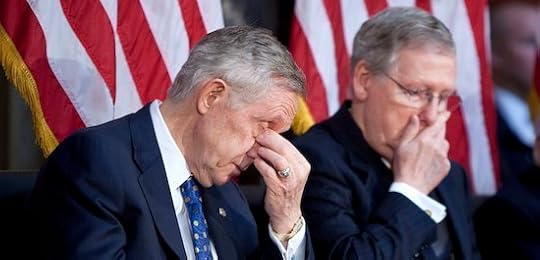
Harry Reid and Mitch McConnell are trying to strike a debt ceiling compromise:
But as long as Boehner struggles with his own members, the balance of power will shift back to Senate Majority Leader Harry Reid (D-Nev.), who has been negotiating with Minority Leader Mitch McConnell (R-Ky.).
“There is no question who would own a default after this episode, and that weakens the speaker’s position,” said a Senate Democratic leadership aide. “Reid now has [the] upper hand in pushing ahead with his Senate plan — possibly with a couple tweaks to get McConnell on board, but nothing that compromises our bottom line. Boehner, in turn, has little choice but to acquiesce to relying on Democrats to pass a bipartisan Senate plan through the House.”
Reid announced Friday that he will move forward with his proposal, which calls for just one vote to raise the debt limit, about $2.2 trillion in spending cuts and savings, and the creation of a special legislative committee to recommend a broader deficit-reduction package.
Reid invited McConnell to craft a deal.
To win Republican support, Democrats are considering adding stronger trigger mechanisms to move forward the joint committee’s recommendations. If the committee cannot reach agreement, one fail-safe under discussion could be directing Congress to cast an up-or-down vote on the Senate Gang of Six proposal, a $3.7 trillion package, according to Democratic officials.
The really weird thing about this negotiation is that Reid's bill is to the right of McConnell's. McConnell does require two extra votes to embarrass the Democrats. But Reid's plan requires $2.5 trillion worth of spending cuts, only half of which are the Afghanistan drawdown. Theoretically, Reid could "compromise" with McConnell by reducing his spending cuts in half.
I don't expect that. Both Reid and McConnell have signaled a willingness to accept a broad range of outcomes that ends the debt ceiling crisis. They're going to try to craft something that can pass the House and avoid deposing John Boehner. Still, I would like to see Reid propose a compromise plan that consists of accepting McConnell's proposal in toto.
The Very Small Sacrifice That's Not On The Table
 As Ezra Klein points out, John Boehner is facing the real problem that any passable debt ceiling deal will provoke a rebellion from his own caucus:
We’ve now seen the same farce play out four times. Republican leaders get close to a deal and then, just before they can close it, their members revolt and they have to pull back. The first time was when House Majority Leader Eric Cantor walked out of the Biden talks rather than discuss revenue. The second and third time when when Boehner walked out on the various iterations of the $4 trillion deal he had been cutting with Obama. And the fourth time is playing out right now. Boehner is rewriting his bill so that it links any increase in the debt ceiling to the passage of a balanced budget amendment.
The basic problem is this. Lifting the debt ceiling requires a bill that's acceptable to 217 members of the House, 60 Senators, and President Obama. The easiest way to get a bill like that would be to write something that passes the House with maybe 10-20% of House Republicans supporting it, and the rest of the votes coming from Democrats. Unfortunately for Boehner, such a scenario would probably result in House Republicans kicking him out of his job. So we're stuck relying on a vote coalition containing most of the House GOP caucus, which means relying on people who are extremely reluctant to raise the debt ceiling or to compromise at all.
So basically, we're risking mass financial havoc so that... John Boehner can remain as House Speaker, and not have to go be a lobbyist making way more money. That sounds like a bad trade-off for virtually in the world everybody except Boehner. (Boehner's family might even take that deal.)
It seems odd to me that, of all the potential pain we're contemplating here, the one sacrifice nobody seems willing to broach is John Boehner having to lose his Speakership and go be a lobbyist. Why is that? Wouldn't he love to be a still-powerful and plugged-in extremely rich guy who gets to play even more golf?
Jonathan Chait's Blog

- Jonathan Chait's profile
- 35 followers

