
Jonathan Chait's Blog, page 16
August 2, 2011
Paul Ryan Is Making Things Up Again
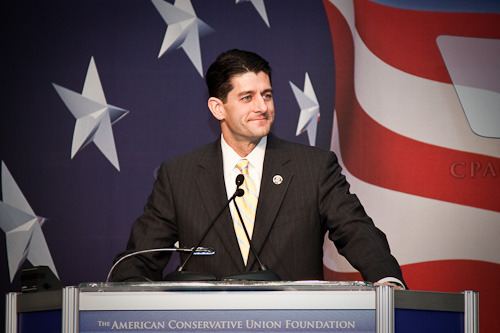
In a Wall Street Journal op-ed, he writes:
During the negotiations over raising the debt ceiling, President Obama reportedly warned Republican leaders not to call his bluff by sending him a bill without tax increases. Republicans in Congress ignored this threat and passed a bill that cuts more than a dollar in spending for every dollar it increases the debt limit, without raising taxes.
Yesterday, Mr. Obama signed this bill into law. He was, as he said, bluffing.
In fact, every media outlet has reported that Obama said this not with regard to passing a debt ceiling hike without tax increases, but in response to a Republican proposal to pass a short-term debt ceiling extension. this is not a subject of partisan dispute. Even Eric Cantor's version of the exchange confirms this:
The Cantor version:
Immediately upon leaving the White House on Wednesday night, Mr. Cantor and his aides offered their description of the clash.
It came at the end of the meeting, they said, when Mr. Cantor complained that Mr. Obama was constantly changing the amount of spending he was willing to cut, and Mr. Cantor raised the idea of increasing the debt limit in small, temporary increments over the next 18 months.
What about a short-term goal, Mr. Cantor asked?
The president “got very agitated, seemingly,” Mr. Cantor told reporters.
“Eric, don’t call my bluff,” the president said, according to Republican aides. “I’m going to the American people with this.”
I suppose what's interesting here is that Ryan is trying to present Obama as a weakling rather than as a fearsome, tax-crazed socialist.


&c
-- The People's Daily says that the U.S. has merely "pushed off" its sovereign debt problems.
--
How George Will lost his mind.
-- The nation turns its eyes to the Fed.
-- Extortion: it works and it's staying with us.
-- The debt ceiling may be resolved, but there's still the unresolved crisis in Europe dampening the markets.
What Should Liberals Demand From the Super Committee?
The next step of the deficit fight moves to the super committee, in which each party appoints members. Since the committee can't recommend any deficit reduction without a majority, each party has the incentive to appoint members unamenable to compromise. I would like to see the committee come up with a sensible bipartisan compromise. But since Republicans are already vowing to insist that any appointee disavow any increase in tax revenue, it makes sense for Democrats to reciprocate.
But what does "reciprocate" mean? Think Progress says that any member must oppose plans that don't contain revenue. Greg Sargent adds:
One idea making the rounds, which was first floated by Think Progress, is to demand that Nancy Pelosi and Harry Reid — who each appoint three members to the committee — pledge to only appoint people who will vow to hold the line on core liberal priorities.
At her presser today, Nancy Pelosi was asked by a reporter if she would do that, and she came close to endorsing the idea. Asked if she would “require” that her appointees to the committee draw a bright line protecting Medicare, Pelosi replied that protecting Social Security, Medicare and Medicaid benefits is a “priority” for Democrats.
Wait. Think Progress says the red line is revenue. Sargent is defining the red line as no entitlement cuts -- or, at least, quoting Pelosi sort-of defining it that way. These are completely different things!
You could agree to entitlement cuts on the condition that they come attached to more revenue. Think Progress's criteria would allow that, while Sargent's wouldn't. Meanwhile, Sargent's criteria would allow huge cuts to discretionary programs with no entitlement cuts or revenue, while Think Progress's would not. [Update: upon closer reading, Sargent is defining the criteria in terms of both revenue and entitlements.]
Personally, I like the Think Progress idea a lot more. I'd add my own twist to it. I'd insist on revenue as part of the deal, and I'd also insist that the revenue come outside of the framework of the Bush tax cuts. They can't agree to lock in large segments of the Bush tax cuts, sunset others, and define that as a revenue increase. Just leave that to 2012.
On the other hand, there is room to play with things like the Alternative Minimum Tax. That, as I've explained before, offers a path to raise revenue while not technically increasing taxes. I'm not going to go through my explanation again -- read my explanation if you're curious -- but it offers a way to increase revenue over the likely baseline if Republicans are inclined to cut a deal rather than sock it to the defense and medical industries.
The one commonality between all the liberal positions is the common belief that another all-cuts deal should not be acceptable. The default is a better option, even though it stinks.
How Clinton Foiled Debt Ceiling Extortion
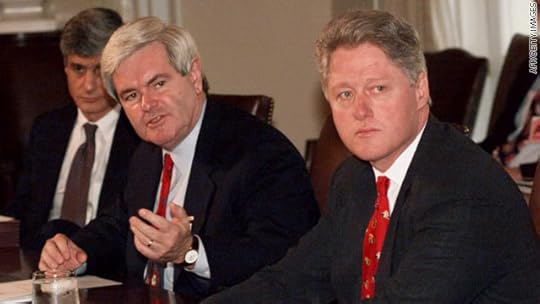
If you haven't already read Kara Brandeisky's story about how the Clinton administration handled the debt ceiling in 1995, you should definitely do it. As she notes, the circumstances were different in 1995. Republicans were somewhat less fixated on thed ebt ceiling, and also somewhat less destructive and crazy. But they weren't that much less destructive and crazy:
“Nobody should assume we’re going to have a debt-limit extension,” John Boehner warned. “If the vote were held today, it would not pass.” Sound familiar? This was Boehner in November of 1995, when he was the House Republican Conference chairman and his party was refusing to raise the debt ceiling unless President Bill Clinton agreed to a package of sweeping spending cuts.
The biggest single difference is that the Clinton administration simply refused on principle to get jacked up on the debt ceiling:
Still, even though Clinton enjoyed political and economic advantages that Obama does not, his no-compromises strategy had some clear advantages. Unlike Obama, he refused to let the threat of default set the national agenda. Because he would not enter into negotiations over the debt ceiling, the issue barely roused the public consciousness. On November 9, 1995, a senior administration official told the Washington Post, “Our position is it does not matter what they put on this legislation, we are not going to accept anything but clean bills because we will not be blackmailed over default. Get it? No extortion. No blackmail. What you hear are their screams of complaint as they realize we are not, not, not budging on this.”
Kind of hard to imagine somebody from this administration talking like that.
It's worth noting that the implications of this capitulation go beyond the current deal, which is not that terrible. Republicans are emboldened that they have set a new precedent for using the debt ceiling to extract concessions (it "establishes a pattern for when the debt limit expires in 2013," exults Keith Hennessey.) This would have dire consequences, writes Robert Greenstein:
Anticipating the policy battles to come, we should not lose sight of an alarming development. Those who have engaged in hostage-taking — threatening the economy and the full faith and credit of the U.S. Treasury to get their way — will conclude that their strategy worked. They will feel emboldened to pursue it again every time that we have to raise the debt limit in the future.
They also will likely continue insisting, in future hostage-taking efforts, that for every dollar we raise the debt ceiling, we must cut spending by a dollar, with no revenue allowed. When one considers that even the harsh budget plan of House Budget Committee Chairman Paul Ryan would require policymakers to raise the debt limit by nearly $9 trillion over the coming decade, one begins to understand the extraordinary results such a policy path would produce over time.
The even more serious problem as I wrote in my most recent TRB column, is the degree to which the debt ceiling represents a new era of crisis in American political institutions. We have a rickety political system that gives the opposition party power without accountability, and lacks any clear channels for resolving competing claims to legitimacy. Obama's weakness merely encourages more acts of brinkmanship, every compromise making it harder for him to make a credible public stand.
It's easy to overestimate Clinton's resolve in the golden light of history. At the time, the Clinton administration was freaked out, desperate to move to the center and highly amenable to compromise. Still, Obama needs to recognize that capitulating to economic hostage-taking creates long-term dangers -- not just to his agenda but to the health of American democracy.
Who Will Win The Supercommittee?
When two implacably opposed sides negotiate an agreement, often it's because they disagree on what the agreement means. The supercommittee plays this role in the debt ceiling deal. Tasked with finding $1.8 trillion in deficit reductions, or else triggering cuts to spending concentrated in defense, Democrats think they'll get a balanced solution and Republicans think they'll just roll the Democrats again. Here's former GOP staffer Keith Hennessey laying out the Republican view:
There is a simple Republican counter strategy available:
Speaker Boehner and Leader McConnell appoint to the Joint Committee six Members who will not raise taxes.
These six Republicans call the President’s bluff, and tell their Democratic counterparts they are willing to reject a deal that includes tax increases, even if that deal means the trigger will cut defense deeply. They deny the six Democratic Members of the Committee negotiating leverage from the difference between a triggered 10% cut in defense and an 8% cut in nondefense discretionary spending. “This is going to hurt you almost as much as it’s going to hurt me, so I’m not giving you anything to avoid it.”
These six Republicans encourage everyone to cooperate to get most (all?) of the $1.5 T in deficit reduction from the Big 3 entitlement programs: Social Security, Medicare, and Medicaid. They are the cause of our long-term fiscal problems and they are so big and growing so rapidly that you can save lots by changing them. ...
This means that all Republicans need to do is call the President’s/Democrats’ bluff on tax increases, threaten to allow the pain of the trigger hit both sides, offer $1.5 T of entitlement spending cuts, and wait.
You'd call that bluffing, except that liberals also seem to expect their side to roll over as well. Matthew Yglesias argues that it's follow to assume that health care and defense lobbyists, facing huge cuts in the event of failure, will lobby Republicans to compromise:
[H]ow about this scenario. First, Republicans refuse to agree to more revenue. Second, Democrats refuse to agree to a no-revenue deal. Third, lobbyists for the defense and health care industries get nervous. Fourth, lobbyists for the defense and health care industries remember that they are high-income people who don’t want to pay taxes. Fifth, executives at defense and health care industries remember that they are high-income people who don’t want to pay taxes. Sixth, executives at defense and health care industries start lobbying Democrats in swing districts, red states, or in which key weapons manufacturing or certain hospitals are major industries. Seventh, Democrats fold.
This scenario certainly wouldn't shock me. On the other hand, I suspect the recent negotiation has conservatives a little too giddy about the prospects for more hard-line negotiating, and liberals too depressed about the same. The supercommittee negotiation will be different than the debt ceiling negotiation in two important ways. First, the "trigger" of cuts to defense and Medicare is far less frightening to Democrats than the trigger of exploding the U.S. economy. Democrats succeeded in excluding programs for the poor from the trigger, specifically to make the cost of gridlock bearable.
Second, it's worth recalling that the Obama administration did insist that large entitlement cuts could be part of the budget deal only if Republicans agreed to higher revenue. Obama did hold that line. Agreeing to cut entitlements without new revenue would be crossing a different line, and it would represent a massive defeat for Democrats, as well as a political debacle.
It's also worth noting that the Republican position is, on its face, totally absurd. That position holds that no additional revenue at all can be considered. If we take them at their word, Republicans would turn down a compromise offering one dollar in higher taxes in return for a trillion and a half in entitlement cuts. That's obviously an extreme case, but what about cutting a few billion in oil company subsidies? A couple hundred billion in other loopholes?
That sets up the same contrast that existed during the debt ceiling showdown -- Republicans defended a vastly less popular position. Raising taxes for the rich and closing corporate tax loopholes is popular, even to a degree among Republican voters. Cutting entitlements is unpopular, even among Republicans. Democrats won the public opinion fight but couldn't press their advantage simply because they were terrified of a failed negotiation. In this instance, the Obama administration set the terms of the negotiation specifically so that failure would not terrify them.
They certainly might cave again. And Republicans probably won't agree to anything passable. But I do see gridlock or a deal with a reasonable level of revenue as more likely than another total Democratic cave in.
JONATHAN CHAIT >>
Gingrich: We're Living in Paul Krugman's America. Krugman: No, We're Not.
[Guest post by Gabriel Debenedetti]
Last night on “The O’Reilly Factor,” pseudo-presidential candidate Newt Gingrich called President Obama’s tenure a “Paul Krugman presidency.” Gingrich confidently explained that Obama “believes that stuff. He believes in left-wing economic ideas.”
It is possible that the nature of Krugman’s worldview is one of the few subjects beyond the reach of Gingrich’s encyclopedic knowledge. A sampling of Krugman’s commentary on the president who has, allegedly, built his presidency on following Krugman:
• “Back when the original 2009 Obama stimulus was enacted, some of us warned that it was both too small and too short-lived. … By the beginning of 2010, it was already obvious that these concerns had been justified.” The Mistake of 2010, June 2
• “Obamacare was very much a second-best plan, conditioned by perceived political realities.” Vouchercare Is Not Medicare, June 5
• “Last December … Mr. Obama agreed to extend the Bush tax cuts—a move that many people, myself included, viewed as in effect a concession to Republican blackmail.” To the Limit, June 30
• “Watching the evolution of economic discussion in Washington over the past couple of years has been a disheartening experience. Month by month, the discourse has gotten more primitive.” Corporate Cash Con, July 3
• “Mr. Obama’s people will no doubt argue that their fellow party members should trust him, that whatever deal emerges was the best he could get. But it’s hard to see why a president who has gone out of his way to echo Republican rhetoric and endorse false conservative views deserves that kind of trust.” What Obama Wants, July 7
• “Ever since the current economic crisis began, it has seemed that five words sum up the cenral principle of United States financial policy: go easy on the bankers.” Letting Bankers Walk, July 17
• “These are interesting times—and I mean that in the worst way.” The Lesser Depression, July 21
• “At the time of writing, President Obama’s hoped-for “Grand Bargain” with Republicans is apparently dead. And I say good riddance.” Messing With Medicare, July 24
• “The cult of balance has played an important role in bringing us to the edge of disaster.” The Centrist Cop-Out, July 28
And the kicker(s), from Krugman’s latest column, lovingly titled, “The President Surrenders”: “A deal to raise the federal debt ceiling is in the works. If it goes through, many commentators will declare that disaster was avoided. But they will be wrong. … Did the president have any alternative this time around? Yes. … Make no mistake about it, what we’re witnessing here is a catastrophe on multiple levels.”
The Islamic Center Near Ground Zero, Take 2
[Guest post by Isaac Chotiner]
The New York Times has a long report today on what the paper calls the "new, quiet effort" to build a Muslim community center near Ground Zero. The piece can be read from a number of angles, or with varying degrees of optimism. Yes, the project is moving forward. But:
[The project's developers] have also embraced what they call a slower, more deliberate and more realistic approach to the project, acknowledging it will take years of hard work to determine what kind of facilities Muslim and non-Muslim visitors want and need, to raise money, and to build public support. That means it could be five years before they even try to begin any physical transformation of the property, now a bare-bones building that once housed a Burlington Coat Factory store. And the Muslim center might never become the 15-story, $100 million edifice that the developers had once envisioned, and that some opponents had labeled a “megamosque.”
As nice as it is that Sharif El-Gamal, the main developer, is working toward his goal, the "sensitivities" that he is now forced to shower on the project's opponents, and on the city more generally, are wince-making.
He has severed ties with the project’s original imam, Feisal Abdul Rauf. He has crisscrossed the country to attract donors, built relationships with neighborhood groups and Muslim organizations and recruited the aunt of a 9/11 victim to his advisory board--all things he says he should have done before going public last year.
The problem here is that El-Gamal is at least partially acquiescing to the absurd idea that the 9/11 families should have some say in whether an Islamic center is built near Ground Zero. And there is more:
He said the ultimate form of the center, called Park51, and its building would be determined after consultation with two main audiences, residents of Lower Manhattan and Muslims who live in New York, New Jersey and Connecticut. Mr. El-Gamal also said he would assess the community response to the events now held at Park51’s makeshift space, varying from art exhibits and yoga and Brazilian martial arts classes to Muslim holiday observances and a discussion for Muslim and non-Muslim children about bullying. “If the community only wants four or five floors, it’s going to be four or five floors,” Mr. El-Gamal said.
Again, there is nothing precisely wrong with this, but it does give the impression that El-Gamal has to tiptoe around everyone's sensitivities. And of course there are the center's longtime opponents:
The 10th anniversary of 9/11 this fall poses a new challenge for the center. Pamela Geller, a blogger who drove much of the opposition, has called for a protest on Sept. 11 near Park51; her Web site promotes a film, “The Ground Zero Mosque: Second Wave of the 911 Attacks.” The language employed by Ms. Geller and Robert Spencer, another blogger who writes about threats from Islam, is under new scrutiny after their views were cited by Anders Behring Breivik, who confessed to killing scores of people in Norway on July 22 because of his fears of a Muslim takeover; Ms. Geller and Mr. Spencer have denied any responsibility for Mr. Breivik’s actions.They are not the only opponents. In the campaign for a special election to fill an open House seat serving Brooklyn and Queens, the Republican nominee, Bob Turner, is accusing his Democratic opponent, David I. Weprin, of being insufficiently hostile to the Muslim center.
The completion of this center, if it ever occurs, will be a victory for tolerance and decency. In the interim, we can be assured of more ugliness from some of the development's opponents.
No, Obama Was Not Too Demanding With Boehner
[image error]I'm still shocked and dismayed that President Obama tried so hard to cut a budget deal with Republicans that, in return for enormous concessions, would have raised no more revenue than we'd get if the Bush tax cuts for income over $250,000 expire on schedule. William Galston, by contrast, argues that Obama blundered by asking for too much revenue, thereby blowing up the negotiations:
If news accounts are accurate, the Obama/Boehner talks broke down when the president proposed increasing the revenue component of the grand bargain from $800 billion to $1.2 trillion. Given what he ultimately accepted, $800 billion looks pretty good. (How likely is it that the new congressional committee will be able to agree on anything approaching that figure?) To be sure, we’d have to know more than we do about the other components of the proposed deal, especially the changes in entitlement programs, to reach a solid all-things-considered judgment. And it’s not at all clear that Boehner’s fellow Republicans in the House would have gone along with him on such a bargain, either. But it has been widely reported that the White House shifted its stance only after the Gang of Six made its framework public. If the bipartisan G6 was proposing $1.2 trillion in revenue increases, how could the White House accept less? At the time, that must have seemed like a slam-dunk argument. But it was too clever by half, and the White House ended up throwing away a chance to promote the president’s “balanced” approach to deficit reduction … and, by the way, to drive a wedge into the massed ranks of the opposition.
I have a few disagreements here. First, Obama's request for more revenue did not blow up the negotiations. Here's the Wall Street Journal tick-tock:
The White House asked for an additional $400 billion in tax revenue, saying it was needed to get enough Democratic votes. White House officials say they got no signals the request would be a deal-breaker. But by week's end, the deal was dead.
On a Friday night, July 22, the president and Mr. Boehner held dueling news conferences, each blaming the other for the breakdown. The next day, the president called Mr. Boehner and offered to return to the $800 billion target, trying to save the deal. Mr. Boehner declined.
A Republican aide has also confirmed that Obama quickly abandoned his request for more revenue when Boehner balked. I think this is totally clear. The request for more revenue did not blow up the negotiations. The negotiations foundered on Boehner's inability to sell his party on any increase in revenue.
Second, the Gang of Six did not agree on $1.2 trillion, as Galston says. It agreed on $1.8 trillion. The numbers are confusing because there are several different baselines for comparison. The Gang of Six used what the Congressional Budget Office calls a "plausible baseline," which assumes that after 2012 the Bush tax cuts on income under $250,000 continue but the tax cuts on income over that threshold expire, as Obama has insisted. The Gang of Six agreed to increase revenue by $1 trillion over that baseline, in part because anybody who studies the federal budget understands that even major cuts to federal spending require significantly more revenue than the plausible baseline for the government to operate.
Obama was asking for zero revenue over the plausible baseline. And that was far too much for Republicans to accept, because it would have forced them to acquiesce in the partial expiration of the sacred Bush tax cuts. Even so, it was a giveaway for Obama that would have resulted in the government spending years choosing between large deficits and crippling basic functions of the state. Obama was nuts to make that offer, but thank goodness Republicans refused to accept it.
Obama Administration Frighteningly Slow On The Uptake

The post-mortems on the debt deal are showing the degree to which, as I've suspected, the Obama administration completely misunderstood the Republican Party. Laura Meckler and Gerald Seib's tick-tock is especially good. Here are the negotiations bumping up against the fundamental ideological divide in American politics:
The next day, a Friday, a small group of Boehner confidantes warned the speaker about the political risks of working with the president. "The danger to him is making a deal with no one standing behind him," said one. "We wanted to be sure he understood that, and was going into it with his eyes open."
Meantime, the two sides couldn't agree on a key principle for how the tax code should be structured. The White House wanted to state up front that the code would at least maintain existing "progressivity," meaning the wealthy would bear the same share of the tax burden as they do now. Mr. Boehner's team balked, saying too many middle-class Americans pay no income taxes at all now.
Right -- the Republican desire to reduce the progressivity of the tax code is its central political goal. It's not going to compromise on that in a negotiation where Republicans are holding a gun to Democrats' heads. How did the administration not understand this?
And this part bordered on total parody:
The White House asked for an additional $400 billion in tax revenue, saying it was needed to get enough Democratic votes. White House officials say they got no signals the request would be a deal-breaker. But by week's end, the deal was dead.
On a Friday night, July 22, the president and Mr. Boehner held dueling news conferences, each blaming the other for the breakdown. The next day, the president called Mr. Boehner and offered to return to the $800 billion target, trying to save the deal. Mr. Boehner declined.
Within a few days, the White House would realize that taxes wouldn't be part of any agreement.
Within a few days? Years and years of cementing absolutist anti-tax fervor wasn't enough? Then, after they backed away from a wildly slanted agreement for the second or third time, refused to take phone calls, declared the deal dead, it took a few more days?
Laura came home that night and told Jim that she h ad spent the night with her ex-boyfriend. Jim asked that she agree to stop doing so, and when she refused to answer, he withdrew the request. She told him she despised him, left the apartment without saying where she was going, and would not take his repeated phone calls.
Within a few days, Jim realized the relationship was in trouble.
I suppose, to make the analogy work, Laura would have to have spent the previous couple decades working as a prostitute and authoring a series of tracts denouncing monogamy.
August 1, 2011
How the Debt Committee Could Turn Republican Against Republican
Grover Norquist is always filled with triumphalist theories, and his book elucidates one favorite Norquist claim, that shrinking revenue will turn the Democratic coalition (the "Takings Coalition") against itself in a cannibalistic orgy:
The Takings Coalition can hold together as long as there is more money flowing into the state to finance the demands of each constituent group. Higher taxes can give more money to the government workers; keep the big-city political machines financed; send more government grant money to the universities and the “nonprofit sector; and fund the coercive utopians. The Takings Coalition thrives when the government is growing in resources and power. The coalition holds together when the scene looks like the par of the movie after the bank robbery where the robbers meet around a table and the boss divvies up the loot. But when the Leave Us Alone Coalition succeeds in cutting off the flow of tax dollars, where we put our foot on the air hose, when we say “no new taxes” and mean it, then those sitting around the Takings Coalition table see that there is not enough money for everyone in the gang.
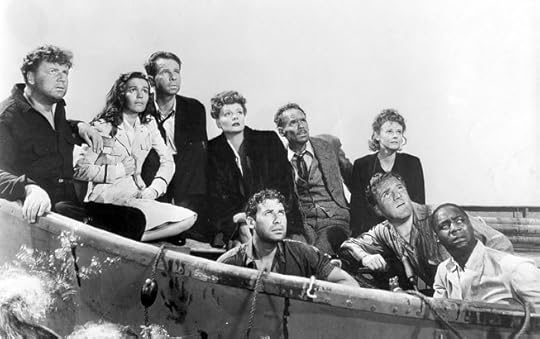
At that point the assembled members of the Takings Coalition begin to look like the scene in the lifeboat movie where everyone must decide whom to eat or throw overboard. This is when we clearly see that the left is not made up of friends and allies. They are competing parasites. If we refuse to send them even more of our tax dollars, they will gnaw on each other.
I thought of that quote when I saw the reaction to the debt ceiling bill. The bill, as you probably know, fulfilled the right-wing demand that absolutely not one penny of extra revenue be raised, and therefore contains significant defense cuts. In other words, the members of the conservative coalition looked around and decided to eat the defense hawks. Ross Douthat writes one of the more delicious observations I've seen in a while:
This clarifies something that’s been increasingly obvious for a while: The interests of right-wing tax cutters and right-wing defense hawks do not necessarily align with one another, and they will continue to diverge as we go deeper into the looming age of austerity. There is simply no scenario in which the United States will close its yawning deficits exclusively with cuts to popular social programs: One can imagine such a world only by imagining the Democratic Party and all its various constituencies out of existence entirely. Conservatives will be free to argue that both tax hikes and defense cuts should be off limits, but in political reality at least one of the two will have to give. ...
At the moment, the hawks are at a clear disadvantage. From Rand Paul to Grover Norquist, there’s a broad constituency within the conservative movement for shrinking the national security state, either as a compromise necessary to keep domestic spending low or as an end unto itself. But there’s no mirror-image constituency among hawks for raising tax revenue for the sake of maintaining the Pax Americana. I’m pretty sure that Bill Kristol or Charles Krauthammer would vastly prefer, say, capping the home mortgage tax deduction or closing the carried-interest loophole for hedge funds to making “massive cuts in the defense budget.” (And I bet that the great neoconservative hope, Marco Rubio, would as well.) Yet the Weekly Standard took the same line on the debt ceiling negotiations that other conservative outlets did: No revenue increases, no grand bargain, etc. The result?
The result, at the risk of spoiling your enjoyment, is that Kristol is not happy. Quite the turn of events. Here was Kristol, loyally serving the party for years on end, including its monomaniacal hatred of taxes, in the belief that this would give him a veto in the one corner of policy he actually cares about, defense and foreign affairs. Kristol was happily chortling along with the party's plan to hold the entire economy hostage to its demands to slash spending and hold revenue low, confident all along that this couldn't impact the $700 billion a year we spend on defense. And then, wham, before he knew what was happening, the hostage was out of the closet he was helping guard, and he was standing in his place with duct tape around his wrists. Funny how that works.
The dynamic is going to get really interesting in the fall. That's when phase two begins. A bipartisan committee is tasked with reducing the deficit by $1.8 trillion, and if the committee's plan fails, huge automatic cuts to Medicare providers and defense will go into effect. Michael Scherer explains the political logic. The idea here is that the normal mechanisms that force parties to compromise have failed. So, instead, the alternative scenario (huge cuts to the medical and defense industries) is designed to mobilize those lobbyists to force the two parties to strike a deal:
So to save their own skin, military contractors, who spent $146 million lobbying Congress in 2010 with more than $16 million in political donations from PACs, will have to get in the game, urging Republicans to find savings in other places. In practice, that will likely mean new revenue, collected by ending corporate tax breaks and eliminating expenditures. If the plan works as Democrats would like, Republicans will be forced to raise taxes with the help of the military industrial complex....
Hospitals have already started running ads on cable television protesting the potential cuts, under the banner of a group called The Coalition To Protect America’s Health Care. But simply advocating against cuts will not be enough. Like defense contractors, they are the hostages now, and they must advocate for Democrats and Republicans to come together on a final deal in the fall, before the trigger gets pulled. In the deficit debate, Congress has proved itself inept at fighting for the common interest. In turning the gun on special interests, they are essentially outsourcing that job to Washington’s most effective actors.
I actually think the design of this plan is fascinating. You take a couple of the most powerful forces preventing major policy change -- partisan gridlock and special interest influence -- and turn them into forces for change by rejiggering the default setting.
It's going to get interesting. Liberals widely assume they'll just get rolled once again, as Republicans will insist on zero revenue, and Democrats will cave. I'm not so sure. For one thing, the trigger really is finally balanced. Last December, inaction on taxes meant an economy-crushing tax hike at a really bad time for Democrats. This summer, inaction on the debt ceiling meant economic cataclysm at an even worse time, the cost of which would mostly be born by President Obama. But the inaction trigger in the fall will be something genuinely painful to both parties.
The anti-tax movement has held absolute sway within the GOP for two decades. But it's worth noting that the GOP has never had to choose among its constituencies in a zero-sum fiscal environment before. The policy of huge tax cuts and big defense spending hikes could coexist as long as Republicans could just run up the budget deficit. The party refused to reconcile its contradictions by refusing to acknowledge fiscal reality. Higher revenue to pay for the wars? Reagan proved deficits don't matter. It's easy to hold all your factions together when you refusing to acknowledge basic accounting properties (deficits equal expenditures minus revenue, not just "too much" expenditures by definition.) George W. Bush made the defense hawks happy, made the medical industry happy with a prescription drug bill designed to maximize their profits, and made rich people in general happy with a series of regressive tax cuts.
But imagine Democrats insist on higher revenue, and they decide, sensibly enough, that failure to cut a bipartisan deal is better than $1.8 trillion in cuts. (Which is probably is.) Then what? Well, then the entire defense lobby plus the entire medical and insurance lobbies turn fiercely against the very people with whom they had marched shoulder-to-shoulder under Bush. If the Democrats hold the line and insist on more revenue, the committee has the potential to split the GOP coalition wide open.
The Wall Street Journal editorial page, sounding slightly nervous about the committee, insists the Republicans stack their nominations with anti-tax absolutists:
GOP leaders Mitch McConnell and John Boehner have to be especially careful in their choice of appointees. No one from the Senate Gang of Six, who proposed tax increases, need apply. The GOP choices should start with Arizona Senator Jon Kyl and House Budget Chairman Paul Ryan, adding four others who will follow their lead.
Well, they can try. But it's not like the Gang of Six was filled with tax hikers, either. The simple fact is that trying to formulate rationale answers to the fiscal challenge without raising revenue is essentially impossible. The Journal no doubt hopes the Republicans follow the traditional course -- the course that has held the party together since 1990 -- of simply ignoring reality. The difference is that this time, reality will be knocking urgently on the door.
Jonathan Chait's Blog

- Jonathan Chait's profile
- 35 followers

