
Jonathan Chait's Blog, page 15
August 4, 2011
Jason Bateman Goes Negative On His Movie
I don't think I've ever seen a movie star attempting to promote his own film go negative in quite the way Jason Bateman did in his Daily Show interview the other day. Jon Stewart needles him about the premise of the movie, and he replies:
It's crap. It's garbage. But here's what I'm going to promise you. While it is a tired, some would say "pleasantly familiar" premise... our obligation, gang, is to please you post-switch, right?
Having made that very substantial concession, he proceeds to sell the movie in a way that's nearly convincing. I'm not going to see that movie, but it's an awesomely honest piece of spin.
The Daily Show With Jon Stewart
Mon - Thurs 11p / 10c
Jason Bateman
www.thedailyshow.com
Daily Show Full Episodes
Political Humor & Satire Blog
The Daily Show on Facebook


What Caused The Deficit? A Reply To Megan McArdle
One of the most effective Republican themes of the last two years has been blaming President Obama for the explosive growth in the budget deficit since 2009. The accusation that "Obama's spending binge" has blown up the deficit has discredited any further fiscal stimulus, and helped encourage Republicans to use the debt ceiling as a hostage. The White House fought back with a chart showing that its policy changes contributed only a small fraction to the worsening deficit picture:
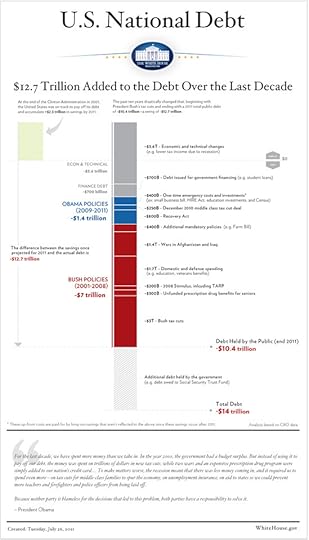
Megan McArdle dismissively responds, "The duck starts here." Her rebuttals are extraordinarily weak. McArdle begins:
this graph attributes decisions made by Obama and an all-Democratic Congress--like doubling down in Afghanistan--to Bush, while taking responsibility for basically nothing except the stimulus. When Obama extends the Bush tax cuts for the rich under pressure from Congressional Republicans, that disappears from his side of the ledger, because after all, he didn't want to do it. When Bush enacts Medicare Part D under pressure from Congressional Democrats, the full cost is charged against his presidency. The list of such silliness goes on.
The notion that Bush passed his prescription drug bill "under pressure from Congressional Democrats" is bizarre. Republicans controlled both houses of Congress at the time, and exerted massive pressure to pass the bill. The coalition that squeezed the bill through after the vote was held open for hours consisted of 207 Republicans and 9 Democrats. Some pressure!
McArdle is probably correct that Bush only endorsed the concept of extending Medicare coverage to prescription drugs in order to avoid being outflanked on a popular issue, just as Obama did on middle class tax cuts. But Bush did not have to design the bill so as to maximize profits for the insurance and pharmaceutical industries, rather than to maximize value for taxpayers. The Republicans also suspended the pay-as-you-go rules, which, had they remained in place, would have forced them to offset the cost of providing prescription drug coverage. When Democrats won back the House, they reinstated those rules, forcing them to offset the cost of the Affordable Care Act, which as a result was far more painful and less popular than if they had simply put the whole thing on the credit card as Bush's Republicans did.
McArdle ends this passage by asserting, "The list of such silliness goes on," but she does not continue the list. If Medicare prescription drugs is her best example, I suspect the list does not go on at all. Instead, she turns to her next point, which is to point out that budget deficits have in fact been higher under Obama than under Bush:
It's not really very easy to look at these graphs and tell a story where the deficit is 1.6% under George Bush in 2007, and then suddenly balloons to 10% under Obama a few years later--and does so almost entirely as a result of policies initiated under George W. Bush, and only those initiated under George W. Bush. (Not because of say, Medicare, Medicaid, and Social Security.) What changed about Bush policies that made them so much more expensive once Barack Obama took office?
Nor is it exactly obvious to look at the $2.4 trillion in additional debt incurred during Bush's eight-year presidency, and say that he is nonetheless actually responsible for $7 trillion of our current debt load--and then turn to the $3.1 trillion of debt incurred during Barack Obama's three-year presidency, and declare that his policies are actually responsible for only $1.4 trillion.
What changed about the Bush policies that made them more expensive when Obama took office? What changed is that the economy underwent its deepest crisis since the Great Depression. Bush inherited a budget that was structurally balanced, which became a large surplus at the peak of the business cycle. His policies turned it into a budget that was structurally in deficit even at the peak of the business cycle. And then when the economy collapsed, those structural deficits became massive.
McArdle is implying, without quite openly arguing, that presidents should be judged on the deficits that occur under their watch, not on whether their policies increase or decrease the deficit. This ignores the reality that the business cycle plays a huge role in year-to-year deficits. Take George H.W. Bush. His policies significantly reduced the deficit. But the deficit ran at extraordinarily high levels under his presidency, and McArdle's data would suggest he was a massively irresponsible president. In reality, what happened is that he presided over a recession and the necessary bailout from the Savings and Loan crisis, which bloated the deficit despite his (eventually successful) efforts to tame it.
It also ignores the reality that the U.S. political system makes significant policy change hard, and that raising taxes or reducing spending tends to be unpopular. Status quo bias is enormous. It's bizarre and unrealistic to treat the federal budget as a kind of blank slate for which a president bears responsibility once he assumes office. If George W. Bush had not cut taxes, does McArdle think Obama would have set tax rates at the current level? Of course not. But, once established, that policy requires immense political capital to overturn.
Finally, McArdle turns to a theme she's explicated before -- she's tired of hearing excuses about who caused the deficit. She wants Obama to take responsibility and fix it:
Settling whether "Bush policies" or "Obama policies" were the "cause" of the deficit wouldn't tell us a damn thing about what we should do--unless you're the sort of person who thinks that the most important fact about a policy is who was president when that policy was enacted. ...
These seem like more important questions than which items to put in the "Bush" ledger and which items to put on the "Obama" side. And I'm afraid that the White House graphic doesn't offer any answers.
McArdle is insisting here that we shouldn't care who caused the deficit, we should care about fixing it. That is a strange case to make immediately after trying to affix Obama with the blame for the deficit. It seems also to assume that understanding which policies caused the deficit interfered with the task of reducing the deficit. I don't understand the logic of this. It might make sense of Obama were arguing that the fact that he inherited the deficit absolves him of any responsibility to address it, but in fact Obama is arguing the exact opposite of that.
Indeed, Republicans are the the party determined to attach the questions of "who is responsible" and "what should we do." The Republicans have proceeded from the erroneous premise that Obama's spending caused the explosion of the deficit to their syllogistic assertion that "we have a deficit because the government spends too much, not because it taxes too little." Given that they have done so, Obama's effort to recontextualize the cause of the deficit is highly relevant to the solution.
McArdle's item contains a great deal of signalling about her lack of interest in partisan finger-pointing, such as disdaining "the sort of person who thinks that the most important fact about a policy is who was president when that policy was enacted." Obviously, you can care about both long-term fiscal re-balancing and determining which policies led to the deficit. Elected officials often enact policies whose effects, good or will, are felt long after they depart office, complicating the ability of voters to assign responsibility, and giving the officials an incentive to take short-term benefits and long-term costs. Determining which policies led to what outcomes seems like an important function in an electoral democracy.
Please, Tim Geithner, Don't Go
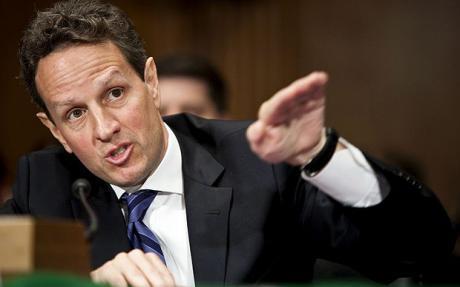
The New York Times floats a list of possible successors to Tim Geithner. My lord, this is horrific:
Among those named by people familiar with administration thinking are Jamie Dimon, the chief executive of JPMorgan Chase; Jeffrey R. Immelt, the chairman of General Electric and of Mr. Obama’s Council on Jobs and Competitiveness; Roger Altman, a deputy Treasury secretary in the Clinton administration; and Erskine Bowles, a former White House chief of staff to President Bill Clinton and co-chairman of Mr. Obama’s fiscal commission in 2010.
I think the way to understand this is that Altman wrote a Wall Street Journal op-ed in 2009 asserting that "the views of industry often coincide with those of independent voters." The basic premise that Obama's most fundamental error has been to offend business is the key premise of his new chief of staff, Bill Daley. It informs the selection of all the names on the list, who come from finance, not economics. Which is not to say that they don't have some, even many, liberal beliefs. And the notion that Obama has to move to the center out of sheer political expediency is not wrong. But the whole analysis that the center is more or less the view from the boardroom is totally daft. What Obama needs right now is to fill in the gap from the economists who have departed his administration. That list suggests a very different goal.
JONATHAN CHAIT >>
August 3, 2011
&c
-- It's a "Great Contraction" not a "Great Recession." And that means we need some inflation.
-- But where are the Fed appointees?
-- How Nancy Pelosi bailed out John Boehner.
-- Bloomberg surveys economists. And the survey says: strong chance that everything is screwed.
-- The consequences of the autism-vaccine myth.
-- David Frum's Susan Sontag moment.
Matt Damon's Bad Defense Of Teacher Tenure
Matt Damon appeared at a rally this weekend held by the anti-education reform left, and this video exchange between him and a Reason reporter is getting a lot of attention:
It's certainly nice that Damon wants to defend teachers. But, first of all, the fact is that not all teachers are dedicated and good. A few are lazy and bad. Their badness and laziness has serious consequences for children, because it is extremely hard in practice to fire even obviously incompetent teachers.
Damon gives voice to the old idea of teaching as a monastic profession, a difficult job with bad wages. He concludes that only people motivated by love of children would do it, which may be widely true but is probably not universally true.
What's more, his entire vision rests on maintaining teaching as a monastic profession. The old liberal slogan always demanded that we "treat teachers like professionals." That entails some measure of accountability -- we can debate the metrics -- which allows both that very bad teachers be fired and that very good ones can obtain greater pay and recognition. That's the definition of a professional career track, and the current absence of it is what drives most of the best college graduates into other professions.
Damon argues that teachers love their jobs, and therefore that career incentives are irrelevant to their performance. Well, I love my job. I love it so much that if somebody handed me $10 million and I never had to work again, I'd still do it. Nevertheless, if I were guaranteed a fixed salary that was tied to my tenure, I would work a lot less hard than I do.
Fox News Journalistic Integrity Goodness
I'm not sure how many readers are going to be interested in this, but I've been dragged into a pissing match between right-wing pseudojournalist Andrew Breitbart and various lackeys and critics thereof. A couple days ago, Breitbart clipped an exchange in which Norah O'Donnell asked Jay Carney about Democratic objections to the debt ceiling deal. Commentary quoted a portion of the clip to make it appear as though O'Donnell was describing those objections as her own.
I wrote about Commentary's misleading item. The Huffington Post stole aggregated the item, adding the twist that Breitbart had doctored the clip, for which it's since apologized.
Follow all that? Okay, meanwhile, various right-wing bloggers have hurled invective at me, and the Fox News story seems to finger me as the culprit for the Huffpo's inaccurate version:
The Huffington Post took their information from The New Republic’s Jonathan Chait, who claimed that the clip did not include a portion of the video where O’Donnell led into the quote by saying that Democrats were upset about the debt, not the reporter herself.
A careful examination of the clip reveals that it was not doctored at all by Breitbart, but that the beginning of O’Donnell’s quote was shrouded by ambient noise.
In fact, I did not claim Breitbart doctored the clip. Here is what I wrote:
Andrew Breitbart has clipped an exchange from today's press at conference at the White House. In the exchange, reporter Norah O'Donnell press Jay Carney by asking, "Democrats are saying, 'You gave them everything they wanted and we got nothing." Commentary has picked up the story, giving it the headline, "CBS's O'Donnell to Carney: We got nothing."
For any readers who don't read block quotes -- I assume this includes whoever writes stories for Fox News -- I specifically wrote that Breitbart clipped the entire exchange, and Commentary misleadingly edited the quote. Let me repeat: I did not accuse Breitbart of doctoring the quote. I accurately described Breitbart as clipping the entire question.
I'd huff and puff about how Fox News should be apologizing for leveling a false accusation in a story about false accusations but... eh, what's the point.
"It Takes Balls To Execute An Innocent Man"
 Alexander Burns and Maggie Haberman have a story for Politico about Rick Perry's limitations as a general election candidate. It's a really excellent piece on its own terms, but at the same time, it's a bit of a parody of a Politico story in that it takes a vital moral question, drains it of all its moral significance, and presents it in purely electoral terms. The thesis of the piece is that Perry appeals to very conservative white southerners, but not to anybody else, making him a questionable choice to head the Republican ticket. The piece bears out that thesis pretty well. In the middle it includes a glancing reference to one episode of Perry's gubernatorial tenure:
Perry would also have to answer for parts of his record that have either never been fully scrutinized in Texas, or that might be far more problematic before a national audience.
Veterans of Sen. Kay Bailey Hutchison’s unsuccessful 2010 primary challenge to Perry recalled being stunned at the way attacks bounced off the governor in a strongly conservative state gripped by tea party fever. Multiple former Hutchison advisers recalled asking a focus group about the charge that Perry may have presided over the execution of an innocent man – Cameron Todd Willingham – and got this response from a primary voter: “It takes balls to execute an innocent man.”
The Willingham case is just one episode in Perry’s gubernatorial tenure that could be revived against him in the very different context of a national race, potentially compromising him in a general election.
If you're not familiar with this episode, David Grann wrote about in for the New Yorker in 2009 in what may be the single greatest piece of journalism I have ever read in my life. (I am biased, as David is a friend and former colleague.) The upshot is that Perry is essentially an accessory to murder. He executed an innocent man, displaying zero interest in the man's innocence. When a commission subsequently investigated the episode, Perry fired its members.
It is telling that the political culture that has nurtured Perry is so morally demented that demonstrating that he blithely executed an innocent man is not a political liability. This probably does have some electoral ramifications worth exploring. But I also couldn't read that piece without imagining a Politico story about Hitler. ("Opposition researchers are combing through Mein Kampf, which could become grist for devastating attack ads, especially in the crucial Florida primary.")
The Crazy Baseline Fight

There's a really strange fight brewing between the Obama administration and Republicans over which baseline the supercommittee should use to measure its deficit proposals. The baseline is the comparison the Congressional Budget Office uses to figure out how much a policy change saves. Republicans say the baseline needs to be "current law."
Why does that matter? Current law says that the Bush tax cuts expire. All the bipartisan commissions that came up with deficit plans that lose tax revenue compared with current law. That is, they set tax levels that would bring in less tax revenue than if all the Bush tax cuts expire at the end of 2012, but more revenue than if we extended all of them. The essence of the bipartisan agreements is setting revenue somewhere in the midpoint of those two outcomes (full extension and full expiration.) That's the way to arrive at a Grand Bargain.
Still with me? Okay.
Conservative Republicans don't want a Grand Bargain, because that would entail agreeing to phase out at least some of the Bush tax cuts, which as everybody knows constitute one of the most successful policy interventions in U.S. -- nay, world -- history. So locking in the current law baseline means that any tax bargain like that would be scored as a tax cut -- saving only some of the Bush tax cuts would cost the government revenue against the baseline of letting all the Bush tax cuts expire. So conservatives like Paul Ryan are insisting that that the supercommittee tasked with coming up with deficit reduction is required to follow the current law baseline. Former GOP staffer Keith Hennessey agrees with Ryan. Gene Sperling disagrees.
I don't really know who's right about the technical merits. In general, I think that if both parties wanted to strike a tax deal that scored a tax reform that lost revenue compared with current law as saving money, they would do it. The CBO works for Congress, not vice versa.
But the reason this is all so strange is that I hope the Republicans are right. If the supercommittee uses current law as a baseline, then it can't lock in any of the Bush tax cuts. Before the debt ceiling deal, Obama kept trying to get Republicans to agree to a tax reform that would lock in more than $3 trillion of the Bush tax cuts, foregoing only about $800 billion in revenue. That's no more revenue than Obama would get if he simply vetoes extension of the tax cuts on income over $250,000. (And if Obama isn't around in 2013, it won't matter what deal he cuts, because the next Republican president is going to cut taxes.)
Under the Republican interpretation, the supercommittee can still raise revenue. It could close tax loopholes without dealing with the Bush tax cuts. That means any revenue it gets would be on top of the revenue from expiring the Bush tax cuts. In other words, it's a way better situation for Democrats.
This is why I said that this debate is so strange. Each party seems to be arguing against its own interest.
Now, why are Republicans arguing this? Because they're absolutists. They don't want to agree to something that increases taxes, even if that would merely take the place of a tax hike that's scheduled to occur anyway. In other words, they're binding themselves from taking some version of the wildly generous offer Obama kept trying to give them.
But why the administration would be fighting this is rather disturbing. Obviously, it wants to try again to give away the tax store and get Republicans to take it. Yet it seems perfectly obvious that they won't. Republicans view the Bush tax cuts as a sacred totem. So, why not just try to pitch them on closing a few tax loopholes in return for some entitlement trims?
How Should Democrats Stop The Next Hijacking?

President Obama may have escaped from the debt ceiling hostage standoff having incurred minimal damage to his agenda, but the long-term damage to the health of the U.S. political system appears to be quite high. Republicans have shown that the debt ceiling makes an effective hostage for the Congressional party to demand concessions from an opposing-party president. Mitch McConnell boasts that this tactic will become a regular part of American politics. This is a nightmare -- a constant ticking bomb that is bound to go off at some point.
How should Democrats treat the issue going forward? Michael Shear of the New York Times predicts Democrats will start reciprocating:
Given the proven power of the issue, it is not hard to imagine a future in which a Democratic minority finds it in their interests to advance a top priority by threatening to hold up a debt ceiling increase for a Republican president.
That would seem rather hypocritical for current Democrats, who all accused their Republican counterparts of playing fast and loose with the American economy. But politicians rarely worry too much about hypocrisy. And given enough time, political realities shift.
As a practical matter, I doubt this. In order to hold the debt ceiling hostage, you need, at the very least, extremely high levels of party discipline (in the House and the Senate, lest the upper chamber openly break ranks and isolate your hostage-taking wing.) You also probably need a propaganda apparatus that can create its own empirical reality in which the experts who warn that failing to lift the debt ceiling would create dire consequences are all wrong. I don't think the Democratic Party has either of these.
But let's think about the question from an abstract perspective. Shear asserts that it would be hypocritical for Democrats, having denounced hostage-taking, to use the tactic themselves. But of course if Democrats refrain from using it, we'll live in a world where this is simply a tactic that comes out whenever we have a Democratic president and Republican control of the House (or even merely Republican control of 41 seats in the Senate.) Under that scenario, of course Republicans would block any attempt to eliminate debt ceiling hostage-taking. Why would they agree to eliminate something that provides them with leverage against democratic president s but is never used against their own?
It seems to me that, if Democrats want to eliminate this dangerous new tactic -- as they should -- they can neither unilaterally disarm nor simply ape the Republicans. The correct tactic would be to jack up the next Republican president, demanding policy concessions in return not for lifting the debt ceiling but abolishing it altogether.
Somebody please save this item and remind me of it the next time we have a Democratic House and a GOP president. The way the economy is bringing down Obama and the House Republicans insanity is bringing down themselves, this could be as soon as January 2013.
Will The Supercommittee Be Different This Time?
There's been some debate over whether the supercommittee will simply deadlock over the Republican refusal to raise any taxes, or whether Republicans will roll Democrats again and force another all-cuts budget deal. I am less sure, in part because the alternative to a deal (huge cuts to medical providers and the military) frightens Republicans as much as Democrats. Pay close attention to this rhetoric:
Democrats said the threat of such large automatic defense cuts would give them powerful leverage to renew their demand that Republicans consider tax increases for corporations and the wealthy as part of the solution to the nation’s budget problems.
“Republicans are going to have to decide whether it’s more important to protect special-interest tax breaks or whether it’s more important to protect the national security of the United States,” said Rep. Chris Van Hollen (Md.), the senior Democrat on the House Budget Committee.
“That’s the choice they’re going to have to make.”
In an interview, Senate Minority Leader Mitch McConnell (R-Ky.) agreed that the trigger is “really catastrophic,” and that the consequences of not coming up with a bipartisan debt-reduction plan would be “unacceptable.” Referring to the new committee, McConnell said, “We all view this as a real deal.”
But Sen. Jon Kyl (Ariz.), the No. 2 Republican in the Senate — who is widely viewed as one of McConnell’s likely picks to serve on the panel — called the fate of the tax issue uncertain.
“What remains to be seen is whether any discussion of taxes is appropriate,” Kyl said. “I think it’s pretty unlikely.”
It's Republicans now emphasizing we have to make a deal. And it's Democrats sounding perfectly willing to walk away from the table. Note, also, that Jon Kyl sounded a less-than-absolutist note about revenue.
I'm certainly not predicting a deal. I'm just saying that we shouldn't assume that this episode will play out like the last one.
Jonathan Chait's Blog

- Jonathan Chait's profile
- 35 followers

