
Jonathan Chait's Blog, page 22
July 25, 2011
Why It's So Hard For Republicans To Accept A Deal With Obama
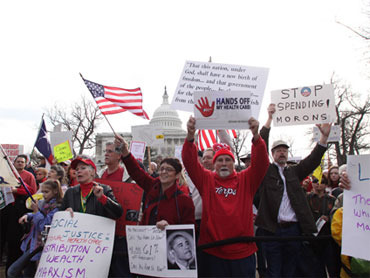
One of the underrated impediments to a debt ceiling hike is the Republican belief that any agreement with President Obama is by definition a bad one. Part of this is the rational partisan urge to deny Obama a big accomplishment he could use to position himself for 2012. Another is a simple heuristic. Budget agreements are convoluted and require assumptions about how present agreements will bind future actors. If you consider Obama a socialist, then anything he agrees to by definition can't be a moderate deficit-cutting program to reduce government.
Obviously, we can't get into the heads of various Republicans and suss out their mental processes. But you can almost prove that this phenomenon is occurring via a simple thought experiment. Obama has signaled his support for at least two major deficit-reducing agreements. When presented with these plans, conservatives have two major decisions to make. One is, does this constitute a genuine (or supportable) deficit-reduction program? And two, is Obama's support for it genuine?
In theory, these would be two separable questions. You could map out conservative reactions into four boxes, representing the four yes/no positions on those two questions. In reality, conservative reaction has broken down into just two positions. You have those who dislike the plan while agreeing that Obama supports it, and those who like the plan in question but doubt Obama supports it. The other two boxes (like the plan and agree that Obama supports it, and dislike the plan and doubt Obama supports it) appear, as far as I can see, empty.
So, for instance, when word leaked of an Obama-Boehner Grand Bargain, you had the Wall Street Journal editorial page denouncing the deal for raising taxes. Charles Krauthammer, by contrast, described the details as "offers of surpassing scope and reasonableness," but insisted they could not be real because they were being proffered behind closed doors. The Journal opposed the reported plan, which allowed it to accept reports of the plan's details, while Krauthammer liked the details, which forced him to angrily deny its existence. Other conservative commentary I've seen has fallen into these two categories.
Likewise, last week the Gang of Six came out with a deficit proposal. After both Republicans and deficit scolds assailed him for failing to openly endorse the deficit commission's plan last December, this time Obama embraced the Gang of Six. Conservative reaction again fell into the same two camps. You had conservatives attacking the Gang of Six. (This was the majority reaction, as the Gang of Six plan was significantly more liberal than the deal Republicans had walked away from with Obama.) You also had conservatives praising the Gang of Six but assailing Obama. See Peggy Noonan's column this weekend:
It is time for the president to get out of the way....
The other day he announced the Gang of Six agreement with words that enveloped the plan in his poisonous embrace: "I wanted to give folks a quick update on the progress that we're making." We're. He has "continued to urge both Democrats and Republicans to come together." What would those little devils do without Papa? "The good news is that today a group of senators . . . put forward a proposal that is broadly consistent with the approach that I've urged." I've urged. Me, me, me.
That approach includes "shared sacrifice, and everybody is giving up something." He was like a mother coming in and cheerily announcing: "Dinner's served! Less for everybody!"
We're trying to begin a comeback, not a famine. We're trying to take actions that will allow us to grow.
He's like a walking headache. He's probably triggering Michele Bachmann's migraines.
The Gang of Six members themselves should have been given the stage to make their own announcement, and their own best case.
The president, if he is seriously trying to avert a debt crisis, should stay in his office, meet with members, and work the phones, all with a new humility, which would be well received. It is odd how he patronizes those with more experience and depth in national affairs.
This is more or less what a Republican staffer inadvertently conceded when he told Mike Allen that Obama's embrace killed the Gang of Six plan. Republicans simply may not have the emotional capacity to accept a bargain that they don't see as a humiliation for Obama. Obama seems to have figured this out, and is trying to let Democrats in Congress make the deal for him. The Journal has favored just raising the debt ceiling even without policy concessions, and is trying to pitch a compromise ironed out within Congress as a repudiation of Obama's negotiating skills. (Today's editorial argues, "it says something that the country has a better shot of getting something out of a divided Congress than it does out of the Oval Office."
The Journal seems to view this angle as the best way to get conservatives to back down -- sell them on cutting a deal with Democrats in Congress, and present this as a repudiation of Obama. Well, whatever works for them.


House GOP: Obama Engineered The Crisis
A House Republican offers this GOP spin, per Mike Allen:
“President Obama blew up any chance of a bigger agreement with his insistence on tax hikes and by backing away from some of the serious structural entitlement reforms he agreed to rhetorically. He has only himself to blame. The President desperately wants a large debt limit increase that will take him past the next presidential election. Republicans will not give him a $2.4 trillion blank check he can use throughout his re-election campaign to continue the spending binge that has driven our nation to the brink of a job-destroying downgrade and default.
“He is trying to set up a no-win situation for taxpayers: either he gets his $2.4 trillion blank check, or America defaults. Republicans will put forward a responsible, common-sense proposal that reflects the principles of Cut, Cap and Balance and which can pass both chambers. As the deadline approaches it would be inexcusable and indefensible for the President to veto a plan that preserves the full faith and credit of the United States simply because it's inconvenient to his re-election campaign.”
Even by the standard of political spin, this is really pretty amazing. Consider some of the Alice-in-Wonderland assertions here. Obama acceded to large cuts in discretionary and entitlement spending in return for much smaller tax hikes that are scheduled to occur anyway. The Republican aide presents this as Obama blowing up the deal. Obama blew up the deal, by insisting on giving 80% instead of 100%.
Next we have the claim that the debt ceiling increase is a "blank check." Oh, really? You mean, once the debt ceiling is higher, Obama can spend as much money he wants on anything at all? No, I'm pretty sure Congress has to appropriate the money.
And then, piggybacking on this bizarre counterfactual assertion, the ultimate Orwellism: "He is trying to set up a no-win situation for taxpayers: either he gets his $2.4 trillion blank check, or America defaults." First he's defined a debt ceiling hike as a "blank check." Now it's Obama who's setting up a devil's choice of a blank check or default. But the choice between raising the debt ceiling and defaulting is literally the definitional nature of the debt ceiling. That's not Obama's choice. Indeed, nobody in politics ever considered it a choice at all until the House Republicans viewed it as an opportunity to take the economy hostage.
I suspect the House republican believes very little of this spin. It is a measure of how far the GOP has to go in order to present itself as the innocent party in a hostage crisis it initiated and has deepened by refusing to accept as payment anything short of the total ratification of its governing agenda.
THE DEBT CEILING >>
Boehner's Lowest Common Denominator Plan
David Frum wonders why Republicans have decided to push for another debt ceiling vote in 2012:
House Republicans apparently regard the early renewal of the debt-ceiling debate as a feature, not a bug. It means that they can resume the debate over debt and deficits in the election season.
Except – I thought the 2012 election was supposed to be about the economy? Jobs and the Obama administration’s disappointing record of creating them?
Isn’t that the winning issue?
Why the eagerness to change the subject in 2012 to Republican plans to end the Medicare guarantee for those now under 55?
Isn’t that a big loser?
Nate Silver asks the same thing:
Not clear to me why GOP want another debt limit fight in the winter. Obama's polling isn't good on this, but theirs is terrible.
It's a good question. One possible explanation is that some Republicans are in denial about the Ryan plan's unpopularity. Another explanation is that extending the political and financial chaos into an election year increases the chances that Obama will be seen as a failure, and improves the prospects for a Republican nominee from outside Washington to pose as the savior.
But I don't think either of these is really the driving factor. My analysis is that John Boehner simply doesn't have the votes. Between members who hate raising the debt ceiling and members who hate taxes and members who hate cutting a grand bargain with Obama (however favorable the terms), he can't do anything. So the default plan, as it were, is to do nothing: Keep the debt ceiling hanging around, don't make a deal, don't raise taxes. Boehner's plan seems entirely designed to minimize objections within his caucus.
The plan is to avoid offending Republicans, keep Boehner in his role as Speaker for another six months or so and see what happens next. It's not really a great plan from any perspective, unless you're John Boehner and the alternative is being relieved of your power in short order.
Debt Ceiling Hypocrisy Madness!
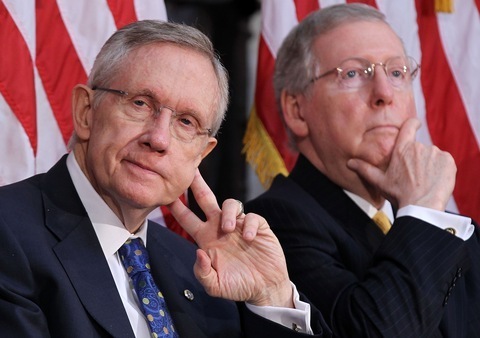
The next step in the debt ceiling showdown appears to be the release of the Senate Democratic proposal. Harry Reid is preparing to include large savings from the drawdown of the Afghanistan war, and Republicans are preparing to call this a gimmick. The Washington Post reports:
[P]eople familiar with the months-long search for a debt-reduction compromise said that hitting such a large target without raising taxes or cutting entitlement programs would probably require Reid to rely heavily on savings from ending the wars in Iraq and Afghanistan — a figure budget analysts said could easily amount to more than $1 trillion over the next decade.
Counting money not spent on wars that the nation is already planning to end is widely viewed as a budget gimmick, and House GOP leaders have been reluctant to include it as savings.
Republicans may have been "reluctant" to include it as savings, but their budget did in fact include it as savings:
What’s the difference between what Chairman Ryan claims and what his plan really does? The chairman claims that his plan generates $5.8 trillion in spending cuts over ten years, relative to the Congressional Budget Office (CBO) baseline. But that number falls by $1.5 trillion — to $4.3 trillion — once one corrects for two things:
$1.3 trillion in “savings” from the official CBO baseline that comes merely from the fact that the Ryan plan reflects the costs of current policy in Iraq and Afghanistan. The CBO baseline contains a large anomaly related to the costs of the Iraq and Afghanistan wars. Following the rules governing budget baselines, CBO’s baseline mechanically assumes that current levels of U.S. operations — and costs — in Iraq and Afghanistan will continue forever rather than phasing down in accordance with current policy. The CBO baseline figures are thus much higher than the costs of current policy. Ryan himself said earlier this year on National Public Radio — in attacking President Obama’s 2012 budget proposal for not doing enough to reduce deficits — that simply showing the costs of current policy in Iraq and Afghanistan produces “phantom savings” from an anomalous baseline, not real deficit reduction.
Maybe the GOP budget should have had a category distinguishing reluctant savings from enthusiastic savings.
As CBPP points out, we've already gone through this dance one time. President Obama included $1.3 trillion in phony savings from Afghanistan, then Paul Ryan attacked him for it, and then Ryan used those same savings. Now it seems we're going to continue the cycle.
July 24, 2011
What's John Boehner Up To?
 The White House has really drawn just one bright line in the debt ceiling debate -- it won't sign a short-term extension. The reason is that resolving the issue will only get harder as the election draws nearer, and the window for a market panic widens. So John Boehner has unveiled his plan and it's... apparently a short-term extension of the debt ceiling:
In a conference call with House Republicans, Speaker John A. Boehner (R-Ohio) called for the party to unify behind a plan that he declined to detail, saying he would provide more information when lawmakers return to the Capitol Monday. But aides in both parties said they expected Boehner to press ahead with a two-stage strategy that would give the Treasury only about $1 trillion in additional borrowing authority, forcing another debt-limit battle early next year when the parties are embroiled in the heat of the 2012 presidential campaign.
What is Boehner thinking? Here's my guess. He's got a faction that opposes raises the debt ceiling on principle unless and until President Obama has agreed to implement the entire Republican fiscal agenda. He's got another faction that's willing to cut raise the debt ceiling, but fiercely opposes any tax hike. They're willing to raise the debt ceiling without any deal -- that is, they support a version of the Mitch McConnell plan -- and they also oppose a deficit agreement that would allow President Obama to move to the center on fiscal policy. But you have a larger group that regards the McConnell plan as a sell-out.
Basically, Boehner doesn't really have the votes for anything. He doesn't even have the votes for Cut, Cap and Balance, because that requires a supermajority in each house to pass a Constitutional amendment.
So he's reduced to the lowest common denominator. That's a plan that only temporarily lifts the debt ceiling, pleasing the faction that opposes lifting the ceiling, avoids any tax increases, pleasing the anti-tax absolutists, and provokes a confrontation with Obama, pleasing the political hardball faction. It also positions the party as having voted to lift the debt ceiling past August 2nd, thus providing the party with an argument for laying the blame on Obama if and when dire consequences occur.
How should Obama respond to this apparent move? He needs to veto it, for two reasons. First, as he's said, extending debt ceiling chaos into the election year will only worsen the crisis. And second, abandoning his one true demand would prove that he's willing to capitulate on anything at all. This would set up a second debt ceiling showdown in which Republicans would be emboldened to make even more maximalist demands.
Meanwhile, Harry Reid is preparing to unveil a bill to cut $2.5 trillion from the budget, with no tax increases. That is what I think the best solution is anyway. I hope to explain more of my thinking of this soon. But the short answer is that, as long as the Bush tax cuts are unresolved and scheduled to expire, neither party is likely to agree on taxes because they don't agree on the alternative scenario. The answer is going to be to cut spending and let the elections determine whether the next step involves revenue or deeper cuts.
July 23, 2011
Why Conservatives Abandoned Monetarism
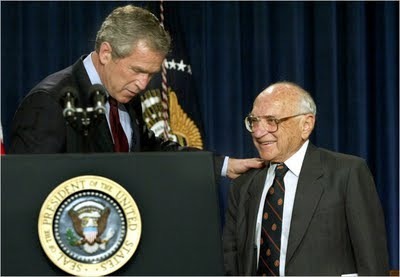
asks why conservatives have almost uniformly abandoned Milton Friedman's monetarist views in favor of various hard-money approaches:
Mr Friedman died a beloved figure of the free-market right. Yet it does seem that his influence on the subject of his greatest technical competence, monetary theory, immediately and significantly waned after his death. This suggests to me that Friedman's monetary views were more tolerated than embraced by the free-market rank and file, and that his departure from the scene gave the longstanding suspicion that central banking is an essentially illegitimate criminal enterprise freer rein.
I see two factors at work here. First, Friedman, in his time, was counterposed against the more big government alternative of Keynesian fiscal policy. The height of Friedman coincided with the height of liberal confidence in using Keynesian policies to fine tune the economy. (Ironically, many center-left economists concluded that liberals took this way too far, wanting to use fiscal policy to respond to even mild downturns, and believed it should be reserved for liquidity traps. Many of those same liberals -- I'd count Larry Summers and Paul Krugman among them -- are looking at the gravest economic crisis since the depression and saying, yes, this is the time for Keynes.) Friedman thus represented the "conservative" vision of anti-recessionary policy.
Second, what you're seeing now is less an intellectual change than a simple partisan one. When George W. Bush was president and the economy turned down in 2011, essentially nobody on the right questioned the need for the Federal Reserve to cut interest rates. The level of interest in Austrian economic thought at the time was zero. I quickly pulled up a few articles from the Washington Times, which is the easiest searchable database of mainstream movement conservative thought circa 2001. A small sampling follows.
Donald Lambro, April 23:
Alan Greenspan and the Federal Reserve Board, trying to repair the damage they did to the U.S. economy with six straight interest-rate boosts, seem to have learned a valuable lesson - at our expense.
Remember when Mr. Greenspan said interest-rate increases were needed in 1999 and early 2000 to cool the economy in order to keep an inflationary Godzilla (which only Mr. Greenspan could see) from terrorizing us? In fact, there never was any inflation to speak of.
Washington Times editorial, May 15:
On four previous occasions this year, Federal Reserve Chairman Alan Greenspan and his central bank colleagues have slashed short-term interest rates by one-half percentage point, cumulatively reducing the federal funds rate to 4.5 percent from 6.5 percent. If the Fed waited too long to respond to the economy's slowdown, the subsequent enthusiasm with which the Fed has cut interest rates has gone a long way toward compensating for any delay in its initial response. However, the Fed's work on the monetary-policy front at this stage in the business cycle is not finished. When the monetary policy-making committee meets today, another one-half percentage-point cut is in order.
Jack Kemp, October 31:
My best reading of the economic data is that we are in a deflationary recession inadvertently created by the Federal Reserve Board...
Congress and the president must demand an end to deflationary monetary and insist that the Fed replace discretionary monetary policy based on targeting short-term interest rates with monetary policy based upon targeting market price signals.
News story, November 7:
House Speaker J. Dennis Hastert applauded the Fed's action and called on the Senate to follow the House's example and pass an economic-stimulus package that could be on President Bush's desk by Thanksgiving.
"I believe it's fairly obvious that more than just rate cuts are needed" to restore lost jobs and get the economy growing again, the Illinois Republican said.
(Note the appearance here of fiscal stimulus, another concept Republicans embraced when a Republicans was in the White House, despite a dramatically weaker case for it on the merits compared with 2009-2011.)
I don't think conservatives have all adopted hard money views out of conscious cynicism. Rather, it's a familiar psychological process. Their understanding of monetary policy is shallow. Their understanding that economic growth is the key variable impacting their return to power is keen. They're going to be attracted to an argument that tells them that any measures to boost growth, whether fiscal or monetary, will have dangerous side-effects.
July 22, 2011
Obama Gets Mad

Two interesting developments emerged tonight. The first is that the Grand Bargain appears dead. Interestingly, and contrary both to public reports and the tenor of President Obama's press conference, Obama himself drew a line. The two sides had at some point discussed a deal that would raise $800 billion in revenue over the next decade -- a terrible deal, no more than Obama would gain by fulfilling his promise to veto more Bush tax cuts for income over $250,000 a year. The two sides dispute the degree to which they ever agreed on this level.
It seems likely that John Boehner tried to sell his caucus on a deal, met resistance, and then walked away from the negotiations, which seems to keep happening. Boehner, countering Obama's narrative that he "can't say yes to anything," says it was Obama who upped his demands. This line seems a little suspicious:
“It’s the president who walked away from his agreement and demanded more money at the last minute.”
Prior to the breakup, discussions were already underway among Senate leaders Friday about how to proceed. Boehner has indicated some openness to a four to six week extension to get past the immediate crisis. But this short term approach still faces resistance in the Senate, where Majority Leader Harry Reid ruled it out directly Friday night as “unacceptable.”
“The deal was never reached, and was never really close,” the speaker wrote in a letter to House members
It seems hard to square Boehner's claim that Obama walked away from his agreement and that no agreement ever existed. It's possible that Obama altered his offer, asking for more revenue in return for higher entitlement cuts. But if they didn't have a deal, then Obama couldn't have walked away from it.
Indeed, Boehner's spin seems like an attempt to walk the awkward line between portraying himself to the general public as willing to compromise, and convincing conservatives that he never compromised. Boehner released a letter making his case, published by Jennifer Rubin. It's pretty transparent:
The White House agreed to a revenue total that would set a ceiling of about $800 billion in new revenue over ten years that could be generated through economic growth and efficiencies in our tax system (not tax hikes).
•After the ‘Gang of Six’ plan was released, and in the wake the reaction from Hill Democrats, they moved the goal posts and insisted on $400 billion more in higher taxes – a 50% increase – and wanted that to the floor instead of the ceiling.
The first paragraph says that higher revenue came from "economic growth and efficiencies," which implies that the revenue was produced through dynamic scoring voodoo. (I doubt the administration would agree to that, and I know the Congressional Budget Office wouldn't score that.) The next paragraph refers to Obama's demand for "$400 billion more in higher taxes." So, the agreed to revenue was just "efficiencies and economic growth," while the revenue Boehner rejected was "higher taxes"? Really? I think pretty obviously it was all higher revenue from eliminating or reducing tax expenditures.
But Obama insisted on $1.2 trillion, which is still a bad deal -- $800 billion less than the Gang of Six agreed to -- though somewhat less so. After moving further and further, and further right, Obama finally stopped.
Perhaps what's more interesting is the tone of Obama's press conference. It was the most heated I'd ever seen him. And it was also the first time I can recall that he fully abandoned his stance as above the fray and spoke as the leader of the Democratic Party.
This was not a total break with his familiar persona. There was still the imploring his opponents to compromise, insisting upon his reasonableness. But he assailed Republicans for refusing to compromise, for failing even to consider the public good as opposed to the pressure of conservative activists. Whether it was an attempt to pressure Republicans to make a deal, or to set the tone for his 2012 campaign, we don't yet know. Perhaps Obama doesn't either. But it was a fascinating glimpse of the Trumanesque figure liberals have long waited to see emerge -- an Obama-ized Truman, castigating republicans for refusing to move to the center, but a Trumanesque figure all the same. perhaps he is figuring out that a political and policy strategy based on the getting Republicans to meet him halfway isn't likely to work very well.
&c
-- George Packer’s New Yorker comment on the debt ceiling is pitch perfect.
-- Paul Campos on Grover Norquist and the metaphysics of taxes.
-- Marxist Socialist jokes.
-- Shocker from Gallup: “Basic lack of money remains Americans' foremost financial concern”
-- Why Newt Gingrich’s latest is the “most inaccurate, least intellectual book about our nation’s past” that Michael Kazin has ever read
Boehner Walks; Obama Talks
I have to run, but both John Boehner's latest walk away from the debt ceiling deal and President Obama's press conference tonight were major events. I'll have more to say in a post later this evening.
Thank You, Willis Carrier
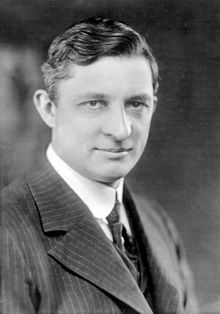 On this day, we can all give thanks to Willis Carrier, inventor of air conditioning:
In 1906, Carrier discovered that "constant dew-point depression provided practically constant relative humidity," which later became known among air conditioning engineers as the "law of constant dew-point depression." On this discovery he based the design of an automatic control system, for which he filed a patent claim on May 17, 1907. The patent, No. 1,085,971, was issued on February 3, 1914.
On December 3, 1911, Carrier presented the most significant and epochal document ever prepared on air conditioning – his "Rational Psychrometric Formulae" – at the annual meeting of the American Society of Mechanical Engineers. It became known as the "Magna Carta of Psychrometrics." This document tied together the concepts of relative humidity, absolute humidity, and dew-point temperature, thus making it possible to design air-conditioning systems to precisely fit the requirements at hand.
With the onset of World War I in late-1914, the Buffalo Forge Company, for which Carrier had been employed 12 years, decided to confine its activities entirely to manufacturing. The result was that seven young engineers pooled together their life savings of $32,600 to form the Carrier Engineering Corporation in New York on June 26, 1915.
Carrier descended from deep Yankee stock, including an ancestor who refused to confess to witchcraft:
The first Carrier in America was Thomas, who arrived in Massachusetts around 1663. There is historical evidence that Thomas was born in Wales in 1622 and that he was a political refugee who assumed the name "Carrier" upon coming to America.[6] Thomas married Martha Allen, daughter of Andrew Allen, a first settler of Andover, MA. After standing up against the Andover town fathers in a boundary dispute, she was accused of being a witch. Two of her sons, aged 13 and 10, were hung by their heels until they, too, testified against her. Cotton Mather denounced her as a "rampant hag" whom the Devil had promised "should be the queen of Hell." She was arrested, convicted and, on August 19, 1692, hanged on Salem's Gallows Hill. Later it was recorded that of all the New Englanders charged with witchcraft, "Martha Carrier was the only one, male or female, who did not at some time or other make an admission or confession."
The lineal descent from a woman hanged for witchcraft (and boldly refusing to confess) to a brilliant scientific mind that made such a vast contribution to human progress is a wonderful expression of the triumph of science and reason.
Stay cool!
Jonathan Chait's Blog
- Jonathan Chait's profile
- 35 followers

