
Jonathan Chait's Blog, page 27
July 15, 2011
Tim Pawlenty Takes Early Lead in the Walter Sobchak Primary
[Guest post by Matthew Zeitlin]
In this exchange with Tim Pawlenty, conservative economist Larry Kudlow points out that failure to raise the debt ceiling means economic disaster, and that it will be impossible to get the Senate to pass an ambitious “cut, cap and balance” plan. In light of these facts, would Pawlenty still back a debt ceiling hike?
Pawlenty responds that the best strategy is to “draw some lines in the sand”:
One interesting part of this is that Pawlenty eventually backs a last-ditch plan that has Obama requesting a raising of the debt ceiling every one or two months, instead of every six months as McConnell’s plan calls for. Besides the “double Gitmo”-esque level of pointless policy amplification, it is noteworthy that even Pawlenty can envision eventually supporting a plan that would raise the debt ceiling in exchange for now-major policy concessions. What’s even more interesting is that Pawlenty’s approach to negotiation on the debt ceiling is strongly reminiscent of Walter Sobchak’s:
And as for how Pawlenty plans to get 5 percent GDP growth every year for ten years? If you will it, it is no dream.


The Tragedy of Tim Pawlenty
TNR writer Walter Shapiro recently spent a month on the Tim Pawlenty beat, reporting a profile for the latest issue of the magazine. Shapiro found an ambitious, meticulous, details-oriented politician who is everything the Republican electorate says they want in a nominee, but who is failing to gain traction:
PAWLENTY HAS ALWAYS displayed a striver’s zeal for advance planning and perfectionism—and that may well be his defining trait as a politician. “He is a great strategist,” says Steve Sviggum, who became house speaker at the same time Pawlenty was elevated to majority leader. “When we would negotiate as majority leader and speaker, he’d have the endgame mapped out in advance and have already figured out alternative ways to get there.” But Sviggum was both amused—and occasionally irked—at Pawlenty’s penchant for sweating the small stuff. “Tim would re-work almost every line in every news release,” Sviggum recalls. “He would get into minute detail, and there were times that he’d try to manage too much.”
That same obsession carried over to the governor’s office. “He was a very detail-oriented governor,” says Charlie Weaver, who was Pawlenty’s first chief of staff. “When it came to the legislature, he’d read every bill. He’d read every press release. He’s a nit-picker. It used to drive me crazy.” Hanson, who was deputy chief of staff at the time, says: “It was Trivial Pursuit every time I’d brief the governor. He’d ask questions until I missed one. The game was how long could we go before he got me.”
Although it rarely comes up on the campaign trail, a potential president’s administrative style matters more than his predictable response to the one hundred thirty-ninth straight question about his expectations for the Iowa Straw Poll. When I asked Pawlenty about his reputation for detail-obsessed management—even citing Weaver’s nit-picking comment—he acknowledged, “That may have been true in the past, but it isn’t true more recently.” Harking back to his transformation from a legislator with a tiny staff to a governor in 2003, Pawlenty said that he adopted “a more delegating style” as he “got a bigger team and got a team that I trusted.” But the former governor also conceded that “the need to micro-manage more or macro-manage more depended on who was working for me at the time.”
The topic clearly hit a nerve with Pawlenty. When I attempted to move on and ask a question on an entirely different subject, Pawlenty interrupted me. “On this nit-picker issue,” he began—and then launched into another protestation that he had evolved since Weaver worked for him.
Read the entire story here.
"Modest Adjustments," Trillions Saved?
[Guest post by Alex Klein]
The president's press conference didn't contain any major new revelations on the debt ceiling; POTUS didn't accept a deal, propose a new one, or threaten to resign. But commenting on the Balanced Budget Amendment, Obama did dangle something interesting about Medicare and Medicaid. Counter Ryan and Coburn-Lieberman, Obama said "we don't have to do anything radical" — like benefit cuts — in order to fix the programs. Rather than "gut" them, Obama proposed "modest adjustments [which could] save trillions."
"It turns out that making some modest modifications in those entitlements can save you trillions of dollars."
If he's talking about the "Biden framework" for cuts here, the math looks a bit fuzzy. Is the "trillions" number part of the 1.1 trillion total cut already outlined in Obama's 2012 budget? That seems a bit of a stretch. And according to the Cantor slides, Biden plan discretionary cuts to health programs only amount to $350 billion.
So, if Obama is still married to "modest adjustments" that "save trillions" on Medicare, that means the Grand Bargain is very much still in play. This would imply, as usual, means testing and a new benefit structure. But importantly, and much to the woe of Jonathan Cohn, it would also have to mean a "modest adjustment" to the Medicare age. So although the president dodged a direct question about raising the eligibility age, the imperative is still very much present in his rhetoric. The president is sending smoke signals about an age raise, whether he realizes it or not.
Krauthammer Having Trouble With Concept Of Bargaining
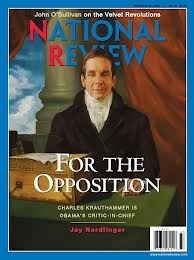 I'm on vacation, but this Charles Krauthammer column in my morning paper is so wildly obtuse I cannot restrain myself from blogging about it. Krauthammer argues that President Obama's claim to favor a deficit reduction deal is phony because he's offering it in closed door negotiations:
All of a sudden he’s a born-again budget balancer prepared to bravely take on his own party by making deep cuts in entitlements. Really? Name one. He’s been saying forever that he’s prepared to discuss, engage, converse about entitlement cuts. But never once has he publicly proposed a single structural change to any entitlement.
Hasn’t the White House leaked that he’s prepared to raise the Medicare age or change the cost-of-living calculation?
Anonymous talk is cheap. Leaks are designed to manipulate. Offers are floated and disappear.
Say it, Mr. President. Give us one single structural change in entitlements. In public.
The basis for this argument is Krauthammer not understanding, or pretending not to understand, the concept of negotiation. Allow me to give an example. Suppose the New York Times wanted to hire Krauthammer away from the Washington Post. The Times offers Krauthammer $50,000 a year to take the job. Krauthammer asks for $60,000. Now, imagine the Times says that Krauthammer's willingness to accept its offer is fake. If he wants to make this deal, then why doesn't he publicly announce that he wants to come write for the Times?
Because -- he's only willing to work for the Times if they meet certain conditions! Meanwhile, he understands that publicly conceding his willingness to give up his side of the bargain (I'll leave my job and come work for you) without getting what he asks in return would make a negotiated settlement impossible. Obama is willing to cut entitlement spending if and only if Republicans make policy concessions in return. He is not willing to offer unilateral concessions.
Indeed, Obama has been operating all along on the principle that unilateral public concessions will make it harder to reach a deal. Pundits have lambasted him for "ignoring" Bowles-Simpson, when in fact he's simply been signalling that he wants to bargain along the lines the commission established. It's worth keeping in mind that the Republican members of that commission voted against the plan.
I'm pretty sure that Krauthammer is smart enough to understand how negotiations work. He simply chooses not to understand.
The Continuing Fracturing of the GOP Over the Debt Ceiling
[Guest post by Matthew Zeitlin]
Lawrence Kudlow, as pure a supply sider as there is, makes noises that sound like what a decent number of Republican congressmen describe as “alarmism”:
Senator McConnell is determined to produce something from this grand-design package. He’s a smart guy. He may be saving the GOP from itself. McConnell believes that debt default must be completely taken off the table. That’s the thinking behind his debt-ceiling proposal, unless overturned by two-thirds of a congressional vote.
He strongly believes that Republicans must disassociate themselves from any debt default or downgrade by the ratings agencies. And he recognizes that the monthly revenue and spending numbers are so unbalanced that the idea of revenue allocations in the event of no debt-ceiling hike is simply not feasible or desirable.
Other Republican sources are telling me they do not want to risk the destruction of the dollar as the world’s reserve currency by allowing a debt default or a downgrade. Eighty million checks have to go out. Otherwise the GOP could be blamed.
So one way or the other the tide is turning toward a deal. Credit McConnell’s uber-clever stratagem.
When Mitch McConnell, Lawrence Kudlow and Bill Gross are all agreed that failure to raise the debt limit could lead to economic disaster, and for the first two, a huge political loss for Republicans, the rationale for the McConnell plan becomes very obvious. Now, it seems, there is not only a wedge driven between the business community and the base of the Republican Party, there is now a division between the supply-siders and the base, and even between those who prioritize Republican political power over all else and the Republican base.
Look, Lawrence Kudlow understands that there is no chance of tax cuts in a debt ceiling deal, and from the Republican perspective, things were getting uncomfortable with talks of any revenue increases. Moreover, he says what I imagine many Republicans already know: that the GOP would likely be blamed for the resulting downgrade, interest rate hikes and chaos that resulted in a failure to raise the debt limit.
These considerations are what have lead supply siders and Republican loyalists like the Wall Street Journal editorial page, Fred Barnes and Jennifer Rubin to praise McConnell’s plan so passionately. And yet there is still a sizable section of the Republican caucus that simply will oppose any plausible deal.
A split between the business wing of the party and the base is certainly unexpected, but not totally impossible to fathom. The split we seem to be seeing now, between a base that does not think failure to raise the debt ceiling is a big deal and those conservatives who are primarily concerned with low taxes and/or the continued electoral viability of the Republican Party, is truly something to behold.
Rupert Murdoch: Rupert Murdoch is a Fearless Leader
[Guest post by Alex Klein]
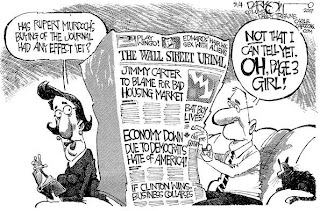
"In Interview, Murdoch Defends News Corp." proclaims a much-buzzed headline on the Murdoch and News Corp.-owned Wall Street Journal. It's a stretch of a title. The 700-word piece is less "interview" than stenography, a generous opportunity for the mogul to swagger, project confidence, and bend the truth. There are a lot of so-sad-it's-funny quotes, but the best by far is Murdoch's promise to institute a "protocol for behavior" at all of his newspapers. This meaningless pledge falls right in line with a great deal of bad News of the World commentary that misconstrues the paper's sins as journalistic overreach or inappropriateness. Stealing, bribing, and hacking aren't a 'best practices' issue, like misattributing a quote or wearing hawaiian shirts to work: they're illegal. Beyond breaking stuffy American ethics protocol, News International broke real British law. So unless the first bullet-point in News International's new "protocol for behavior" is "Don't commit crimes. Also don't cover up crimes by committing more crimes," I'm not quite sure what he and the Journal are playing at. The dishonest two-step from illegality to immorality is even reflected in the Journal's own reporting, which frames the issue as one of "dubious reporting tactics." And as Media Matters has pointed out, it took the paper a whole week — and a couple of buried NOTW stories — before it reported that its own publisher and Murdoch friend Les Hinton has a starring role in the scandal.
A few other knee-slappers from the interview bear mentioning. Murdoch tells the Journal that his company has handled the scandal "extremely well in every way possible" barring a few "minor mistakes." I'm sure this includes the paper's hacking of the people who were investigating them for hacking. And News Corp's brave decision to "unreservedly" apologize in April for a decade's worth of hacking and then proceed to keep doing it.
The Journal also gave Murdoch a chance to depict himself as the fearless, meticulous, responsive leader he is: "When I hear something going wrong," he said, "I insist on it being put right." Not to judge an older gentleman's hearing, but surely the chairman must have "heard something going wrong" in 2003, when Rebekah Brooks told a parliamentary commission that her paper regularly paid off police. Or in 2005, when the police launched their first inquiry. Or in January of 2006, when a high-ranking News International editor was convicted and jailed and Andy Coulson resigned. Or in February of 2010, when the House of Commons said it was "inconceivable" that News International bosses didn't know about hacking. Or in January of this year, when the police opened up another investigation, or in February, when two more reporters were thrown in jail, or, or, or... Mr. Murdoch must be missing his ear trumpet.
And finally, as if giving a tip of the hat to all that is most chummily craven and politically incestuous about this mess, Murdoch told the Journal that Gordon Brown shouldn't be making such a big deal about getting hacked because "the Browns were always friends of ours."
Now, none of these Murdoch quotes match my all time favorite, which is "You f-ckwit! You bastard! Get this f-cking newspaper out!" But earlier this year, Murdoch said the country "had lost its sense of humor." It's good to see that with the help of the Journal, the mogul is proving himself wrong.
July 14, 2011
&c
-- Nate Silver thinks that Moody's is underestimating the chance of US default at 0.05 percent.
-- David Frum catches Mitt Romney having it both ways on the debt ceiling.
-- Financial Crisis Inquiry Commission Member Peter Wallison, in a message to Douglas Holtz-Eakin: “It’s very important, I think, that what we say in our separate statements not undermine the ability of the new House GOP to modify or repeal Dodd-Frank.”
-- Josh Green on the tragedy of John Boehner.
-- In defense of college football blogs.
What Deal Should Obama Take?
Ezra Klein has a nice rundown of the Obama administration's rationale for cutting a deal to reduce the deficit as part of the debt ceiling negotiations:
Here’s their thinking:
You can’t spend till you cut: The deficit is sucking the oxygen out of everything else in Washington. It isn’t just powerful as an issue in and of itself, but as a response to any significant investments the administration might propose. If you believe we need to do more on jobs, or more on anything, you need finish the deficit conversation. And as an added bonus, if you finish the deficit conversation in a way that convinces the American people you’ve made sacrifices and forced government to live within its means, you have, at least in theory, more credibility when proposing new initiatives that would expand the size of government again.
It’s your only shot at stimulus: A big deficit deal could include mild stimulative measures such as unemployment insurance and an extension of the payroll tax cut. That’s not much, but it’s better than nothing. A small deficit deal, or no deficit deal, won’t include any extensions of stimulus.
It’s a way to control the timing: If you strike a deal that lasts 10 years, you can backload the savings to protect the recovery over the next three or four years. If you don’t strike a deal, Republicans are likely to take out their frustrations on the 2012 appropriations, which is to say we won’t have much long-term deficit reduction, which most economists think we need, but we’ll have a lot of immediate austerity, which most economists think would be poison for the recovery. It’s the worst of both worlds.
Getting Obama reelected is important: The White House believes striking a major deficit deal would be good for Obama’s reelection chances. They also believe that getting Obama reelected would be good for the priorities that Democrats care about. President Mitt Romney’s spending cuts would be worse than theirs, his hostility to taxes would be more implacable than theirs, and he’d repeal or hollow out both the health-care law and financial regulation.
Deficit reduction is good economic policy, both now and later:There’s something close to a consensus view that we need deficit reduction within the next five to 10 years or the odds of the market turning on us rise to unacceptable levels. But many in the White House also believe that a credible commitment to deficit reduction in the long and medium term could help the economy in the short term. In his July 2 radio address, for instance, Obama said, “Government has to start living within its means, just like families do. We have to cut the spending we can’t afford so we can put the economy on sounder footing, and give our businesses the confidence they need to grow and create jobs.”
To put all this slightly differently, White House officials believe a big deficit reduction deal would do them enough good, both politically and economically, that it’s worth making very significant compromises on the details of that deal.
I find this mostly, but not completely, sensible. I'm pretty skeptical that Obama could pass any new government-expanding initiatives in a second term if Republicans control the House. That means he needs to help democrats take what may be their best chance in a long time to win the House in 2012, which means not giving Republicans serious cover on Medicare. That doesn't mean Obama can't offer some cuts, he just needs not to agree to take the Paul Ryan budget off the table in 2012.
It also seems clear tome that Obama's own reelection depends on being able to draw a contrast with Republicans over budget priorities. Obama's goal here seems to be a fiscal adjustment that takes the deficit off the table as an issue. But that would just lead to an election focused on the state of the economy, and that's a bad grounds for Obama to fight on. What Obama needs is to be able to contrast his proposals to reshape government -- sensible cuts plus closing tax loopholes and phasing out the Bush tax cuts on the rich -- against the Republican plan to cut taxes on the rich and phase out Medicare. Positioning himself in the center is good. Taking his own issue off the table is bad.
As for policy, which is the most important element, I'm not convinced Obama is prioritizing the right things. Eliminating wasteful government programs is a good thing. Small entitlement cuts is tolerable, given the political constraints. Where should Obama be looking to fight? Place number one is Medicaid and the domestic discretionary budget. People hate paying taxes, and they love entitlements, and defense spending has tons of clout. For that reason, Medicaid is always an inviting target, and elected officials in both parties have been finding savings in domestic discretionary spending for three decades. There's not more blood to squeeze from that rock. Indeed, projected budget levels here are already too low.
Next, revenue. Obama's main trap is that he promised not to raise any taxes on income below $250,000 a year. That realistically prohibits the government from raising sufficient revenue to fund its current commitment levels over the long term. It also bars a lot of good tax policy. The tax code is filled with inefficient subsidies that are regressive but still provide some benefit to the middle class. (Think home mortgage deduction.) Because of his 2008 campaign promise, Obama can't close those tax expenditures. He needs Republicans to give him cover. In return for that, he can offer entitlement cuts, which is something Republicans crave but can't get without Democratic cover.
What Obama can't do is surrender his leverage over the Bush tax cuts. That's a political imperative -- it sets up the priority fight he needs going into 2012 -- as well as a policy fight. There's simply no way Obama can get sufficient revenue out of this Republican House to fund the long-term budget. He needs to ability to get more when the Bush tax cuts expire. Obviously Republicans don't want to give him the chance to raise taxes twice, but they're also apparently eager to fight the 2012 election over tax cuts.
So if a deficit deal is to be had, these are the contours for Obama. Root out wasteful spending on the domestic side, with some balance between domestic and military. Cut spending on Medicare and Social Security in return for closing some tax loopholes. Leave the fate of the Bush tax cuts to the 2012 election.
Vacation
I'm headed to the beach with the family through Monday night. The timing is bad in the sense that, when I made these plans, I didn't realize financial and political cataclysm might occur. On the flip side, I'll be well-positioned if I return to a world using sea shell-based currency.
In the meantime, Matthew Zeitlin and Alex Klein, the journalism stars of tomorrow, will be filling in.
Paul Ryan Looks Ready To Throw In The Towel
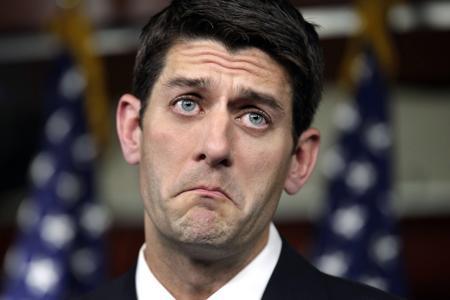
This is the big chip I've been waiting to see fall into place:
"I don't want to go to [McConnell's plan] yet. I'm not trying to evade it, but I want to cut spending, and I don't want to give up on spending cuts. Because if I start saying 'yeah, I'll take [the McConnell deal],' then we're giving up on spending cuts. I'm not a fan of the idea. I understand the merits -- the pros and cons -- of the idea. It has a fairly cool reception around here. But I want to get as many spending cuts as I can."
Sounds like he wants to hold out but is waiting for the inevitable.
I wonder -- pure speculation alert -- if the friction between John Boehner and Eric Cantor is a huge part of the House GOP's paralysis. Suppose both Boehner and Cantor understand that they're going to wind up just passing a clean debt ceiling increase, and suppose they both realize doing it the Mitch McConnell way is better than doing it hastily on August 3rd. What's keeping them?
Well, if you're Boehner, you probably know that pitching your caucus on a debt ceiling hike without spending cuts will go over very badly with ultra-conservatives. If you're Cantor, you know that, too. So Cantor would want Boehner to take the fall, but Boehner would want to wait until cantor supports him, which Cantor has no incentive to do. Indeed, if I'm Cantor, I want to stick Boehner with full responsibility for an outcome that, even under the best scenario (a deal with Obama to cut spending by a lot), is going to strike most Republicans as a bitter betrayal.
Jonathan Chait's Blog

- Jonathan Chait's profile
- 35 followers

