
Jonathan Chait's Blog, page 29
July 13, 2011
Scarborough Unfair
A couple months ago, I wrote a column quoting a Clinton administration official during the 1990s, who said of the Republican Party's self-destructive aggression, "Every once in a while the Hezbollah wing of their party gets ahold of the steering wheel and drives right off the cliff." Joe Scarborough complains:
Chait — who once criticized mainstream Republicans for using an apocalyptical approach against their opponents — compared the GOP’s leadership to a terrorist organization that killed over 250 Marines in Beirut, tortured to death a CIA operative and a Marine colonel, kidnapped scores of Americans and hijacked TWA Flight 847.
I wonder why Chait and Democratic officials from past administrations feel the need to associate fiscal conservatives to bloodthirsty terror organizations. I also wonder how such inflammatory rhetoric does not qualify as the kind of politics that Chait himself criticized not so long ago.
I'd like to note that my column was not actually attempting to assert that the Republican Party shares the Hezbollah Party's advocacy of violent jihad in order to spread a particular brand of Shiite Islam. Nor, for that matter, was I arguing that Republican officials literally drive cars off cliffs. The point of it was a cheeky metaphor.
Now, Scarborough tries to zing me for hypocrisy, but he doesn't actually quote anything I have written that expresses outrage over the use of cheeky metaphors. Instead he quotes Washington Post columnist Richard Cohen doing so. ("Cohen wrote a piece titled “On the Right, Hateful Words Are Fired Like Bullets," in which he bemoaned the fact that GOP candidates used heated rhetoric to attack Democrats.")
It's true that I've contradicted Richard Cohen's prissy aversion to cheeky metaphors. But that really isn't the same thing as being a hypocrite myself.
As for my views on cheeky metaphors, I have a longstanding belief that there's far too much umbrage about the use of political metaphor. I've written defending Rick Santorum for making Nazi analogies. And I even defended Sarah Palin over the absurd controversy regarding her use of targets to symbolize congressional districts Republicans planned to target. Scarborough may want to pull out the fainting couch because some of us are pointing out that House Republicans are nuttier than a fruitcake*, but I'm not a hypocrite for running afoul of his sense of proper discourse because I never shared it in the first place.
*They do not literally contain nuts.


The Politics Of Hostage-Shooting
 The overview of the Republican position right now is that the overwhelming majority of Republicans do not want to cut a deal with President Obama to reduce the deficit in return for raising the debt ceiling. They don't want this deal even if it's very friendly to their ideological position. The split is over what to do instead. The craziest House Republicans (and Mitt Romney) want to continue holding the debt ceiling hostage until Obama gives them total capitulation, like a balanced budget amendment. Mitch McConnell just wants to lift the thing and stick Democrats with the vote. The constituency for any remotely plausible policy bargain seems vanishingly small.
The interesting thing with McConnell is the political calculation, because that's the only kind of calculation McConnell usually engages in. A bipartisan deal to lift the debt ceiling would help Obama to position himself in the center and assuage some fears about debt and big government. But what about adopting the crazy House republican position, holding out for total victory and precipitating a default crisis? Political scientist John Sides argues that McConnell should be pushing for that:
Assume there is no deal and then assume, as Geithner and others have warned, that there are serious consequences for the economy when the debt ceiling isn’t raised. This will hurt Obama. And it will hurt him more than it will hurt the Republican Party. Presidents suffer the consequences of a bad economy. Divided government does not change this. Beware pundits who see silver linings for Obama in this scenario.
That sounds plausible. Except... McConnell himself does not see the issue this way. In McConnell's view, a debt ceiling standoff would result in voters blaming Republicans:
"[W]e knew shutting down the government in 1995 was not going to work for us. It helped Bill Clinton get reelected. I refuse to help Barack Obama get reelected by marching Republicans into a position where we have co-ownership of a bad economy," McConnell said. "It didn't work in 1995. What will happen is the administration will send out to 80 million Social Security recipients and to military families and they will all start attacking members of Congress. That is not a useful place to take us. And the president will have the bully pulpit to blame Republicans for all this disruption."
To be sure, McConnell may be wrong here. But this is a case where I think Sides is over-relying on the data. Yes, historically, voters blame the president for a bad economy, even if divided government has blocked the president's agenda. But how many historical examples can we find of the opposition party engaging in high profile acts of economic destruction?
Kevin Drum has a correspondent who offers some perspective on McConnell's debt ceiling hostage release:
I spoke to some (very) conservative investment bankers yesterday on some deals we are handling and asked about the debt ceiling as an aside. They were very concerned about the ceiling and seemed very favorable to McConnell's offer. Europe is really, really spooking the investment community. Thus, they would like to tamp down the uncertainty here in the hopes that some sense of normalization here will help the sanity over there and otherwise across the board.
They said it was common knowledge that McConnell was taking very serious back-channel heat from Wall Street because the conclusion was that there was no reliable leadership in the House with Boehner unable to control his caucus and Cantor making his leadership play now. They view Boehner as out. In other words, McConnell is Wall Street's only viable player and so he is taking all the calls. And those calls are not saying to insist upon cuts only come hell or high water. They are saying raise the F-Ing ceiling NOW.
It seems highly plausible to imagine that, if the Republicans block a debt ceiling increase, that the public will turn on them. The business elite will decide that the Republicans are dangerous and must be stopped. Obama will use his bully pulpit to explain to the public that the Republicans have forced withholding of entitlement payments and the closing of vital government services. Quite possibly, this effect could overwhelm any actual economic ramifications. I know the models say the economy will be all that counts. That could be right. But the models have never seen anything like this before.
The Republican Crazy Is Not An Act
This last weekend, Ross Douthat argued that Republican intransigence on the deficit was not really evidence that the party had lost its marbles. The party, he postulated, was shrewdly attempting to maximize its leverage. Douthat's argument hinged on the premise that Republicans had to account for the fact that any budget deal would come with future tax hikes when the Bush tax cuts expire:
The White House hasn’t made spending concessions just because the president wants to campaign as a deficit cutter next year. It has made concessions because it knows that taxes are already scheduled to go up when the Bush-era tax rates expire at the end of 2012.
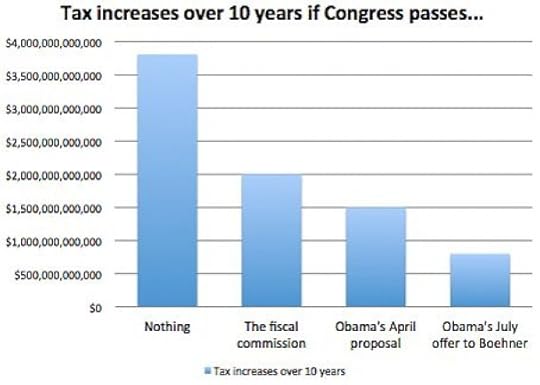
If Obama gains a second term, Congressional Republicans will have to choose between a deal that lets the top rate go back to 39 percent (a $700 billion tax increase over 10 years) or no deal at all (a $3.8 trillion tax increase). Obviously, this dilemma won’t exist if President Mitt Romney occupies 1600 Pennsylvania Avenue. But Obama’s re-election is the more likely scenario, meaning that any deal struck this summer comes with a very large asterisk attached: *Includes tax increases to be named later.
My TRB column, which suggests that the Republicans are in fact nutty, points out that this premise is false:
Press accounts reported that Obama, distressingly, proposed to make future revenue increases from the Bush tax cuts’ expiration—the tax hike Douthat warns will happen later—the source of the revenue in the deal. In other words, he was willing to bargain to get something he could have gotten by doing nothing if he wins reelection. What’s more, Obama offered to prevent any increase in upper-bracket tax rates in 2013, as long as Republicans agreed to close tax loopholes to make up the revenue. That is the deal Republicans refused—a deal to lock in the top-level Bush tax rates, while raising more revenue from a cleaner tax code, while getting Obama’s sign-off on large-scale cuts to entitlements.
Meanwhile, the evidence that's leaked out about internal Republican deliberations suggests the Republicans are not shrewdly trying to maximize their leverage. They're just barking mad. Robert Draper's profile of House Whip Kevin McCarthy peers in on the House caucus's thinking about the debt ceiling:
The freshmen have not been shy on this subject, either. McCarthy informally polled them when they first came to town in November for orientation. All but four of them said they would vote against raising the ceiling, under any circumstances. Then McCarthy (along with Ryan and the House Ways and Means chairman, Dave Camp) began conducting more listening sessions. The whip recognized that it would be counterproductive to lecture the freshmen about the economic hazards of not raising the debt ceiling. He also realized that it’s one thing to pass a budget — which in the end is a nonbinding political document — and another thing to throw America into default. And so McCarthy has urged them to consider raising the ceiling under certain conditions and thus to view this moment as a golden opportunity to force significant changes from the White House. “We all ran for a reason,” he tells them. “What’s most of concern to you? What is it that we think will change America?”
As a result, the freshmen have begun to move away from a hard “no” on raising the debt ceiling to a “yes, if.” In the conference room, several freshmen have said they’ll vote to raise the ceiling only if the president agrees to repeal his health care legislation. Or if Obama signs into law a constitutional amendment to balance the budget, after all 50 states have ratified it. Or if he’ll agree to mandatory caps on all nondefense spending. Or if he’ll enact the Ryan budget. The whip writes down all their ideas on a notepad.
And Robert Costa at National Review has more reporting:
Rep. Tom Graves (R., Ga.) says he’s “starting to hear” a sentiment from leadership that is more in line with that of the conservative and freshman members of the conference. “It’s something that we have heard here recently, and we’re starting to hear more of it,” he tells NRO. “Out of today’s discussion it’s clear that the conference is unified behind the need for a balanced-budget amendment.” Graves said the House vote on a balance-budget amendment, scheduled for the week of July 25, would send an important signal to the White House.
Still, not every Republican leaving the closed-door confab was pleased. “Only one word comes to mind right now: chaos,” says one leading House conservative. “There is no plan. Cantor’s cuts would never pass the House, Boehner has walked out and Obama is not serious about anything. There’s nothing.” Another conservative member agreed: “It’s going to be a very rocky few weeks,” he says. “We’re holding, but beyond that, I have no idea what is going to happen.”
The predominant conservative view here seems to be that nothing bad would happen if we fail to lift the debt ceiling. Indeed, failing to life the debt ceiling is simply another way of imposing a balanced budget requirement, which would be good! (Even Mitt Romney has endorsed this plan.) Therefore, why should they lift the debt ceiling and allow the un-balancing of the budget, if they don't get a balanced budget requirement in return?
The more we find out about the House Republican caucus, the more obvious it becomes that they're not just trying to maximize their leverage by pretending to be crazy. They're crazy.
Did Obama Offer Budget Cuts?
The conservative line of the moment holds that the Republicans are the real fiscally responsible party, because President Obama’s proposed budget cuts have not come in the form of official legislation. Here’s National Review’s editorial today:
House Republicans passed a budget that cuts spending, including entitlement spending, even though many Republican voters objected. President Obama, meanwhile, first proposed a budget that even Senate Democrats rejected as unserious, and then gave a speech outlining a second budget but failed to follow up by submitting an actual proposal. Only Senate Democrats performed worse; they have not enacted a budget in more than two years.
Obama is at it again, saying fine things about cutting trillions of spending without making any public disclosure of what specifically he would cut.
No public disclosure? I could swear I’ve been reading things like this:
Option 1: The Harry Reid proposal:
“Some” discretionary cuts
No changes to entitlements
No changes on the taxes
Total savings: less than $1 trillion
Option 2: The Obama/Biden framework:
Discretionary cuts: $1.1 trillion
Mandatory cuts: $500–$700 billion (about $340 billion in health care, $260–$330 in other mandatory)
Interest savings: about $300 billion
“Modest” changes to Medicare (e.g., means testing, increase in co-pays)
No changes to Social Security
Some revenue neutral tax reforms
Total savings: about $2 trillion
Option 3: “The Big Deal”
Discretionary cuts: $1.2 trillion
Slightly more significant changes to Medicare (e.g., increase retirement age, means testing, benefit structure)
Social Security Consumer Price Indexing (CPI)
“Massive” future savings in out-years
De-coupling Bush tax rates on upper income brackets
$1 trillion in “new revenues”
Comprehensive tax reform, to be completed by agreed upon date
Total “savings” (with tax increases): about $4 trillion
My source is National Review.
Eric Cantor’s office has been distributing even more detail about these cuts.
Now, it is true that Obama’s proposed cuts contain varying levels of specificity -- some being highly specific (like the chain CPI or raising the Medicare retirement age) and others being less so (like cutting the domestic discretionary budget.) It’s also true that these cuts are phased in slowly. But both these criticisms apply equally to the House Republican budget, which NR and other conservatives hold up as the model of fiscal seriousness.
Laying out one’s plans in a party-line vote like the Paul Ryan budget is a useful exercise in informing the public about the party’s aspirations. But under divided government it does nothing at all to reduce the deficit. If a party is only willing to reduce the deficit under its own ideological terms, then it’s not actually willing to do anything about the deficit. The only deficit reducing program that can pass is one that makes policy compromises. And the indisputable fact is that Obama has proposed such compromises, and Republicans haven’t.
July 12, 2011
The Debt Negotiations Are Getting Awkward
This means... something. I just don't know exactly what:
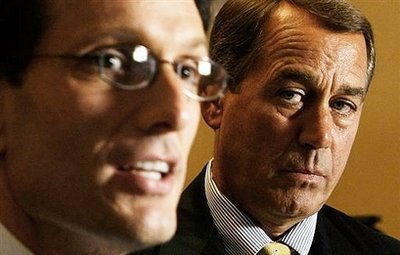
Since pulling the plug on the deal, Boehner has been largely silent in the meetings, leaving House Majority Leader Eric Cantor (R-Va.) to present details of the House’s position. On Tuesday, people in both parties said, Obama tried to reestablish Boehner’s primacy.
Cantor, who is advocating a smaller deal, at one point demanded that Obama offer the details of his vision for a “grand bargain.”
“Where’s your paper?” he asked angrily.
Obama snapped back: “Frankly, your speaker has it. Am I dealing with him, or am I dealing with you?”
You're dealing with Cantor! Does Obama want Boehner to assert himself? Does he want Cantor to officially depose Boehner? Is he genuinely confused about what's going on here?
&c
-- The Wall Street Journal editorial page supports the McConnell plan.
-- Erick Erickson describes the proposal as the “Pontius Pilate Pass the Buck Act of 2011”
-- John Boehner gives a long and scary pause when asked what happens next if a debt-ceiling deal can not be reached.
-- Michael Irvin’s support for marriage equality probably guarantees opposition from Eagles fans.
-- Why “the flip” is the iconic moment of Derek Jeter’s career, not his 3,000th hit.
McConnell Proposes To Let Hostages Go
Yesterday morning, Mitch McConnell gave away a key tell when he said he had a contingency plan to ensure the debt ceiling gets lifted. Today he showed his hand and it's a fold. The plan announced by McConnell today is highly, and intentionally, convoluted, but the details don't really matter. The essence of it is to abandon efforts to force policy concessions in return for lifting the debt ceiling, and instead set up a bunch of show votes to embarrass the Democrats. In other words, it's a reversion to the old status quo, before President Obama and the Congressional Republicans turned the debt ceiling vote into a high stakes hostage crisis.
We don't know how this gambit will turn out. John Boehner's spokesman is definitely not ruling it out. At the very least, McConnell's capitulation will pressure House Republicans into going along. They may refuse. But assuming this winds up being the mechanism to increase the debt ceiling, it's a staggering turnaround.
If you told me last week that we might get a debt ceiling hike without Obama making policy concessions to Republicans, I wouldn't have believed you. What happened since then? Well, Obama called the Republicans' bluff. He turned the debate from a generalized question of cutting spending, where the public sides with Republicans, into a debate over specific policy priorities, where the public overwhelmingly supports the Democrats. Most people want a balanced package of revenue increases and spending cuts, in contradiction to the GOP's all-cuts-or-die stance. The public strongly favors higher taxes on the rich and strongly opposes entitlement cuts. Obama smoked out the GOP's actual policy choices. And he smoked out the Republicans' refusal to compromise on its unpopular priorities, establishing himself as the one party who was willing to make the kind of compromise that was the only plausible avenue to deficit reduction.
More recently, Obama said that if the debt ceiling is not lifted, he won't be able to send out Social Security checks. Imagine how that one would play out for Republicans. In general, he demonstrated yet again that it's very hard for Congress to win a public relations fight against the president. Meanwhile, the business lobby was no doubt pushing hard behind the scenes, and the business lobby usually wins.
Many conservatives are understandably furious with McConnell. (One Republican Senate aid calls it "a full surrender, white-flag approach.") But it's amusing to watch a handful of them present this retreat as a victory. Jennifer Rubin, who leaked the plan from McConnell, says it puts Democrats "in a bind," as if having to cast a vote to raise the debt ceiling -- which Congress has been doing for years on end -- is a worse bind than choosing between large-scale spending cuts or catastrophic default. (I wonder if Rubin's gullibility recommended her as the messenger for the leak.) Fred Barnes pushes the frontiers of propaganda to new limits by describing McConnell's plan as "a bold offensive."
I've been lambasting Obama's strategy pretty much on a daily basis. It appeared that Obama blundered into a hostage crisis he didn't need, and then wound up offering Republicans an absurdly generous deal, trading away major entitlement cuts in return for a pittance of revenue -- no higher than what will be raised if the Bush tax cuts expire on schedule.
So those were the options as of last week: A massive policy giveaway that won Obama some centrist credibility at immense substantive cost, or else let the economy get killed. Instead, Obama has reestablished credibility on the deficit at zero substantive cost. (He can always cut a deal without a gun to the economy's head.) Either the administration is run by pure political geniuses, or they're the luckiest sons of guns who ever lived.
Obviously, the House could revolt and refuse to go along. They'd be splitting off from their Senate Republican counterparts, and isolated as the party willing neither to make a bipartisan deficit deal to raise the debt ceiling, as Obama is, nor to just let the ceiling get lifted, as McConnell is. Obama can keep pounding the House Republicans for being crazy, and then wait and see what they do when the Social Security checks don't come in the mail. The worm has turned.
In Defense Of The Anti-Deficit Lobby
My post about the anti-deficit lobby prompts Paul Krugman to conclude their whole posture is a ruse:
As he says, it makes no sense — unless you consider the possibility that the anti-deficit lobby doesn’t really care about deficits. If you believe that its real agenda (not always consciously) is to dismantle the welfare state, with deficit fears as the excuse, then the seemingly bizarre positioning makes perfect sense. Democrats trying to preserve the essence of the New Deal and the Great Society are always deemed insufficiently committed, never mind the numbers, while Republicans eager to tear the whole thing down are serious people, never mind their obsession with budget-busting tax cuts.
I don't really agree with that. Krugman is describing the views of conservative Republicans who posture as opponents of the deficit. But the anti-deficit lobby is a different group with different beliefs and positions. They oppose deficit-financed tax cuts as well as social spending.
None of this is to say I agree with the perspective of the anti-deficit lobby, but my differences are much narrower than my differences with movement conservatism. I think members of the anti-deficit lobby are genuinely committed to the concept of "non-partisanship," defined in such a way that they frequently cannot interpret reality. Well, that and they believe they need to maintain a posture of non-partisanship in order to keep their credibility.
Even on that score, I notice that the Washington Post today editorially pats Obama on the back. They'll be back to pox-on-both-houses-ism soon enough, but it is worth noting the distinctly different tone today.
Why Is John Boehner Still In the Room?
Ever since the 2010 elections, I've been saying that John Boehner's speakership was living on borrowed time. At some point the compromises he'd have to make to avoid political overreach would make him break faith with the maximalist demands of the House GOP caucus. I suppose there's an alternative scenario, which could last for some period of time, in which Boehner keeps his title but simply lacks any authority:
The House majority leader’s voice was heard most often in Sunday night and Monday afternoon debt-limit negotiations at the White House. It has been loud in opposition to changes in tax policy to add new revenue. And some Republicans said it sounds more in tune with the sentiment of the House GOP majority than Speaker John Boehner’s voice....
“It looks like he’s maybe listening to the rank and file a little bit more closely,” Rep. Raul Labrador, an Idaho Republican with strong tea party credentials, told POLITICO’s Arena on Monday. “He understands what the rank and file want.”
There's a lot of intrigue going on behind the scenes, but this seems like a straightforward situation. Boehner and President Obama had a bunch of meetings and came to an agreement on what to do. Then Boehner discovered he can't sell the deal to his members, because in a sense he does not represent his members.
There are a several interesting ramifications here. One is that Obama's approach was self-defeating. Obama figured he could sit down with the Republican leadership, reason together about the future of the deficit, and persuade his partner to drop his most unreasonable positions (i.e., "we don't have a revenue problem") and adopt a compromise. He may have succeeded in talking sense to Boehner, but in so doing, he rendered Boehner unfit to represent the House Republicans. If you have a grounded understanding of the fiscal picture -- i.e., there's no politically plausible way to educe the long-term deficit without increasing revenue at least some -- then by definition, you do not represent the views of most House Republicans.
A second ramification is that the turmoil (or, at minimum, uncertainty) within the Republican leadership is occurring at a pretty scary time. The parties have locked themselves into a position where major policy changes must be agreed to in order to forestall potential economic disaster. It's not a good time for the hostage-taking party to begin eyeing each other nervously.
But the simplest and most immediate ramification is that Boehner seems to have made himself useless to Obama. If Boehner needs to go to Cantor to approve any agreement, why is Obama dealing with Boehner at all? Boehner right now is Junior Soprano, permitted to keep his title while Tony actually runs the family. If I'm Obama in the next round of negotiations, I'm looking at Boehner and thiking, "Why are you in this room?"
JONATHAN CHAIT >>
Bleeding from Behind
[Guest post by Alex Klein]
In a fine Ryan Lizza piece this April, a highly quotable White House official gave Obama’s foreign policy the unfortunate nickname “leading from behind.” As Jason Ukman just pointed out in the Washington Post, the phrase is becoming July's conservative cat-nip, and those on the left are scrambling to explain that it was misunderstood, mistimed, misrepresentative, misguided, et al. It’s the biggest linguistic Obama-apologia yet. Ukman:
Whatever one might think of that foreign policy, it is not the simplest one to articulate at a campaign rally. And for that, perhaps, Republicans can be grateful.
Or, as Lizza himself puts it:
I think the meaning of leading from behind has become slightly muddled…Despite the funny phrasing, at the heart of the idea of leading from behind is the empowerment of other actors to do your bidding…
Fair enough. Because far from the sunny climes of Libya, the ‘leading from behind’ doctrine is on full display in the debt-ceiling imbroglio. And it isn’t working. The President has taken a hectoring-from-above approach, consistently allowing and even encouraging Republicans to set the terms and drive the debate. At yesterday’s presser:
I don’t see a path to a deal if they don’t budge, period.
The dad-like consternation — the waiting for the kids to get their act together — is calculated: the President wants to look like the moderate, levelheaded adult in the room.
But when a deal is struck it will be the fiery, compromising-in-the-nick-of-time Republicans who will be visible and laudable out in front. It’s worth remembering that the President began this showdown a month ago by strictly instructing his party not to “draw lines in the sand.” But politically, the hard-line sandbox is the place to be. That’s why every time John Boehner and company pull another childish talk-withdrawal stunt, the President looks weaker — and why when the Republicans make even the smallest of concessions, they look patriotic.
Obama is certainly trying to “empower other actors” — namely the Republicans — to “do his bidding.” But he’s doing it by comparing them to prepubescent girls and telling them to eat their peas. It’s empowerment through embarrassment. This holier-than-thou nagging, as my fellow guest-blogger Matt Zeitlin has argued, only convinces Boehner to tough it out for the sake of 2012. No, the Republicans don’t look “stubborn” — they look principled. And no, Obama won’t look responsible — unless the GOP pushes the decision past August 2nd, which they won’t.
I don’t subscribe to the theory that Boehner would gamely crash the economy to secure a Republican president in 2012. But I do believe that Obama started this fight by giving the GOP miles — not inches — to play in; and we should expect them to take political advantage up until the last possible moment. Obama is leading from behind on the debt ceiling by articulating a grand vision and leaving the dirty work of fighting it out to those below; the problem is that, in the Republicans, he has found about as reliable a foot-soldier as the Arab League.
Jonathan Chait's Blog

- Jonathan Chait's profile
- 35 followers

