
Jonathan Chait's Blog, page 30
July 12, 2011
The Asymmetry in Tax Debates
[Guest post by Matthew Zeitlin]
David Brooks in his column today argues that there is are almost symmetrical obsessions with “magic levers” policies that can always be counted to increase growth. One group thinks that the magic lever is marginal tax rates, some other group thinks it is deficit spending, and both of these groups are very bad:
The spending they began must have done some good to cushion the recession, but either through a failure of theory or a failure of implementation, their lever was not as powerful as they promised. Federal spending rose from 19.38 to 24.91 percent of gross domestic product, but the economy refused to rebound and the world is awash in oceans of debt.
Now a third group has emerged, also claiming that it has the magic lever to control the economy. Staunch Republicans argue that taxes are central to determining economic growth. Tax cuts, they argue, have huge positive benefits and tax increases have disastrous negative effects.
This “third group” Brooks describes in his column can also be called the “contemporary Republican Party,” and they have not “emerged,” they have been around since 1981, and there is a fundamental asymmetry in how the parties view fiscal policy and the budget and it is one that columnists ought to point out, not obscure.
The mainstream of the Republican party supports supply-side tax cuts no matter the economic circumstances. They pushed through major tax cuts in 1981, 2001 and 2003, Bob Dole campaigned on a 15% across-the-board tax cut in 1996 and McCain campaigned on extending the Bush tax cuts and lower corporate taxes. Tim Pawlenty, who can always be relied on to channel conservative policy consensus, proposed a tax plan that envisioned only two income tax brackets at 10 and 25 percent and a 15 percent corporate tax rate.
1981, 1996, 2001, 2003, 2008 and 2013 (the first year of a Pawlenty administration) all present wildly different economic circumstances that call for different policy responses. And yet extending supply-side tax cuts or passing new ones has always been the order of the day for the GOP.
Democrats, on the other hand, have responded to different economic circumstances with different ideas. There is also a range of views within the Democratic party. When Clinton came into office, he proposed a stimulus, but then proceeded to govern as a deficit-cutter, and his 1993 budget, which produced huge budget savings and preceded the boom-time of the 1990s, was opposed by every Republican in Congress. There was a huge debate in the Democratic Party in the 1990s over whether they should pursue public investment or deficit reduction, and the deficit reducers won. And now Obama, after a large stimulus in response to a gigantic economic downturn, is begging the Republicans to let him sign a deal that would include massive spending cuts over the next ten years. But since it includes tax increases, there is little-to-no chance that such a deal can be reached. This turn of events, of course, is totally unsurprising if you have been following the conservative movement for anytime in the last three decades.


Playing Games With Life Expectancy
[Guest post by Matthew Zeitlin]
Some may object to dedicating a post to a tweet, but an argument advanced recently by Charles Blow, a New York Times columnist who is ostensibly focused on “all things statistical,” is based on a wildly misleading interpretation of life expectancy statistics and presents a good opportunity to get into the actuarial weeds .
Blow objects to President Obama’s proposal, reported in the Huffington Post, to raise the eligibility age for Medicare, and one reason is that, “Deal pushes Medicare to 67 blk men are out. 67 is blk mens' life expt” [sic]. He then tweeted “Imagine paying into a program your whole life and then dying before you experience any of it's [sic] benefits. That isn't a 'balanced approach.'"
What Blow is arguing is that increasing the eligibility age for Medicare would have a disproportionately negative impact on African-American men compared to the rest of the population because their life expectancy is lower and thus have fewer years to utilize Medicare. When put that way, such a conclusion is obvious to the point of banality.
According to the most recent data I could find from the CDC, in 2006, the life expectancy for men at birth in 2006 was 75.1 years; for white men, it was 75.7 years; while for black men, it was 69.7 years. There is a real disparity between black men and white men, and the disparity is due to differences in health and social outcomes that you can read about here.
What’s most important for looking at Medicare is life expectancy for people who will actually utilize Medicare soon. And so when you look at life expectancy at age 65, white men are expected to live for another 17.1 years, while black men are expected to live for another 15.1 years. There’s still a two year gap, but it’s considerably narrower than the six year gap at birth. There is also the fact that black men at age 65 have a higher probability of dying in their 66th year than white men do. This gets to the overall gist of what Blow is saying, but he did not refer to death probability statistics.
Looking at those life expectancy numbers shows clearly that any significant implication of “Deal pushes Medicare to 67 blk men are out. 67 is blk mens' life expt” expect the obvious one that “raising the Medicare eligibility age will decrease utilization of Medicare” is at wrong, and at best understated.
If you read the introduction to the CDC Life Tables, you will clearly see the distinction between life expectancy at birth and life expectancy at any given age, which Blow blurs together for dramatic effect. One should expect better from someone whom America’s greatest newspaper entrusted with writing a blog called “On the Numbers.” Or, to be more charitable, perhaps the lesson is that it’s not best to discuss the social policy implications of actuarial tables when you only have 140 characters to do so.
July 11, 2011
News of the World: No Weddings and a Funeral?
[Guest post by Alex Klein]
The country of my birth is parodying itself. We’ve spun around the roundabout of funny and turned off directly into sad. The News of the World’s Pandora’s box is daily spilling out even fresher hells, so embarrassing in their corporate-journo-politico complicity that one could almost forgive Rupert Murdoch for burning a million emails worth of evidence — well, almost. Today, we learn that NOTW tried to hack Gordon Brown, Prince Charles, and 9/11 victims. Then they tried to buy the Queen’s phone number. In times like these, England rarely turns to the clergy. Which is just as well, because the Church of England holds $6 million in News International shares.
Alright, so maybe it's still a bit funny. It's Mary Poppins and the Royal Wedding through a funhouse mirror. We’ve got the delightful image of Rebekah Brooks and David Cameron gallivanting on game ponies together on the Chipping Norton lawns. Bully! How and why? Well Mr. Brooks, the race-horse trainer: he and Dave were at Eton together. In fact, last Christmas the Camerons dined at chez Brooks in Oxfordshire with a few special guests, including James Murdoch. This just a few days after the PM got rid of that awfully uncouth regulator Vince Cable, who would have stood in the way of James’ dad’s BSkyB purchase. Cameron installed Jeremy Hunt, fellow Murdoch friend.
Weddings and poolside parties not ‘Brideshead’ enough for you? Well, in 2008, Matthew Freud — son-in-law of Murdoch and great-grandson of Sigmund — picked up the Camerons on his private jet and flew them down to Santorini to mingle with Rupert on his yacht. With Billy Joel. And Rebekah Brooks. At least they didn’t pick up any Greek bonds as souvenirs.
So what’s the big deal, we on the other side of the pond might ask — just throw the bums out! Unfortunately, as Oborne and Hitchens pointed out today, the recent hacking scandals barely scrape the surface of the chummy tangle that chains so much of the English power elite to this mess. In short, the other bums have been just as bum-ish — just as terrified, seduced, or both by the Murdoch clan. Labour has relied on News International for years, and their doyen Ed Milliband will soon give a speech-offering to News International execs at their annual conference — just like Blair did in 1997.
So, with the police paid off, the politicians playing polo, the journalists poolside, and the clergy invested in News International, to whom can a nation turn?
Why, Hugh Grant of course, stumbling his way charmingly into an awkward situation and making the best of it.
Bully!
Obama Gives Boehner the Death Hug
[Guest post by Matthew Zeitlin]
It has become clear that Obama thinks that it would be a good idea to reach some kind of grand bargain deficit reduction deal with the Republican House. Whether he thinks this for political reasons, substantive reasons or some combination of the two is immaterial.
However, by telegraphing the political stakes so clearly, he has made it very difficult for Boehner to sign on a to a deal that involves a substantive compromise – i.e. some form of revenue or tax increase – and the political compromise of getting the House GOP to support a deal that will make it more likely that he will win reelection in 2012.
This puts Boehner in a position where he almost has to avoid helping the White House lest his position as speaker be in jeopardy. And today, at his press conference, Obama gave Boehner the death hug:
I have a stake in John Boehner successfully persuading his caucus that this is the right thing to do, just like he has a stake in seeing me successfully persuading the Democratic Party that we should take on these problems that we’ve been talking about for too long but haven’t been doing anything about.
…
I think Speaker Boehner has been very sincere about trying to do something big. I think he’d like to do something big. His politics within his caucus are very difficult -- you’re right. And this is part of the problem with a political process where folks are rewarded for saying irresponsible things to win elections or obtain short-term political gain, when we actually are in a position to try to do something hard we haven’t always laid the groundwork for. And I think that it’s going to take some work on his side, but, look, it’s also going to take some work on our side, in order to get this thing done.
What Obama is saying is that Boehner is torn between what he knows is the right thing to do for the country—help Obama “do something big” and pass a major deficit reduction package with revenue increases—and what is right for him politically, which is to oppose Obama at every turn. Of course, House Republicans and Republican voters think that opposing Obama is what is good for the country, and since Obama has made the deficit issue about him and his political prospects, this makes it very difficult for Boehner to be seen as helping him, because Obama faces near-blanket total disapproval in the Republican party.
If a grand bargain is something that Obama thinks will help him in 2012, that guarantees massive Republican opposition, which explains why negotations over the debt ceiling have been at a standstill. Republicans don’t like Obama and don’t want him to succeed politically.
Why he thinks the Republican speaker is able or willing to help him in these circumstances is beyond me.
THE DEBT DEBATE >>
Today's WSJ Editorial Page Ignorance
The Wall Street Journal editorial page is, once again, not so much with the understanding of the economics. Today's editorial begins by noting that the Affordable Care Act increases payroll taxes on high income earners, but that Obama also supports a temporary payroll tax cut now:
The economic ironies are also, well, rich. Mr. Obama is now pushing to reduce the payroll tax by two-percentage points for another year to boost the economy, but he's already built in a big increase in that same payroll tax for 2013. So if a payroll tax cut creates jobs this year, why doesn't a payroll tax increase destroy jobs after 2013?
The Journal keeps making this error. Keynesian theory says that, in a liquidity trap, the government should boost consumer demand by running deficits. One way to run deficits is to cut taxes. The tax cuts should be aimed at workers who would be most likely to spend their tax cut, which means workers who aren't rich. And the tax cut should be temporary, because after the economy improves, you need to get back to tax rates sufficient to cover the government's annual operating costs.
In the Affordable Care Act, Democrats passed a payroll tax increase that takes effect in 2013 -- hopefully when the economy has passed its emergency conditions -- and falling on the rich, who won't be forced to reduce their consumption very much. In the meantime, Obama wants a payroll tax cut on the non-rich today.
Obviously the supply-siders at the Journal disagree with that position, because they disagree with Keynesian economics and they oppose any policies that hurt the rich. But beyond mere disagreement, they actually don't understand the theory that they're arguing against. They don't understand the difference between a Keynesian tax cut and a non-Keynesian tax cut. This isn't advanced economics, either. It's fairly remarkable that the country's most prestigious financial newspaper has an editorial page whose writers don't understand very basic economic concepts.
Bachmann As 2007 Obama
[image error]
I've been arguing that the dynamic of Michelle Bachmann's campaign is somewhat analogous to Barack Obama's in 2007. Obama trailed badly in the national polls throughout 2007. But he had high favorability seemed to do well among those voters most attuned to the campaign, which suggested that as elections neared and voters paid more attention, he had the potential to win over voters who were not paying attention months and months before any vote.
You can see a similar thing going on in Iowa. Another poll has Bachmann narrowly leading, but her lead expands when the sample is confined to voters paying a lot of attention:

One caveat, of course, is that a Rick Perry candidacy might hurt her. But Bachmann is positioned very well so far.
On The Deficit, Think Medium

One line I'm seeing from advocates of the Grand Bargain is that a smaller deal to lift the debt ceiling won't be any easier:
Mr. Obama is pushing for a bigger deal on the argument that it will, paradoxically, be easier for Democrats and Republicans to sell to their rank and file, because they could present it as a historic effort to begin undoing years of deficit spending.
As Mr. Geithner said on “Face the Nation,” “It’s not clear that it’s easier trying to do less.”
I suppose it's true that you can more easily get members of Congress to sacrifice their priorities if they think they're supporting a historic deficit deal to end all deficit deals rather than the first fiscal adjustment in a series. But every previous fiscal adjustment since Ronald Reagan introduced massive peacetime deficits has been incremental -- under Reagan in 1982 and 1983, George H.W. Bush in 1990, a Bill Clinton in 1993, and Obama's Affordable Care Act in 2010. the history has always been taking bites out of the deficit problem one at a time, rather than reordering the federal budget in a big bang.
In any case, the Republican anti-tax animus appears insurmountable. The only deal that seems plausible to me is one that would be scored as having no net tax increase but still would raise revenue as compared with current law. The medium deal is where it's at.
The Weekly Standard's Bad Defense Of Defense
The Weekly Standard continues to rally conservatives against a debt ceiling agreement, under the slightly awkward platform of insisting that the country faces an existential debt crisis while demanding no tax increases or cuts to defense. Part of the campaign involves insisting that defense spending has not actually increased at all in recent years. Jeffrey H. Anderson writes:
How are we accruing such colossal sums of debt?
President Obama and many members of Congress seem to think that defense spending is largely to blame. Is it?
According to the White House Office of Management and Budget (see Table 4.2), during the middle of the John F. Kennedy administration, in 1962, defense spending accounted for 47 percent of total federal spending — nearly half — while spending by the Department of Health and Human Services (then named the Department of Health, Education, and Welfare) accounted for just 3 percent. Today, defense spending accounts for just 19 percent of total federal spending, while spending by Health and Human Services (HHS) accounts for 24 percent. In 2016, according to White House estimates, defense spending will account for just 15 percent of total federal spending, while spending by HHS will account for 27 percent.
Anderson helpfully includes this chart:

You may notice that the chart does not indicate actual levels of defense spending. It merely compares it to federal health care spending, which has certainly exploded. So -- has defense spending actually grown? Well, yes, per the Congressional Budget Office:
[image error]
Obviously, the rise in defense spending does not prove that it's desirable to cut defense spending. Perhaps defense spending has risen because our military needs have grown. (And perhaps federal health care spending has risen because the cost of providing medical care has skyrocketed! Nah.) In any case, if you want to defend the Standard's crusade not to touch a hair on the head of the defense budget, you need to actually make the case that there's nothing in the military budget that can be safely cut. Making misleading charts to suggest defense hasn't contributed to the budget deficit isn't very persuasive.
McConnell's Tell
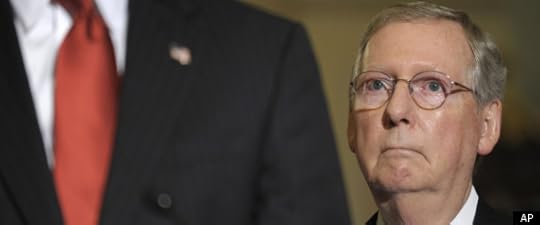
One of the great unknowns of the debt ceiling fight is how much freedom Republicans in Congress actually have. It seems clear that their political incentive is to demand maximal terms. This would allow them to keep their base together, and if the debt default triggers an economic crisis, the resulting chaos will probably increase their chances of winning the presidency in 2012. Cutting a deal with Obama not only forestalls such an event, it positions him as a centrist who's serious about reducing the deficit, which would aid his reelection prospects. The smart play from a pure political point of view, then, is to hold fast to maximal demands.
The only question is whether the business lobby can and will exert serious pressure on Republicans to lift the debt ceiling. This, too, is hard to game out. Most of the pressure will be exerted out of the public eye. And the business lobby obviously wants the debt ceiling lifted, but it would be happier to do so in conjunction with cuts to social spending. So business may well hang back and let Republicans exert their leverage now, while swooping in to demand a deal as the deadline nears. We don't know, but the answer is a key piece of the puzzle.
In that light, pay attention to this very interesting quote from Mitch McConnell:
“Nobody is talking about not raising the debt ceiling; I haven’t heard that discussed by anybody,” the Senate minority leader, Mitch McConnell of Kentucky, said on “Fox News Sunday,” adding that he had an unspecified “contingency plan” to raise the ceiling if the talks fell apart.
Does McConnell actually have a secret contingency plan? I dunno. The important thing is that he feels bound to claim he does. That's not a message for the GOP base or the broader public, neither of which see the need to raise the debt ceiling at all. It's a message for business. That McConnell feels compelled to say that he won't allow default suggests he faces real pressure .
July 10, 2011
The Pathologies Of The Anti-Deficit Lobby
[image error]
The anti-deficit lobby is a powerful force in American political life. The lobby consists of a loosely aligned network of think-tanks, institutions (many funded by Pete Peterson), and allied journalists. Of course, the anti-deficit lobby does not always win -- indeed, it usually loses,as its basic mission runs in opposition to the general tendency of politicians to avoid unpopular choices as well as the specific ideology of the modern Republican Party ("Reagan proved deficits don't matter"), which refuses to accept the notion that revenue levels ought to bear any relation to spending. The anti-deficit lobby has had extraordinary success, though, in making the deficit the top item on the Washington agenda.
And yet the strange thing about the this lobby is that, unlike almost all other lobbies, which are dedicated to rewarding political allies and punishing enemies, the anti-deficit lobby largely avoids doing so. This is because the most committed members of the deficit hawk lobby are committed to bipartisanship, which they understand as a disposition that assigns blame for most problems equally to both parties.
Washington Post editorial page editor Fred Hiatt is a key member of the anti-deficit lobby. In the face of news reports that House Republicans have rejected a deficit package heavily tilted toward spending cuts endorsed by President Obama, Hiatt has written a column framing the question as a series of choices facing Obama:
[T]he Aug. 2 deadline offers three potential strategies. One is to join Nancy Pelosi and go for broke on “Mediscare”: Accuse the Republicans of getting ready to wheel every granny out of every nursing home and otherwise threaten civilization as we know it.
A second would be to end up with Mediscare but first appear open to compromise, to appeal to independents, while assuming there can be no grand bargain with Republicans.
The third is to go for something real: a long-term debt reduction plan that would increase revenue, begin to control entitlements without threatening granny and reassure financial markets that the American political system can get its act together when push comes to shove.
After this weekend, option three is looking like a longer shot than ever. It may be that Obama missed his moment to make it work, when he shunned his Bowles-Simpson fiscal commission. It may be that the Republicans and his own liberal caucus always were fatally inclined toward intransigence.
But it’s also true that the political path to a $2 trillion deal doesn’t look all that much clearer than to a $4 trillion deal. And the bigger bargain still offers the biggest payoff. It would most enhance Obama’s chances for reelection. By controlling the national debt, it would give him in a second term the most scope for the kind of action that is off-limits to him today.
There are a lot of strange things about this analysis. One is that it presupposes Obama has the option to engage in "Medicare," which is the anti-deficit lobby's term for any kind of criticism of a plan to trim, privatize, or essentially eliminate Medicare. How does this get Obama through the debt ceiling fight? Does he think Republicans will lift the debt ceiling with no concessions? Hiatt does not explain.
A second oddity is that Hiatt omits the possibility of Obama agreeing to a $2.5 trillion deficit reduction plan in return for lifting the debt ceiling, an outcome that seems like the most plausible path forward and would amount to a major step forward.
But the strangest thing about Hiatt's analysis is that he persists in presenting the question as Obama's choice. He urges Obama to go for the big deal. I really don't understand what he's saying here. The House leadership has made it perfectly clear they they won't pass an agreement like that, or any agreement that contains a net tax increase. I don't see how this could be any clearer.
But this strange analytical tic is perfectly reflective of the anti-deficit lobby's style. You have one side embracing its proposal, and the other side rejecting it, and the instinct of the anti-deficit lobbyist is... to urge the former to embrace its position. Aside from the bizarre disconnect from political reality, this simply highlights a huge problem with the incentive structure. Aren't you supposed to reward politicians who agree with you, and impose some cost on those who oppose you?
Obama surely has other political and substantive factors on his mind. But to the extent that the anti-deficit lobby impacts the political discourse, it ought to create an incentive structure where a president who embraces the lobby's position can expect adulation from the lobby's members, and when a House caucus opposes the lobby's measures it can expect some harsh words. Instead you have someone like Hiatt going out of his way to lay at least partial blame for the opposition of the hostile party upon the doorstep of the party who's adopting his position. It's bizarre.
JONATHAN CHAIT >>
Jonathan Chait's Blog

- Jonathan Chait's profile
- 35 followers

