
Jonathan Chait's Blog, page 31
July 9, 2011
The Doomed Grand Bargain Dies
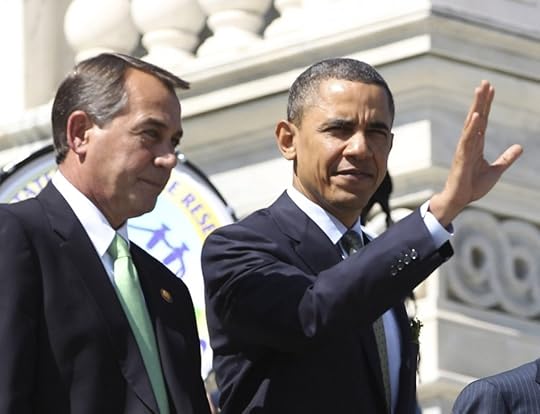
Who could have seen this coming?
House Speaker John A. Boehner (R-Ohio) abandoned efforts Saturday night to reach a comprehesive debt-reduction deal worth more than $4 trillion in savings, telling President Obama that a mid-size package was the only politically possible alternative to avoid a first-ever default on the nation’s mounting national debt.
Oh, wait -- I did!
(Sorry for the obnoxious self-back-patting -- I don't really have any commentary on this other than to refer to my previous item explaining why the demise of the Grand Bargain was inevitable. If you want an explanation as to how the medium-sized bill could pass, read it here.)
The other thing to add is that this demonstrates a fact that media centrists have failed to grasp for months: the impediment to a balanced (or even heavily rightward-tilting) deficit plan isn't "both parties." It's Republicans. Democrats may not like the idea of cutting entitlements, but their objections don't come close to matching the GOP's theological opposition to tax increases.


July 8, 2011
&c
-- A liberal defense of the chain CPI.
-- The world map of useless stereotypes.
-- Warren Buffett says he could end the deficit "in five minutes." Imagine what he could do in ten!
-- Ethanol lobby gets smacked around, doesn't seem to mind.
-- What David Plouffe actually said about unemployment.
-- Archie Comics co-CEO yells "PENIS PENIS PENIS" at her male employees, gets sued.
-- The GOP stumbles around a tax reform program.
A Primary Challenge?
[Guest post by Matthew Zeitlin]
In a somewhat odd post for the Atlantic, libertarian-ish Conor Friedersdorf suggests that left-wingers disappointed in the Obama administration ought to support a primary challenge so that they can get Obama to stop taking the left wing of the Democratic Party for granted:
Is there any way out of this cycle, whereby every president is virulently hated by the opposition and proceeds to betray his ideological allies, who submit for lack of an alternative? Are we condemned to a political establishment that has failed all of us?
…
What I'd like to see, apart from everything else, is a return to strong primary challenges against sitting presidents. It's easy to understand why they don't happen. But hard to argue that we wouldn't be better off if President Bush had been forced to worry a bit more about fiscal hawks, and President Obama was worried a bit more about anti-corporatists and the anti-war, civil libertarian left.
It’s hard to see who would support this primary challenge. The visible left-wing activists and writers who are criticizing Obama from the left are not representative of the actual voters that a primary challenger would try to appeal to. Obama is less popular than he was at his inauguration, but among those subgroups that make up the Democratic base, his appeal has been persistent.
National Journal has a good feature looking at Obama’s performance among a wide range of demographic groups, comparing his approval rating in May of this year, August of last year and exit polls from the election. Obama has a uniform dip from the election through summer of 2010, but since then, has stabilized among nearly all groups, especially among those groups that a left-wing primary challenger would appeal to. The Gallup data largely shows the same trend.
So Friedersdorf is trying to summon up a primary challenge when the groups that make up the Democratic Party and its base—self identified Democrats, self identified liberals, women and ethnic minorities—are largely satisfied with Obama and approve of him the most, meaning that the actual voting population for a primary challenge from the left is basically nonexistent.
There’s also the riskiness of opposing Obama before what is sure to be a close election. The history of primary challenges to sitting presidents after their first term is not pretty. Ford in 1976, Carter in 1980 and Bush in 1992 were all weak candidates. That they were primary-challenged may have more to do with their preexisting weakness and unpopularity rather than having been cause of it. However, it certainly can’t help to have to tack left in an election where your base is supposed to be what you count on.
This is different than primary challenges in congressional races, where a serious primary challenge to one or a few congressmen can have a wider effect on the entire caucus. Losing a presidential election for the sake of making Obama win over the base is something few Democrats would want to risk, especially those voters that Friedersdorf thinks should support a primary challenge in the first place.
The party base’s leverage over its president peaks in the primary campaign before his initial nomination. After that, a primary challenge is only useful for self-destruction.
Economic Sabotage vs. Rationalization
Jonathan Bernstein objects:
I disagree with Jonathan Chait, who basically accuses the Republicans of preferring the economic conditions that would help them elect a president in 2012.
I ought to clarify this. I certainly don't think Republicans are consciously taking steps they think will hurt the economy. That isn't how most brains work. Rather, they understand that the state of the economy is the primary variably impacting their chances of regaining power, and then reasoning toward a view of the economy that melds their self-interest with their perception of the public good:
McConnell is obviously well aware that maintaining a poor economy is the key to his party's success next year. He's a very cynical man, but he's probably not cynical to wake up every day plotting ways to keep unemployment high.
Rather, the question of economic stimulus is always a long-term versus a short-term calculation. You take on more debt for the long term in order to alleviate today's economic emergency. The mainstream economic position has been, and to a somewhat lesser extent remains, very friendly to the view that the current emergency is dire enough to justify taking on more debt to alleviate. But when you change the question to, should we take on more debt to alleviate mass suffering and improve Obama's reelection prospects, then suddenly it's easy to understand why Republicans would persuade themselves that no stimulus meets the test.
Eric Cantor's Gibberish
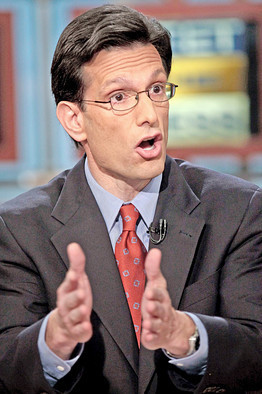 Eric Cantor reacts to the jobs report:
"Just look at the jobs report today," Cantor added. "I cannot fathom how anybody, how anyone thinks right now is a good time to raise taxes. Who thinks that raising taxes on individuals and small businesses can help create jobs?"
I just want to point out again that there is literally no economic theory consistent with Cantor's argument. I wrote a TRB column last year explaining this fully. The short explanation is that, if you think the state of the business cycle should influence your fiscal policy, then you should oppose any spending cuts at all, and the tax cuts you support should be as progressive as possible. Alternatively, if you're worried about the incentive effects of tax cuts on business and the rich, then you don't care about whether unemployment is high or low at any particular moment. Cantor's position, which is the universal Republican position, is pure nonsense by absolutely any standard, including the most conservative standard.
That's even aside from the fact that nobody is proposing an immediate tax hike. Democrats are perfectly happy to phase in any tax increase slowly. Cantor's argument is nonsense economics piled on top of a factual misrepresentation.
Why Are Spending Cuts "Phony"?
Here's Bill Kristol laying out what I suspect is going to be the emerging conservative line on a deficit agreement:
The line is that tax hikes are bad, cutting the defense budget is bad, and the domestic spending cuts are "phony." James Capretta made the same charge recently. Note that we don't know what the deal is, and conservatives have no specific reason to believe that any domestic spending cuts will be "phony." It's simply an article of faith on the right that any spending cuts in bipartisan deficit agreements are phony.
I would note, however, that this belief is problematic even by its own internal logic. While lamenting the "phony" spending cuts, Kristol laments the defense cuts, which he assumes are all too real. It's not clear what mechanism he believes will guarantee that the military cuts go into effect while the domestic cuts are ignored. Perhaps he expects the Republican leadership to agree to have all spending cuts administered by an independent board run by Tom Hayden and Acorn.
It's certainly true that some mechanisms of spending discipline are more specific and binding than others. The least specific mechanism is discretionary budget caps. And yes, it's quite conceivable that Congress might vote to impose extremely tight caps on the overall discretionary budget, only to recoil when they discover this requires them to slash the transportation budget, scientific research and food inspections. That sort of dynamic has been known to occur. But of course the celebrated Paul Ryan budget imposes ludicrously tight domestic spending caps that would require the near-elimination of all non-entitlement, non-defense spending:
Perhaps the single most stunning piece of information that the CBO report reveals is that Ryan's plan "specifies a path for all other spending" (other than spending on Medicare, Medicaid, Social Security, and interest payments) to drop "from 12 percent [of GDP] in 2010 to 6 percent in 2022 and 3½ percent by 2050." These figures are extraordinary. As CBO notes, "spending in this category has exceeded 8 percent of GDP in every year since World War II."
Defense spending has equaled or exceeded 3 percent of GDP every year since 1940, and the Ryan budget does not envision defense cuts in real terms (although defense could decline a bit as a share of GDP). Assuming defense spending remained level in real terms, most of the rest of the federal government outside of health care, Social Security, and defense would cease to exist.
Oddly, nobody on the right considers these cuts "phony." I believe the guiding principle is that spending cuts pushed through by hewing to purist conservative values are "real," while spending cuts obtained through bipartisan compromsie are "phony."
Man Jailed For Cashing Check
This horrific story offers a window into the reality of life for low socioeconomic status minorities:
Ikenna, a 28-year old construction worker, went to deposit a $8,463.21 Chase cashier's check at his local Chase branch, only for the teller to decide that neither he nor his check looked right and he got tossed in jail for forgery, KING5 reports. The next day, a Friday the bank realized its mistake and left a message with the detective. But it was her day off, so he spent the entire weekend in jail.
By the time he got out, he had been fired from his job for not showing up to work. His car had been towed as well. It ended up getting sold off at auction because he couldn't afford to get it out of the pound. He had been relying on that cashier's check for his money but it was taken as evidence and by the time he got it back it was auctioned off.
All this while the cashier's check had been issued by the very bank he was trying to cash it at.
Chase didn't even apologize, not even after a year.
Something like this would never happen to me. I'm white, which makes me far less likely to be accused without evidence of trying to cash a fake check. And if I were so accused, I know enough lawyers that somebody would save me very quickly. But, say, a black construction workers lacks that kind of protection.
Cracked, of all places, recently published a very good -- though highly profane -- piece about being poor. The best way to think of its is that middle-class people enjoy all sorts of protections against misfortune. For poor people, a single thing going wrong can lead to a life-altering spiral -- they lack the social and financial resources to overcome one problem, so a flat tire become a late day at work which becomes a lost job, an overcharge fee busts a checking account, which in turn becomes a ruined credit rating.
It's worth keeping all this in mind when you consider the common conservative view, expressed most recently by Orrin Hatch, that people in the bottom half of the income distribution are getting a free ride off the rich. The underlying assumption here is that market income reflects differences in merit, and that exceptions to this rule are primarily limited to cases of political manipulation of the markets. In the real world, class is very sticky. You have to be very smart, hard-working, and/or lucky to move from the bottom to the top, and very dumb, lazy, and/or unlucky to fall out of the upper tier if you've arrived or even been born there.
The Case For Fatalism

The debate among liberals over the economy has essentially created two camps. You have economic pessimists/political optimists, who have emphasized the awfulness of the economy, but argue that stronger action (or at least rhetoric) from President Obama could measurably improve things, or at the very least help him avoid the blame. Then you have economic optimists/political pessimists, who insist there's no way to pass better macroeconomic policy, but the economy isn't really as bad as people think. (This is more or less the Obama administration's view.)
Personally, I'm an economic pessimist and a political fatalist. The economy is awful, and it's going to stay awful for a long time. Financial crises tend to produce very, very slow recoveries. But Americans don't really believe in economic stimulus. And even if they did, Republicans have zero incentive to support it. Here's former Bush administration press secretary Ari Fleischer's reaction to this morning's jobs report:
Today's unemployment numbers: Uh-O. And the O stands for Obama.
Yeah, Republicans are perfectly aware that the slow recovery is their best chance to retake power. And no, I don't think they lock that information into a sealed compartment when they figure out their position on legislation that could impact unemployment between now and November 2012.
I should say I'm not a complete and total fatalist. The Federal Reserve still has a few bullets in its chamber if Ben Bernanke can overcome the phantasmal fears of inflation hawks. Obama could start to do more to champion a few specific policies, like a payroll tax cut, and blame Republicans for opposing them. But otherwise, yes, I have to admit that I think the economic situation is very grim and the political system isn't capable of doing much to fix it.
As for Obama, the underlying economic facts make him vulnerable. But his popularity has held up remarkably well given the underlying economic conditions. At this point, the state of the economy is almost completely beyond his control. All he can impact is the other stuff.
Obama Steals The Deficit Hawk Mantle
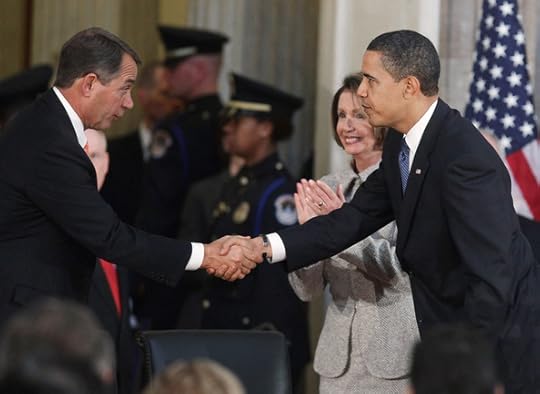
President Obama, as I've argued before, badly bungled by allowing the debt ceiling vote to turn into a hostage crisis which may well exact a horrendous economic toll. But he has clearly turned the politics to his benefit very recently, snatching the mantle of deficit hawk away from the Republicans. One good gauge of his success on that score is to watch Charles Krauthammer rage today:
President Obama assailed the lesser mortals who inhabit Congress for not having seriously dealt with a problem he had not dealt with at all, then scolded Congress for being even less responsible than his own children. They apparently get their homework done on time.
My compliments. But the Republican House did do its homework. It’s called a budget. It passed the House on April 15. The Democratic Senate has produced no budget. Not just this year, but for two years running. As for the schoolmaster in chief, he produced two 2012 budget facsimiles: The first (February) was a farce and the second (April) was empty, dismissed by the CBO as nothing but words untethered to real numbers.
Obama has run disastrous annual deficits of around $1.5 trillion while insisting for months on a “clean” debt-ceiling increase, i.e., with no budget cuts at all. Yet suddenly he now rises to champion major long-term debt reduction, scorning any suggestions of a short-term debt-limit deal as can-kicking.
The flip-flop is transparently political.
Now, obviously as an argument, this is pretty weak. Krauthammer is pulling out every trope used to bash Obama on the deficit the last two years. Obama has run up huge deficits! (Never mind that CBO projected the deficit at well over a trillion dollars before Obama took office.) He attacked poor Paul Ryan! He did not immediately make the Bowles-Simpson plan his negotiating position!
Those arguments did work for many months. But the fact is that the Ryan plan, reflecting right-wing values, stands no chances of passing because Democrats will block it. Krauthammer also repeats the GOP talking point that Democrats have failed to pass a budget that can't pass because Republicans will block it, but it's hard to see the importance of this.
The boring, endlessly-repeated yet true fact is that only way to actually reduce the deficit is to compromise on a plan that offends both parties. And now it's clear that Obama is willing to support a plan like this, and most Republicans are not. The habitual pox-on-both-houses centrist pundits are actually beginning to recognize this fact. Krauthammer desperately wants to invoke the old metrics of seriousness -- which president was in office when the deficit exploded (Obama), which party made the most dramatic futile ideological gesture (Republicans), and which party was meaner to Paul Ryan (Obama!)
But the reality is that none of those things was ever a real indication of willingness to do the things that would lead to a major deficit bill. Now that is finally becoming clear. We don't yet know what substantive toll his negotiating method has extracted, but the political benefit is obvious.
July 7, 2011
Why The Big Budget Deal Won't Happen
Because conservatives won't go for it:
Mr. Obama, seated between Mr. Boehner and the Senate majority leader, Harry Reid of Nevada, told the lawmakers he would not sign an interim deal, only one that extended through the 2012 election.
Then he surveyed the eight leaders about their preference for three deals of different sizes — the largest being up to $4 trillion in deficit reduction over the next decade, according to aides briefed on the discussion.
Six of the eight expressed their support for the biggest deal, the aides said. But Representative Eric Cantor, the House majority leader, and Senator Jon Kyl of Arizona, the ranking Republican on the Senate Finance Committee, favored the midrange $2 trillion, voicing doubts about how they could sell a $4 trillion deal to their rank and file, officials said, since it would involve tax increases.
It's interesting that John Boehner is apparently open to a grand bargain. Maybe, lurking beneath that tanned face and hackish career is the soul of a patriot, or a deficit hawk, or prospective future member of blue ribbon panels. Possibly Boehner's hours of discussions have persuaded him that he must abandon party orthodoxy to address the deficit.
It still doesn't matter. If Eric Cantor doesn't want to pass a budget deal, then the chances of it making it through the House are zero. If Boehner and Cantor and Paul Ryan pushed for a deal, there'd be a chance. But even the medium-sized deal will be hard.
Jonathan Chait's Blog

- Jonathan Chait's profile
- 35 followers

