Greg Marcus's Blog, page 8
November 5, 2018
Climb The Mussar Ladder of Voting Like Maimonides
 Voting is just the first rung on the Mussar ladder of voting
What would Maimonides say about voting?
Maimonides, the great medieval Jewish philosopher, defined eight levels of giving charity. For example, we can give reluctantly and with regret, or we can give a large loan to help someone escape poverty entirely. Maimonides ladder of charity sets forth an important principle – there are levels of doing good, and each rung we climb brings us closer to heaven. Inspired by Maimonides ladder of charity, Mussar can guide us to create a ladder of voting.
What might a Mussar ladder of voting look like? Each rung will bring more mindfulness, and a greater positive impact. And, each rung would be more about others, and less about ourselves.
The Mussar Ladder Of Voting.
Vote in the most important races. Given the length of the ballot, you may not have time to research every race. Rather than not voting, cast your ballot for what you deem to be the most important races. For example, you vote for the President and Senator, but don’t vote for the ballot measures or local officials.
Vote in every race based on third party recommendations. Here, you are using party affiliation, and/or a voter guide to vote for each and every issue on the ballot. You are making your voice heard more widely, and thus taking on more responsibility for the outcome of the election. This approach also includes people who vote no on every ballot measure unless they have a very good reason to vote yes.
Vote every line of the ballot based on personal research. Here, you are taking your responsibility to create a just society very seriously. You research each candidate, and make an informed decision for each one.
Vote according to the totality of your values. Not only are you making an informed decision, you are making a moral one. Rabbi Ira Stone reminds us that Mussar is a practice to learn to bear the burden of the other. Consider the impact of the laws passed by your candidates on “the other”. Elections have consequences. If you are thinking only about yourself, you are missing the fundamental imperative of living a moral life.
Bringing morality to voting can be tricky. For example, some Fundamentalist Christians only vote for candidates who oppose abortion. And some Orthodox Rabbis have told people to vote against any candidate who supports gay marriage. While each of these positions are heartfelt and grounded in values, they run into the danger of idolatry. There is no one single Jewish value that encompasses them all, except for Rabbi Hillel’s teaching which says “That which is hateful to you, do not do to another.”
Rabbi Moshe Chaim Luzzatto wrote, “Just as Enthusiasm can result from an inner burning so can it create one. That is, one who perceives a quickening of his outer movements … conditions himself to experience a flaming inner movement.” May your zeal for a just world inspire you to climb the Mussar ladder of voting.
Where do you land on the Mussar ladder of voting? Should there be other rungs, like voting for other Jews, or people who share your ethnicity/religion; voting against anti-semites; or enabling others to vote? Please comment below and let me know.
You might also like 5 Ways Spirituality Can Fight Post Election Despair
The post Climb The Mussar Ladder of Voting Like Maimonides appeared first on American Mussar.


November 1, 2018
Practice Gratitude After Tree of Life?
 Reverend Terry Gleason gives support and comfort from the Bimah
Is it too soon to practice Gratitude after Tree of Life? It was a massacre of our siblings on Shabbat. Less than a week later, I remain upset, sick, worried, sad, mad and confused.
I am working to make room for the sadness, as I described in the last post. And in that context, Gratitude after Tree of Life may seem a long way away. Yet is it exactly part of what we need to help get through.
The soul trait of Gratitude in Hebrew is Hakarat Ha’Tov, recognizing the good. In Mussar, we train ourselves to recognize the good, even in bad situations. I’ve done this mussar practice many times. While is works after I’ve gotten a parking ticket, or been in a painful argument with my wife, can it really help at a time like this?
Being grateful for the good and the bad is one of the most challenging Mussar lessons. Each and every time I facilitate a Mussar circle focusing on Gratitude, people initially get tripped up at the idea that we should give thanks for bad things.
The idea comes straight from the Talmud
One recites a blessing for the bad that befalls him just as he does for the good. Berachot 54a
The word “recognizing” reminds us how often we take things for granted. Even in a terrible event, some good things happen that we can take for granted. Together, lets us try to practice Gratitude after Tree of Life.
****Here’s the Mussar Practice*****
Recognize the good and give thanks for the events after the murders. Being sad is the first mussar practice after the murders. Now lets try to find a few areas of light. Here are three things to be grateful for:
We live in a country where police will rush into a building to protect us. Four police officers were wounded trying to save Jewish lives. Throughout our history, again and again, the police turned a blind eye or were complicit in killing us. It is wonderful and amazing to live in a country where today, the police risk their lives to protect us.
We can be grateful to the people who care for the bodies of the dead. I don’t want his mother to see him this way, Don Corleone said to Bonasera the undertaker in the Godfather, referring to the bullet riddled body of Sonny. The Chevra Kadisha is the Jewish burial society who wash and care for the bodies of the dead. In Pittsburgh, a team of volunteers stood outside the Tree of Life synagogue through the night until the bodies were removed. Later, they cleaned the synagogue to gather all of the human remains for burial. Every day, all over the world, volunteers and professionals work to treat the bodies of the dead with dignity. Truly Holy and sacred work.
People are coming together. Sunday night I attended a community gathering hosted by my synagogue. I was astounded to see a traffic jam, and close to 1000 people jammed into our sanctuary and social hall. It lifted my heart to see so many people there to support each other. I can’t tell you how much it meant to me to hear from clergy from many faiths, including a woman who chanted the Koran from the Bimah. It was one of the most beautiful things I have ever heard.
Be sure to verbalize your Gratitude after Tree of Life, both directly to the people you are grateful to, and to third parties.
*******************************************
Almost 1000 years ago, Rabbi Bachya ibn Pakuda wrote “Many good things are left unenjoyed, and the happiness to be had from them becomes tainted either because people do not recognize the good in it, or they do not realize its value.” (Duties of the Heart.)
For me, there is no joy in recognizing the good in these circumstances. However, Gratitude after Tree of Life does ease the pain. A Mussar practice of Gratitude today means that, in the future we will not miss an opportunity to recognize the good, and enjoy something that can be enjoyed.
For the good will return. It is still here. We can and must find it again.
See also 15 Minutes of Gratitude Could Change Your Life
The post Practice Gratitude After Tree of Life? appeared first on American Mussar.
October 28, 2018
A Spiritual Response To The Tree of Life Massacre
 It is with profound sadness that I write this post. There is no right or wrong way to cope with the murders at Tree of Life *Or L’Simcha Congregation in Pittsburgh. I’ve seen lots of wonderful emails and posts from leaders in the Jewish community, with suggestions on what to do for kids, as a leader in a congregation, etc. But I have been struggling on how to react as a person. Here are my thoughts as they unfolded on Saturday, with a suggested Mussar practice.
It was surreal to pull up to the synagogue where I facilitate two Mussar groups and see a police car parked in front. There was another police car parked behind the synagogue, near the main entrance. Surreal, but not a surprise. Word of the shooting at Tree of Life *Or L’Simcha Congregation in Pittsburgh had already hit the news. When something like this happens, we need to protect ourselves.
We spoke of it on both groups – one person said they were not sure they were going to come, but upon hearing the news “I made sure to be here.” This is what we do – we show up in times of grief.
The full horror of the murder of my Jewish siblings did not hit me until later in the day. I am in shock and mourning, as is the whole community of Jews and our allies.
The soul trait of Loving-Kindness (Chesed in Hebrew) teaches that comforting mourners is one of the highest and most sacred acts in Judaism. But how exactly do we mourn when we do not know the dead personally? What if I don’t want to visualize my own beloved sanctuary drowned in blood?
A friend of mine died unexpectedly a few years ago, and I’ve seen first hand how shattering it was to her husband and children. Must I dwell upon the survivors of the 11 who were murdered?
My denial gone, I sit feeling shattered. But still, how do I mourn?
I offer a mussar practice to help us through.
****Here’s the Mussar Practice*****
Allow yourself to feel sad. I didn’t feel sad the morning I first heard the news. I didn’t feel much of anything. I used to fear that I was low in the soul trait of Compassion because I did not feel in situations like this. Now I understand that I have too much Compassion, and shut off to avoid being flooded. Now I know this is a normal response to trauma.
A spiritual response to mass murder is to inhabit the feelings that arise. Skipping sadness is dangerous, and opens the door to the evil inclination influencing our actions in ways that make things worse.
So, I am choosing to let myself feel sad. Here are a few ways we can do this together.
Tell people you are sad when they ask how you are. When I picked up my Chinese food for dinner, when they asked how I was, I said that I was sad over the Tree of Life Temple. They were shocked, and did not know what to say. And, they were sympathetic, and know that this event across the country impacts a regular customer who they greet by name.
Reach out to others. Call friends and loved ones and let them know you are sad. Offer comfort, and allow them to comfort you. Many organizations across the faith spectrum are hosting events. Go to one, whatever your faith. Be there for others, and for yourself.
Make their memory a blessing. “May their memory be a blessing” is a traditional way that Jews offer comfort to a mourner. It means may their memory inspire us and bring comfort. For example, we can give blood, donate money, or volunteer to help those in need. You are invited to join me and donate directly to Tree of Life*Or L’Simcha Congregation.
**********************************************
Rabbi Ira Stone teaches that the mission of Mussar is “bearing the burden of the other.” In a time like this, we need to hold each other up. We need to bear and be bourn.
Mussar is a practice of personal growth and spiritual transformation. Is it too early to think about growth and change? Yes and no. Before we get to growth, we need to pass through sadness. We practice Mussar so it can be there for us in times of crisis when we need it. We aspire to grow and learn each day, even on the worst days.
We have endured a lot as a people, and will endure more as we continue to pray for peace and a just society. I trust our tradition that coming to grips with sadness is key way station on the path of wholeness, and holiness.
The post A Spiritual Response To The Tree of Life Massacre appeared first on American Mussar.
October 26, 2018
Five Ways Mussar Can Make Halloween Jewish For Your Kids
 Halloween can be a mixed bag for many parents. Seeing lots of cute kids in costume is balanced by another straw a hectic and over-scheduled life. For Jewish parents, there is the extra baggage of a grumble from Rabbis and experts who say that this tradition with pagan origins is not appropriate for our kids.
The Jewish mindfulness practice of Mussar offers an opportunity to make Halloween more mindfully Jewish. Mussar teaches how to close the gap between our aspirational values and how we act in everyday life.
Five middot, or soul traits to make Halloween Jewish.
Joy/Simcha. Whenever I talk to small kids on Shabbat, I ask them “what is the number one rule of Shabbat? Shabbat is a delight.” I don’t share with them the full quote from Isaiah 58:13, which says “And you shall call the Shabbat a delight.” Since we are commanded to make one seventh of our life a delight, it is clear that Joy is a fundamental Jewish value. And if you are now thinking that your Shabbat is more about schlepping kids than joy, think of a way to bring a little more joy to your Shabbat too.
Gratitude. The soul trait of gratitude is known in Hebrew as Ha’karat ha’Tov, recognizing the good. Getting candy and wearing a costume are fun things that we should not take for granted. We can remind our kids that saying thank you is not only polite, but a fundamental part of being Jewish. And, we can model being grateful for the financial means to have a home, and to buy candy and costumes. There is a big difference between saying “You should be grateful that daddy bought you this costume” and “Daddy is grateful that we have a home to welcome all these kids, and the money to buy candy.”
Generosity. Mussar teaches that generosity is giving from an open heart, as opposed to Tzedakah, which is giving out of obligation. When you are preparing for Halloween, are you modeling generosity, or are you showing your kids a litany of stressed out comments about putting up decorations and having to buy candy? In addition, we can work with our children to find a way to give some of their candy to homeless kids or other people in need.
Honor/Kavod. The Talmud teaches that Rabbi Yochanan Ben Zakkai would greet others in the marketplace before they greeted him, even gentiles (Berachos 17a) Once I stopped rolling my eyes at “even gentiles” I realized how profound it was that a sage in a tribalistic society of 2000 years ago opened his heart to people who were not like him. Halloween is a holiday where it is ok and celebrated to be different. We can remind our kids of the importance of respecting other people’s costume choices. And by participating, we have an opportunity to mindfully decide to connect to a cultural tradition of our country.
Silence. In the book of Genesis, we learn that the world was created with speech. Indeed, we assist in the ongoing creation of the world with our speech every day. Be mindful of what you say and don’t say on and about Halloween. Are you using words like “lame or schlep,” or words like “cool and welcoming?” In addition, we can remind our kids that lashon ha’ra, or evil speech is not ok. In other words, don’t make negative comments or jokes about other people’s costumes or homes. Rabbi Hillel taught that one should always praise a bride as beautiful on her wedding day (Ketubot 17a). Why? Because a wedding is a time of joy. making negative comments about the groom’s shoes could detract from the joy of the occasion. Rather, we should proactively add joy. Similarly, we can teach our kids to praise the costumes of their friends and guests.
Finally, by taking a Mussar approach to make Halloween more Jewish, you are demonstrating to your family that one way to be Jewish is to show up as a mensch. Tell your kids that Joy, gratitude, generosity, honor and/or silence are fundamentally a part of being Jewish. Wherever you go and whatever your decide to do, we can bring a bit of Jewishness simply by choosing to live according to our values.
How will you make Halloween more Jewish this year?
The post Five Ways Mussar Can Make Halloween Jewish For Your Kids appeared first on American Mussar.
October 16, 2018
How To Trust The Political Process Like a Mensch
 Last post I shared a Mussar practice to deal with political worry by taking action. This week we’ll tackle political worry head on, by focusing on the soul trait of Trust.
Trust is a very hard soul trait – so hard that many Mussar facilitators avoid it. I took the opposite approach, and include it early in my mussar book. Why? Because it is impactful. And because it is hard, we need more practice.
I am part of a Mussar Circle that is spending a year on the shadow side soul traits. After a summer hiatus, we met again, focusing on the soul trait of Worry.
Just what I need! Today’s political situation gives me plenty of reasons to worry. The divisiveness alone should worry people across the political spectrum. The traditional way to combat worry in Mussar is to practice Trust, as in Trust in God.
I was both drawn to and repelled by the following passage that we read in the group:
Trust in the Divine with all your heart; and do not lean on your own understanding. In all your ways acknowledge the Divine, and the Divine shall direct your paths. Proverbs 3:5-6
I was drawn to this in an aspirational way, and so wish that I could receive guidance and support to get through these turbulent times. And the “all your ways” is a theme that refers to the actions and decisions we make in everyday life, which I am totally into. At the same time my rational mind rebelled because I am not in the habit of blindly trusting that things will be ok.
We spent a lot of time in the Mussar circle discussing what the Divine means to us. Nina Piken gave me permission to share her conception of the Divine as a process of engagement, and she Trusts that process. Her framework helped crystalize what the passage above meant to me. Notice how it looks when I substitute “The Process” for “the Divine”
Trust in The Process with all your heart; and do not lean on your own understanding.
In all your ways acknowledge The Process, and The Process shall direct your paths.
Proverbs 3:5-6
Could The Process mean the political process too? I am struck by the convergence of the return of the Mussar circle focusing on worry at the very time my own political worries are starting to spike. And then Rabbi Rachel Adler referred to the Divine as a process on a Judaism Unbound Podcast I listened to the day after our group met. All of this brings to mind a Mussar practice for this week.
****Here’s the Mussar Practice***
Let the Process direct your path. If you are worried about the election, engage with the political process. In the 2016 election, too many people placed blind trust in the polls, which led to complacency. The political process means at minimum you should vote and encourage others to vote. You can also knock on doors, make phone calls, or contribute money.
Nina explained that the process represents in part self reflection. Am I making a knee-jerk reaction? Am I acting from my best self, or from a place of worry? A regular Mussar practice gives us a process to connect our actions to something beyond the surface, something higher or deeper. And we learn to Trust that process.
Trusting the political process keeps an eye on the big picture, and not to mistake today’s fight as a fight for all time. Trust reminds us that we are not alone, and that we have the resources to handle whatever happens.
**************************************
We all have the ability to be a Mensch, even when it comes to the anger and frustration so many of us are feeling about the government, or the opposition. Taking action is what the political process is all about, and taking action is also what Mussar teaches us to do. There are no guarantees about the outcome, which is why we need to trust the political process like a mensch. Let’s fight the good fight with sound minds and hearts, from a place of strength and respect.
As Rabbi Tarfon taught: “It is not your responsibility to finish the work [of perfecting the world], but you are not free to desist from it either” (Pirkei Avot 2:16).
Or to put it in a more modern context:
We shall overcome, some day.
You might also like Practice Trust To Overcome Election Stress Disorder
The post How To Trust The Political Process Like a Mensch appeared first on American Mussar.
October 11, 2018
How To Worry About Politics Like A Mensch
 Bluto (a future Senator) is not a mensch, but he understands resilience in the face of adversity.
Today someone told me she thought the country is heading for martial law. I agreed we could be. It is one of my fears. Why else a Presidential alert text system, it whispers.
But she thought martial law would be a good thing, to arrest a bunch of people and “clean things up.” She was almost giddy.
Practicing what I preach about not giving advice to those who don’t want to hear it, I said, “Ok then,” and moved on to the next topic. Yet I am angry and worried about the political situation in this country. How can I worry about politics like a mensch?
Worry is a disconnect between what is and “what might be.” We worry about things we can’t control, like how our boss or friend will react to a request we make. And more often than not, worry prevents us from being our best self.
However, we need to remember that worry is a soul trait, which means that not enough worry is just as bad as too much. Just like some anger is ok, some worry is ok too. Righteous anger can drive us to take action to fix an injustice. In a similar way, we should try to practice righteous worry when it comes to politics. Given that those in power are acting in a way counter to my values, this is one of those times when some worry is ok.
If I want to worry about politics like a mensch, what should I do?
I should take action. Which brings us to this week’s Mussar practice.
****Here’s the Mussar Practice***
Read Less. Do More. I notice myself obsessively reading articles about the state of the election. I try not to, and find myself looking for articles about politics that don’t mention particular politicians by name. What a complete and total waste of time. I don’t even bother to rationalize this to myself. All it does is stoke my worry, or allay it for five minutes. It doesn’t change anything.
As Shammai taught, “Make your Torah fixed, say little and do much, and receive every person with a pleasant countenance.” (Pirkei Avot 1:15).
The first part suggests that we set a fixed time for our political action. If you are worried about the election, put time on your calendar to do something about it.
Second, say little and do much means stop complaining, and start taking action.
The third part, receive every person with a pleasant countenance is a direct challenge to people who complain or troll incessantly on social media. It does no good to blame the “Bernie or bust” people, to rail against the president, or against Democrats. That kind of activity only divides us further, and does nothing to change who has power in this country.
**************************************
Shammai’s teaching is an Enthusiasm Mussar practice. Judaism is a religion of action, and Enthusiasm is the soul trait that helps us take action with energy and purpose. Right now, when I feel that heaviness and concern about what is happening, and what might happen, I need to draw on Enthusiasm to get me going.
Each and every one of us has what it takes to be a Mensch. Sometimes we need some inspiration to step into our best selves, and not give in to fear, worry, or despair. Maybe you can get that from a friend or relative, maybe from our ancestor Abraham who used to “run to do good” or maybe from a fictional not very menchy character like Bluto in Animal House.
What matters is getting people to vote. Period. As a Mussar practitioner, you need to start with you self. Click here to take the pledge to vote, and access resources to help in close races across the country.
Please share encouragement, resources and links below.
My own political views are heartfelt, and not a secret. If you disagree, I hope we can stay civil with me and in relationship. While we will not litigate the issues here, you are free to share election resources to support any reasonable candidate or party below.
The post How To Worry About Politics Like A Mensch appeared first on American Mussar.
October 5, 2018
How to Disagree About Abortion Like a Mensch
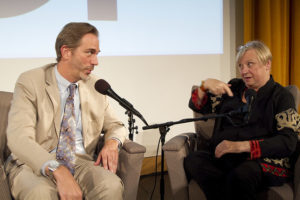 Christian ethicist, David Gushee and abortion rights activist Frances Kissling disagree about abortion like a mensch
In this week when the political divide in this country is growing like a flesh eating bacterial infection, I am feeling blue. My political views are not a mystery, and I don’t like what is happening with the Supreme Court.
But even more, I am upset about the vitriol between regular people. The nastiness on the internet, and the rifts between friends and family is literally painful to me. I think I must be crazy for hosting an workshop on Healing the Political Divide next week.
Yet just a few days ago, I listened to an inspiring interview that gives me hope that we can bring healing between people. Krista Tippett talked to abortion-rights activist Frances Kissling on her podcast On Being. Kissling described a process she uses to bridge the gap, which I’ll share below in our practice for the week. But first, she invoked a few soul traits with her assumptions
Don’t try to find common ground between apposing sides. I think she spoke her Truth when she explained that there isn’t a lot of common ground between a group of Catholic Bishops and abortion rights advocates.
Recognize the good in the other side. This reminds me of Gratitude mussar practice , to recognize the good and give thanks.
Refuse to see the other side as evil. This is a wonderful Honor practice, in that we remember there is divine in each person.
With these three assumptions, we come to a Mussar practice, which is based directly on one of Francis Kissling’s tools.
****Here’s the Mussar Practice***
Say something that you are attracted to in the other side’s position, and something about your own sides position that gives you trouble. Speak out loud, either alone or to someone close to you. This is particularly powerful when you are paired with someone who disagrees with you. Frances Kissling, an abortion rights activist and Christian ethicist David Gushee use this tool at the end fo the podcast.
Kissling said, “I’m generally troubled by the one-value approach to the question. That the only value in both moral decision-making and in legality, is what the woman wants.” Complicated questions, like abortion for sex selection are not considered. And, she found something very attractive about the holistic approach to life and life-processes on the other side.
Gushee said, “One of the things I’m attracted to … is the sustained knowledgeable commitment to the well-being of women.” Gushee said he is concerned about that the activists who want to see Roe overturned might be leading to a world with more abortions if they are also shredding the safety net.
If these two people on opposite sides debate can each disagree about abortion like a mensch, then perhaps we can find something attractive in the position of people on the other side of the political chasm.
*****************************
This is a practice in the soul trait of Honor (Kavod.) Each of us has a Divine Spark that is occluded by our baggage. If you are unsure of the Divinity, think of it as the basic element of goodness that each of us has. Our baggage can keep us from seeing our own spark, or the spark of others. Or, it can keep others from seeing our own spark. The universal Divine Spark means that each of us has merit, as Yehoshua ben Perachia said:
“Make for yourself a mentor, acquire for yourself a friend and judge every person as meritorious.” – Pirkei Avot 1:6
In his book “Every Day Holy Day,” Alan Morinis suggests the mantra “There is another side to the story” when we are working on judging others favorably. Getting to know someone you disagree with enough to see their side of the story is a menchy action, a Holy action.
May each of us find the strength to get to know one person on the other side well enough to see through their eyes.
Do you want to help heal the political Divide? Join the Healing the Political Divide Mussar Workshop on October 11th, 2018
The post How to Disagree About Abortion Like a Mensch appeared first on American Mussar.
September 25, 2018
How To Wait In Line Like a Mensch
 Which of these people are waiting in line like a mensch?
I am writing today from the DMV, while I wait for my daughter to take her learners permit test. The DMV is the great equalizer –everyone needs to go there. And when we go, waiting in line is inevitable.
At one point, I stood on my tippy toes to peak over the wall to see how many testing computers there were. “Dad, be patient!” my daughter said with exasperation.
“But I am being patient,” I thought. “I’m not ruminating or raging. I was just curious to see how many testing machines there are.”
“OK,” I said. I know better than to get into it with a teen. And really, she had a point. I was wondering how many computers there were, because the line just wasn’t moving.
Patience, like all soul traits, lives on a spectrum from too little to too much. Too little patience and we are angry and frustrated; too much and we are staying in bad situations without taking action. My peaking over the top was perhaps a strategy to try to deal with rising impatience. All of this makes me wonder:
How does one wait in line like a mensch?
When we wait in line, we have three options.
Wait with suffering and impatience.
Wait with indifference, zoning out or snacking on phone content.
Wait with connection and meaning.
There are no right or wrong answers per se. But if we want to wait in line like a mensch, we take the opportunity to make the most of the moment. A mussar practice comes to mind.
****Here’s the Mussar Practice***
Wait in line with a sense of wonder. I tried this today, and it wasn’t easy. The DMV does not exactly present a feast for the eyes. Yet I was able to see some interesting patterns on the wall, and all kinds of different people. I wondered what their stories were. A few years ago, I would seek out longer lines, and say the Patience mantra “This too shall pass, and I have the strength to get by until it does.” Now that I don’t get frustrated waiting like I used to, this feels like the next challenge for me.
************************************
R. Dov Ber of Radoshitz would waken his roommates with the call “Wake up, my brothers! A guest you’ve never seen has arrived. Once he leaves, you will never see him again. [Who is the guest?] Today.” I was going to spend two hours at the DMV no matter what. Instead of just hoping the time would pass as quickly as possible, why not try to make the most of the moment?
This is a Mussar Practice for Enthusiasm. B”en Azzai would say: “Run to pursue a minor mitzvah , and flee from a transgression. For a mitzvah brings another mitzvah, and a transgression brings another transgression.” (Pirkei Avot 4:2).
Life is the sum total of many minor moments, and a few major ones. Elevating the minor moments like waiting in line can add up to huge changes over time.
As it happens, the DMV was the DMV. We were sent to the wrong line when we arrived. After two hours, we were told that we needed to come back with different paperwork. It was not a waste of time.
Where do you sit on the ladder of waiting in line? Reply below and let me know.
The post How To Wait In Line Like a Mensch appeared first on American Mussar.
September 17, 2018
How To Repent On Yom Kippur Like a Mensch
 Finn does not play the Shofar, but he does ask for only one thing at a time
The first way to repent on Yom Kippur like a mensch is not to use the word repent. Rather, a mensch uses the word “return.”
The word in Hebrew is Teshuva, from the root “shuv” which means to return. I could not even begin to guess at how many books and articles have been written on Teshuva over the few thousand years. But here is a good one if you’d like more info.
I have always gotten a lot out of Yom Kippur. The process of making it right with people, thinking about the past year, fasting, and going to services is both meaningful and transformative. My life changed on Yom Kippur when I was 40 – a sacred number in Judaism – it was the first of several strong spiritual experiences I’ve had on the holiday. (See page 4 here for the story).
How the Mensch Repents on Yom Kippur
Rabbi Alan Lew of blessed memory wrote “Teshuvah begins with a turn, a turn away from the external world and toward the inner realm of the heart.” (This is Real and You Are Completely Unprepared. p 157)
This teaching puts us within a Mussar framework because we are focusing on the inner world. In addition, “return” takes us away from the flavor of shame that can come with the word “repentance.” Moreover, it implies that we already have what we need to do the right thing.
At the same time, we can’t do it alone. This is especially true when it comes to longstanding hurts or habits. It is not an accident that 12 step programs turn to a higher power for help overcoming addiction. While a lifetime of habits are not an addition per se, they might as well be when it comes to changing some of them. So how do we ask for that help, especially if we are not sure about the Divinity? One hint to the answer comes from the 27th Psalm. King David wrote,
One thing I ask from the Divine, this only do I seek:
that I may dwell in the house of the Divine
all the days of my life
As I wrote in the concluding chapter of The Spiritual Practice of Good Actions, “dwell in the house of the Divine” means to be a good person. Today let’s focus on the beginning of the phrase, where it says “one thing I ask.” David shows us that we can ask the Divine for help on a personal basis. And, we should ask for only one thing at a time.
In the month of Elul, it is traditional to read the 27th Psalm every day. Each day we’ll repeat it
One thing I ask…
One thing I ask…
One thing I ask…
Which brings us to a Mussar Practice to repent on Yom Kippur Like a Mensch
****Here’s the Mussar Practice***
Ask for one thing. I am in two personal transformation workshops this year – the American Mussar one I am facilitating, and one run by Rabbi David Jaffe. Both offer an opportunity to create a spiritual plan for transformation. Through the discussion in these groups, it has become clear to me that we should only ask the Divine to help us with one thing. Not because the Divine is unwilling to help us with more than one thing, but because we are only capable of changing one thing at a time!
When coaching kids in softball or soccer, we were taught to only correct one thing at a time. When they improve on the first thing, then we help them improve the next thing. Similarly, when I work with clients, we pick one change to make in our life at a time.
When you are in services or on your own, say quietly to yourself “Please help me________.”
If you are not sure of the Divinity, you may be wondering who will hear you. At minimum, you will hear yourself, which is an important step on the transformation path.
*****************************
This Mussar practice to repent on Yom Kippur like a mensch is an Order practice, as it says
First things first, and last things later – Pirkei Avot 5:10
A mensch remembers that there can only be one first priority. By asking for one thing, we bring our focus to a single thing we want to change. Yes, we have many things we want to improve about ourselves, but by going one at a time we can actually make lasting and meaningful transformation.
What is the one thing that you will ask for in 5779? Please comment below.
The post How To Repent On Yom Kippur Like a Mensch appeared first on American Mussar.
September 11, 2018
How To Remember September 11th Like A Mensch
 I hadn’t planned on writing anything to commemorate September 11th, but as the day has progressed, here I am. The words just started to flow, beginning when I wrote the following on the American Mussar Facebook page:
Feeling sad today remembering the September 11 attack. Things have not been the same.
Then I read an article called For 9/11 Families, A Bittersweet Anniversary Falls On Rosh Hashanah. Reading about those Russian-speaking Jewish families who lost sons and daughters and sisters and brothers was tough. But I made myself keep reading to remember their stories. It brought something home to me: All of us lost something on 9/11. But some people lost people.
9/11 on Rosh Hashanah has a special resonance. It is a day of intense introspection that comes in a season of reflection. For example, this “like a mensch” series of blog posts started in the month of Elul, as I started to reflect more deeply on my life.
In fact, Rosh Hashanah is also known as the Day of Remembrance. Remembrance is one of the three parts of the Shofar service. The traditional interpretation is that we remember the covenant with God. Mishkan Ha’Nefesh, the Reform High Holiday prayer book, includes the phrase “The Divine wakens within us – a sudden awareness of Your presence.” If you are not sure about the Divinity, or don’t really understand the covenant, think of the Shofar blast as a reminder to connect to the Divine in other people.
We do this on two ways on 9/11. The first is to come to a state of Hineni, a Hebrew word which means “HERE I AM.” On Rosh Hashanah, we read the story of the binding of Isaac from the Torah. When Abraham is about to slay his son, an angel calls out to him and he answers Hineni, Here I am. It is a moment of total attention, where life hangs by a knife edge. If we are to remember September 11th like a mensch, we must come from a place of Hineni. Then, we do the following Mussar Practice.
*** Here’s the Mussar Practice.***
Read names out loud. In Judaism we say, “May their memory be a blessing” to someone in mourning. Saying a person’s name is one way to keep their memory alive. A widowed friend recently told me she find that people are reluctant to say her husbands name, which is the last thing she wants. “How can we make his memory a blessing if we never talk about him or say his name?”
While many of us don’t know the stories of those killed on 9/11, we can say their names.
Right now, read the names of the three people mentioned in the Forward article out loud:
Yelena ‘Helen’ Belilovsky
Marina Gertsberg
Vladamir Savinkin
Another option is to go to set a timer, and read names for a minute. I did this, and read 21 names.
**********************************
The Untaneh Tokef prayer on Rosh Hashanah and Yom Kippur asks who will live and who will die? It goes on to list ways that we could go e.g “who by fire and who by water, who by war and who by beast.” And then it says, “But through return to the right path, through prayer and righteous giving, we can transcend the harshness of the decree.”
It is ok and normal to be sad on 9/11. We cannot change what happened, but we can work to transcend the harshness of the decree. Lets make this day about something more than sadness, and sharing stories of where we were when we found out about it.
Remembering those who were killed is a way for us to connect to other people, which helps us to return to the right path.
When we speak, we practice the Soul Trait of Silence, and assist the Divine in the ongoing act of creation of the world. How does reading the names of the dead create a better world?
The post How To Remember September 11th Like A Mensch appeared first on American Mussar.