Greg Marcus's Blog, page 13
December 28, 2016
Jewish Superhero Carrie Fisher Dies During Hanukkah
.jpg) I particularly like that she had a name tag, even though she was famous. See Humility below.
I particularly like that she had a name tag, even though she was famous. See Humility below.Jewish Superhero Carrie Fisher Dies During Hanukkah. Oy vey, what a year. I admit it – one of my first thoughts was can’t 2016 just be over already? My second thought was, “What about the next Star Wars movie.” Lets dispense with the second thought first. They already filmed episode 8, so we’ll see the General again. But seriously, someone died, and I’m worried about a movie? We think all kinds of things. The reason why I know about Carrie Fisher is because of Star Wars. So I guess it shouldn’t be surprising that I have that kind of mental association.
I feel like I’m channeling the Jewish Forward, calling out Carrie Fisher as Jewish in the headline. Her father was Jewish, and so according to the ruling of the Union of Reform Judaism, she is Jewish from her father’s side. Others would say she isn’t Jewish because her mother wasn’t. I won’t get into that debate here. I consider her a Jewish Superhero because of the way she lived her life. She was an outspoken advocate for the mentally ill. Fisher told the truth, and her openness and example helped combat the stigma that goes with mental illness and addiction recovery. The Vilna Gaon, a famous Lithuanian Rabbi of the 19th century, taught that the greater the person, the greater the evil inclination. She was a larger than life character, whose great appetites and passions were her greatest strengths and weaknesses.
I find it particularly poignant that Fisher died during Hanukkah. An upcoming documentary about Fisher and her mother Debbie Reynolds is called “Bright Lights.” Many describe her as fearless, and unflinchingly honest about her own shortcomings. While I doubt Fisher ever heard of Mussar, I think she would have loved it. Those of us who practice Mussar are trained to be open about our journey, honest about our shortcomings, while at the same time working every day to make small improvements. Here are a few soul traits that I see in Ms. Fisher’s life
One soul trait I think about in particular is Humility – Carrie Fisher occupied a lot of space. She was famous from the time she was born. She worked hard, and applied her talents to be a successful actress and a great writer. In an era were people are famous for being famous, she delivered value added content to the world. Moreover, she used her fame as a platform for social good. I particularly admire the way she took on Twitter trolls commenting on how poorly she had aged in Episode Seven. To paraphrase- “I was 19 when Star Wars was filmed. Of course I look older. Get a life.”
I also think about Enthusiasm, because Carrie Fisher was one to take action. Enthusiasm is about taking action, and it seems like she was proactive about taking on the world. Which brings me back to where I started this post.
My first reaction to Fisher’s death was “can’t 2016 be over already?” So many famous people died. I’ve had serious illness in my family. And I am in the majority of Americans who voted for one candidate, but will see the candidate who got fewer votes go on to be the president. It was distressing. But to wish 2016 away is off base. If we could somehow magically jump ahead to January 1st, 2017, we’d never get those last few days back.As I’ll write in my New Years post, 2016 was also a year of wonder. Who knows what great things will happen over the next few days. Not the least of which will be my birthday. You don’t want the world to skip past my birthday, do you?
There is always light – sometimes we have to work just a bit harder to find it. Carrie Fisher’s career started with a movie we now call A New Hope. It was a time of darkness, yet a small group of good people called upon a mystical Force to help right the course of history. Kind of like a story from a few thousand years ago, when a small group of Jews called the Maccabees used their Faith as a rallying cry to defeat a vastly superior occupying army. Today we celebrate the Hanukkah miracles.
Hanukkah means dedication. I don’t think it is an accident that the last night of Hanukkah begins on December 31st. To what will you dedicate yourself in 2017? Lets use the next few days to contemplate and prepare ourselves.
Comment below and I’ll use your feedback in my New Years post.
Want to start your own Mussar journey? Take the Soul Trait Profile Quiz here.
Image credit: By Gage Skidmore from Peoria, AZ, United States of America (Carrie Fisher) [CC BY-SA 2.0 (http://creativecommons.org/licenses/b...)], via Wikimedia Commons
The post Jewish Superhero Carrie Fisher Dies During Hanukkah appeared first on American Mussar.


December 16, 2016
What is Mussar?
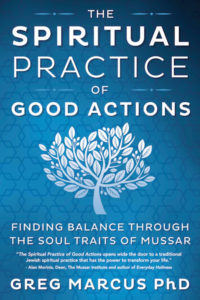 Excerpt from “The Spiritual Practice of Good Actions”
What is Mussar?
Believe it or not, there is a solid argument that the Jews invented self-help over 1000 years ago. At the time, the Rabbinic scholars were trying to understand why it is so hard to be good. The Ten Commandments and other Jewish teachings clearly spell out how we should act. Yet many of us, both now and then, violate either the letter or the spirit of these commandments quite regularly. One of the answers to this question was Mussar.
Mussar is a practice that gives concrete instructions and guidelines to help you live a meaningful and ethical life. The first Mussar book was Duties of the Heart by Rabbi Bahya ibn Paquda, which was written in eleventh century Spain. Rabbi ibn Paquda clarified a central tenet of Mussar: Following the spirit of the commandments is just as important as following the letter of the Law. For example, he scorns a scholar who focuses on pointless intellectual exercises instead of working to become a better person, and he praises a scholar who worked for 25 years refining his conduct.
In the ensuing centuries, the Mussar literature grew as scholars contemplated how various character traits like humility, patience, anger and jealousy contribute to a good life. Mussar became a widespread movement in Eastern Europe starting in the early 19th century under the leadership of Rabbi Yisroel Salenter. Rabbi Salenter transformed Mussar from a solitary practice to something practiced in community. Throughout it’s history, Mussar masters used real world examples, and describing situations that are often as relevant today as they were hundreds and thousands of years ago. In short, the struggles of our soul have not changed.
The fact of the matter is that we all have issues, whatever our religion or level of spirituality. Mussar teaches how to find those things inside that cause us to get in the same situation over and over again. And, it provides guidance for how we can begin to make small changes in our lives to help bring healing to the Soul through greater balance. Rabbi Elya Lopian (1876-1970) defined Mussar as “making the heart feel what the mind understands.” I love this definition, because so often we know what we should be doing, but we just can’t seem to make ourselves do it.
Mussar can be translated from Hebrew to mean, “correction” or “instruction.” In modern Hebrew, Mussar means ethics. When we practice Mussar, we are adjusting and correcting our Soul. But we don’t try to adjust the whole thing at once. Rather, we focus on specific parts of the Soul called Soul Traits.
Real World Spirituality
Compared to Mussar, Kabbalah is the more widely known branch of Jewish spirituality. Kabbalah is spiritual/mystical and focuses on the unseen forces in the universe. Mussar is spiritual/practical, and focuses more on our inner world, and how it impacts the choices we make day today. I’ll be the first to admit that I don’t know a lot about either traditional or modern Kabbalah. I do know that there is significant overlap in the traditional Mussar and Kabbalistic literature. If you are currently a seeker who has explored Kabbalah, Mussar will complement and enrich your understanding. If you find Kabbalah a bit too “out there,” you will be able to relate to the Mussar because it is a very grounded practice.
The great 20th Century Mussar master Rabbi Schlomo Wolbe defined spirituality as building your interior world, and Mussar is the process we use to build it. In Judaism, we don’t wake up, decide to be spiritual, and then book a retreat to a mountain top for contemplation. Jewish spirituality is doing the inner work, to change our very Souls to become better at living in the real world. We are not expected to become great over night, and we only strive to become a little better than we were the day before.
One of my teachers Alan Morinis writes that we each have our own unique spiritual curriculum, meaning that we each have our own path in life, with a unique set of challenges and opportunities. We are presented with the same test over and over again until we pass it. For example, my trait of Humility is out of balance – I have a tendency to be arrogant. My arrogance hurt my relationships with others, especially my coworkers, for years. Each chance I had to say something arrogant was a test, and until I learned to make room for other people’s opinions and feelings, I was caught in this cycle of starting well on a job, and then gradually losing support from my colleagues. When I started bringing my Humility into balance, I started keeping my mouth shut, (“passing the test,”) and became easier to work with. As a result, I was spared a lot of unnecessary stress and conflict.
As this example also illustrates, Mussar teaches that actions count – in fact only actions count. We all have good intentions, but more often than not our intentions don’t translate into good actions. Mussar brings our actions and intentions into alignment with Jewish values. What are Jewish Values? Rabbi Hillel summarized it best: “That which is hateful to you, don’t do to another. The rest [of the Torah] is just detail.” Mussar offers key insights to help us understand why we sometimes do the right thing, and sometimes not. Hillel was articulating the Jewish version of the Golden Rule, more commonly knows as, “Do unto others as you would have them do unto you.” Whether or not you are Jewish, it is hard to argue with the Golden Rule as a universal ethical principle. Mussar turns real world situations into opportunities for spiritual growth, which in turn make the world a better place.
From The Spiritual Practice of Good Actions by Greg Marcus, PhD. © 2016 by Greg Marcus, PhD. Used by permission from Llewellyn Worldwide, Ltd.www.Llewellyn.com.
Rabbi Bachya ibn Pacuda, Duties of the Heart, Hebrew trans. Rabbi Yehuda ibn Tibbon Feldheim, English trans. Daniel Haberman (Jerusalem: Feldheim, 1996) 1:23.
Ibid 1:25.
Morinis, With Heart in Mind, 6.
Alan Morinis, Everyday Holiness: The Jewish Spiritual Path of Mussar (Boston: Trumpeter, 2007), 8.
Alan Morinis, With Heart in Mind: Mussar Teachings to Transform Your Life (Boston: Trumpeter, 2014), 13.
Morinis, Everyday Holiness, 3.
Talmud Shabbat 31a.
The post What is Mussar? appeared first on American Mussar.
November 28, 2016
What’s In It For Me? How Moses Answered the Call to Conscience
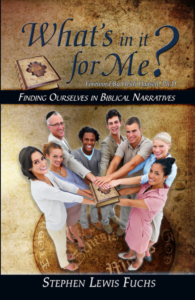
Today, I am pleases to share with you an excerpt from What’s In It for me: Finding Ourselves in Biblical Narratives by Rabbi Stephen Fuchs.
I rarely post excerpts from books or have guest posts on American Mussar. I picked this one because I love the way Rabbi Fuchs brings the biblical story of Moses into the realm of human decision making. If you are unsure of the Divinity, where the text says things like “God spoke” think of it as the Universe, or the internal Divinity, that spark of goodness that no one can take away.
I can only hope that I will never be challenged with a task as great as the one that confronted Moses. Yet I can relate to the idea of being overwhelmed by a great task, and the importance of not ignoring the quiet voice of conscience.
Chapter 11: Moses Answered the Call to Conscience. Will We?
Moses grows up as an Egyptian prince. According to the Midrash, his mother, Yocheved, teaches him about his heritage and the importance of loyalty to his people. Her efforts pay off.
One day, as Moses walks among the Hebrew slaves he encounters an Egyptian taskmaster beating one of them. An Egyptian prince should not care, but Moses smites the Egyptian.
In one of the most profound of all Midrashic statements, the Eternal One observes Moses’ action and says, “Moses, if you have descended from your high station to take up the case of a Hebrew slave, then it is time for Me to descend from my high station and redeem my people, the Children of Israel” (Shemot Rabbah 2:2).
Wow. It doesn’t get more dramatic than that. Imagine, through our acts of righteousness, we are capable of influencing the Almighty. The notion of a God responding positively to human goodness is one of the most revolutionary ideas in the Torah.
Unfortunately, because he smote the taskmaster, Moses has to leave Egypt and his princely status behind. Again, he is a role model for us and encourages us to consider one of life’s most vital questions: What is more important? Success and reward? Or doing what is just and right?
Moses traverses the desert, arrives in Midian, meets (like Jacob and Isaac) his wife-to-be at a well, and eventually settles into a comfortable existence as shepherd for his father-in-law, the Midianite priest, Jethro.
Later, Moses encounters God, calling him back to Egypt from a burning bush. A burning bush, as the rabbis note, was hardly a dramatic event in the desert. It took a person with extraordinary insight to realize the bush did not go up in flames, and to listen to the voice of God calling from within [Louis Ginzberg, Legends of the Jews, (Philadelphia, Jewish Publication Society of America, 1968) Vol. 2, 304].
People often ask me, “Why doesn’t God speak with us anymore?” I believe God does, but we must learn how to listen to God’s voice. Like Cain, we can choose to ignore the voice or defy it. If we train ourselves to not only hear, but to listen, God will speak to us in the voice of our conscience⎯just as God spoke long ago. We must strive to recognize that voice urging us to choose the path of righteousness and justice over that of expedience and narrow self-interest.
Although Moses clearly heard God’s voice, initially, he was reluctant to heed it. He throws every possible excuse at the Almighty: “Who am I,” he asks, “to go before Pharaoh? I don’t speak very well.” But God would not be dissuaded (Exodus 3 and 4).
The task God had chosen Moses to undertake was enormous. Moses had to convince himself, that he was the man for the job.
Fortunately, Moses heeded God’s voice and fulfilled his destiny. Perhaps there is only one real difference between Moses and Cain. Cain turned away from God’s call, but Moses obeyed it.
Think of it. The Torah teaches that our lives can have purpose and meaning. The rest is up to us. God wants us to try our best⎯setbacks and frustrations notwithstanding⎯to use our talents to make the world better. We do not all have the ability to lead a nation, cure cancer, or invent a life-changing device, but we all can do something to make life better for others. Cain said no to God. Moses said yes. Perhaps the most important question we can ask ourselves is, “What will our answer be when God⎯in whatever mysterious way God chooses⎯affords us a glimpse of our potential destiny?”
Rabbi Stephen Lewis Fuchs is Rabbi Emeritus of Congregation Beth Israel, West Hartford, Connecticut and the former President of the World Union for Progressive Judaism. Earlier is his career he served at Temple Isaiah in Columbia, Maryland and at The Temple, Congregation Ohabai Sholom in Nashville, Tennessee. Since 2014 Rabbi Fuchs and his wife Victoria have spent several weeks in Germany raising Holocaust awareness in secondary schools and speaking in synagogues, churches and universities. They are the proud parents of three children and five grandchildren. Please visit http://www.rabbifuchs.com to learn more.
Never miss a post
The post What’s In It For Me? How Moses Answered the Call to Conscience appeared first on American Mussar.
November 22, 2016
Help Pick the Final Mantra Card Design
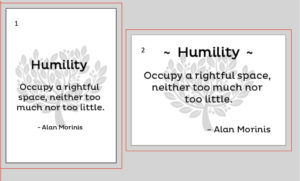
Mussar practice starts every morning with a mantra – a recititation of a phrase to help frame the day. By repeating, or singing, the phrase over and over again, we are making an impression on our soul, and heightening our awareness of how that soul trait comes into play.
I am excited to announce that we are in the final stages of designing mantra cards to go with The Spiritual Practice of Good Actions.
Rather than write the mantra on a sticky note, or on an index card,
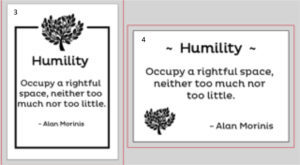
why not just get a high quality set of cards? Just grab the card for the soul trait you are working on, and put it on your bed table.
We need your help to pick the final design. In the comments below, please let us know which design 1-4 you like.
Or alternatively, you can join the conversation on the American Mussar Facebook page.
The post Help Pick the Final Mantra Card Design appeared first on American Mussar.
How to Give Unconditional Loving Thanks
This is a difficult time in this country for many people. This time of fear, sorrow, and uncertainty is exactly the time when we need to cling to our spirituality, and draw close with this we most care about. This Thanksgiving, lets turn to Rabbi Nachman of Breslov to help us learn how to give unconditional loving thanks. Rabbi Nachman (1772–1811) taught that music is a way of directly hacking the soul to make a connection with the Divinity, and to unlock the joy latent within all of us.
Kind and Generous by Natalie Marchant brings up special memories for me. I took my wife Rachel to a 10,000 Maniacs concert for her 25th birthday. We had been dating just a few months and we had an amazing time. The concert was pivotal for us, and remains a huge milestone in a love that continues to grow more than 20 years later.
I can in no way adequately express the gratitude I feel towards her every day. So I’ll let Natalie speak for me. I read the lyrics to the song (here) and if I pasted every section that spoke to me, I’d be accused of plagiarism. So here is the passage that speaks to me the most.
You’ve been so kind and generous
I don’t know how you keep on giving
For your kindness I’m in debt to you
And I never could have come this far without you
So for everything you’ve done
Who is close to you in your life that you want to thank for being there? Friend, lover, parent, mentor?
Maybe it is a stranger who showed you kindness just when you needed it the most.
A Mussar Gratitude Practice to Give Unconditional Loving Thanks
Visualization is a powerful technique to get in touch with the soul, and this song is just perfect for a Mussar visualization. Please join me in this visualization exercise, to open the heart to unhindered loving action.
To prepare, get your Mussar journal or a piece of paper, something to write with, and make yourself comfortable.
Start the recording, and close your eyes.
Just listen to the music, and allow the words to wash over you. No analysis. Just listen, and allow images to form in your mind.
Who do you see?
What do you feel?
When the song ends, leave your eyes closed for a few minutes. Take a few relaxing breaths, and then write down what you experienced. Who did you see? What came to you?
And finally, how can you give unconditional loving thanks you felt towards the one you care about?
Write down your intention, including a specific time and place when you will act. For example, you might write “At dinner tonight, I will thank my husband in front of the kids.” Or it might be “On Thanksgiving, I will call my sister at 11 AM and thank her for being there. Or maybe you will write a thank you note to your best friend who you haven’t talked to in 2 years.
Please share your intention below.
Ready to start your own Mussar Journey? Take the Soul Trait Profile Quiz now.
You might also like: 15 Minutes of Gratitude Could Change Your Life
The post How to Give Unconditional Loving Thanks appeared first on American Mussar.
November 10, 2016
5 Ways Spirituality Can Fight Post Election Despair
 For those who wait by Robert Couse-Baker via Flickr CC
I am really sad about the outcome of the election on many levels. I suspect that many (but not all) of you feel the same way. Now what? I’m looking for ways that spirituality can fight post election despair. But first, something must be said.
I have not made a secret of the fact that I do not like Donald Trump. At the same time, I have done my best to remain in conversation with Trump supporters, especially on my Facebook page. And I often wrote “whomever wins, we need to come together as a country and find a way to heal.” I’ll be honest – I hoped that I would be the one who got to play the role of gracious winner, but the Universe has other plans for me. So I will take a page from Hilary Clinton’s speech, and look at Trump with an open mind. He won, and he and his supporters have an opportunity to prove that my fears are unfounded.
I really do want to heal as a country. This does not, however, mean giving up on what I believe in. As President Obama said, we see to a peaceful transition of power. Then we go back to work and fight the political fights.
But what can I do? I feel like crap.
Mussar as always has some suggestions. Here are Five Soul Traits to help you process the results.
Here are Five Soul Traits to help you process the election results and fight post-election despair.
Humility: We each only get one vote. Although I volunteered and donated, in the ballot box, I only have one vote. In fact, my vote counts less in California than it would have in the Midwest. It appears that Clinton won the popular vote. When it comes to a National Election, I occupy a very small space. We can rage against the machine, or we can accept reality. On the National and World Stage, I occupy a very small space.
However, in other parts of my life, I occupy a much larger space. I can make a positive contribution to my family and community. One friend of mine said she will write one letter about climate change a day for the next year. And I love this article from Jenna Amatulli in the Huffington post that outlines ways to help, by listing organizations that support progressive causes. Don’t move. Volunteer.
Patience – Mussar is teaching that Patience is bearing the burden of the situation, much as the Israelites bore the burden of slavery in Egypt. It is a gift to help us endure when we cannot take action. When it comes to this election, there is little we can do. The painter Paul Klee died in 1940, at a time when it looked like Hitler would take over everything. Five years later Hitler was destroyed. This election is not the end of the story, but we will have to endure years of policy changes that will hurt some of us to the core.
Honor the Divine Spark in others. I remember feeling bad for Republicans who were so bitterly disappointed that Obama was re-elected in 2012. I felt the same way in 2004 when Kerry lost to Bush. Today I tip my cap to the Trump supporters. It is their turn. I hope they will be gracious winners.
HOWEVER, it is more important to honor minority communities who may be feeling scared about what a Trump presidency means for them. And they way we can honor them is by taking action.
Enthusiasm – Mussar teaches that we should “Run to do good.” There are many hurting people out there. We can acknowledge Trump’s presidency while at the same time remain active in the civic and political arenas. Be aggressive to stop bullying when you see it. Reach out to your LGBT, black, Latino, Jewish, feminist friends and let them know that you have their back. Another thing you can do is provide a safe space for people. A Rabbi friend started a private group where people can support each other through the stress of the election. And the Pantsuit Nation Facebook Group of women who support Clinton has over 3 million members. The woman’s issues raised in this campaign are not going away. Join a group and get active.
Equanimity – This soul trait is also known as Calmness of the Soul. It is a zen-like ability to be present, to accept what is, and stay on an even keel whatever happens.This is so hard for me. Spiritual masters like Eckhart Tolle call it being present, or being Awake. I’ll be honest – I’ve suffered a lot this year. I write suffered with a small s because the things that caused me unhappiness are stress and work related. Now, I have something truly calamitous to be unhappy about. Maybe this will be the incentive I need to start meditating, and doing what I need to do to wake up. Tolle tells a story of a student of his who was grateful for his illness because it forced him to go deeper into their consciousness and dissolve the ego. I really want to do this.
Finally, let me leave you with a Korean quote from my sister in law “It’s not the seven falls. It’s the eight rises.”
For many of us, this is a fall. When you rise, look around, and look within. I’m sure that something needs fixing in your own back yard.
Want to start your own Mussar journey? Click here to join me on the American Mussar Cycle.
The post 5 Ways Spirituality Can Fight Post Election Despair appeared first on American Mussar.
November 4, 2016
3 Character Traits That Make You a Better Leader
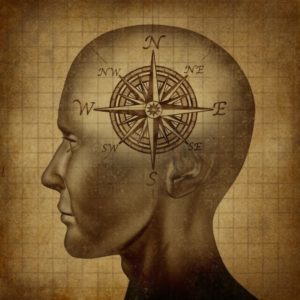 Being a better person is easy in theory – do less of the negative stuff, and more of the positive stuff. The same holds true for leadership. The problem comes in when we either don’t know what we should do, or we do know but can’t help ourselves and do the negative anyway. When I was in the corporate world, I was very good at my job, and very, very arrogant. It held me back in a very, very, very, big way. I so wish I had practiced Mussar back then.
Mussar is a 1000-year-old Jewish mindfulness practice that teaches us how to find those things inside that cause us to get stuck making the same mistakes again and again. And, Mussar offers a step-by-step way to bring those things towards balance and healing. On a personal level, Mussar is a daily practice that helps one become a Mensch, a person of outstanding character. On a professional level, Mussar can be the key to unlocking your full leadership potential.
Mussar offers a different perspective than many other wisdom practices, in that having too much of the trait is just as bad as having not enough. The way we change is to first identify where we are on the spectrum from too much to too little for a given trait, and then to take action to bring ourselves towards balance.
Never miss a post
The post 3 Character Traits That Make You a Better Leader appeared first on American Mussar.
October 28, 2016
My Dad Had a Stroke. Mussar Spoke.
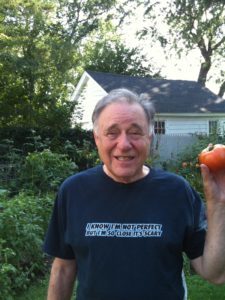 David Marcus with tomato
I’ve often said that my soul traits follow me around, but this is ridiculous. I am currently leading three Mussar groups, and my personal practice was out of sync with all of them. Then something changed.
In one of the Mussar Parenting groups, we had a very intense discussion about the soul trait of Loving Kindness. Some instinct told me to change the order of my practice and to start on Loving-Kindness right away. We practice Loving Kindness by helping other people without the thought of reward even if they do not deserve it. Of course our kids deserve it, even when they act in ways that drive us crazy.
Mussar teaches that the world is built on acts of Loving Kindness. There are a few classical examples of acts of Loving Kindness, that include burying the dead, clothing the naked (usually interpreted as taking care of the poor), and visiting the sick. In each case, we are doing something that is uncomfortable, and we are not in a position to get anything in return.
In Mussar we practice by picking one small action to move towards balance. My first thought was to clear all of the dishes off the table after we eat. We tend to all jump up and leave our dirty dishes on the table all day. Thus I am building our world at home by just clearing the table. However, I realized that I tend to err on the side of too much Loving-Kindness. So, this week I will also to do more self care. I have been better about exercising, and making time to watch videos of Eckhart Tolle. I have been working of following Tolle’s teaching to make the present moment your friend and not your enemy.
Then yesterday, my cell phone rang when I was getting a decaf almond milk latte at Peets. It was my stepmother. “Oh no,” I thought. “She never calls my cell phone.”
My Dad Had a Stroke
As I feared, the news was not good, but not nearly as bad as it could have been. My dad had a stroke.
My parents are divorced, and I lived with my father growing up. Suddenly this man who had raised me is weak on one side of his body, and is having trouble speaking. I feel numb in the moment, and very helpless living on the other side of the country. I wander in the street outside Peets, asking my stepmother to pause as the train blares its way into the station. It is surreal. Then I talk to him on the phone. He speaks with energy, and obvious mental clarity, but I don’t understand the words coming out of his mouth. They are slurred. Very slurred.
To be honest, I was confused about what I should do. I live in California, he lives in Syracuse. The emergency wasn’t so dire that I had to leave immediately. With my wife was in Europe, I needed to take care of the kids. I talked with my stepmother about when to come out. Our initial conversations were very much in head space – “practical considerations” about when I could be most helpful. This week, next week, the following week… Each had it’s advantages when I could be there to help with various things.
Then I sat down to journal that night, and a quiet voice spoke to me. It said “visit the sick.”
“Visit the sick” has no time qualifications attached to it. It purely exists within heart space.
And I knew what I had to do.
The voice of someone in my father’s generation came to me – “I don’t need an ancient Rabbi to tell me the right thing to do.” True. Mussar does not tell us the right thing to do. We already know it most of the time. As Rabbi Eliyahu Dessler put it, Mussar helps the heart understand what the mind already knows. Whether we like to admit it or not, the heart is in charge. The heart is stronger than the head.
Want to start your own Mussar journey? Take the Soul Trait Profile Quiz.
PS Did you know that Maimonides wrote rules on how to visit the sick? They include:
Don’t stand over the sick person, and don’t sit on their bed. Sit on the floor or a chair
Don’t bring bad news, and don’t be Pollyanna about their condition either
Bring a gift
Ask permission
The reality is that it is hard visiting sick people, at least it is hard for me. These rules give me something to hold on to. And they remind me of a greater truth – we visit the sick to preserve human dignity, to sanctify life, and to honor the Divine Spark in all of us.
The post My Dad Had a Stroke. Mussar Spoke. appeared first on American Mussar.
October 17, 2016
Practice Trust To Overcome Election Stress Disorder
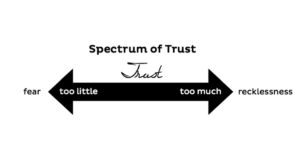 The Spectrum of Trust from “The Spiritual Practice of Good Actions” (Llewellyn)
I am upset about the election. I admit it – it has thrown me off. Political junkie combined with really caring about the outcome is a formula for losing sleep and feeling like I am in a nightmare. My mother chastened me over the weekend for letting it get to me. Don’t get me wrong – she cares too. Yet we still have to live our lives. My grandparents had daily struggles living through the depression, World War II, rationing… the list goes on. They grew strong, and learned to get through. Mussar has taught me that we need to keep striving to be a mensch even in difficult time. I’ve decided that I need to practice Trust to overcome Election Stress Disorder.
If I let a certain candidate just take over my mind, if I let the stress spill over into other parts of my life, then he wins; he, who wants to sow anger, panic, discord. After his rant about Mexican rapists, I vowed not to give him any more airtime. That is a vow I could not keep. But, I need to move back in that direction. So he will not be named here, because I am taking away his power to make me angry and upset and fearful about the future.
I feel so fortunate that my Mussar practice has taken me to the soul trait of Trust. The mantra for Trust is:
Trust in God, but tie your camel
If you are unsure of the Divinity, think of this as a reminder that most things work out.
And, a reminder that whatever happens, you will be able to handle it.
And, a reminder that you only have a limited sphere of control.
For me, I’ve donated money, and speak out regularly, – my camel is tied. I need to let go of the outcome. I also have a life to live – a family to take care of, a business to run, a community to be a part of. When I get too worked up over the election, other parts of my spiritual ecosystem start to suffer. And in Mussar, the spiritual ecosystem is the real world.
I am truly tired of being slapped around by the highs and lows this last month. One of my teachers, Alan Morinis teaches a Trust visualization based on the following passage from the book of Jeremiah ( 17:7-8).
7 Blessed is the man who trusts in the Lord; the Lord will be his security.
8 He will be like a tree planted near water; it spreads out its roots by the river; it does not notice when heat comes; and its foliage is luxuriant; it is not anxious in a year of drought but keeps on yielding fruit.
I realize that many of you are unsure of the Divinity, and are unused to reading passages like this. Just give it a try. Imagine that you are the tree, drawing strength from the river. Your leaves are strong and vibrant, and you draw strength to maintain health and resilience through summer and winter.
That reservoir of spiritual energy is out there. God, the universe, family, community, nature… It is there. And when you connect with it, nothing can bring you down.
I now feel calm and centered. And you are heartily invited to join me.
Want to start your own Mussar journey? Click here to take the free Soul Trait Profile Quiz now
Never miss a post
The post Practice Trust To Overcome Election Stress Disorder appeared first on American Mussar.
Practice Trust To Overcome Election Angst
The Spectrum of Trust from “The Spiritual Practice of Good Actions” (Llewellyn)I am upset about the election. I admit it – it has thrown me off. Political junkie combined with really caring about the outcome is a formula for losing sleep and feeling like I am in a nightmare. My mother chastened me over the weekend for letting it get to me. Don’t get me wrong – she cares too. Yet we still have to live our lives. My grandparents had daily struggles living through the depression, World War II, rationing… the list goes on. They grew strong, and learned to get through. Mussar has taught me that we need to keep striving to be a mensch even in difficult time. I’ve decided that I need to practice Trust to overcome election angst.
If I let a certain candidate just take over my mind, if I let the stress spill over into other parts of my life, then he wins; he, who wants to sow anger, panic, discord. After his rant about Mexican rapists, I vowed not to give him any more airtime. That is a vow I could not keep. But, I need to move back in that direction. So he will not be named here, because I am taking away his power to make me angry and upset and fearful about the future.
I feel so fortunate that my Mussar practice has taken me to the soul trait of Trust. The mantra for Trust is:
Trust in God, but tie your camel
If you are unsure of the Divinity, think of this as a reminder that most things work out.
And, a reminder that whatever happens, you will be able to handle it.
And, a reminder that you only have a limited sphere of control.
For me, I’ve donated money, and speak out regularly, – my camel is tied. I need to let go of the outcome. I also have a life to live – a family to take care of, a business to run, a community to be a part of. When I get too worked up over the election, other parts of my spiritual ecosystem start to suffer. And in Mussar, the spiritual ecosystem is the real world.
I am truly tired of being slapped around by the highs and lows this last month. One of my teachers, Alan Morinis teaches a Trust visualization based on the following passage from the book of Jeremiah ( 17:7-8).
7 Blessed is the man who trusts in the Lord; the Lord will be his security.
8 He will be like a tree planted near water; it spreads out its roots by the river; it does not notice when heat comes; and its foliage is luxuriant; it is not anxious in a year of drought but keeps on yielding fruit.
I realize that many of you are unsure of the Divinity, and are unused to reading passages like this. Just give it a try. Imagine that you are the tree, drawing strength from the river. Your leaves are strong and vibrant, and you draw strength to maintain health and resilience through summer and winter.
That reservoir of spiritual energy is out there. God, the universe, family, community, nature… It is there. And when you connect with it, nothing can bring you down.
I now feel calm and centered. And you are heartily invited to join me.
Want to start your own Mussar journey? Click here to take the free Soul Trait Profile Quiz now
The post Practice Trust To Overcome Election Angst appeared first on American Mussar.