What’s In It For Me? How Moses Answered the Call to Conscience
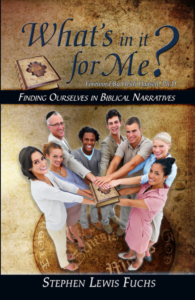
Today, I am pleases to share with you an excerpt from What’s In It for me: Finding Ourselves in Biblical Narratives by Rabbi Stephen Fuchs.
I rarely post excerpts from books or have guest posts on American Mussar. I picked this one because I love the way Rabbi Fuchs brings the biblical story of Moses into the realm of human decision making. If you are unsure of the Divinity, where the text says things like “God spoke” think of it as the Universe, or the internal Divinity, that spark of goodness that no one can take away.
I can only hope that I will never be challenged with a task as great as the one that confronted Moses. Yet I can relate to the idea of being overwhelmed by a great task, and the importance of not ignoring the quiet voice of conscience.
Chapter 11: Moses Answered the Call to Conscience. Will We?
Moses grows up as an Egyptian prince. According to the Midrash, his mother, Yocheved, teaches him about his heritage and the importance of loyalty to his people. Her efforts pay off.
One day, as Moses walks among the Hebrew slaves he encounters an Egyptian taskmaster beating one of them. An Egyptian prince should not care, but Moses smites the Egyptian.
In one of the most profound of all Midrashic statements, the Eternal One observes Moses’ action and says, “Moses, if you have descended from your high station to take up the case of a Hebrew slave, then it is time for Me to descend from my high station and redeem my people, the Children of Israel” (Shemot Rabbah 2:2).
Wow. It doesn’t get more dramatic than that. Imagine, through our acts of righteousness, we are capable of influencing the Almighty. The notion of a God responding positively to human goodness is one of the most revolutionary ideas in the Torah.
Unfortunately, because he smote the taskmaster, Moses has to leave Egypt and his princely status behind. Again, he is a role model for us and encourages us to consider one of life’s most vital questions: What is more important? Success and reward? Or doing what is just and right?
Moses traverses the desert, arrives in Midian, meets (like Jacob and Isaac) his wife-to-be at a well, and eventually settles into a comfortable existence as shepherd for his father-in-law, the Midianite priest, Jethro.
Later, Moses encounters God, calling him back to Egypt from a burning bush. A burning bush, as the rabbis note, was hardly a dramatic event in the desert. It took a person with extraordinary insight to realize the bush did not go up in flames, and to listen to the voice of God calling from within [Louis Ginzberg, Legends of the Jews, (Philadelphia, Jewish Publication Society of America, 1968) Vol. 2, 304].
People often ask me, “Why doesn’t God speak with us anymore?” I believe God does, but we must learn how to listen to God’s voice. Like Cain, we can choose to ignore the voice or defy it. If we train ourselves to not only hear, but to listen, God will speak to us in the voice of our conscience⎯just as God spoke long ago. We must strive to recognize that voice urging us to choose the path of righteousness and justice over that of expedience and narrow self-interest.
Although Moses clearly heard God’s voice, initially, he was reluctant to heed it. He throws every possible excuse at the Almighty: “Who am I,” he asks, “to go before Pharaoh? I don’t speak very well.” But God would not be dissuaded (Exodus 3 and 4).
The task God had chosen Moses to undertake was enormous. Moses had to convince himself, that he was the man for the job.
Fortunately, Moses heeded God’s voice and fulfilled his destiny. Perhaps there is only one real difference between Moses and Cain. Cain turned away from God’s call, but Moses obeyed it.
Think of it. The Torah teaches that our lives can have purpose and meaning. The rest is up to us. God wants us to try our best⎯setbacks and frustrations notwithstanding⎯to use our talents to make the world better. We do not all have the ability to lead a nation, cure cancer, or invent a life-changing device, but we all can do something to make life better for others. Cain said no to God. Moses said yes. Perhaps the most important question we can ask ourselves is, “What will our answer be when God⎯in whatever mysterious way God chooses⎯affords us a glimpse of our potential destiny?”
Rabbi Stephen Lewis Fuchs is Rabbi Emeritus of Congregation Beth Israel, West Hartford, Connecticut and the former President of the World Union for Progressive Judaism. Earlier is his career he served at Temple Isaiah in Columbia, Maryland and at The Temple, Congregation Ohabai Sholom in Nashville, Tennessee. Since 2014 Rabbi Fuchs and his wife Victoria have spent several weeks in Germany raising Holocaust awareness in secondary schools and speaking in synagogues, churches and universities. They are the proud parents of three children and five grandchildren. Please visit http://www.rabbifuchs.com to learn more.
Never miss a post
The post What’s In It For Me? How Moses Answered the Call to Conscience appeared first on American Mussar.