
Greg Marcus's Blog, page 12
May 7, 2017
Mussar Book Review: Rebbe by Joseph Telushkin
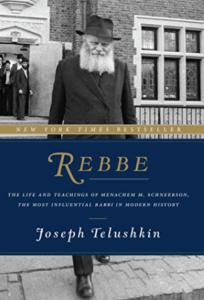 Rebbe by Joseph Telushkin is a wonderful read – it is like having a conversation with someone telling you about the most interesting Jew in the world. And Menachem Mendel Schneerson, the Lubavitcher Rebbe, was an innovator, a man of strong conviction, and a Mensch of the first order.
When I was growing up in Syracuse and into early adulthood, the Rebbe was hardly on my radar, beyond an impression that he claimed to be the Messiah. That alone was turn off enough to keep me away from the book. Let me clear that up right away. Telushkin makes it abundantly clear that the Rebbe did not consider himself the Messiah, not did the majority of his followers. And even most of those who considered him the Messiah really only thought of him as a potential Messiah. There is a teaching that a Messiah is born in every generation. Such people of outstanding character walk among us, and after reading about the Rebbe’s life, I can understand why people revered him so deeply. You do not need to be Orthodox, or familiar with the chasidic world to appreciate this book. In fact, I thought it was really interesting to get a view into this world.
Here are a few of the things I particularly appreciated about the Rebbe’s life.
Love and Pride of Judaism.
The Rebbe was passionate that every Jewish life was sacred, and that no one should be left behind. He sent young couples to live all over the world to open Chabbad houses, to offer observant and non-observant Jews a place to go. I share this passion – there is so much more to Judaism than most people know. The Rebbe instructed his followers to offer an opportunity to do just one traditional observance, like putting on tefillin or lighting shabbat candles. While such ritual observances are not a priority for me, I am moved by the love behind the Rebbe’s plan.
Passionate Disagreement While Staying In Relationship
He was a man of extraordinary influence, who knew the secret of disagreeing with someone while at the same time finding common cause with them. Such is the soul trait of Honor. His secret – he never criticized someone by name.The Rebbe once said, “I don’t speak about people, I speak about opinions.” And the Rebbe was fearless about stating his opinion. Telushkin wrote, “Confidence in your idea means that you don’t have to make other people wrong for you to be right.” Rebbe Schneerson took many positions that I disagree with. For example, we was for prayer in schools, and against public protests against the Soviet Union. Inevitably, his positions were motivated by a sincere belief in what he thought was best for the Jewish people, and often, best for humanity in toto.
Values Are Primary
While Rebbe is not a Mussar book per se, and the Rebbe did not as far as I know follow the Mussar masters, he lived a life of kindness, focused on the needs of the other, that is the primary goal of Mussar practice. While the Rebbe was a stickler for traditional Jewish practice, he felt the commandments about slander were just as important as the dietary laws. In fact, he was critical of Orthodox Jews who shamed others for not being traditionally observant. There was a great anecdote about a time when he chastened a follower who was so wrapped up in studying Torah that he didn’t hear a child crying in the other room. Again and again throughout the book, Telushkin shared examples of the Rebbe’s thoughtfulness. He even went so far as to conceal the deal of his younger brother from his mother for 12 years for fear that news of his death would harm her health.
In summary, I highly recommend Rebbe by Joseph Telushkin. If you read it, you’ll be uplifted, and inspired to be your best self.
Looking for more Mussar books? Check out our Mussar Book Page.
Learn more about Rebbe by Joseph Telushkin on Amazon.
The post Mussar Book Review: Rebbe by Joseph Telushkin appeared first on American Mussar.


April 27, 2017
Mussar Basics: Pirkei Avot Asks Who Is Wise
 Who Is Wise?
When it comes to Mussar basics, Pirkei Avot is high on the list. It is hard for me to describe the delight I felt while attending a wonderful webinar by Yaakov Feldman discussing my favorite lesson from Pirkei Avot. If you are not familiar with Pirkei Avot, you are in for a treat.
First, let me start by sharing the text of Pirkei Avot 4:1 (from Sefaria.org)
ben Zoma says: Who is the wise one? He who learns from all men, as it says, “I have acquired understanding from all my teachers” (Psalms 119:99).
Who is the mighty one? He who conquers his impulse, as it says, “slowness to anger is better than a mighty person and the ruler of his spirit than the conqueror of a city.” (Proverbs 16:32).
Who is the rich one? He who is happy with his lot, as it says, “When you eat [from] the work of your hands, you will be happy, and it will be well with you” (Psalms 128:2). “You will be happy” in this world, and “it will be well with you” in the world to come.
Who is honored? He who honors the created beings, as it says, “For those who honor Me, I will honor; and those who despise Me will be held in little esteem” (I Samuel 2:30).
ben Zoma is a hero of mine – he was not a Rabbi, and I find it inspiring that he teaches that we can learn from anyone. The soul trait of Honor reminds us that part of our mission in the world is to respect the Divine in everyone. Feldman explains this basic interpretation, and then turns it on it’s head. He reminds us that most people don’t know much, and that many people are fools. What are we to learn from them? Feldman says that we can learn from a fools mistakes. I was a bit uncomfortable with this lesson. Who am I to call another a fool? And moreover, are they a fool about everything? Then I remembered that, I wrote a blog post calling Bernie Sander’s supporters fools for blindly believing fake news about Hilary Clinton. It is an important lesson for all of us.
Feldman also contrasts the idea of learning from everyone with the idea of having one master to learn from. There are strands of Judaism that tend to follow a Rebbe, a singular leader, and branches of Mussar that limit the universe of texts from which we draw inspiration. I carry more of the ben Zoma sensibility – there are lessons to be learned from everyone. Yes, of course there are Rabbis and masters to learn from, but there are also more secular experts like Brene Brown, as well as menchy people in our own lives who may never have read a word of Torah. And, we can learn from our kids, parents, the check out person in the grocery store, and the homeless.
You are heartily invited to give the webinar a view. Rabbi Feldman goes on to discuss each of the parts of the teaching. Strength is measured by overcoming the worst part of ourself. I live the way Feldman kept saying “little by little” – that is how we do Mussar. The “little by little” approach works, and can show immediate results. Riches are measured by the Soul Trait of Gratitude, being content with what you have. (more below)
Feldman ends the webinar with an invitation to develop a personal relationship to God, to ask God questions and to make God a presence in your life. I know that many of you are not sure of the Divinity, and I admit that I found his suggestion somewhat jarring. But then again, he brings up an interesting point: When you learn to ask God for help, you learn to ask others for help too.
The whole webinar is part of a backstory to our Mussar practice. Ending with Humility – an invitation to ask for help – WOW.
Where do you need help in your life? Where do you want help? Are they the same? Take a few moments to write down an answer.
Interested in reading Pirkei Avot or other Mussar books? See the recommended translation on the Mussar Books page.
Hat tip to The Mussar Institute for producing the great webinar series about Pirkei Avot.
The post Mussar Basics: Pirkei Avot Asks Who Is Wise appeared first on American Mussar.
April 18, 2017
Trans Outing on Survivor: a Mussar Practice Lesson
If you are a Survivor fan, you already watched the tribal council when Jeff outed Zeke as a transgender man, arguing that Zeke’s secrecy made him untrustworthy. This tribal council represents a rare opportunity to glean a Mussar practice lesson from a complicated and painful human experience. I was stunned, not only because it was a cruel and dangerous thing to do, but because I am practicing the Mussar Soul Trait of Silence this week. Silence governs when we should speak and when we shouldn’t. Of course you don’t need Mussar to know that Jeff should have stayed Silent. But what Mussar can teach us is how to process the entire experience.
Mussar Practice Lesson 1: The Evil Inclination will lead you hurt others to save yourself
Remember that the Evil Inclination represents our survival instincts. Because Varner was facing elimination, he allowed his survival instincts to override his conscience. The EI operates in the subconscious, and provides a wealth of rationalizations to justify bad behavior.
Varner: “I feel horrible about it, I’m just trying everything I can”
Ozzie “Jeff, you should be ashamed of yourself for what you are willing to do for a million dollars.”
Probst: “You are saying there is no line. If I am desparate enough, I will do or say anything.”
Mussar Practice Lesson 2: The Evil inclination will lead you to rationalize your decisions
Varner:”I thought he was out and proud and loud about [being trans].” (5:30)
Others did not buy Varner’s argument
Sarah: If you thought that, why did you make a point of everyone had to know it.”
Probst: “You can’t have it both ways, to say he was deceptive, and then immediately say he was out and proud of it.”
Sarah: “That was a malicious attack”
Varner: “There was no malice in it. … I don’t treat people that way. … I don’t want you to paint me as something I’m not.”
Mussar Practice Lesson 3: We can have Compassion for someone who has messed up, even as we deliver consequences.
The cast member Tai, who is gay, was crying and upset when Varner outed Zeke. Yet he still showed compassion for Varner a few minutes later when he put his hand on Varner’s back as he wept. Tai at one point said, “I can understand he was desperate, and crossed a line that he didn’t realize he did.” This is the soul trait of compassion in action, feeling what another person feels, and seeing it from their point of view. And he presented compassion in balance, and did not let Varner off the hook.
Mussar Practice Lesson 4: Humility helps you through a crisis
Zeke showed amazing Humility, in that he seems to know who he is. While visibly upset, he didn’t go to pieces, apologize, or point fingers. And, he explained why he didn’t tell anyone. (8:08)
Transitioning is a long and difficult process. There are people who know. I stopped telling people, because it becomes who you are … and overwhelms everything else that they know about you…I didn’t want to be the trans survivor player, I wanted to be Zeke the survivor player. … So I think I’m ok.”
Jeff Probst also displayed amazing Humility balance, occupying his space by keeping control of a very emotional and raw conversation.
Learn more about Humility Here.
Mussar Practice Lesson 5: Good Can come out of bad situations.
The soul trait of Gratitude teaches that we should give thanks for the bad, because often there is a unique opportunity that comes out of awful things. Varner’s behavior was awful, yet something amazing happened.
Sarah Lacina explained her personal growth (11:15):
Sarah: “I’m thankful that I got to know Zeke for who Zeke is. I’m from the midwest. I come from a super conservative background. It’s not very diverse when it comes to gay and lesbian and transgender … I’m not exposed to it like most of these people are. The fact that I can love this guy so much and it doesn’t change anything for me makes me realize that I’ve grown huge as a person… the metamorphosis that I’ve made as a person that I didn’t realize I made until this moment is invaluable. I’m sorry it came out that way, but I’m glad it did. I’m glad I got to know you as Zeke, and I’ll never look at you this way.”
And then Zeke was equally amazing. (12:00)
Zeke: “I’m certainly not someone who should be a role model for anyone else, but maybe there is someone who is a survivor fan and me being out on the show helps him or her or someone else. Maybe this will lead to a greater good.”
Probst: “Tonight was a complicated, but ultimately beautiful night, that will never be forgotten.”
Mussar Practice Lesson 6: We all have a choice
The reason why this was powerful, and ultimately positive experience was the choices that people made. Zeke’s tribe members chose to immediately speak out in his defense. They could have acted with revulsion at the news that Zeke was trans – I suspect that the North Carolina legislature would have voted him out on the spot, using the “deception” as a fig leaf to cover their prejudiced actions. Each and every one of us has a choice when faced with injustice. In fact, we face Choice Points all the time, where we have an opportunity to follow the influence of the Good Inclination or the Evil Inclination. In this Survivor episode, we saw one person make a very bad choice, and many more people make good choices.
Mussar practice requires knowledge of who you are. What Soul Traits hold you back? Take the Soul Trait Profile Quiz to find out. Click here to take the quiz.
[image error]


The post Trans Outing on Survivor: a Mussar Practice Lesson appeared first on American Mussar.
April 10, 2017
Three Key Soul Traits for Your Passover Mussar Practice
 Remember this day by Tim Sackton via Flickr CC
Passover is THE Jewish story. Yes we became liberated from bondage, and more importantly, the fundamental message of Judaism is told again and again in this story and throughout Jewish literature. “Be Kind to the stranger, for you were strangers in the land of Egypt.” Rabbi Ira Stone teaches that the goal of Mussar is to learn to bear the burden of other people – which itself directly translates from this Passover lesson. So let’s take this opportunity to do a Passover Mussar practice.
Remember that Passover is not only about ancient liberation but personal liberation. The Hebrew word for Egypt, Mitzrayim, is translated as “narrow place.” Slavery in Egypt confined us to a narrow place, with constrictions on our physical, emotional, and spiritual lives. The Rabbi Nachman of Bratzlov (1772-1822) said, “The Exodus from Egypt occurs in every human being, in every era, in every year, and in every day.” Exodus is the story of liberation from the things that hold us back. By practicing Enthusiasm, Order, and Honor, we can begin to exit our narrow place.
Focus on Enthusiasm in your Passover Mussar Practice
In the Mussar classic Path of the Just, Rabbi Luzzatto makes Enthusiasm a key pillar of personal transformation. In part, this is because he argues that our natural inclination is to be “lazy.” While I dislike the judgmental connotation of the term, the fact remains that many of us would prefer to just avoid the hard work of personal change. I saw a great cartoon with two panels. In the first, the speaker asks who wants change? Everyone raises their hand. In the second, he asks “Who wants to change.?” As you may have guessed, not a single hand was raised. Even when we are unhappy about something, the Evil Inclination will supply us with ample excuses and fears to prevent us from taking action to make it better.
Luzzatto points to Abraham, who ran around his camp to welcome guests, and Rebecca who hastened to water a guests camels, as examples of our behavior. We should run to do good. When we do, we unlock an inner fire as our “emotions are aroused and [our] enthusiasm waxes stronger.”
Moses saw a flame that did not consume, that led him on a path of discovery and personal growth, that led him to take on a seemingly impossible task. Moses was reluctant at first, but the Divine helped him grow personally to take this task on. And one way he helped was to give Moses a plan.
Practice Order by Creating a Plan to Change as Part of Your Passover Mussar Practice
The Hebrew word for Order is Seder – yes, that meal we have every year at least once during Passover. Moses presented a litany of excuses why he could not lead the Israelites out of Egypt, including worries about his speaking ability, and fears that the people will not believe him. In response, God gives Moses a plan, teaching him a few miracles to show the people, and reminding him that his brother can do the talking when needed.(See Exodus 4:1-17 for the full story). While you may be unsure of the Divinity, forming a plan of action is a sensible approach to bring about personal change. What are some small miracles that you can perform to help you on the way? By miracle, I mean some action outside of your comfort zone. I have a friend who was a cut you off, screamer of a driver. As part of her Mussar practice she started letting every car that wanted to merge in front of her. She became a calm driver, and as far as I’m concerned, it was a miracle.
The second part of the story is equally important? Who will be the Aaron in your life, a relative, friend, or mentor who will help you on your journey? Part of the challenge is to be bold enough to commit to change, and to ask for someone for help.
Balance Honor in your Passover Mussar Practice
Part of the answer to changing oneself is paradoxically to think less about yourself. When we focus our energy on serving others, we can take a break from our own worries, and the path of such service will carry us outside boundaries that are keeping us stuck. And, often we hold ourselves back precisely because we are framing the issue in a self-centered way. Try doing something particularly loving for your partner or for a friend. Listen without speaking. Bringing the focus away from yourself will provide you a breath of fresh air, to carry your life in a new direction.
Now of course, your narrow place might be excessive service to others. In fact Tova Ross wrote a great article for Tablet about overcoming her narrow place of people pleasing. Ross shares an inspiring story of he she came to recognize just how miserable and unhealthy she was making herself trying to be well liked. Passover teaches us that we should remember the stranger, not that we should become a stranger, nor make self care a stranger in our life.What is the narrow place you are seeking liberation from this year? What soul traits can help you overcome it? Please share below.
[image error]

The post Three Key Soul Traits for Your Passover Mussar Practice appeared first on American Mussar.
March 24, 2017
Why Did Sanders Supporters Ignore Truth and Share Fake News?
 Bernie Sanders – Painting by DonkeyHotey via Flickr CC
Recently, I read a story that described a systematic effort to plant false news stories in Facebook groups of Sander’s supporters during the 2016 general election campaign. While the details and politics of this effort are beyond the scope here, what particularly interests me is what happened when someone discovered the deceptions, and tried to inform other people in the group. They were shunned and ostracized, accused of being a “Hillbot” and in some cases kicked out of the group. You can read the story here. Why did Sanders supporters ignore Truth?
There is an important Mussar less for us about the Soul Trait of Truth. It took me a while to sort it out, because Truth teaches that falsehood has no legs, and if you supply untruths, people will no longer believe you. Yet these statements seem to have little bearing on what actually happened. In the long run of course, these falsehoods were ultimately uncovered. But in the short run, they may have had their intended impact, making Sanders supporters less likely to vote for Clinton.
Some people were so insistent about sharing these obviously fake news stories that they where kicked out of the Facebook groups by the moderator. The fake news stories ranged from “the Clinton-has-Parkinson’s conspiracy to the Clinton-is-running-a-pedophilia-ring-out-of-a-pizza-shop conspiracy.” Pedophilia ring? Seriously? Mussar provides two answers to help us understand why Sanders supporters ignored Truth.
First, the fake news was feeding into anger they already felt. For example, many Sanders supporters were livid that the DNC was biased for Clinton. Anger lies within the realm of the evil inclination, and when the evil inclination is aroused, we become susceptible to manipulation. As Rabbi Moshe Chaim Luzzatto wrote in the Path of the Just, “One who the evil inclination holds in bondage either does not see the truth, or fails to recognize it when he beholds it, for the evil inclination literally renders a man so blind that he becomes like one that gropes in the dark and stumbles over the obstacles which he does not see.” (Path of the Just chapter 3).
This realization holds an important lesson for all of us: who has not gotten angry and had their judgment impaired? When you were in the midst of that anger, were you even aware that your judgment was off? The key mistake the Sanders supporters made was to share this fake news without discernment. And, they ignored evidence that the news was fake.
The second reason comes from Proverbs:
“Fools see their own way as right, but the wise listen to advice.” Proverbs 12:15
“A fool gives vent to all his feelings, but the wise, thinking of afterwards, stills them.” Proverbs 29:11
To answer someone before hearing him out is both stupid and embarrassing. Proverbs 18:13
Do you get the gist of the point I am making? These people were acting like fools, allowing their evil inclination to incite them to participate in the perpetuation of a falsehood. Some of you might rightly think this is a harsh assessment. Nevertheless, I stand by the assertion. People who ignored evidence that they were sharing fake news were acting like fools.
At the same time, who among us has never acted like a fool? I know I have, more often than I’d care to admit. The more asleep we are, stumbling in darkness & ruled by our emotions, the more we’ll find ourselves acting the fool.
One Mussar practice to counter the danger of passing on false information comes from Rabbi M. M. Levin, who wrote “Do not allow anything to pass your lips that you are not certain is completely true.” (Chesbon HaNefesh chapter 12). Were Facebook and Twitter available in the 19th century when Levin wrote his classic, he undoubtedly would have included a picture of an unfortunate retweet with embarrassing consequences. This lesson is so important, and so counter to the prevailing culture in the world today, that it bears repeating: Do not allow anything to pass your lips that you are not certain is completely true.
What would it take for you to meet this very high bar? What is one step you can take today to move in this direction? I’ll be honest, it becomes a lot easier with a dedicated Mussar practice. Start your practice now by taking the Soul Trait Profile Quiz.
The post Why Did Sanders Supporters Ignore Truth and Share Fake News? appeared first on American Mussar.
March 12, 2017
Esther’s Mussar Humility Lesson
 Purim Street Party by State of Israel via Flickr CC
Esther’s Mussar Humility Lesson: The story of Purim is a great lesson on the soul trait of Humility. As you may recall, the mantra for Humility written by Alan Morinis is “No more than my place; not less than my space.” It is a great reminder that Mussar humility is the perfect balance between arrogance and self-effacement. Purim teaches that sometimes we are thrust into a situation where we have an opportunity for greatness. And we are thus called upon to occupy a greater space.
As a quick reminder, in the Purim story, a Jewish woman named Esther wins a beauty contest to become Queen. Then, an evil advisor to the King arranges to have the Jewish people annihilated. Esther’s uncle Mordechei asks her to go to the King to prevent this calamity.
At the time, however, to approach the king uninvited was an offense punishable by death. Esther could have been dissuaded by the risk; nevertheless she persisted. Now remember, Esther is Queen by virtue of a beauty contest. She could have fallen prey to the Imposter Syndrome, and decided that she was unworthy of the task at hand. The Megillah (5:1) describes what happens next.
“Esther donned [garments of] royalty and stood in the inner courtyard of the palace, facing the palace. The king was sitting on his royal throne in the palace facing the palace entrance.” Notice how it reads if we eliminate the [garments of].*
Esther donned royalty.”
What does that mean to don royalty? This is Esther’s Mussar Humility lesson. She went before the King not as a trophy wife, but in a regal persona. She occupied her space, and did not get hung up on the vagaries of the selection process. She had a right to be there, and made the most of her opportunity.
Have you ever been faced with a situation where you were called upon to do something outside your comfort zone? Do you ever get worried that you aren’t sure what to do, or that you really don’t belong and let yourself get paralyzed? Take inspiration from Esther, and just do it.
Thankfully few of us will have to step up the way that Esther did, where failure means genocide. At the same time, we live in extraordinary times, with political turmoil at home, and war abroad. Do you feel called on to speak out? But we should not simply read this story an an invitation for civic action. Who among us has not been faced with a trying situation at work, in our marriage, with a friend, or with the challenge of growing into full adulthood? How best can we step up, to do right by the people in our lives?
You are heartily invited to stop for a moment and consider how Esther’s Mussar Humility lesson applies to you. Read the following and then close your eyes.
Think of the people in your life. What challenges do they face? What is one small step you can take to support your friends, family and community in a new way? How can you occupy your space to take responsibility, and try to be part of the solution. Or, perhaps you need to occupy less space. As a parent of teens, I know well the challenge of letting them make their own mistakes.
Please comment below or send me an email to capture your intention.
Want to learn more about Mussar Humility? Click here for a free sneak peak at the Humility lesson from the American Mussar cycle.
*The brackets indicate an interpretive translation as opposed to a literal translation.
The post Esther’s Mussar Humility Lesson appeared first on American Mussar.
February 27, 2017
Did Warren Beatty Need Mussar at the Oscars?
 Photo courtesy of Disney/ABC TV via Flickr CC
Did you watch the Oscars? Even if you didn’t, you probably heard that there was a colossal error: The wrong winner for best picture was announced. It was a surreal moment – in the middle of his acceptance speech, the producer of La La Land suddenly said “Moonlight won, this isn’t a joke.”
It was a real stunner, and a real bummer. Warren Beatty, who along with Faye Dunaway made the announcement, explained what happened. Apparently, he was handed the wrong envelope, and it read “Emma Stone, La La Land.” He looked in the envelop, read slowly, and was understandably confused. In hindsight, he could have said “Hey, something doesn’t seem right. Let me check backstage to make sure this is correct.” It raises the question: Did Warren Beatty Need Mussar at the Oscars?
Mussar teaches us to be in the moment, and perhaps if Beatty were a practitioner, he would have behaved differently. Maybe he would have called on the Soul Trait of Enthusiasm to overcome his paralysis and run over to the side to check with someone backstage. Or maybe he would have called on Equanimity to have the presence of mind to ask someone to come double check right there on live TV. But of course Mussar is not a practice for us to back seat drive other people’s lives.
The question for me is why am I obsessed with this mistake on an awards show? I feel badly for the cast and crew of La La Land, who thought for a moment that they won the big one. And I feel badly for the Moonlight folks whose moment in the sun was tarnished. Then I remind myself – no one here is suffering too badly. Everyone made a great movie, and both movies won Oscars and recognition.
The Soul Trait being activated for me is Order – I like things to happen the way they are supposed to happen. When they don’t, I am bothered. I’m reminded of the mistake I made at my Bar Mitzvah that haunted me for years. And I’m reminded of when my grandmother touched the chuppah and it went crashing over at my wedding. My grandmother was fine – she rightly put the responsibility on the planners who had an unstable design. But I was bothered.
To quote David Byrne “Things fall apart; it’s scientific.” I’ll take this an an opportunity to remind myself to be a bit more flexible, and a bit more forgiving when things don’t go to plan.
Where do you come down on the spectrum of Order? Do you get stressed when things deviate from your expectations? If you are like me in that respect, we can both practice a bit of Trust, remembering that things usually work out in the end. And when they don’t go according to plan, sometimes something wonderful and unexpected emerges.
Please comment below.
Remember a few months ago when you had an opportunity to give feedback on the mantra card design? They are now done and on sale. See the final designs here.
The post Did Warren Beatty Need Mussar at the Oscars? appeared first on American Mussar.
February 13, 2017
Mussar Can Open Hearts on the Internet
 Angry Monkey by Danny O via Flickr CC
To say that things have gotten nasty on the internet is an understatement. To say that people behave like animals is not as harsh as it sounds. We all have animal instincts, which show up as the evil inclination, that drives us to behave in a selfish, uncaring, and/or fearful way. This is side we see on the Internet – people write harsh and unthinking things, without regard for the impact on others. The Good Inclination is what inspires us to be our best selves, caring of others, and mindful of the impact of our actions on others. And believe it or not, Mussar can open hearts on the internet.
For example, I recently got into it with someone on Twitter* over my letter to the editor in the Forward. I stressed how important it was not to judge and stereotype others. Someone responded on Twitter that they agreed me, and then went on to tweet that Peter Beinart, the author of the article I was refuting, “exists 2 hurt #ISRAEL, & Jews he does not approve of.”
This kind of reaction is just not acceptable, dehumanizing someone with whom you disagree, and deciding that they must hate Israel and other Jews. There was a back and forth, and in the end, something amazing happened. He tweeted “I will say I should learn to tone down my words, u were correct.” We remain connected and in relationship.
Do you want to help improve conversation and connection on social media? Here are three Mussar soul traits you can call on to help you do it.
Mussar Humility: Come clean, occupy your space and remember it’s not about you.
It is important to come clean about one’s own mistakes. In the letter to the editor, I freely admitted my enjoyment at reading criticism of our Orthodox brothers and sisters, and explained how I used that mistake for spiritual growth. Leading by example can disarm someone who could become an opponent, and open the door for reconciliation.
At the same time, you should be ready to occupy the space of calling someone on bad behavior. If not you, who? The key is to do so in light of the soul traits below. And, your job here is not to let hurt feelings about being misunderstood and mischaracterized get in the way of learning about other people.
Mussar Honor: Remember the Divine Spark, and make your comments only after being given permission to do so.
We all have a Divine Spark, occluded by our baggage. That person making the snarky comment has one too. If you keep that idea first and foremost, it will influence the way you address them. They have the right to their opinions, and they have the right to hold positions with which you passionately disagree. Our goal is to elevate the level of discourse, and restore respect. You don’t have to agree, you don’t have to change your mind. But it isn’t ok to just think the person making a snarky comment, or espousing a political position you find abhorrent is a bad person.
In addition, don’t try the technique below with just anyone. You should only ask for someone to moderate their stance if they initiate the conversation with you. In the examples I give above, the people were making comments directly to me on Twitter, or on my Facebook page. They have given permission for a conversation. It is a very different dynamic if you just start responding to someone you hardly know on social media. The point is to build on an existing relationship and opening.
Mussar Silence: Choose your words carefully, for you are helping create the world.
Judaism teaches that God created the world with words, and when we speak, we participate in this act of creation. If you are insure of the Divinity, the point still holds: What we say has a profound impact, and changes reality for both ourselves and those who hear us.
The secret to improving discourse is to ask people one by one to withdraw, moderate, or change their comments.  You aren’t asking them to change what they believe, only how they say it. Ask them to take responsibility, and to make a change. For example, someone posted a comment about Hitler and Muslims on the American Mussar Facebook Page. I was direct, writing below his comment, “This is a page to elevate our personal conduct. This link is offensive and inappropriate. You are better than this. Please remove it so I don’t have to.” To my amazement, he not only took down the comment, but replaced it with the picture to the right, wishing me a #ShabbatShalom. Similarly on Twitter, I pointed out that it was dehumanizing to say that Beinart wants to hurt other Jews. It is fine to disagree with him, but don’t dehumanize him.
Mussar Can Open Hearts on the Internet
This method doesn’t always work, but to paraphrase Rabbi Tarfon, we don’t need to complete a hard task, but neither are we free to desist from trying. We need to learn how to heal the divisions within the country and within the Jewish community.
Special shout out to Rabbi Sharon Brous who helped me recognize the power of the 1:1 approach after her talk at my synagogue. She explained how prophets who run naked through the streets and scream at the top of their lungs are ignored, but 1:1, thoughtful conversations can change hearts and minds. Listen to her teaching and get the handouts here.
Want to start your own Mussar journey? Take the Soul Trait Profile Quiz now.
The post Mussar Can Open Hearts on the Internet appeared first on American Mussar.
January 26, 2017
Time To Leave Your Post Election Cave
 Gender inequality awareness idea by craftivist collective via Flickr CC
As you may know, after the election, I stopped reading the news and in many ways went into a cave. It was not a very Jewish thing to do. Unfortunately, we do not have the luxury of checking out and ignoring the world. To quote Rabbi Yisroel Salanter, the founder of the 19th Century Mussar Movement, “One who lives a life of tranquility in the service of God knows nothing about true service.” As I wrote in my book, this quote really gobsmacked me when I first read it. But I came to understand that the point is that our job on this planet is to make the world a better place. And we can’t do that if we are focused on being blissed out all the time. Even if you are unsure of the Divinity, the point still applies.
In my own defense, it was a tough time for me. As I wrote previously, my father had a stroke in late October, and I was pretty shattered by the whole experience. Thank you if you were one of many who reached out over the months to ask how he was doing. I am happy to report that he finally came home a few weeks ago, and is doing much much better. Still lots of rehab work to do, but being at home with his wife and cat has been a big moral boost. Sometimes we need to withdraw to take care of ourselves, and when it is over, we need to get back in the game.
A friend of mine last week said that after the inauguration was a great time to leave your post election cave. He was referring to the literal sense, of coming out and reengaging in life. Neither of us is happy about the outcome, but this is the world and we need to live in it.
I immediately thought of the cave on a metaphorical level. Plato wrote that most people live life as if they were chained in a cave, and could only look at shadows of the real world on the wall. Very few people can break free of those chains and see the world the way it really is. Wow, does that fit the world today. We can’t agree on the facts, and the media seems helpless to take a stand over what is True. That is a post for another day.
On a personal level, I am working on the Soul Trait of Watchfulness. It is very much Jewish Mindfulness, watching oneself, and trying to see life the way it really is. That is a key part of Mussar – and Jewishness – to see the world the way it really is, and to jump in to close the gap with the way it could be. There is no closing in the gap while huddled in a cave, watching shadows on the wall, wringing our hands, or preaching to or listening to the chorus.
How Awake do you think you are? How much are you watching shadows versus striving to see the underlying reality beyond what is being shown to you?
Comment below and let me know.
The post Time To Leave Your Post Election Cave appeared first on American Mussar.
January 4, 2017
2016 Was a Year of Wonder
 As I wrote in my last post, I was among many people who felt an urge to wish 2016 away. It was a year of personal and emotional hardship for me in many ways. It started with two friends who died in their 50s… at this point I have a mental list of people with cancer, personal illness, and a litany of bad news in 2016, culminating with you know who and you know what. That is yesterday’s bad news. Today I realize that 2016 Was a Year of Wonder
I am practicing Gratitude, which sports the mantra “Give thanks for the good and the bad.”
One of the things I am most Grateful for is Hanukkah – it brought light at a time of darkness. One of you wrote the following in response to last weeks post, and it give me hope. You wrote, If 2016 has thought me anything, it’s that life has its own story and how that story is told is determined by those who live in it who can set the darkest of nights against the backdrop of a new dawn and day! Better times will come.
Another one of you wrote a moving tribute to your father who passed away. I love the way you said My father was known for his kindness…and while I am good at being kind to strangers, it is those I am closest to that I wish to work on being more of that with. I can so relate to that – I too want to be better with those closest to me. And my fathers illness brought us closer this year.
In addition to the litany of bad news, 2016 was a year of absolute wonder for me. Just before writing you, I did the 15 Minute Gratitude Challenge, and identified some amazing milestones last year: One daughter became Bat Mitzvah, and another was confirmed. One daughter discovered a love of volleyball, and the other got her drivers license. My wife had a meaningful milestone, and she and I celebrated our 19th wedding anniversary. My cats turned seven, and I turned 50. And my dream of having a Mussar book was realized. The outpouring of love an support related to the book has truly been remarkable.
But none of that compares to the miracle of the Cubs winning the world series. I mean seriously, who can’t feel good about that? No, Cleveland fans, of course I did not forget you. I’m sure you are really bummed, but I also suspect at least some of you feel hope that if the Cubs can win, then the Indians day will come too. And the Cavs won it all, beating my Warriors. You see, for every winner in sports, someone has to lose. For every loss in an election, someone wins.
In Mussar, there are no winners or losers. Why? Because Mussar is a spiritual exercise. It looks at the world differently, with a sense of wonder and gratitude. It does not mean that there are not issues to deal with. There are, but with a spiritual outlook the context and coloring is improved. Our task is to improve ourselves, which adds light to the world, and makes everyone else better too.
But I really got energized and jazzed reading this list of amazing things that happened in 2016. Please skip the beginning of the article that rehashes the sorrow of 2016. A few things on the list with particular meaning for me:
200 people attending the funeral of a homeless vet with no family. This is just awesome, and reminds me of the Jewish practice of everyone standing and reciting Kadish (the mourning prayer) in services together. Even if we do not have someone specific we are saying Kadish for, we say it for those who may not have someone to say it for them, or for people who died in the Holocaust and may not have family left today.
New chemotherapy treatments, robotic limbs directly connected to the brain, and a decrease in child mortality worldwide. As Rabbi Yitz Greenberg reminded me earlier this year, Jews are on team life. How can I not rejoice at this news?
Portugal and Costa Rica ran their entire countries on renewable energy for a few days, India planted 50 million trees in 24 hours, and California has 6 million solar roofs. And, Pandas and many other animals came off the endangered species lists. This is significant progress in our task to repair the world.
This list, and the Twitter hashtag #GoodThingsin2016 that reminds me of advice from Fred Rogers, who reminded us that in every disaster, there are always helpers. And Mussar teaches us that we have a choice whether or not to be a helper.
I’ll admit it – I am feeling super energized by writing you this letter. I am reminded of the time when I was a super helper last year – I left my power cord at the library with a young woman taking her end of year exams. I was awake enough and aware enough to see an opportunity to make someone’s day. That was an easy one. Now the task is to find a way to be a helper every day.
Should we have a live event, a Google hangout or Zoom video call to share some of the experiences we had helping others in 2016?
For now, you are invited to do three things.
1. Take the 15 minute Gratitude Challenge. Click Here to take the challenge.
2. Read about the amazing things that happened in 2016, and then comment below to let me know what resonates with you.
3. Set an intention for 2017 – what will you do to be a helper?
2016 Was a Year of Wonder, if we remember to look for it.
Here’s to an amazing 2017, filled with wonder and community.
Want to learn more about Mussar and Gratitude? Here’s a free preview of the Gratitude content from the American Mussar cycle.
The post 2016 Was a Year of Wonder appeared first on American Mussar.



![[image error]](http://www.facebook.com/sharer.php?u=http%3A%2F%2Famericanmussar.com%2Fmussar-practice-lesson%2F&t=Trans%20Outing%20on%20Survivor%3A%20a%20Mussar%20Practice%20Lesson&s=100&p%5Burl%5D=http%3A%2F%2Famericanmussar.com%2Fmussar-practice-lesson%2F&p%5Bimages%5D%5B0%5D=http%3A%2F%2Famericanmussar.com%2Fwp-content%2Fuploads%2F2017%2F04%2FZeke-Sarah-and-Jeff.jpg&p%5Btitle%5D=Trans%20Outing%20on%20Survivor%3A%20a%20Mussar%20Practice%20Lesson)
![[image error]](http://www.facebook.com/sharer.php?u=http%3A%2F%2Famericanmussar.com%2Fthree-key-soul-traits-passover-mussar-practice%2F&t=Three%20Key%20Soul%20Traits%20for%20Your%20Passover%20Mussar%20Practice&s=100&p%5Burl%5D=http%3A%2F%2Famericanmussar.com%2Fthree-key-soul-traits-passover-mussar-practice%2F&p%5Bimages%5D%5B0%5D=http%3A%2F%2Famericanmussar.com%2Fwp-content%2Fuploads%2F2017%2F04%2F6916977596_93070096c0_z.jpg&p%5Btitle%5D=Three%20Key%20Soul%20Traits%20for%20Your%20Passover%20Mussar%20Practice)