Greg Marcus's Blog, page 6
October 7, 2019
Turn Shame to Sadness This Yom Kippur
 Shame lives in darkness
Even when I would not be caught dead in other Jewish spaces, I always went to services on Yom Kippur and Rosh Hashanah. In part, this was because my father stressed how important it was not to work on the High Holidays. “Don’t give the anti-semites an excuse to put down the Jews who do care by going to work yourself,” he would say to me. And he was and is right.
But that did not mean that I had to go to services. There was something else, a renewal that came from the exercise of looking within and trying to improve myself. I loved the long lists of sins. I read them carefully. But there was one problem:
I felt shame every time I found a sin that applied to me, which was frequently.
Rabbi Brene Brown defines shame as “the intensely painful feeling or experience of believing that we are flawed and therefore unworthy of love and belonging – something we’ve experienced, done, or failed to do makes us unworthy of connection.” She further teaches that while guilt is a healthy, adaptive trait to help us feel bad when we fail to live up to our values, whereas
“Shame corrodes the very part of us that believes we are capable of change.”
Shame is not the point of Yom Kippur. Indeed, if shame was making it harder for me to change, it was undermining the opportunity for personal transformation that Yom Kippur brings.
Turning Shame To Sadness
When we do our spiritual accounting on Yom Kippur, we will find places where we missed the mark. How are we to react? If we don’t feel any emotion, we are unlikely to change. Yet if we feel too badly, spiraling into shame, we can paralyze ourselves into inaction. So lets try to find a different emotion.
Fear? I don’t like Fear as a motivator – indeed research shows it is effective for short term but not long term change.
So what about sadness?
 Sadness looks you in the eye
Sadness, like guilt, is uncomfortable. It looks you in the eye, and leaves the door open to compassion. Compassion and self-compassion are exactly what we need in order to change.
If you start to feel that crushing shame, ask yourself the following 10 questions:
Have I felt this feeling before?
Did I actually damage the relationship?
What can I do to repair?
What happened?
What is my reaction?
What am I sad about in this situation?
What will the impact be on me?
What is God’s truth about the situation? (If you are unsure of the Divinity, think of it as looking at the Truth from the perspective of the Universe, that sees all sides and perspectives.)
Who will I NOT talk to about this? (Here you are exercising the soul trait of Silence, to prevent you from amplifying and more energy to this negative situation that is required.)
What other explanation is there for this?
By fully inhabiting the situation, you’ll open the door to transform those shame feelings into sadness. Rabbi Alan Lew of blessed memory called the High Holidays a journey from “hard-heartedness to broken-heartedness…the journey the soul takes to transform itself.” (This Is Real p.8)
Given the choice between shame, which undermines the ability to change, and sadness, a gateway to personal transformation, I’ll take sadness every time.
Which will you choose?
Want to know which soul traits might be making it hard to turn shame into sadness? Take the Soul Trait Quiz
Images by Kevin Jesus Horacio and Irena Carpaccio on Unsplash
The post Turn Shame to Sadness This Yom Kippur appeared first on American Mussar.


September 12, 2019
Prune Your Life For Growth: A Mussar Elul Practice
 Explosive growth after this bush was pruned
Three weeks into Rabbi school, I have just one thing to say: I can’t believe how much work it is.
My challenge is to remain a whole person while doing all this work. I don’t want to neglect my family relationships, nor get away from my spiritual practice. Studying Torah and Jewish history for 30+ hours a week does not in itself bring spirituality into my life.
One of the ways I have kept in touch with my spiritual side is through Elul Mussar practice. I never heard of Elul until a few years ago. It is the last month of the Hebrew calendar, and is traditionally spent in contemplation to prepare for the High Holidays. Both Elul and Mussar have let me to start practicing the Soul Trait of Order. I need to be organized and plan in order to get my work done, and to remain a whole person.
Then last night, I read something that touched me. In his wonderful book “This Is Real, and You Are Completely Unprepared.“ Rabbi Alan Lew of blessed memory, asked the following: What unfinished business is giving us a torn mind, “tearing our focus away from the present-tense reality of our experience, from the present moment, the only place where we can live our lives.” (p 84-85)
For me, this aligns with the teachings of Rabbi Marie Kondo, who teaches us to let go of things cluttering our lives. Which brings me to my first website, idolbuster.com. I wrote my first book as a serial on the idolbuster blog. I haven’t posted on that blog in years. Nor have I kept it up to date, meaning it is a security risk.
But more importantly, this website gnaws at me. Not in a big way, but at least a few times a month, I ask myself: What I should do with it. It used to mean so much to me. Can I just cut it loose?
Earlier in the year I got rid of the Dr. Greg Marcus Facebook page. And today, I turned off the automatic renew of the domain, giving me 5 weeks to archive it.
Which brings us to an Elul Mussar Practice.
************Here’s the Elul Mussar Practice*************
Let go of something in your life. What are you holding on to that no longer serves you? It might be “stuff,” something virtual like my old website, or it might be something emotional, like decades long anger.
It is no easier letting go of something painful than it is to let go of something that was once positive but is no longer serves a purpose. There is always a nagging voice “it might get better,” or “it might be useful someday” or just a rehash of the past hurt.
Elul gives us an opportunity to spend a month working our way up to change. You don’t need to change everything, but one small and lasting change is priceless.
**************************************
The mantra I use for Order comes from Pirkei Avot 5:10 – First things first, and last things later. For this practice, we can modify it to “last things never.” I don’t know about you, but I am way too busy to get to the last thing on my list. I was even before I went back to school.
So, I’ll prune away a few things that no longer serve me, thanking them for their service, and composting them so that they may bring life to something else.
What can you prune from your life to enable new growth?
Reply below and let me know. I answer every comment.
The High Holiday Mussar Workshop is a wonderful opportunity to identify something to prune from your life, and establish a practice with your freed bandwidth for personal growth. Scholarships available. Learn more here.
The post Prune Your Life For Growth: A Mussar Elul Practice appeared first on American Mussar.
July 16, 2019
Can Mussar Silence Heal The Political Divide?
 Photo by Ricardo Mancía on Unsplash
When I was in my twenties, a friend told me I was really religious.
“Really?” I said. “I never go to the synagogue.”
“You are constantly talking about Jewish stuff. During Passover you are obsessed with Matzah.”
Maybe he was on to something. Thirty years later I’m off to Rabbinical school, and right now I’m obsessed with Hebrew. I’m taking an online class, and meeting with a tutor a few times a week on a separate track. I’m learning, but it is exhausting.
And, I’m noticing how often the English translation strays from the Hebrew. For example, in the Reform prayer book, it does not change the Hebrew in the prayers, but gives a translation removing gendered language and softening the role of the Divine. For example, instead of “His people Israel” it will say something like “the Jewish people.”
On the other side of the spectrum, Chabad translates Exodus 15:2 as God’s “strength and vengeance,” whereas most translations say “strength and might.” As context, this is in the Song of the Sea, an ancient poem presented in a special script within the Torah that recounts the drowning of the Egyptians in the Red Sea. Rabbi Janet Marder from Congregation Beth Am explained that the word “vengeance” incorporates an interpretation of this verse from the medieval commentator Rashi.
The words we choose have the power to change the world.
Hebrew has such a sacred place within the Jewish tradition that whomever translates it has tremendous power in how the words will be interpreted. The Hebrew word “Mussar” is translated as “rebuke” in much of the Orthodox word, instead of “guidance” or “discipline” which is much more in line with how we think of Mussar today. Just look at the difference it makes in the following Psalm 1:8
My son, heed the Mussar of your father, And do not forsake the instruction of your mother;
One translation shows an angry and disapproving father; the other two parents providing moral lessons, which is both easier for me to hear and more appropriate to the Mussar project as it stands today.
In a similar way, Jefferson’s word choices for the Declaration of Independence continue to have significant implications for our country. The phrase “all men are created equal” serves both as a beacon to highlight how far we are from living up to its promise, and the opportunity to reimagine it as “all men and women are created equal.”
Which brings us to a Mussar Silence practice we can all try during this time of division within our country
*****Here’s the Mussar Silence Practice*********
Speak respectfully about the other side, or at least do not call them names and make things worse.
Today, our country has political, social and class divisions that in my opinion threaten our future. The stakes are high, with intolerable situations like the immigrant detention camps. Yet if we cannot fight for change without name calling or demonizing our opponents, we will just exacerbate and deepen the spiritual sickness that is killing our nation.
As it says in the Mussar classic Pele Yoetz,“Silence at the time of anger is like water on a fire.” This does not mean to remain silent in the time of injustice. But when it comes to people who disagree with you, speak of the problem and try to get them to agree or disagree on whether it is a problem. Remain silent if you feel the urge to attack them.
*****************************************
Recently, I almost had to ban one of the most active people on the American Mussar Facebook page. While I agreed with their comments, they were name calling and being unnecessarily harsh, especially when the initial comment was nuanced and reasonable. They removed their comment after I asked them to, although they messaged me that I had shamed them publicly which is also not a proper way to use the power of speech.
This is not easy stuff!
Whether or not you can speak respectfully about people who vote differently from you, I know that we can all at least not dehumanize each other.
Want to understand why it is hard for you to stay silent? Take the Soul Trait Profile Quiz. No email address required.
The post Can Mussar Silence Heal The Political Divide? appeared first on American Mussar.
June 10, 2019
A Generosity Mussar Practice I learned By Donating My Computer
 A small and obvious action led to something deep that was hidden. Photo by Ben Kolde on Unsplash
After an amazing year of working on the shadow-side soul traits, my Mussar practice was in a rut. My focus was on learning Hebrew, looking ahead to Rabbinical school, and taking care of my daughters who had their wisdom teeth out in successive weeks. And don’t get me started on the ups and downs of the Warriors quest to win another championship.
None of which actually preclude my Mussar practice, although each of them are feeding my Evil Inclination, to distract me from what is important. To be clear, Mussar is never far from my thoughts, but I haven’t been systematically working on a particular soul trait, with a mantra, mindful action and journaling. Hence, my Mussar practice is in a rut.
That started to change when I decided to donate an old computer to clear out space on my cluttered so-called desk. I erased the memory, re-installed the operating system, and posted on Nextdoor for ideas on where to donate it.
I was shocked at how many people wanted it. I got the expected suggestions for schools to give to college bound kids, and non-profits. I did not expect a personal request from a young adult working full time and going to school. Or this note
“…we have a single mom who works for us as a cleaner & has just started her 1st set of classes to become a preschool teacher. A MacBook Pro would be an AMAZING gift to her. She is hard working & wants to better her life so her kids have a better life too.”
The person I choose is local, working, in school, and is always posting on Nextdoor offering to housesit or to feed pets. She wrote to me, “Words can’t describe how grateful I feel reading your message this morning.”
After I read this email, I felt profoundly different, in a way that can be explained by the Mussar masters. Rabbi Moshe Chaim Luzzatto wrote in Path of the Just “One who perceives a quickening of his outer movements… conditions himself to experience a flaming inner movement.” Or put another way, taking action changes our inner world.
Teachings about the soul trait of Generosity go even further. One of the spiritual traps we can fall into is a “stopped up heart.” This is a barrier that prevents us from connecting with others. Perhaps it is a result of past hurts, or just something that has happened as external events or internal habits distract us from what is important. Whatever the cause, giving to others is a way of opening the heart.
This is exactly where I was with my Mussar rut – too focused on tasks and my own stuff, and not enough on the external world. Giving away the computer to a specific person opened my heart, and got me out of my rut. Which brings us to a Generosity Mussar Practice:
**************Here’s the Generosity Mussar Practice***********
Give something other than money. If you are able to give financially, that is wonderful. What else can you add to the gift? If you are giving money to a homeless person, give attention and dignity, by making eye contact and saying hello.
If you work all the time, give some undivided attention to someone you love.
And if you have an old computer you aren’t using, give it away.
*****************************************************************
The point of a Generosity Mussar practice is to open the heart.
Once you’ve successfully done an act of generosity, do another one the next day, and again the next. Can you do one extra generous thing seven days in a row?
I guarantee that if you try to push yourself, you’ll find the voice of resistance in your head. In his book Everyday Holiness, Alan Morinis points out that this voice can take many forms, like rationalization, or fear. By stepping into this resistance, we can learn more about what holds us back. Each time we give anyway, we open the heart just a bit more.
In invite you to join me in doing one generous thing every day for the next seven days. I’ll start my day with the mantra “Open your hand to open your heart,” and will journal about my experiences at night.
If you’d like to join me, or have another thought, please comment below. It doesn’t matter when you start. Generosity can and will open your heart to the wonderful souls you share the earth with.
I’ll update my generosity practice every day on Facebook. Please come join and follow along.
The post A Generosity Mussar Practice I learned By Donating My Computer appeared first on American Mussar.
May 22, 2019
Three Mussar Lessons From Game of Thrones.
 Our choices define who we are
Yes, I am a total Game of Thrones fanatic. My wife and I got hooked on the books early on, and have waited patiently for each new book or season to come out. As you may recall, Mussar teaches that Patience is enduring an unpleasant situation, and when it comes for waiting for new books in the series, Patience is our only recourse. While I promised three Mussar lessons from Game of Thrones, consider this lesson on Patience to be a bonus.
Mussar Lesson 1: You don’t get the end you want. You get the end you get. I have been somewhat baffled by the complaints and petitions about GOT season 8. 1 million people really want to redo the entire season?
The lesson for us is Humility. Mussar teaches that Humility is about knowing one’s proper place in the universe, as Alan Moranis wrote “No more than my place, not less than my space.” At times all of us have been in a position that we wish for a redo. If you want to redo something that you said or did, you may have an opportunity to try again, apologize, or revisit. But if you are looking at the acton of another, it is your place to rewrite what they have done?
The same is true of our own lives. We control very little, and are but a small part of the universe. We can fight the universe or recognize our place in it. One of the lessons for Moses not entering the promised land before he dies is the reality that we can’t control when we go. We can spend our last days fighting and filled with regret, or we can spend them in thanks for all the gifts we have been given.
 Mussar Lesson 2: Good and evil get pretty muddy. As George RR Martin says in this wonderful interview with Stephen King, “In my view, the battle of good and evil is waged within the individual human heart. It is our decisions – we are all partly good and partly evil. We make decisions every day. We may do a good thing on Wednesday, and an evil thing on Thursday, or a selfish thing.”
If you’ve read my book, this will remind you of the conflict between the Good Inclination and the Evil Inclination. Remember that these are translations of Hebrew phrases, and evil is a challenging translation. In Game of Thrones, the evil decisions tend to be truly evil with a capital E. Take Daenerys, for example. As Tryion explained, we could overlook some of her brutal decisions early on because she was killing evil men. But when she burned Kings Landing, there was no where to go but to admit how bad she was. But it didn’t have to be that way. She also had a forgiving and compassionate nature, and could have chosen a different path.
None of us are totally good nor totally bad. Learning to tolerate our mistakes, and becoming mindful of our choices are key building blocks on the path of the mensch. See this post on Choice Points for more.
Mussar Lesson 3: Joy has many faces. Arya Stark said “Death has many faces.” And wow, did we see a lot of death in these books and shows!
Yet tens of millions of people found joy reading and watching. The joy we feel comes in different forms. The acting, the effects, the twists and turns. And many of us enjoy discussing each episode – some prefer to argue that X or Y should have happened.
We should not take for granted the joy we get from entertainment. In the first Mussar book Duties of the Heart, Rabbi Bachya ibn Pakuda wrote the danger of not feeling gratitude for things we take for granted. “Many good things are left unenjoyed, and the happiness to be had from them is tainted either because people do not recognize the good in it, or they do no realize its value.”
Entertainment is a gift. It is not our place to change or rewrite it. We take what is offered, and make of it what we will.
What is some of the good you’ve found in Game of Thrones? Please share below.
Take the Soul Trait Quiz to see where a Mussar Practice can influence your life.
The post Three Mussar Lessons From Game of Thrones. appeared first on American Mussar.
May 2, 2019
How To Hold a Door Like a Mensch
 Better to make a conscious choice at a doorway than to just go through.
Have you ever wondered if you are doing too much for other people? Perhaps you’ve felt taken advantage of, or felt like it is selfish to take care of yourself. Sometimes ordinary daily activities, like holding a door for another person, can provide insights to help you deal with more complex situations. For example…
I was on a collage tour my daughter and wife. As we entered a building, I held a door for one of the other dads. He was walking slowly, his head glued to his phone. I was filled with resentful and judgmental thoughts. “What a bad dad, “I thought. “Doing work when he should be focused on his family.” I felt a strong temptation not to hold the door for him.
Then, I thought, “A Mensch would not act on judgmental thoughts, and holds the door for other people.” In Mussar terms, holding the door for someone is a way to practice Honor, the soul trait that reminds us to notice the Divine Spark in everyone. So, I held the door for him.
A little while later, he was off phone and was in front of me as we exited a stairwell. He did not hold the door for me. “Hmmm,” I thought. “Not everyone thinks about these things, and makes the extra effort.”
As the tour came to a close, I was once again in front of him as we were going through a door. This time, I elected not to hold the door for him. I would have had to wait a few seconds, and thought “Tit for Tat,” This phrase is shorthand for a Game Theory approach to cooperation when you interact with the same person again and again. In short, you lead with generosity, but if the other person does not reciprocate, you do not reciprocate the next chance you get. Tit for Tat is considered a winning strategy.
Granted, holding a door for someone else is a small example. The other person did not notice whether I held the door or not. The person impacted by this exercise was me. And it provides a doorway to a Mussar Practice for all of us to try.
***********Here’s the Mussar Practice************
Hold the door open more or less. Metaphorically, in your life, do you hold the door for others or allow others to hold it open for you? Holding the door for a stranger is a menchy thing to do. But if you are holding the door again and again for the same people and they do not reciprocate, you have an opportunity to examine whether this relationship is working for you.
Let me be clear: There are no right or wrong answers. Understanding this dynamic will give you more options in your life.
And if you never hold the door for other people, over the next week hold the door and smile whenever you get a chance.
*******************************************************
It says in the Talmud, “Whomever exercises mercy where strictness is required will eventually be cruel where kindness is required.” (Rabbah 7.33). This is an analogous situation – a limit is better than just giving and giving.
When I was in the business world, I tended to help others even when they were not helping me. I think it would have helped my career to say no more often. My coworkers would have respected my time more, and realized they needed to help me in return if they wanted me to go the extra mile.
How does this practice fit in with your life?
Want to see if Honor is one of the keystone soul traits in your spiritual curriculum? Take the Soul Trait Quiz.
The post How To Hold a Door Like a Mensch appeared first on American Mussar.
April 18, 2019
Allow The Notre Dame Fire To Inspire You This Passover
 Notre Dame fire, with a sky that looks like the Angel of Death
In the days before Passover, I was saddened by the Notre Dame fire. As I was busy feeling terrible, I found myself personally challenged by Rabbi Shmuly Yanklowitz’s Facebook post.
He argued that we as Americans should be less worried about the loss of a building, and more concerned about “the oppression of invisible people around the world.” Rabbi Shmuly cited a story from Leviticus Rabbah about the Romans giving better treatment to stone columns than to the poor. I was stopped in my tracks, and immediately stopped thinking of the fire as a “tragedy.” Instead, it became something I am sad about.
Then, I read about some of the backlash against the billion dollars pledged by the ultra wealthy to rebuild the cathedral. While some of the criticism is overblown, I personally agree with those who point out that if we can find money for a building, we can find money to deal with societal inequality and poverty.
Which brings us back to Passover. The story we tell every year is a central narrative of Jewish peoplehood. Throughout the Torah, we are asked to remember that we were slaves in the land of Egypt, as it says “You too must befriend (love) the stranger, for you were strangers in the land of Egypt. (Deuteronomy 10:19).”
When we were slaves, we too were invisible.
This Passover, let us channel our emotions from Notre Dame fire to remember the forgotten and invisible people all over the world. When we see and remember, how can we not act?
What invisible people or person would you like to remember? Please reply below. I’ll repost your answer on Facebook. (Or if you are shy, you can email me here)
You might also like these other posts about Passover
Photo by Olivier Mabelly via Flickr CC
The post Allow The Notre Dame Fire To Inspire You This Passover appeared first on American Mussar.
April 14, 2019
Who Will You Liberate This Passover?
 Who will you liberate this Passover?
As we approach Passover, I’ve learned of a new way to think about the holiday. It stems from a conversation I was in recently, when a friend shared how her mother freed her from guilt.
A few years earlier, she and her family moved away from her parents, and her father used to needle her about how much he missed his grandkids. My friend confessed her guilt to her mother, who said “Do you really think your father is moping around all the time? He is fine and happy. He is living his life, and you are living yours.”
My friend said it was like a weight lifted from her shoulders. She truly felt liberated in that moment. And she was liberated – we carry these negative feelings around with us. They weigh us down, and prevent us from being our best selves.
In past years, I’ve written how we must free ourselves from the our personal “narrow place” every Passover.
Yet we did not free ourselves in Egypt. There were many people involved in our liberation – leaders like Moses, Aaron, and Miriam; individuals who painted the doorposts with lambs blood so they and their families would be spared the visit from the angel of death, and of course the Torah teaches that the Divine itself played a direct hand in our liberation.
So this year, I have a new Mussar practice to suggest.
****Here’s the Mussar Practice*****
Free someone else. Look for opportunities to free someone else from a long standing burden. Help them to get free of their “narrow place.” Here are a few ways you can do this.
1. Dispel a myth or story. Encourage people to walk their own path and dispel the story that is causing them suffering. In my friends case, her mother stepped up and dispelled the myth that her father was unhappy. If you are lucky, someone will confide in you and be open to advice. Remember, giving advice unlooked for is not helpful and is actually forbidden in the Talmud.
2. Forgive someone. Has someone asked for forgiveness, but you have found it hard to forgive? Find a way to forgive them, and help them move past the guilt they are feeling. Have they promised to never do it again and are they making good on it? Healing and reconciliation is a collaborative process – try to get to the place of forgiveness by talking with them if you need to.
3. End the guilt trip. Maybe you are playing the role of the father in this story, and are guilt tripping someone else. Your words may be having a far bigger impact than you realize. All trips come to an end. Take this opportunity to let the other person know that you are over it and they should not feel guilty. Not sure this is you? This about your relationships with friends and family, and do an audit to see if you are laying it on too thick.
****************************
On Passover, we are instructed to think as though we were personally delivered from bondage. The Divine heard our cry and set us free.
We all carry the spark of Divinity, and have an opportunity to participate in the liberation of others. (If you are unsure of the Divinity, think of it as the core spark of human goodness.)
This practice is a great way to focus on the needs of others, and provide help where you can.
How do you plan to liberate others this Passover? Leave a comment and let me know.
Want to understand what is holding you back from liberating others? Take the Soul Trait Profile Quiz.
The post Who Will You Liberate This Passover? appeared first on American Mussar.
March 19, 2019
Do You See Esther As A Jewish Woman Of Color?
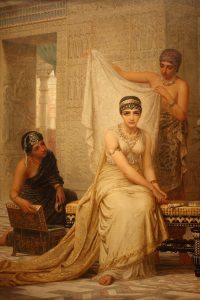 Esther has white skin and the servants have dark skin in this painting by Edwin Long
As I was revising last Purim’s blog post Esther’s Mussar Humility Lesson, I had a shocking realization. Esther is a Jewish Woman of Color.
Could that be true? I asked myself. I’ve always thought of her as white.
She must have been. The story takes place in Persia, and Persian people have darker skin.
In the painting to the left, notice how Esther has white skin and the servants have dark skin. I absorbed a cultural transformation: We’ve turned a Person of Color into a white person.
I did some research online, and found this wonderful story that describes what happened when a young boy heard a description of Queen Esther as someone with beautiful brown skin and hair in braids. He started jumping up and down, saying “Like me! I have brown skin too.” This young Jewish boy with a white mother and a dark skinned father saw himself in the Jewish narrative for the first time.
And I got an inkling of how it must feel to be a Jewish Woman of Color. I’ve read articles about Jews of Color feeling like they don’t fit in because in the synagogue people automatically think they are a guest or worse. Or they are ignored and not seen.
I admit, I felt a little sick to my stomach. It was confusing as my body coped with the discord of wanting to be inclusive, and my unconscious “elevation” of one of our greatest heroes to whiteness. I did not see Queen Esther for who she was.
In the words of Rabbi Shlomo Wolbe, The ultimate value you can give a person is to treat a person seriously, to take notice of that person. When you treat a person lightly and you don’t acknowledge them, you sit at a table and talk to all your friends, ignoring the one person who sits by themselves you are stripping this person of their value in effect giving them a curse. – Alei Shor Chapter 8
This offers us an opportunity for a Purim Mussar Practice.
***********Here’s The Mussar Practice***********************
Name Queen Esther as a Jewish Woman of Color, especially if no people of color are around.
Whether or not you are Jewish, you are invited to participate in this practice. Please join me in this practice of Honor, going out of our way to make our siblings of color feel seen today.
I hope you’ll give this practice a try. When you do, be on the lookout for how it feels inside. Will you havec a strong somatic reaction like me, or something else?
*******************************************************************
As it says in the Book of Esther, this is a time when we remember a day when great sorrow turned to joy.
This practice offers us opportunity to take people in our community seriously. It can turn their sorrow of being invisible to the joy of being seen.
When we do so, we add another inch on the road to the World to Come.
What do you think? Comment below and let me know.
The post Do You See Esther As A Jewish Woman Of Color? appeared first on American Mussar.
February 28, 2019
Three Steps To Judge The Truth About Green Book Like a Mensch
 What is the Truth about Green Book?
Spoiler Alert: Green Book won the Oscar for Best Picture. And some people are really pissed off about that. What is the Truth about Green Book that makes it so polarizing?
I loved Green Book, and I smiled when it won Best Picture. My smile faded a bit as I watched the producers acceptance speech. (You an watch it here on YouTube). I thought it weird that Vigo Morenson and Carrie Fischer got more praise than Mahershala Ali, who played the musical genius Dr. Don Shirley. And neither Shirley, the Green Book, nor civil rights were mentioned.
Then I read criticism of the movie by Spike Lee and others. I became downright confused. For some people of color, this movie win, and the silence about Don Shirley, became another story of marginalization. They saw what should be a black story co-opted by white film makers, with a white man put in the role of savior.
Many white presenting people share this perspective. On Facebook, the writer Peter Birkenhead compared Green Book to the story of Anne Frank, told from the viewpoint of “Miep Geis, one of the gentiles who helped hide her.” In this version, Miep is the hero and center of the story, and anti-semitism gets reduced to stereotypes. And when the movie wins best picture, not a single writer or producer accepting the award is Jewish.
How was I to square my reactions liking the movie with this true and authentic reaction from some people of color and their allies? And how could Mussar help me understand the truth about Green Book?
First, I stepped back and remembered that the screenplay was cowritten by Tony’s son Nick Vallelonga. It isn’t a movie about a black man dealing with racism in the South. It tells the story of a white man who took a job working for a black man and became friends with him. It is a story Nick is telling about his dad. If Miep’s daughter decided to write a movie that made her mom the hero, that would be ok with me.
Why do I say this? Because I had been telling people the movie was about Don Shirley. Yet there were no scenes with Don Shirley that did not also have Tony Lip in them. I was confused in part because I was trying to make Green Book a civil rights movie, which it isn’t. It is a relationship movie, between people of different backgrounds during the last days of the Jim Crow Era.
Second, we Americans have a long history of marginalizing and silencing people of color. I interpret reactions against the movie from some people of color as “Here we go again. I’m tired of this crap.” That is the Truth from their perspective, and I am trying my best to hear them and honor them.
As Rabbi Hillel said, “Do not judge your fellow until you have come to [their] place.” (Pirkei Avot 2:4). Since I have not been a person of color, I don’t know what they have been through. But I know enough to know they are not wrong for thinking this way.
Third, it is ok for me to like the movie, and have my own Truth. It was wonderful watching the movie with my father and 16 year old daughter. She had never seen what it was like in the South, when people of color used the Green Book to know where they would be allowed to stay and eat. My father shared that when Don Shirley came to Syracuse, NY in 1970ish, the hotel would not let him stay there. Dr. Shirley stayed with a Syracuse University faculty member.
Now that I’ve shared with you how I processed this movie in the Mussar way, I hereby invite you to try a Mussar Practice. After all, the point of Mussar is personal growth. I hope you’ll give this practice a try.
**********Here’s the Mussar Practice*********************************
See the Truth from another’s perspective. The people who dislike Green Book and I have different Truths. This is part of the human condition. Here are three steps to judge the comprehensive Truth about Green Book.
First, think about your own Truth about the movie. What leads you to that perspective? Have you seen it yourself, or are you reacting to other people’s reactions? What about you makes you have that perspective?
Second, pick a perspective different from yours. What is the Truth of persons of color who don’t like the movie? What about them makes them have that perspective. If their story were your story, would you be reacting the same way?
If you are one of the people uncomfortable about Green book, think about the Truth of the people who are annoyed with the backlash against the movie. Are they all white supremacists in the making? What about them makes them have that perspective. If their story were your story, would you be reacting the same way?
Third, integrate the truths together. Allow your Truth to evolve. Accept that it is ok to have a different Truth from someone else. You can both have different Truths and be in relationship together. After all, isn’t that one of the messages of Green Book?
********************************************************
Mussar teaches that only the Divine sits on the Throne of Truth, meaning that humans are incapable of knowing the Truth from all perspectives. As humans, we need to do some work to see the Truth from multiple perspectives.
Finally, Truth is key for Tikkun Olam, repair of the world.
The world stands on three things: truth, justice, and peace. Truth brings justice, which results in peace.” –Rabbi Simeon ben Gamliel
Until we can acknowledge the Truth about historical and current marginalization, we will never have justice. If you are skeptical about marginalization, start with an academic description, like this one here.
At the end of the day, it isn’t about Hollywood. It is about the pain of our fellow humans.
How do you see the Truth about Green Book?
What steps will you do to see the Truth from another’s perspective?
Want to learn more about the Truth and Mussar? Start with the Soul Trait Quiz.
The post Three Steps To Judge The Truth About Green Book Like a Mensch appeared first on American Mussar.