Amy Julia Becker's Blog, page 134
October 7, 2019
In Her Own Words: Penny on Healthy Eating and Exercise
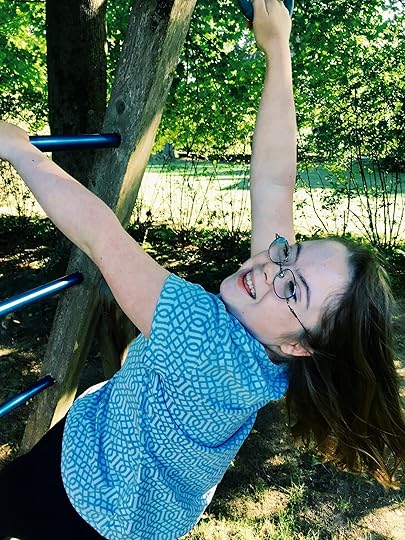
In honor of Down Syndrome Awareness Month , I’ve asked our daughter Penny (who is 13 and has Down syndrome) to share some reflections on her life in her own words. Today she’s writing about a decision we made together this summer to adjust her eating and exercise habits so that she could reach her stated goals of health and comfort. One great gift of this change has been taking regular walks together. Here, Penny explains how these changes have affected her mind, body, and spirit (I suggested those categories), and she offers some advice:
Before I decided to make some changes, i was eating a lot of carbs and a lot of unhealthy food. My favorite foods are pizza, mozzarella sticks, ice cream, and frozen yogurt. Yes there is a problem with these foods they are bad for you and you can not have them everyday and every time you want them.
I do not like exercising as much as my brother and sister do. You can find me reading a book inside not exactly what my mom wants me to do.
After I changed, my body was feeling pretty much the same but I did notice some changes to what I was eating and being aware of the foods I was allowed to have. My mind was saying go for it eat as much as you want. While my spirit was saying you know what foods you are allowed to have stay healthy.
I decided to change my portions to become more healthy.
I am sizing my amounts on what I have I can still have the same foods as I listed above but we need to set some boundaries.
Yes I do still eat the food that I love just in healthy and more supportive versions.
Now most days i am walking a mile with one of my parents. Sometimes my muscles start to feel sore. I like about it that I can talk with my parents about whatever I want.
My goals are to stay healthy and eat the foods that I still like just with healthy choices.
For other kids who have the same trouble, I would say stay healthy and you can still have the same foods that you like but with more healthy portions.
My body feels awesome with all the workout I have to do. My mind and spirit feel the exact same.
For other posts written by Penny, you can check out what she wrote when she wanted to quit dance class or the letter she wrote to a new mom expecting a baby with Down syndrome or what she had to say about starting eighth grade.
If you haven’t already, please subscribe to my newsletter to receive regular updates and news. You can also follow me on Facebook , Instagram and Twitter .
The post In Her Own Words: Penny on Healthy Eating and Exercise appeared first on Amy Julia Becker.


October 4, 2019
Talking with Brian Allain about the Business of Being a Writer
I had a great conversation with Brian Allain about writing and business and agents and editors on his webinar yesterday. If you’re curious about what I’m working on these days, or wondering what advice I have for writers who are just starting out, or just generally interested in the business of being a spiritual writer, check out our 30-minute conversation HERE.
(Brian, by the way, is a terrific guy who offers all sorts of resources for spiritual writers. He sends a weekly email list of resources and also hosts conferences like Writing for Your Life, Publishing in Color, and the upcoming Madeleine L’Engle conference. He’s also just started a new website called Compassionate Christianity and once wrote about Publishing in Color for my blog.)
The post Talking with Brian Allain about the Business of Being a Writer appeared first on Amy Julia Becker.
AJB Recommends: Podcasts on the Problem of Pain
Like many Americans, I think a lot about the problem of pain. There’s my own lower back pain that has mostly disappeared but showed up most nights for many years. There’s my father’s last ten years of surgeries and recoveries for his own back and the daily pain he lives with. There’s the opioid crisis that isn’t just in the headlines but has had devastating effects in our own local community. And then there’s the pain that goes beyond individuals–the collective pain of a nation with deep wounds crying out for healing, especially when it comes to social divisions.
I could (and someday I hope to) write about pain and healing for hours, but for today I just want to recommend three podcast episodes I’ve listened to lately that offer fascinating insights into the problem of pain, the purpose of pain, and the potential for freedom from pain.
Nathan Foster interviews Philip Yancey about Yancey’s newly updated book, Fearfully and Wonderfully Made on the Renovare podcast. They talk about what Yancey learned about physical bodies in pain and then about how we can apply that knowledge to the more metaphorical Biblical concept of the body of Christ. Yancey says, “ A healthy body is not one that feels no pain. A healthy body is one that attends to the pain of its weakest part.” https://podcasts.apple.com/us/podcast/renovar%C3%A9-podcast-with-nathan-foster/id917771018?i=1000450016943
Erik Vance talks with Krista Tippett on the On Being podcast about the way our brains already have pain-relieving medication within them, and how when we believe that healing will happen or is possible, our brain will often do the necessary work to repair our bodies and alleviate pain. Vance grew up as a Christian Scientist and is now a science journalist (who no longer practices Christian Science) and he brings a fascinating scientific/spiritual perspective to the problem of pain: https://onbeing.org/programs/erik-vance-the-drugs-inside-your-head/
This is the one that really blew my mind: Invisabilia’s episode called The Fifth Vital Sign looks at a cohort of teenage girls who experience pain that spreads uncontrollably through their bodies and the seemingly harsh treatment they endure to try to rewire their brains. At first it seems as though the “answer” to their pain is just to keep a stiff upper lip, but in time it becomes clear that yes, they need to push through the pain, but they also need to express their feelings (not their feelings about the pain–their feelings about their lives). Healing comes through ignoring the pain but attending to the feelings. I think. Again, this one’s a little trippy and left me with lots of questions but is totally worth listening to: https://www.npr.org/programs/invisibilia/701219878/the-fifth-vital-sign
If you haven’t already, please subscribe to my newsletter to receive regular updates and news. You can also follow me on Facebook , Instagram and Twitter .
The post AJB Recommends: Podcasts on the Problem of Pain appeared first on Amy Julia Becker.
October 3, 2019
Why I Disagree with The National Review about the 1619 Project
I wrote recently about the 1619 Project by the New York Times. The name of the project comes from the year that the first African captives were sold as slaves in Virginia. As I described in that post, the project seeks to reframe the history of the United States to incorporate this event and articulate the legacy of that moment in our current day. It’s a difficult subject and one that has sparked debate and discussion, but it shows how deeply important the power of truth is in our country. Below are some of my thoughts on one op-ed written in response to this project.
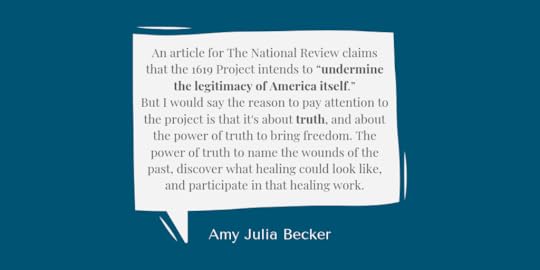
In an article for The National Review, Rich Lowry claims that the 1619 Project intends to “undermine the legitimacy of America itself.” But I would say the reason to pay attention to the 1619 Project is not about undermining the legitimacy of our nation. It is about truth, and about the power of truth to bring freedom. The power of truth to name the wounds of the past, discover what healing could look like, and participate in that healing work.
On the one hand, Lowry offers a helpful perspective on the history of human beings enslaving one another across continents and cultures and throughout time. And yet he does so as an antagonist to what “they” (aka the “liberals”) don’t tell “you.” I assume everything Lowry reports about global and historical slavery is accurate, but it’s an absurd premise. He implies that because other countries across time and space have enslaved people Americans shouldn’t have to reckon with the horrors and injustices in this nation.
Lowry’s article brings up with pride the fact that our country–unlike many other nations–was founded upon principles of human rights and democracy. It is a terrible irony that a country ostensibly founded upon freedom was also founded upon slavery. And it is precisely that irony that the 1619 Project invites us to consider.
Lowry suggests that because human beings have enslaved one another across time and cultures, Americans shouldn’t have to reckon with our own participation in enslaving people. I thought of parents who say to kids, “Just because your friend did it doesn’t make it right.” Lining up a historical record of slavery demonstrates the human inclination to self-centered evil that spans continents. But this historical and global context offers no excuse–the founders knew that slavery contradicted the very principles they were advocating (as Nikole Hannah-Jones’ article for The 1619 Project mentions, Thomas Jefferson, himself a slaveholder, called slavery a crime in the first draft of the Declaration of Independence!).
The reason to pay attention to the 1619 project is not about shame. It is about truth, and about the power of truth to bring freedom. In this case, the power of truth to bring freedom both to the oppressed and to the oppressor. The power of truth to name the wounds of the past, discover what healing could look like, and enable us to participate in that healing work.
If you haven’t already, please subscribe to my newsletter to receive regular updates and news. You can also follow me on Facebook , Instagram and Twitter .
The post Why I Disagree with The National Review about the 1619 Project appeared first on Amy Julia Becker.
October 2, 2019
The Spectrum of Welcome: Moving from Exclusion to Tolerance to Inclusion to Belonging

As we wrestle with ways to love and care for each other across differences, I want to share some helpful definitions of terms that have helped me break down the differences between exclusion, tolerance, inclusion and belonging. I’m writing here in terms of disability, but these concepts apply to changing any system that excludes individuals or communities.
Our daughter Penny was diagnosed with Down syndrome at birth nearly 14 years ago. When she was born, I was afraid that she would be rejected by peers, teachers, doctors, and our society more generally. But as I’ve written before, I soon learned that the vast majority of people in our society are open to Penny, and to people with Down syndrome and other disabilities.
Despite those good intentions, people also often have questions about Down syndrome, and they often feel awkward about asking those questions. They aren’t familiar with people with Down syndrome, and they often feel as though they don’t know how to welcome people with Down syndrome. There’s a disconnect between intention and reality for many of us. As a result, Penny sometimes gets sidelined from activities or events, not out of ill-will, but out of difficulty knowing how to welcome her.
For as long as Penny has been in my life, I’ve been thinking about how to welcome diverse people into communities. Over those years, I’ve learned from others about how to create welcoming communities. I’ve also learned the history of people with disabilities within the United States. And of course, I’ve reflected on Penny’s personal experiences. I’ve begun to see that there is a spectrum of welcome, a progression, from exclusion to belonging.
Exclusion
Last week, I drove past the Southbury Training School, a huge brick structure set back on a large lawn about thirty minutes away from where we live. I happen to know the history of this institution that once held thousands of residents. It was in places like this that many families were encouraged to send their children with Down syndrome at birth or during childhood. The large institutions like this one across our nation provide a picture of exclusion.
Over the years that Penny has been in my life, I’ve had multiple people tell me stories of family members they never knew about. One friend talked about discovering he had an aunt with Down syndrome that his mother had never mentioned. Another told me about how she never had a chance to really know her sister with Down syndrome because she had been institutionalized so young. Another discovered she had a brother with Down syndrome as an adult, after her father died. I first learned about the Southbury Training School when reading an article about the playwright Arthur Miller, who never publicly acknowledged his fourth child, Daniel, who had Down syndrome and lived in institutions like this one for most of his life.
People with Down syndrome, mental illness, and other forms of disability were often sequestered from the rest of society and therefore excluded not only from community life but also from education and opportunity. And as the stories of these family members testify, the exclusion not only often did harm to the person with Down syndrome, but also to the entire family system.
I’m focused in this post on the message of exclusion to people with disabilities, but that message is the same to all groups and individuals who have been marginalized over our history. The message of exclusion: “We don’t want you here.”
Tolerance
When it comes to American history, over time, society began to move away from exclusion of people with disabilities. In the early 1970s, parents chose to take their children with Down syndrome home from the hospital and keep those children at home rather than institutionalize them. Legislation like the Individuals with Disabilities Education Act was passed in the mid-70s that mandated children with disabilities, including children with Down syndrome, have access to public education. These social, educational, and legal changes helped to move the whole society from exclusion to tolerance.
Tolerance is a relatively neutral posture that permits people to attend or participate in a community even if core members of the community don’t desire their presence. While there have always been some communities that welcome people with disabilities, these laws meant that people with disabilities became more visible in their communities. Churches became more likely to recognize the existence of congregants with physical or intellectual disabilities. Still, institutions like churches and schools had much to learn before people with disabilities became active and full members of their communities.
If exclusion is negative, then tolerance is neutral. The institutional structure doesn’t change. But it also does not actively exclude. The message of tolerance: “We tolerate your presence here.”
Inclusion
Inclusion is the manifestation of a desire to welcome someone else into an institution or community. Most schools and places of worship desire inclusion these days, but actually moving to a posture of inclusion takes deliberate action on the part of the institution. Inclusion is movement from “we tolerate your presence here” to “we want you to be here with us.”
To give one example, when Penny was going into first grade in New Jersey, the administrators recommended a self-contained classroom. She would be with other kids with disabilities all day. She would be offered supports and given an education.
But when we moved to Connecticut, Penny went into a typical first grade classroom, supported by a paraprofessional as well as various therapists. As a result of this school’s inclusion, Penny had the opportunity to learn and grow in and amongst the wider community of her peers.
Inclusion has brought many positive goods to our society, and not only to the people who were previously excluded but also to the people at the center. Inclusion is awesome, and we are grateful for it.
And yet the message of inclusion still often assumes that the way the group at the center has behaved is the right way to behave. The message of inclusion: “We would love for you to be here and become like us.”
Belonging
When Penny was little, she attended what was called an “inclusive preschool”, where kids with special needs learned alongside their typical peers. Penny was the only child with Down syndrome in that class. Some of her friends were on the autism spectrum. One used a wheelchair. Others hadn’t developed spoken language yet.
One of those typically-developing peers had a birthday party, and before the party, her dad talked to each parent. He wanted to know all the allergies, all the phobias, all the ability levels represented in the group. He structured the food and the activities around who these children were and what they could do.
As it turned out, not every kid wanted to ride the pony that this dad had hired for the party. And not every kid loved the gluten-free cake. But those details didn’t matter. What mattered was his desire for every kid not just to be included, but to belong.
Vanderbilt University Professor Erik Carter writes and speaks about what it takes for people with disabilities to feel a sense of “belonging.” As he explains, no heroic measures are needed. No special programs. No huge budget increases. Just a sense of welcome, care, and reciprocity. Neither inclusion nor “belonging” are legislative acts (though legislative acts paved the way for these possibilities.) “Belonging” is not a policy. It is a posture of welcome.
Belonging depends upon humility. The person at the center recognizes their own gifts and offers them freely to the person on the margin. But the person at the center also recognizes their own needs and limitations and gratefully receives the gifts of the person on the margins. Belonging emerges out of a deep desire not just to include the “other,” but to love and be loved.
True community does not end with inclusion. True community—and the ability to both understand our common humanity and embrace what we learn from each other through our diverse identities—comes when we give and receive to one another in such a way that it transforms all of us. This sense of belonging can be cultivated in schools, churches, friend-groups, and virtually any other communal structure.
The message of belonging: “We are not us without you.”
Many of us who find ourselves at the social center want to build relationships of trust and care with people who have been marginalized. Tolerance is one step, and inclusion another. But for those of us who want to exist in diverse communities where people of different abilities are able to flourish side by side, we need to learn how to move from communities of exclusion to communities of belonging.
If you haven’t already, please subscribe to my newsletter to receive regular updates and news. You can also follow me on Facebook , Instagram and Twitter .
The post The Spectrum of Welcome: Moving from Exclusion to Tolerance to Inclusion to Belonging appeared first on Amy Julia Becker.
October 1, 2019
It’s Down Syndrome Awareness Month!
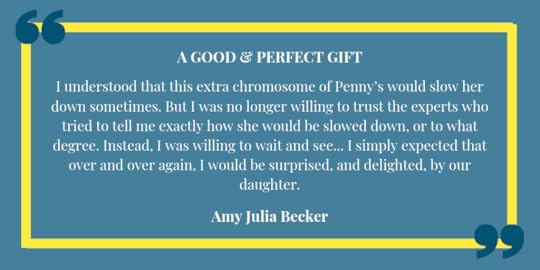
October is Down Syndrome Awareness Month. I join with many others to take this opportunity to celebrate people with Down syndrome. When our daughter Penny was diagnosed with Down syndrome at birth thirteen years ago, our lives changed immediately. At first there was a lot of fear mixed in with the love and joy of being a new mom, but as I got to know Penny and I began to understand more about disabilities, my fear began to fade while the love and joy remained. Over these past thirteen years, I have learned so much about myself, God, and our common humanity. Having a child with Down syndrome has truly been a blessing to me.
My second book, A Good and Perfect Gift traces this journey that helped me begin to understand that love is stronger than fear. If you haven’t read it yet, now is a great time to check it out. (There are other great books and memoirs about Down syndrome, which I will be recommending this month as well!)
Throughout Down Syndrome Awareness Month, keep an eye out for posts from Penny and me about life with Down syndrome. Whether you have someone in your life with Down syndrome or not, I hope what we share will be an encouragement to understand our common humanity so that we can celebrate our diverse identities.
If you haven’t already, please subscribe to my newsletter to receive regular updates and news. You can also follow me on Facebook , Instagram and Twitter .
The post It’s Down Syndrome Awareness Month! appeared first on Amy Julia Becker.
September 30, 2019
Letter from Penny to a New Mother of a Baby with Down Syndrome
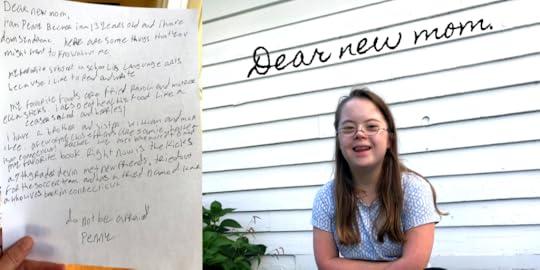 October is Down Syndrome Awareness Month! Over the course of the next month, I’ll share my own thoughts about Down syndrome and the ways having a child with a disability has shaped my understanding of myself, of God, and of what it means to be human. But I am also thrilled to say that I’ve asked our kids to also share what Down syndrome has meant in their lives. Penny, our 13-year old daughter who has Down syndrome, will be writing a short post most weeks. William, age 11, and Marilee, 8, will also offer their thoughts.
I’m starting with a letter Penny wrote to a new mother of a baby with Down syndrome. She has written letters of simple encouragement like this one many times in the past few years. Perhaps what feels remarkable about it is how unremarkable it is. I’ve written before about her typical life as a middle school kid, and that same sense shows up here:
Dear new mom,
I am Penny Becker im 13 years old and i have down syndrome. Here are some things that you might want to know about me. My favorite subject in school is language arts because i like to read and write. My favorite foods are fried ravoli and motzerella sticks. I also eat healthy food like a ceaser salad and berries! I have a brother and sister William and Marilee. A few of my close friends are Jamie, Hailea, Rachel, Lily, and Alex who moved! My favorite book right now is the Kicks. A 7th grader Devin met new friends, tried out for the soccer team and has a friend named Kara who lives back in Connecticut.
do not be afraid,
Penny
I should add that over the course of our thirteen years together, our motto has become, “Love is stronger than fear.” You’ll see a lot of that motto in the month ahead, and I hope it will become an easy way to remind yourself, as it has reminded me, to trust in Love instead of in Fear every day.
If you haven’t already, please subscribe to my newsletter to receive regular updates and news. You can also follow me on Facebook , Instagram and Twitter .
The post Letter from Penny to a New Mother of a Baby with Down Syndrome appeared first on Amy Julia Becker.
September 27, 2019
AJB Recommends: Books and Podcasts on the Legacy of Slavery
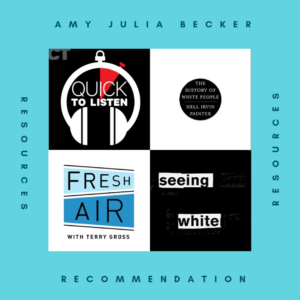
I’ve focused on the content of the 1619 Project this week, and I want to recommend a few additional podcasts, articles, and books for anyone who wants to explore more about the way slavery and racism have affected American history:
Articles on the Legacy of Slavery & the 1619 Project
One reader of my post about the 1619 Project drew my attention to this excellent critique by Andrew Sullivan in New York Magazine. The short version is that Sullivan considers the ideology behind the project and not just the facts the project draws our attention to. As I was reading, I copied sentence after sentence to share with you here so I could convince you to go read the article in full. Sullivan experienced the same discord that I expressed earlier this week–is 1619 our “true founding”? Or is that an overly simplistic rendering of history? The repercussions of slavery in our nation deserve the attention given by the New York Times, but Sullivan’s analysis of why their framing of the issue is problematic was very helpful for me. Here’s a taste:
Take a simple claim: no aspect of our society is unaffected by the legacy of slavery. Sure. Absolutely. Of course. But, when you consider this statement a little more, you realize this is either banal or meaningless. The complexity of history in a country of such size and diversity means that everything we do now has roots in many, many things that came before us. You could say the same thing about the English common law, for example, or the use of the English language: no aspect of American life is untouched by it. You could say that about the Enlightenment. Or the climate. You could say that America’s unique existence as a frontier country bordered by lawlessness is felt even today in every mass shooting. You could cite the death of countless millions of Native Americans — by violence and disease — as something that defines all of us in America today. And in a way it does.
Again, the whole article is well worth your time if you are thinking about the ways in which liberal ideals of democracy and the historical impact of enslavement affect us today.
The Wall Street Journal also ran two articles this week about the historical impact of slavery–one about the historical case for reparations and another about the way African nations who participated in the slave trade are responding to their own role and responsibility in it.
Podcasts on Slavery’s Legacy in America
Mark Galli and Morgan Lee interviewed Michael Haykin about the church’s theology and history around slavery going all the way back to the Roman Empire for Christianity Today’s Quick to Listen podcast. I learned so much from them about the distinctions (and similarities) between Catholics and Protestants when it came to the slave trade and the New World, the economic interests that overrode theological objections when it came to enslaving human beings, and the radical Christians who objected to slavery. (Spoiler alert, but I have to share that this podcast even includes a story of a Quaker who had the gift of nudity. You’ll have to listen to know what I’m talking about!)
I also listened to historian Eric Foner on Fresh Air, talking about his new book The Second Founding. In this conversation about what the “true founding” of America is, I thought his perspective was fascinating. He calls Reconstruction the second founding of America because of the ways the 13th, 14th, and 15th Amendments restructured our society.
I’ve mentioned this podcast before, but John Biewan’s Seeing White series for the Scene on Radio podcast is an incredibly compelling exploration of what it means to be white in America, how this concept of whiteness was created, and what it has meant over time. Most episodes are in conversation with Chenjerai Kumanyika, who is an African American and a Professor of Media Studies. Most episodes focus on whiteness in relation to the history of African Americans, but the series also devotes episodes to the place of Native Americans in this history and immigrants from other countries within the past century.
Books on Deck
And finally, here are a few books in the “up next” category for me. In other words, I haven’t read/finished them yet, but they’ve been recommended by so many people that I am eager to dive in:
With Justice for All by John Perkins. I have started this one, and Perkins explains his own story of personal transformation when he became a Christian and then devoted his life to pursuing fellowship with white Christians (Perkins is black) and pursuing justice for all people.
The History of White People by Nell Irving Painter. Painter is interviewed in the Seeing White podcast I mentioned above, and I had the privilege of having her as a teacher when I was an undergraduate for a History of the American South class. She’s smart, engaging, gracious, and informative as a teacher and on the podcast, so I expect to encounter that same blend of scholarship and accessibility in her book.
Then there are the “I can’t believe I still haven’t read this” pile of books: The Color of Law by Richard Rothstein, Raising White Kids by Jennifer Harvey, and How to Be an Anti-Racist by Ibrahim Kende.
Undergirding all the questions and all the areas of ignorance is my conviction that we have the freedom to explore painful histories and the freedom to celebrate diverse identities because of our common humanity. I look forward to learning more.
If you haven’t already, please subscribe to my newsletter to receive regular updates and news. You can also follow me on Facebook , Instagram and Twitter .
The post AJB Recommends: Books and Podcasts on the Legacy of Slavery appeared first on Amy Julia Becker.
September 26, 2019
For Down Syndrome Awareness Month – Schedule a Normie Screening in Your Area!
Our Family’s Involvement in Normie
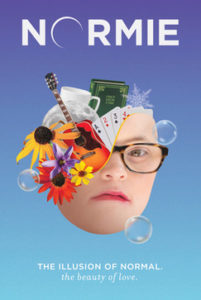
We feel lucky to be a part of this wonderful film, and to get to know Annemarie – the young woman whose story is followed in Normie! My family has a small cameo, so keep an eye out in the trailer for Penny ballet dancing in a pink tutu!
We put together a screening in our hometown this summer, where I spoke on a panel with the creators. I had seen Normie before, but watching it on a big screen in the context of a group of people only made me appreciate this film more. The main subject of the documentary, Anne Marie, is a funny, honest, articulate, young woman who insists on grappling with some of the deepest questions of life and meaning and purpose. Yes, she has Down syndrome, and yes, that defines her in some ways. But we can see ourselves in her as well.
I would also call this a coming-of-age story about a young woman who–like so many of us–longs to be loved for who she is and also wrestles with doubts about whether God has a purpose for her and even stuggles with self-hatred.
Through interviews with her, her parents, other parents of children with Down syndrome (including us!), and a physician, a magician, and a pastor, this film takes us on a journey of self-discovery, connection, beauty, and love. I’m so grateful I got to participate in it and share it with our local community – I highly recommend hosting a screening in October in honor of Down Syndrome Awareness Month!
Host a Screening
Why not host a screening of Normie in your area? Click here to request a screening through Tugg.
Not able to host? Find a Screening!
There may be a screening happening in October near you. Check out Tugg’s site to find out!
Watch the Trailer
Film Synopsis
When Annemarie looks in the mirror, she sees Down syndrome. She hates it. To her, the diagnosis is a giant barricade keeping her from the independence and intimacy she desperately desires. She embarks on a journey of self-discovery as she tries to understand what it means to be normal.
If you haven’t already, please subscribe to my newsletter to receive regular updates and news. You can also follow me on Facebook , Instagram and Twitter .
The post For Down Syndrome Awareness Month – Schedule a Normie Screening in Your Area! appeared first on Amy Julia Becker.
September 25, 2019
The 1619 Project and True History
Perhaps, like me, you’ve read the New York Times 1619 Project or listened to the podcast. I’ve appreciated the thoughts and conversations they have sparked around the ongoing legacy of slavery and the founding of our nation. As someone who has been thinking and writing a lot about race, racism, and privilege this past year (not only in my book White Picket Fences but also on my blog), I continue to wrestle with how to understand and think about American history. I invite you to join with me in considering our past so that we might move towards healing the wounds in our nation.
My (Whitewashed) Version of US History
I loved the history of the United States as a child. I read biographies of Jefferson and Washington and Betsy Ross. I enjoyed field trips to colonial Williamsburg and family trips to Washington, D.C. and Boston. I loved feeling as though I was connected to great people who had done great things for the world.
I first learned that history in a small town in North Carolina. In school, and through the placards near historical locations around town, we learned what there was to commend. We didn’t learn much about slavery or the Civil Rights movement. Recently, I went back to reread my fourth grade history textbook, and I found only three veiled references to slavery among the 350 pages. That textbook stands as a reminder of how white Americans have tried to ignore slavery and its effects for centuries.
Even when I was older and living in Connecticut, I was taught that white Europeans established this nation with high ideals that “just took time to realize.” The year 1776 was engrained in my memory. 1776 called for celebration. It was a way to remember that which defined me as an American: Liberty. Justice. Equality. Freedom.
I never heard anything about the year 1619.
The 1619 Project
According to its statement of purpose, The New York Times’ 1619 Project seeks to “reframe” America’s history by placing the “true founding” of this nation 400 years ago. In the year 1619, the first people from Africa were sold as slaves to Europeans in what we now call Virginia. The Project seeks to articulate the legacy of that moment, a moment which precipitated hundreds of thousands of additional women, men, and children being sold and enslaved on these shores and millions more subsequently born into slavery.
Perhaps what makes the 1619 Project both compelling and controversial is that it claims America was founded upon slavery, not upon the ideals of liberty and justice for all.
I began reading the various articles written for this project without paying attention to its stated mission. I dove right into Nikole Hannah-Jones’ riveting account of her father’s insistence on flying the American flag outside their home. As an African American military veteran, her dad knew that he had every right to be treated with the ideals that flag represented. Flying it was a proclamation of the injustices he experienced as much as it was a challenge for this nation to live up to its principles.
Hannah-Jones connects her family’s story to the larger narrative of the United States. She writes, “the year 1619 is as important to the American story as 1776. . . [B]lack Americans, as much as those men cast in alabaster in the nation’s capital, are this nation’s true “founding fathers.”
As I continued to read (and listen to the 1619 podcast that corresponds with them), I learned more about the influence of African Americans upon the music of this land, about the way prejudice against African Americans has affected health care for all Americans, and about the economic role slavery played in forming this new nation. In other words, I learned more and more about how the enslaved people who were brought here 400 years ago formed and shaped this nation.
I feel uncomfortable with the thought that this nation was founded on the principles of subjugation and economic self interest. I like the idea that this nation was founded upon the ideals of liberty and justice.
I am grateful for the chance to listen and read these stories precisely because of that very discomfort and the 1619 Project’s insistence that I consider the longer and fuller story of this America I call my own.
What Is Our True History?
What is the foundational story of these United States? Upon what were we established? What holds and supports the beams and stones where we continue to build? Was 1619 and the legacy of slavery our “true founding”? Was 1776 with its idealistic vision of government by the people and for the people?
As I write in White Picket Fences:
“There are two ways of seeing my heritage as a white American–as those who have perpetrated years of unjust oppression of native peoples and African Americans and immigrants, or as the founders of modern society with its celebration of liberty and justice for all. I have always thought I had to choose. If I am grateful for my town, my family, my history, then I must not critique it. And if I name the ugliness inside that history, I forfeit the right to be grateful. I am starting to believe that both must be true . . .”
The 1619 Project makes a compelling case that the United States of America was founded upon slavery. History textbooks in classrooms across this country make a compelling case that the United States of America was founded upon ideals of freedom.
Again, I am starting to believe that both must be true.
Holding The Tension of Both
When I returned to my fourth grade textbook and discovered the minimal information I had been given about slavery and its effects, I thought about the impact of unrecorded histories, of whitewashed origin stories. As I’ve written before, we give a truthful reckoning of the ugliness in our pasts not in order to bring shame, but in order to bring freedom. We acknowledge disease in order to bring healing.
Both 1619 and 1776 stand as foundational markers of who we are as a nation. Our ancestors captured, raped, and terrorized. Our ancestors dreamed, created, and loved. We as a nation are built upon good and evil, and the people who built this nation participated in good and evil. If we only remember the good, how will we prevent the evil from perpetuating itself among us?
Our identity as Americans does not emerge out of choosing between the bifurcated narratives of 1619 and 1776. It arises out of acknowledging our common humanity–the brokenness in who we are that brought us the horrors of slavery, the glory in who we are that brought us the unrealized but plainly stated ideal that “all [people] are created equal.”
The 1619 Project names the ways this nation was founded upon evil and injustice. Moreover, it connects those foundational moments to ongoing injustice. The call for Americans now is to continue to name that injustice and turn away from it. The call is to tear down the parts of the building that have been built upon that foundation. The call is to turn away from division and denial and toward healing.
If you haven’t already, please subscribe to my newsletter to receive regular updates and news. You can also follow me on Facebook , Instagram and Twitter .
The post The 1619 Project and True History appeared first on Amy Julia Becker.