Amy Julia Becker's Blog, page 133
October 22, 2019
A Full Life – Quote from A Good and Perfect Gift & Giveaway Info
“Can she have a full life without solving a quadratic equation? Without reading Dostoyevsky? I’m pretty sure she can. Can I live a full life without learning to cherish and welcome those in this world who are different from me? I’m pretty sure I can’t.” — from A Good and Perfect Gift
For Down Syndrome Awareness Month 2019 I am highlighting my book A Good and Perfect Gift because it traces the story of my family when we discovered at her birth that our eldest daughter, Penny, had Down syndrome. I have learned a lot about myself, our daughter, faith, expectations, disability and Down syndrome as well as recognized false ideas and discovered deeply true ones about our common humanity in the nearly 14 years since she was born.
The update from when I originally wrote the words in the quote above is that she indeed is living a full life including pursuing things she enjoys like ballet, reading books and spending time with friends.
This month I’ve also shared several posts from Penny herself including a letter she wrote to a new mom of a baby with Down syndrome as well as her thoughts on living a healthy lifestyle and matters of faith. If you haven’t already, I hope you’ll check them out.
Giveaway October 2019
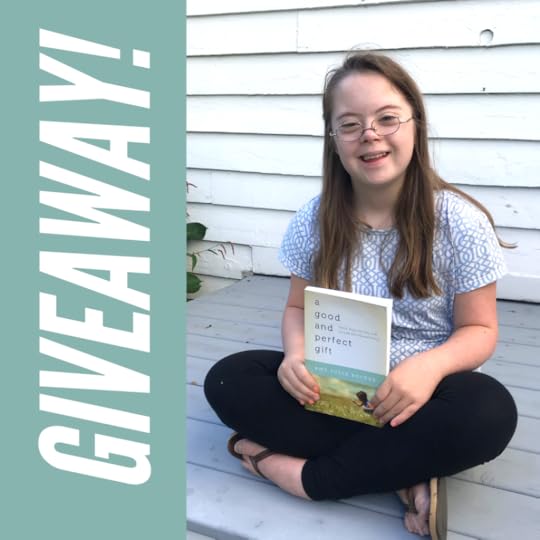
I am giving away three copies of my book along with personal notes/autographs from both Penny and I (or we can address the notes to anyone you choose if you are giving the book as a gift). You can enter to win over on Instagram by liking my page, liking the post (which looks like the photo below), then tagging two friends and using the hashtag #goodandperfectgiveaway by 9pm EST October 30, 2019. Full details are on Instagram.
If you haven’t already, please subscribe to my newsletter to receive regular updates and news. You can also follow me on Facebook , Instagram and Twitter .
The post A Full Life – Quote from A Good and Perfect Gift & Giveaway Info appeared first on Amy Julia Becker.


October 21, 2019
In Their Own Words: William and Marilee on Having a Sister with Down Syndrome
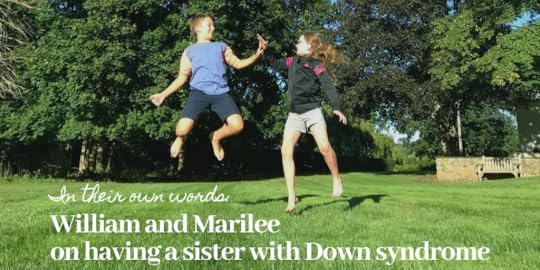 I’ve written a LOT about our family over the course of the past decade, and I’m glad our kids are old enough to do a little bit of writing for themselves. For the past few weeks, Penny (age 13) has written a note to a new parent of a baby with Down syndrome, shared her thoughts on healthy eating and exercise, and answered questions about God, church, and prayer.
Today, I asked her siblings, William (age 11) and Marilee (age 8), to write about having a sister with Down syndrome.
I’ve written a LOT about our family over the course of the past decade, and I’m glad our kids are old enough to do a little bit of writing for themselves. For the past few weeks, Penny (age 13) has written a note to a new parent of a baby with Down syndrome, shared her thoughts on healthy eating and exercise, and answered questions about God, church, and prayer.
Today, I asked her siblings, William (age 11) and Marilee (age 8), to write about having a sister with Down syndrome.
I wrote some questions like, What do you think it means to have Down syndrome? What are some of your favorite/least favorite things about Penny? Do you think that has to do with Down syndrome? What advice would you give to other kids who have a brother or sister with Down syndrome? (Note, as with Penny’s previous essays, I did not correct grammar or spelling for William. Marilee dictated her answer, so she got the benefit of her mother’s editing abilities.)
Here’s what they had to say:
From Marilee, age 8:
Penny loves dance and she loves school well at least that’s what she tells me she loves to read all sorts of books. It’s challenging because her brain processes stuff slower than ours does. She’s kind and sweet sometimes she’s kind of bossy but most of the time she’s nice. Don’t be uncomfortable about her because people with Down syndrome are very smart and kind and nice.
From William, age 11:
It is very fun to live with Penny. She is an amazing sister. She likes to do ballet and play piano. She also likes to read a lot. I do feel like it can sometimes be a challenge. It is interesting to be asked questions like ‘What is Down syndrome?’ and say what I think about it. I think of Down syndrome is not realy a dissability. I think that living with a sister with Down syndrome is good in general. I do not know many other kids with Down syndrome, but the ones I have met are very nice and respectfull. They seem similar in some ways to Penny, but they look different than Penny. Some of them also talk a bit differently than Penny.
One of my favorite things about Penny is that she is very kind and respectfull. One of the things about Penny that I don’t like as much is that she takes more time than me and my younger sister. I think that Down syndrome does have an effect on that because it gave her a lower muscle tone that makes her slower. I also think that it is a good exercise to have to calm it down and go at a slower pace.
I do not feel jelous of Penny becasue I would not realy like to have Down syndrome. Penny has scoliosis which is not common, but part of the reason she has it might be Down syndrome. She has to have a lot more doctors appointments in far away places because of scoliosis. She also wears glasses which most kids with Down syndrome do, but I do not. There are also a fair number of appointments for that. I would say to kids with siblings of kids with Down syndrome is that you should try to be very patient and kind with them because they are wonderfull and important. I think that Penny is a blessing and a gift.
If you haven’t already, please subscribe to my newsletter to receive regular updates and news. You can also follow me on Facebook , Instagram and Twitter .
The post In Their Own Words: William and Marilee on Having a Sister with Down Syndrome appeared first on Amy Julia Becker.
October 17, 2019
AJB Recommends: Resources on Inclusion and Belonging
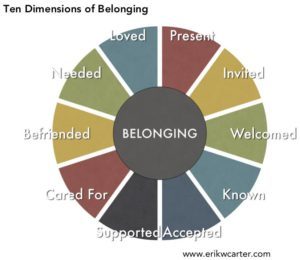
I’ve written about the posture institutions (and individuals) can hold towards people with disabilities (or anyone outside the normative social group): exclusion, tolerance, inclusion, and belonging. I’ve learned about these postures through a number of writers and thinkers, and I wanted to share three resources that have been helpful to me in considering whether I personally am participating in welcoming others, whether I’m allowing the presence of people who are different from me to change who I am (and not just trying to change them to my way of seeing or doing things), and in asking whether the institutions I am a part of are providing ways for a diverse range of people to belong.
Erik Carter’s Wheel of Belonging. Vanderbilt University Professor Erik Carter offers ten dimensions of belonging for people with disabilities. These start with a simple question: are people with disabilities present? And progress through the question of whether those people are not only present and cared for, but also known and needed.
Dan VanderPlaats has created Five Stages of attitudes towards people with disabilities: ignorance, pity, care, friendship, and co-laborers. In this short video, he explains the Five Stages. Any community in which people with disabilities are experiencing friendship and co-laboring is probably a community of belonging.
3. I’ve already mentioned what I see as the relationship between questions of belonging for people with disabilities in most institutional spaces. This continuum on becoming an antiracist muticultural institution has been helpful to me in considering similar questions in terms of historically white institutions that hope to become truly diverse communities.
If you haven’t already, please subscribe to my newsletter to receive regular updates and news. You can also follow me on Facebook , Instagram and Twitter .
The post AJB Recommends: Resources on Inclusion and Belonging appeared first on Amy Julia Becker.
October 16, 2019
Love Is Stronger Than Fear
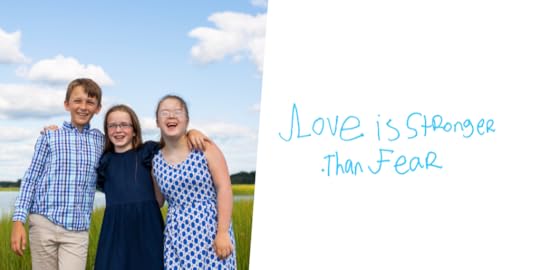 When our daughter Penny was born and diagnosed with Down syndrome, fear felt incredibly powerful. The questions, the doubts, the potential medical complications, the prejudice against people with intellectual disabilities I didn’t even know I had carried in my heart for decades–it all welled up in a mountain of fear. I feared that I would fail completely as a mother and as a human being with a child with special needs. I feared that other people would reject our child and our family. I feared that she would suffer.
But right there alongside the fear was love.
Love was quieter, for sure. Gentler. If fear was a rock threatening to shatter me, then love was water, offering to carry me along.
What surprised me then, and in many ways surprises me still, is that over time, fear retreated. Or maybe it didn’t retreat. Maybe it stayed in one spot–immovable and hard as stone, and love propelled us away from that mountain.
There was the fear of medical complications, softened by the doctors who reassured us of their care for Penny and later by the recognition that she was healthy, and growing, and happy. The fear that she would never have friends, softened when she was invited to a birthday party in preschool, and again when I saw her holding hands on the playground with her new best friend in kindergarten, and again when she sat on the porch outside my office with a new friend from middle school and they chatted and painted each other’s nails. The fear that she wouldn’t learn, softened by her insatiable, if slowly-progressing, determination to learn how to read, how to do the monkey bars, how to put on makeup, how to talk at the appropriate time at the lunch table.
Statistics show the discrimination and harm people with intellectual disabilities still face in social situations, at school, and in the workplace. My fears weren’t unfounded. I just didn’t know that love could carry us through those fears, that fear did not need to be the end of the story.
Penny is almost 14 years old now, and whenever I find myself afraid–afraid that she isn’t learning enough in school, afraid that her friendships won’t last, afraid that her scoliosis will progress–I return to the refrain, the truth that we have lived: Love is stronger than fear.
What’s more, when I read about immigrants being denied access to the United States, or about another innocent victim of police violence, or about anti-semitic or racist symbols scrawled in public–in the midst of the fearful social realities of our modern world, I return to this refrain as well. Love is stronger than fear.
But to get past that mountain of fear, we would need to collectively lament the ways we have allowed fear to divide us, the ways we have held tight to our fear instead of surrendering to love, the ways we have participated in harm, and the ways we have failed to love out of our common broken and beloved humanity.
We must allow love to carry us, together, away from fear and towards collective possibilities for healing. I’ve caught a glimpse of this powerful, eternal, infinite force of love and the way it can heal families, heal friendships, and heal communities. I trust that this love could even heal a nation.
Love is stronger than fear, but fear will win out unless we allow love to empower sacrificial action in the world. Love is stronger than fear, but only if we participate in love. Only as we entrust ourselves to love. Only as we allow love to nourish us. Only as we allow love to connect us to one another. And only as we become willing to give whatever it takes in order for love to abound.
If you would like to read more about the early years in our journey from fear, please check out my memoir A Good and Perfect Gift.
If you haven’t already, please subscribe to my newsletter to receive regular updates and news. You can also follow me on Facebook , Instagram and Twitter .
The post Love Is Stronger Than Fear appeared first on Amy Julia Becker.
October 15, 2019
5 Bible Passages for Parents of Children with Down Syndrome
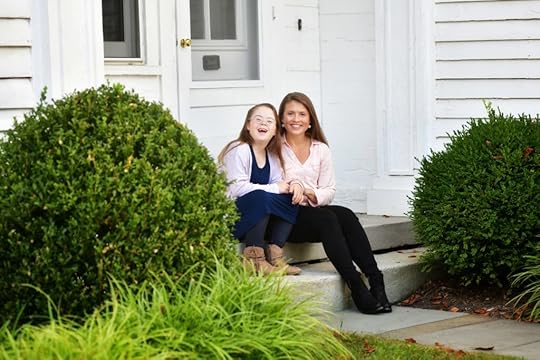
I’ve written several posts ( like this one ) on themes related to disability recently in honor of Down Syndrome Awareness Month . In this post I want to share with you five Bible passages that have led me through thirteen years of parenting a child with Down Syndrome. These Bible passages have encouraged and grounded me over the years and I hope they will bless all of us, whether we have a family member with a disability, or simply need to be reminded that there is hope and that we are broken and beloved.
Bible Passage 1: Flourishing
“She is like a tree planted by streams of water, which yields its fruit in season and whose leaf does not wither.” Psalm 1:3
When I was pregnant with our daughter Penny, I was reading through the Book of Psalms. Psalm 1 frames the whole book, and it offers a picture of what a flourishing life looks like: a tree planted by a stream of water. For whatever reason, those words jumped off the page as a promise for our unborn daughter. She would be like a tree—growing slowly, nurtured by the life-giving water of God’s presence, bearing fruit. When Penny was diagnosed with Down syndrome, at first I wondered whether that Psalm was really the right vision for her life, the right way to pray for her. I feared that having Down syndrome would mean she couldn’t flourish, couldn’t contribute, couldn’t bear fruit.
Bible Passage 2: Displaying The Work of God
“This happened so that the work of God might be displayed in his life.” John 9:3
About halfway through Penny’s first year of life, I read the story of the man born blind in John 9. In it, Jesus’ disciples see the man as a morality tale. They assume that his blindness, his disability, came as a result of sin. Jesus overturns their overly simplistic view of the world when he says, “Neither this man nor his parents sinned, but this happened that the work of God might be displayed in his life.” Again, those words leapt off the page and into my own heart. I had been thinking Penny’s diagnosis was a result of something gone wrong in the cosmic order or in our lives or in her body. Jesus flipped the script and again made a promise. No one did anything wrong. And Penny’s life, like your own, is intended to bear witness to the glory of God.
Bible Passage 3: The Way of Love
“Love is patient, love is kind. It does not envy, it does not boast, it is not proud. It is not rude, it is not self-seeking, it is not easily angered, it keeps no record of wrongs. Love does not delight in evil but rejoices with the truth. It always protects, always trusts, always hopes, always perseveres.” 1 Corinthians 13:4-7
I had the chance to preach at Penny’s baptism. I used the words of 1 Corinthians 13, Paul’s great proclamation about love, as my Scripture reading. Paul explains all the things we might think we can do to prove that our lives matter—impress people with our intellect or our selfless service to others or even our miraculous demonstrations of spiritual power. Paul says none of that matters one bit without the patient, gentle, kindness of love. “Without love, I am nothing,” he writes. Even at eleven months old, Penny was showing me a whole other way to experience and participate in a life of beauty, connection, purpose, and meaning. She was inviting me to understand the way of love.
Bible Passage 4: Wonderfully Made
“For you created my inmost being; you knit me together in my mother’s womb. I praise you because I am fearfully and wonderfully made; your works are wonderful, I know that full well.” Psalm 139:13-14
Once Penny was in elementary school, she was invited to participate in reading Scripture at our church every so often. We had a guest preacher one Sunday. He didn’t know our family. He sent the passages from which he would be preaching ahead of time, and I had Penny practice out loud. As it happened, her reading was Psalm 139. “I am fearfully and wonderfully made,” she spoke, echoing the words of the Psalmist from so many ages ago. And from the pulpit, she proclaimed, “I am fearfully and wonderfully made.” Like a tree, planted by streams of living water.
Bible Passage 5: God’s Peace
Do not be anxious about anything, but in everything, by prayer and petition, present your requests to God. And the peace of God, which transcends all understanding, will guard your hearts and minds in Christ Jesus our Lord.” Philippians 4:6-7
Penny is in middle school now, and she has begun to claim a faith of her own. She has her own questions. She also has her own fears. Those fears show up most often at bedtime—she’s afraid of the dark, afraid of sleeping alone if her sister is away for some reason. She’s afraid of upsetting other people. She’s afraid of confrontations. So now, when she tells me she is afraid, we pray together. We think back to the words from Philippians 4 that we memorized as a family when the kids were little. We simplify those words into “I give you my anxiety. I receive your peace.” We breathe deeply together.
My fears that Penny’s life will not bear fruit (which you can read about in my book A Good and Perfect Gift) have already been proved unfounded. My concern that Down syndrome is a special kind of brokenness has faded away. I have come to believe that Penny has been created with a purpose. I have come to believe in the ultimate and grounding power of love. I have come to understand that love is stronger than fear.
If you haven’t already, please subscribe to my newsletter to receive regular updates and news. You can also follow me on Facebook , Instagram and Twitter .
The post 5 Bible Passages for Parents of Children with Down Syndrome appeared first on Amy Julia Becker.
October 14, 2019
In Her Own Words: Penny on Church and Faith
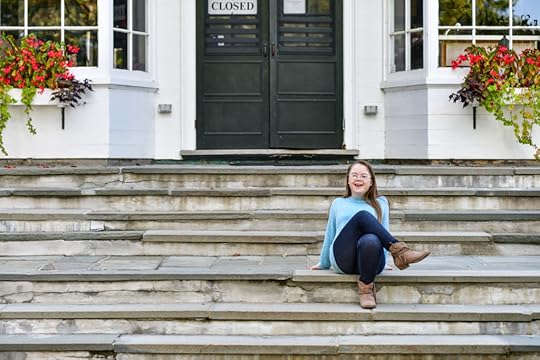
Penny has grown up going to church with our family. She’s also grown up with parents who pray, read the Bible, and offer sporadic attempts to include their children in various spiritual activities. But, as with each of our children, Penny’s personal faith and spiritual practices are hers to claim (or reject). I asked her a set of questions about her experiences of church and spirituality more generally and then pasted together her answers to give you a sense of how she thinks about church, prayer, the Bible and what questions she has about God.
Well on Sunday mornings first I go to my Bagels and bible study and talk about god. We first we go into the kitchen to make our bagels plus juice and then we put either cream cheese or butter on them and then we bring our food and drink to the table while we talk about god.
And then I go upstairs and talk about god some more pray, sing , and scripture readings. I look forward to seeing at church is my old babysitter who now lives in Washington D.C and her mom because i like sitting with them and smelling her hair. I smell it and always say “ mmm lemony.”
My favorite part of church is singing because i want to worship god while we sing. i do have a favorite song it is “oh gracious light” and “Amazing Grace My Chains Are Gone.”
I believe about god that he made the heavens and the earth. i do believe that god made me and one of my special abilities is that i have down syndrome and flexibility.
i do believe that god loves me. It affects me when i am trying hard to do something and if for some reason i can’t god helps me reminds me that i actually can do it if i work even harder. I believe about Jesus that he took away our sin. I think sin is when you lie. I sin a little and then I talk with god and ask for forgiveness.
I have the gift of encouraging people. i encouraged a person when she was feeling down and i said do you want to talk about what happened she said yes i do want to talk about what happened and then she gave me the whole story of why she was feeling down.
When I pray on my own, I pray about my worries.
I do have some questions: Do i have to talk about god outside of church? Why god is so important in our everyday lives?
When I go to school on Monday I still think about god but I know I am not in church. Church always has been a highlight for me.
On Wednesday of this week, check back in for my own thoughts on Penny and faith as I share five passages from the Bible that have guided me from fear to love throughout the course of Penny’s life. If you’d like to read other recent posts by Penny check out here thoughts on the first day of school , exercise and eating healthy and her letter to a new mom of a child with Down Syndrome. I’ve also written several other posts recently in honor of Down Syndrome Awareness Month on moving from exclusion to belonging , explaining that concept to 4th graders , creating institutions that encourage belonging .
If you haven’t already, please subscribe to my newsletter to receive regular updates and news. You can also follow me on Facebook , Instagram and Twitter .
The post In Her Own Words: Penny on Church and Faith appeared first on Amy Julia Becker.
October 11, 2019
“Built for Me”: Belonging within Institutions
I’ve written two previous posts about the difference between communities of exclusion, tolerance, inclusion, and belonging for people with disabilities. This same paradigm has also helped me to consider the ways in which schools, churches, and other social settings communicate a sense of belonging to anyone who is outside the historical social norm for that place, and especially among African Americans within historically white institutions.
I thought about the progression from inclusion to belonging when I read an article in the New York Times by Skylar Mitchell about her decision to attend a historically black college. She had grown up as an African American in a predominantly white school, and she had assumed that she would attend a school similar to her peers, a predominantly and historically white liberal arts college. But her mother insisted that she take a tour at Spelman, and when she saw the course offerings and the pictures of notable African American women and men on the walls, she wrote that she realized how much she wanted to go to a school that had been “built for her.” She didn’t simply want to be included in a group of students when she went to college. She wanted to belong.
I’ve written in recent weeks about the history of exclusion for people with disabilities within the United States. I could write an even more widespread and long-lasting history of exclusion for African Americans within the United States. In the same post, I wrote about how many institutions in America–schools, places of worship, and families–have moved from exclusion to tolerance to inclusion (and sometimes to belonging) when it comes to people with disabilities. Despite the ongoing racism and exclusion that exists in our nation, we have also seen movement in personal relationships and in institutional spaces from exclusion to at least a desire to welcome African Americans and other people of color.
Communicating a sense of welcome and belonging in personal relationships takes intentional work in and of itself. Communicating that same sense of welcome and belonging in institutions takes different, but equally intentional work.
Many institutions have started working to overturn a history of exclusion. Yale University has been wrestling, for instance, with the college named after the slaveholding South Carolina Senator John Colhoun. They eventually decided to the building. Princeton University continues to debate how to handle the legacy of its President (and United States President) Woodrow Wilson in light of his own racist views and policies. These are just two examples of institutions who are living in an age of tolerance and inclusion, confronting a historical posture of exclusion, and asking questions about what it would look like to communicate “belonging” to a diverse array of undergraduates. Renaming buildings are first steps.
Moving from exclusion to “inclusion” is not the same as moving to “belonging.” As Skylar Mitchell noted above, for her to “belong” at a school, the architecture of the courses and of the buildings needed to reflect her presence. In a similar way, for people with physical disabilities to truly belong in a church, the architecture needs to reflect a commitment to make spaces accessible for wheelchairs. Beyond walls and buildings, people who have been central to those institutions will need to pursue true friendship with those who previously have been marginalized. They will need to share positions of leadership. The institution must change to reflect its people if it wants to become a place of belonging.
Institutions are conservative by their nature. They exist in order to preserve the past and in order to offer that same “product” to people in the future. Institutions must do the crucial work of preserving all that has been good and beautiful and true while simultaneously working to undo all the trappings, systems, and attitudes of oppression and exclusion.
I don’t have easy answers, and I suspect the answers will look different from place to place. I am looking at the institutions that I have been a part of throughout my life. I invite you to join me in asking who these places were built for, who belongs here, and what we can do to expand that circle of belonging.
If you haven’t already, please subscribe to my newsletter to receive regular updates and news. You can also follow me on Facebook , Instagram and Twitter .
The post “Built for Me”: Belonging within Institutions appeared first on Amy Julia Becker.
October 9, 2019
Changing the Game: Explaining Exclusion, Tolerance, Inclusion and Belonging to Fourth Graders (and the rest of us!)
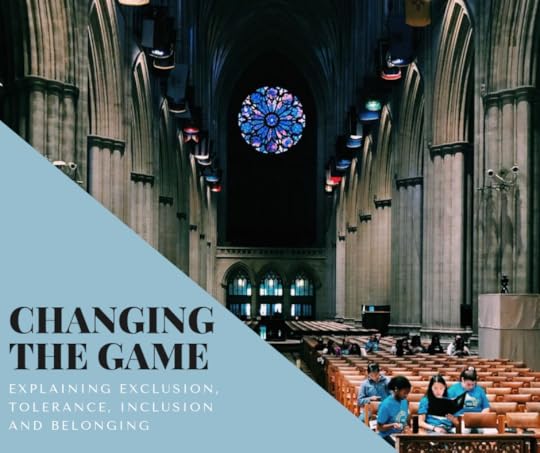
How do communities move from simply including people with disabilities to giving people with disabilities a sense of belonging alongside their typical peers? Many communities have already moved away from exclusion and tolerance towards inclusion. How can we not only include people who were once marginalized but invite them also to belong?
Play the Game
I explained this progression to a group of 4th graders when I spoke at the National Cathedral School last spring by asking three of them to come up to the front of the room. I asked two of them to throw a ball to each other. I then asked the class how they could exclude the third girl. It was easy to come up with the answer. They pointed her out of the room.
Then I asked them what it would look like for this girl to be tolerated. “She can watch the game and be in the room,” they said. “But she can’t play.”
We then moved to the idea of inclusion. At that point, the two girls playing ball became a circle. The two original girls got fewer turns throwing and catching. The new girl got to participate. She played by the rules that had already been established. She conformed to the current reality.
“But what if,” I asked the class, “this new girl has never learned these rules? Or what if she’s never played before? Or what if her body or brain are different so she can’t throw and catch or she drops the ball all the time?”
One option, of course, was to move back to tolerance or exclusion.
The other option was to prioritize the relationship with the third girl instead of prioritizing the status quo of the game.
“Oh!” one student said, with her whole arm held up high, hoping I would call on her. “Oh! You just change the game!”
Changing The Game
This last statement represents an attitude that leads towards belonging, where the system is built in such a way that it doesn’t simply include diverse kids but it actually facilitates a sense of belonging for each of them. It facilitates a sense that we need one another.
It was a simple exercise, designed to give nine year olds a sense of how they could welcome other kids with disabilities, but this same illustration helps me think about welcoming people in so many different ways. Because I am a white, affluent, educated, Protestant, heterosexual, married American woman, my life is analogous to the kids who start the game and throw the ball back and forth without much effort. And it’s easy for me not to even notice the people who aren’t “in the game,” so to speak–whether that’s people who have physical or intellectual challenges that inhibit play, people who can’t afford to play, or people who have grown up in a different culture and have never learned this game.
I’m not actually talking about throwing a tennis ball, of course. I’m talking about all the different cultural norms that I have inherited as a person in my social position, cultural norms that have given me comfort, security, and access. I’m talking about what it takes to welcome immigrants seeking asylum, refugees fleeing persecution, people with autism, people with cerebral palsy, people of color, people who have grown up in poverty, people who appear different than me.
Having a child with Down syndrome in my life has given me the desire to play a different game, but not because I’m a martyr or a do-gooder or even just a protective mother. I want to “change the game,” as the fourth grader above said, because playing the game is not nearly as important or as meaningful as forming relationships with the people playing the game.
“Changing the game” welcomes people who are outside of the circle of privilege in which many of us in majority culture have lived for most of our lives. Which makes it more equitable, more challenging, and more enriching for every one of us.
If you haven’t already, please subscribe to my newsletter to receive regular updates and news. You can also follow me on Facebook , Instagram and Twitter .
The post Changing the Game: Explaining Exclusion, Tolerance, Inclusion and Belonging to Fourth Graders (and the rest of us!) appeared first on Amy Julia Becker.
Finding Myself in Amber Guyger
Botham Jean was an unarmed black man sitting in his home when Amber Guyger, a white former police officer, shot him. In her trial, Guyger claimed that she had accidentally entered the wrong apartment and thought Jean was an intruder. The jury found Guyger guilty of murder. She was sentenced to ten years in prison.
For the past week, my social media feeds and news sources have reported on the verdict of this case. But I’ve also read about the judge, a black woman named Tammy Kemp, giving Guyger a hug and a Bible, after Guyger requested them both. And what has been shared most of all has been a viral video of Jean’s brother Brandt hugging Guyger and saying, “I forgive you. And, I know if you go to God and ask him, he will forgive you.”
But the center of this story, especially for white people, is not forgiveness. The center is guilt.
Not a Feel-Good Story
As many people of color have noted, white Christians like me can easily make this into a feel-good story about grace and forgiveness rather than reckoning with the inequities within our justice system, the implicit bias that many people (white people and people of color, including police officers) hold against African Americans, and the deep pain and suffering such injustice has caused for generations.
We can easily make this a story about forgiveness, but the trial of Amber Guyger is first and foremost a story about guilt. For white people like me, it is engaging with that guilt that holds the possibility of healing.
Jemar Tisby, author of The Color of Compromise, wrote for the Washington Post about the problems of letting “the hug” become the message of this trial. Tisby writes, “A society built around white superiority is also built around white innocence — an assumption of the intrinsic moral virtue of all white people and the purity of their intentions regardless of impact. White innocence assumes black forgiveness.”
Amber Guyger was convicted of murdering her neighbor, an unarmed black man. When we turn our attention only to the gifts of compassion and grace she received, we turn our attention away from the painful reality of her actions and their consequences. When we focus on the beauty of forgiveness, we neglect to ask the question of what caused the pain.
What if?
What if most white people are more similar to Amber Guyger than we would like to admit? What if we are complicit participants in thoughts and actions with devastating consequences to individuals, families, and communities? And what if we, like Guyger, were forced to reckon with that complicity and that participation? What if we found ourselves pronounced guilty?
In that case, a viral video of a young black man forgiving his brother’s murderer might strike us with a different kind of force, a different kind of need. Not the need to tie up a terrible story with a shiny bow of redemption, but the need for utterly unmerited favor. We might begin to long for, but not expect, the gift of undeserved human connection and compassion. We might begin to participate in undoing years of injustice and harm.
A Different Society
If white superiority is predicated upon white innocence, then a starting point for a different society would be an understanding of our common humanity. That none of us are innocent. That none of us are outcast. That all of us are limited, broken, and beloved.
In White Picket Fences, I wrote in the introduction, “Most of the time, being white and affluent and educated puts me in a position of strength, but in looking for ways that our culture might heal, I find myself in a position of weakness. The only way healing can happen is if the people who have been excluded and marginalized are willing to forgive and trust people like me.”
Brandt Jean did model Christlike forgiveness in that courtroom, and Judge Tammy Kemp modeled compassion, hope, and the possibility for reconciliation. For white Christians like me, the uncomfortable reality lies in the thought that our model is Amber Guyger, a person who has been found guilty, a person who is in need of forgiveness, a person who seems to be acknowledging her own brokenness, a person who is ready for the deep, hard, healing work of grace.
If you haven’t already, please subscribe to my newsletter to receive regular updates and news. You can also follow me on Facebook , Instagram and Twitter .
The post Finding Myself in Amber Guyger appeared first on Amy Julia Becker.
October 8, 2019
Podcast: Do Not Be Afraid with John and Kathy
Listen to my interview on the John and Kathy Show here
I had the chance to talk with John and Kathy of the John and Kathy Show last week. I’ve appeared on their show a number of times in the past, but this was the first time I’ve gotten to talk about a piece of writing by my 13 year old daughter Penny.
They focused our conversation around Penny’s words to a new mother of a baby with Down syndrome: “Do not be afraid,” and from there we also talked about prenatal testing, the social reality of life with Down syndrome, the spectrum of abilities for kids and adults with Down syndrome, and the upcoming essays Penny will be writing for my blog. It was a fun but substantive 10-minute conversation, available here. I hope you’ll take a few minutes and listen along!
If you’re interested in listening to other podcasts I have been on (including The Lucky Few Podcast discussing disability and Typology with Ian Cron talking about my enneagram type) you can see the full list here.
If you haven’t already, please subscribe to my newsletter to receive regular updates and news. You can also follow me on Facebook , Instagram and Twitter .
The post Podcast: Do Not Be Afraid with John and Kathy appeared first on Amy Julia Becker.