Amy Julia Becker's Blog, page 131
November 17, 2019
Gratitude and Grumpiness
As easy as it is to rattle off a gratitude list, it’s just as easy to rattle off a list of things that cause grumpiness. How is gratitude the antidote to grumpiness?
A few years ago, we shared a Thanksgiving meal with my parents and two of their friends from church, an older woman and her grandson whom I will call Barbara and Cal. They lived in public housing nearby, and their apartment had caught fire. The possessions they were able to salvage sat in my parents’ garage. Barbara and Cal were displaced and poor and didn’t know when they would be able to return.
Naming Our Thanks
In the kitchen before the meal began, I suggested to my mother that we go around the table and offer something we were thankful for. Mom was uncomfortable with the idea. Our friends had so many reasons not to feel grateful right now. She didn’t want to point out our prosperity or underscore their grief.
But it was Thanksgiving, and at least in our family, Thanksgiving includes naming our thanks as much as it includes pumpkin pie and mashed potatoes. When we got to Barbara, she said, “I could not be more thankful. I have a place to sleep. I have people like you who have helped me and cared for me and Cal. The Lord is good.” Hers might have been the most sincere words at the table.
The following year, I visited my friend, whom I will call Anne, after she broke her collarbone and her neck in a biking accident. She came within a millimeter of death or paralysis, and she had a long recovery ahead of her. She had been a young, active, independent woman until she flew over her handlebars and found herself in a hospital bed. She couldn’t bathe herself. Every step hurt. And when I visited her and asked her how she was feeling, she looked at me with wonder—that same look people get when viewing a sunset on top of a mountain—she looked at me and said, “I’m feeling grateful. I’m alive. You’re here to visit me. Our refrigerator is full of food from people who care. I walked outside today.”
Gratitude vs. Grumpiness
I don’t always move through my days with that same sense of gratitude. It’s not that there aren’t things to be grateful for—the golden light and the rust and ochre and persimmon out my back door as the leaves change colors and float to the earth, the expressions of affection from each of our kids every morning, the delight of exploring new ideas, the security of falling asleep beside my husband each night. Although I can easily rattle off that list, I can also rattle off the reasons to feel grumpy: It is dark far too long in the mornings and the evenings now that we have turned the corner towards winter. The kids are too busy, always. Our evenings are too full. I cannot get even the basic things, like haircuts and dental exams, scheduled. I haven’t seen my closest friends in weeks. I haven’t talked to my sister in over a month. My jeans are getting tight.
Gratitude requires two things. One, like my friends above, that I understand my own position as a dependent creature, as someone who relies upon the love and care of others, as someone who cannot and does not want to be self-sufficient and independent in all ways. And two, that I choose to give thanks instead of complain.
Gratitude is the antidote to grumpiness.
“Be thankful about everything,” (Phil 4:6) Paul writes to the Philippians. These four chapters of the New Testament are known as an epistle of joy, and I could easily mistake Paul’s words for a willfully optimistic and naïve view of the world. But Paul was in prison when he penned those instructions. He had a sense of his dependence on the God who saved him, on the people who brought him food while he was behind bars, on the churches like the one in Philippi with people who prayed for him from afar. He had plenty to complain about. And yet he chose to give thanks.
I want to be like Barbara and Anne. I want to be like Paul. I want to recognize my dependency. And I want to choose to give thanks day after day after day.
I will be writing more about gratitude in the days to come. Tomorrow, we’ll take a look at the relationship between gratitude and grief. Then next week we’ll look at how superficial gratitude can distort the reality of grace. And finally, I’ll write about gratitude and growth, offering a “how to” practice gratitude in the midst of the grumpiness, grief, and grace of the everyday.
If you haven’t already, please subscribe to receive regular updates and news. You can also follow me on Facebook , Instagram and Twitter .
The post Gratitude and Grumpiness appeared first on Amy Julia Becker.


November 14, 2019
Embracing Our Common Humanity

I’ve recently adopted “embracing our common humanity” as my shorthand for what I am attempting to do with my writing and speaking. If you look back through my blog you will see that I use the phrase embracing our common humanity or a variation of that pretty regularly. I wrote this post to explain what I mean by this phrase and why I think embracing our common humanity is so important for the work of justice, love, and healing in the world.
When our daughter Penny was born and diagnosed with Down syndrome, I thought her intellectual disability meant we were fundamentally different from one another.
At the same time, it was clear that we were literally bound to one another. She gazed up at me with big blue eyes that mirrored my own, with her dad’s long eyelashes and his black hair. Our genetic material comprised every cell of her body, and our home environment would shape every day of her young life.
Grief, Guilt, and Love
When Penny was born, I also said that all human beings were created in “God’s image.” We shared a spiritual essence, not just a physical one. But with this diagnosis of Down syndrome, I also felt as though there was a separation. I felt as though my daughter was in another category of human being. Her birth prompted what I called “ugly grief.” It exposed ugly parts of my soul. It forced me to see that I carried bigotry against whole groups of human beings as well as a sense of my own superiority. Penny’s birth helped me see that I carried prejudice against people with intellectual disabilities, which led to the realization that I also carried prejudice against people who didn’t have the same education and opportunities as I did. I hated seeing this truth about myself.
Still, in the midst of the questions and fear and doubts about myself as a mother, in the midst of the ugliness, I encountered something deeper still. I encountered love.
Underneath the guilt and grief and prejudice was the love that fuels existence, the love that created each one of us, the love that sustains us and binds us together, the love that continues to beckon all of us to face the ugliness within our souls, receive forgiveness and grace, and turn back towards that loving embrace.
As I write in White Picket Fences,
“Love existed from the beginning, and love exists eternally. . . As much as brokenness defines our identities and our world right now, deeper still is our common identity as those who are loved.”
Sharing a Common Humanity
Over time, I came to understand that Penny and I didn’t simply share a genetic code. We shared a common humanity, as people who are limited, broken, and beloved.
It took me a while to see the difference between limitations and brokenness, but eventually I realized that every human being has both. Brokenness is everything wrong with the world. Brokenness encompasses all the ways we turn away from love, away from God, away from caring relationships with one another. Brokenness leads to suffering and separation.
Limits, the ways in which we are vulnerable and needy, are God-given. They remind us that we are creatures, not gods. They prompt us to reach out to others, to connect, to recognize our interdependence, to recognize our need for God.
Penny’s limits were more obvious than mine, both because she was an infant and also because she had Down syndrome. But her obvious limits helped me begin to recognize my own, and the ways that I tried to mask them. When I refused to rest, when I insisted on achieving more, when I kept striving and striving, I was pretending I was superhuman, utterly independent, indestructible. Recognizing myself as a needy, vulnerable human being pushed me towards receiving help from God and from others. Acknowledging my own limits led me towards love.
Limited, Broken, and Beloved
Before Penny was born, I would have said that I was connected to other people no matter their race, religion, ethnicity, or ability. But my experience of giving birth to Penny helped me see that this theoretical statement was not the way I lived my life. Penny helped me begin to live what I believe, which meant understanding my own neediness, my own belovedness, and looking for those same things in everyone else I encounter.
Penny still has obvious limits. She struggles to manipulate her little fingers to close a button. She struggles to understand abstract concepts. Some people find it difficult to understand her speech. Penny also has brokenness. She can be selfish. She can be mean to her siblings. She lies to protect herself (She also often comes back to me in the evening and says, “Mom. I need to confess.”). She experiences the effects of brokenness in other people with the sting of loneliness and rejection.
And Penny has gifts. She is created in the image of the God who is love, and she has her own particular ways to offer God’s love to the world. She is a peacemaker, always looking to bring resolution to conflict. Most recently, after a hubbub at school over a new technology use policy, she decided she needed to convince the administrators to gather the entire 8th grade so they could work it out. She is an encourager. She loves cheering other people on. She has qualities of patience, gentleness, and perseverance that point me back to the one who loves us both.
Embracing Our Common Humanity
Understanding the common humanity that I share with my daughter has helped me to look for that same humanity in everyone else. Penny has helped me to believe that everyone has needs as well as gifts. Embracing our common humanity enables us to celebrate our diverse identities.
When it comes to racial conflict, socio-economic barriers, differences in ability, and on down the list of potential divisions, I have learned to look first for what holds us together. There is much structural work that needs to be done in order to change unjust systems so that diverse groups have equal opportunities for education and employment and safety. Embracing our common humanity is not a way to sidestep the realities of injustice. Rather, that common humanity is a starting point to motivate all people to make those changes. Instead of feeling threatened by difference, difference can become an invitation to better understand the wideness, wonder, and beauty of love.
If you haven’t already, please subscribe to receive regular updates and news. You can also follow me on Facebook , Instagram and Twitter .
The post Embracing Our Common Humanity appeared first on Amy Julia Becker.
November 13, 2019
Classroom Conversations: To Kill a Mockingbird and the Discussion of Privilege
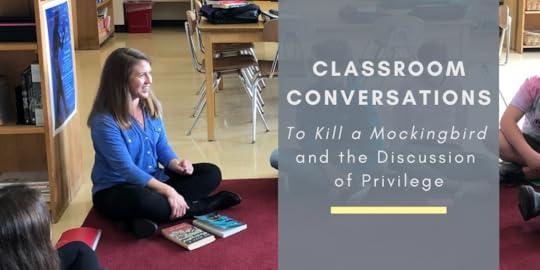
I first read To Kill a Mockingbird when I was in middle school. I had recently moved from a small town in North Carolina to a suburb of New York City, and this book that took me back into the South became beloved. At some point I noticed the injustice at the heart of this courtroom drama, and I wrestled with Harper Lee’s characterization of African Americans and the “white savior” portrayed through Atticus Finch. But at first I think I simply loved it because it reminded me of my childhood.
In the Classroom
So when I was asked to speak with a group of 8th grade students about To Kill a Mockingbird in conjunction with White Picket Fences, I said yes without hesitation. I was eager for the chance to read it again, and I was eager to hear what these young people had to say.
They read chapter five of White Picket Fences (and all of TKaM) in preparation for my visit. In that chapter, I move from North Carolina to Connecticut, and I recognize a few things about the distinctions between the culture of the North and the South, at least in my experience.
As I write in White Picket Fences:
“The northerners talking about southern racism were naming something true, but they were doing it from a distance. My classmates were right to insist that African American people deserved equal treatment under the law and desegregated schools and social systems. But my new friends also ran the risk of caricaturing the white people in the South, losing their complexity, their capacity for both good and evil. What’s more, in distancing themselves from the white people in the South, they failed to see their own legacy of complicity in a system of inequality.”
Questions
When I arrived in the classroom, I sat down on a large carpet square with two different classes of eighth graders to talk about racism and history and living up North. I told them a little bit of my story. They asked questions like, “How do you think your background from both the North and the South benefits you in understanding complicated racial problems?” and “In what way do you think banal evil still exists in modern day Connecticut?” and “When you said that you grew up ignorant during your childhood, do you ever think that you were just as bad as everyone else by being ignorant?”
I told them how when I moved north, it was easier for me to see the racism of my hometown. I could see that it was bad. I could see that I had participated in it. I could see the harm it did to everyone. And I could see how hard and complicated it would be to heal from that harm after so many generations of hurt. But I also saw the racism of my new town. It was very different–a racism of passivity rather than participation, a racism of distance rather than intimacy, but racism that nevertheless perpetuated exclusion and injustice too.
Connections
The conversation offered a chance to make connections–between the North and the South, between this present moment and this story from long ago and far away. It gave the students a chance to reflect on their own participation in systems that perpetuate racism even now. I hope it gave them a sense of compassion for people they might easily dismiss as bigots.
I thought I would reread To Kill a Mockingbird and conclude that it was outdated, but now that I have read it again and discussed it with these students, I’m not so sure. I certainly think it should be read with a critical eye–students need to understand the context in which this book was written, consider why it holds up a white man as a hero, and ask whether it would have sold so many millions of copies without that central white savior. And I would love for students to read it alongside Roll of Thunder Hear My Cry, so that another young girl from the South–and this time, an African American girl–could speak to the intricacies of life within an unjust system. But the book still sparked an important conversation about justice and power, racism and evil, and our common humanity, white and black, rich and poor, North and South.
A Gift
It was a gift to me to see how my story, which was itself shaped in some ways by To Kill a Mockingbird, could also help students understand that book and its implications for our present moment. I hope it gave these students a sense of the complexity of the harm of injustice as well as a sense of the possibilities set before them to engage in healing that harm.
If you haven’t already, please subscribe to receive regular updates and news. You can also follow me on Facebook , Instagram and Twitter .
The post Classroom Conversations: To Kill a Mockingbird and the Discussion of Privilege appeared first on Amy Julia Becker.
My New Website Launch!

I could not be more excited to tell you about the launch of my brand new website. I hope you will spend a minute (or ten, or far more) checking it out. It’s designed (masterfully designed, IMHO, by Brian McCabe of Freshly Roasted Web working in conjunction with my good friend and project manager extraordinaire Elizabeth Bloodworth) to be a place where you can explore the different facets of my writing, teaching, and speaking all under the banner of “embracing our common humanity.”
For those of you who enjoy peeking behind the scenes and seeing how things come into being, I wanted to give a picture of the process we went through to land here.
The History
I started keeping a blog back in 2006, in the months after our daughter Penny was born. A friend set that site up for me as a way for me to every-so-often update family and friends who wanted to check in and see how our new baby (our new baby who had been unexpectedly diagnosed with Down syndrome) was doing. I wrote there about once a month.
Eventually, once a month turned into once a week, twice a week, and soon enough I was writing thoughts about faith, family, and disability on a regular basis. That blog, Thin Places, moved to Beliefnet, and then to Patheos, and then to Christianity Today. Meanwhile, I published my book Penelope Ayers, wrote A Good and Perfect Gift, gave birth to two more children, finished seminary, wrote Small Talk and White Picket Fences (and a number of ebooks and articles) and moved multiple times.
(They say we all overestimate what we can accomplish in one year and underestimate what we can accomplish in ten. This portrait of the past ten years of my life demonstrates the truth of this saying because each one of those years felt like I poked my way forward through diapers and snow days and my own distractions and how on earth did that all happen!?!)
Along the way, the blogging got overwhelming. I said goodbye to CT and went back to my own website, my own small social media presence, and my own thoughts. I dreamed about all sorts of things–a podcast, a video curriculum, a documentary film, all the posts and articles and books I still want to write. And then I hired my friend Elizabeth to help me evaluate it all. She said something along the lines of, “Before we do anything new, we need to figure out how to let people know what is already here.”
Storage Trailer
At that point, my website was like a storage trailer that was holding everything worth keeping while a house undergoes renovation. Instead of inviting you to visit with me in the living room, we were peering into a dark box and saying, “Hmm. That sofa looks comfortable and that table is really cool, but since they are piled on top of each other and wedged in between the armchairs, I guess we aren’t going to get any time together right now.” My website wasn’t a box in the attic that might never get opened again. It was all the good stuff, but disorganized and mashed together, just waiting for the moment when it got to come out and be useful again.
Evaluation
So we began with a process of discerning who I am as an author and who you are as an audience. I still have an 8-page document of different words we used to describe the topics I do and don’t cover, the words that capture my writing and speaking, the themes I return to again and again. We listed things like disability, brokenness, limitations, privilege, Down syndrome, parenting, family, faith. Words like thoughtful, honest, spiritual. And after hours and hours (over months and months), we landed on the phrase “embracing our common humanity.” I’m going to write more in a blog post (soon) to explain what I mean by that phrase, but in short it is what I hope my writing equips us all to do–to discover the points of connection among us as human beings so that we can live in love and celebrate our diverse backgrounds, needs, and gifts.
Website Creation
We also worked on fonts and colors. We hired two photographers to take pictures (shout out to Chris Cappoziello and Phil Dutton for fun and beautiful work). We wrote a new About page, new book descriptions, new descriptions of how and why I speak and teach. We uncovered old interviews, reviews, podcasts, and articles.
Along the way, I remembered that I had written a cover story for Christianity Today once, and that our family had been in TIME magazine a long time ago. I mentioned ebooks I had created with some of my favorite writings gathered together. I talked about how “love is stronger than fear” has become my motto. The process taught me a lot about who I am and what I hope to be able to do through these years and years of writing and speaking and teaching.
Once we had all the pieces and parts, we hired Brian McCabe to pull it all together into this site, which I love for both its simplicity and its intricacy. Hopefully you will find it really easy to navigate and also surprising in what you discover as you explore.
Thank you for coming over. I hope you’ll enjoy the conversation, and I hope you’ll stay a while.
If you haven’t already, please subscribe to receive regular updates and news. You can also follow me on Facebook , Instagram, and Twitter .
The post My New Website Launch! appeared first on Amy Julia Becker.
November 10, 2019
Essential Church Podcast and Privilege

I had a great time talking with Andrew Arndt on the Essential Church podcast about White Picket Fences. He asked great questions that gave me the chance to tell the story about how I backed my way into writing this book. I didn’t ever intend to write a book about privilege. As plenty of people have noted, there are potential problems when a privileged white person writes about being a privileged white person. It can easily be an opportunity for naval gazing or self-aggrandizement. And it also opens me up to criticism from both conservative and liberal perspectives, and I did experience a lot of fear in wading into the waters of privilege.
But, as we talk about on this episode, taking the time to look at my life through the lens of privilege changed me. It made the world more complex. More difficult. More honest. And, ultimately, it humbled me and invited me into a life more deeply rooted in the love of God. I hope you’ll take the time to listen to this conversation.
The post Essential Church Podcast and Privilege appeared first on Amy Julia Becker.
November 7, 2019
Gratitude Podcast with Family Life Radio

Martha Manikas-Foster of Family Life radio approached me a few weeks ago about an old blog post of mine about Thanksgiving. Back in 2014, I wrote about how Thanksgiving is oddly apolitical (in contrast to, say, Columbus/indigenous people’s day) and oddly areligious (though it claims Protestant roots, Thanksgiving is celebrated outside of the Christian tradition just as easily as it is within it). But I also wrote about the relationship between giving thanks and understanding ourselves as dependent creatures.
So Martha and I had a chance to talk about gratitude—what it is, why we need a sense of dependence in order to give thanks, how gratitude can distort our understanding of the world, and how we can actually practice giving thanks regularly and not just once a year. Our conversation can be found here. It runs for about 15 minutes, and I hope you’ll start this season of Thanksgiving by listening in.
That short dialogue got me thinking about gratitude as both a simple practice and a complex idea, so in this month of Thanksgiving I’m also going to offer a series of posts about gratitude: gratitude and grumpiness, gratitude and grief, gratitude and grace, gratitude and growth.
If you haven’t already, please subscribe to receive regular updates and news. You can also follow me on Facebook , Instagram and Twitter .
The post Gratitude Podcast with Family Life Radio appeared first on Amy Julia Becker.
November 6, 2019
Real Privilege and Love: Quote from White Picket Fences
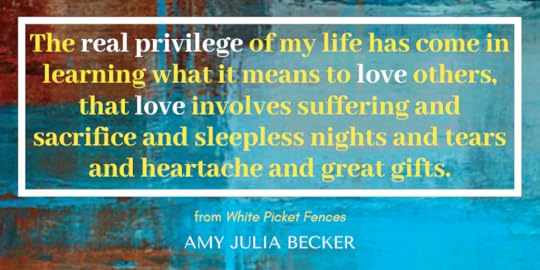
The real privilege of my life has come in learning what it means to love others, that love involves suffering and sacrifice and sleepless nights and tears and heartache and great gifts. — Amy Julia Becker in White Picket Fences
This month I am celebrating the one year anniversary of the release of my book White Picket Fences: Turning Towards Love in a World Divided by Privilege.
I’ve had the chance this year to speak about privilege at the Q conference and write about what privilege is and is not, and speak on several podcasts about the topic. But it isn’t just privilege that I want to start a conversation about. I also want to talk about love. Our family motto has become “Love is Stronger Than Fear,” and we seek to live that out. Typically privilege and love are mutually exclusive. But as this quote suggests we need to recognize what real privilege is about is actually sacrificial love.
If you want to know more why I chose to write a book about privilege and love, check out this post. And if you’ve read White Picket Fences and are interested in sharing the book with others via a book club or discussion group, check out my discussion guides which are formatted for one, three or 7 session discussions.
If you haven’t already, please subscribe to my newsletter to receive regular updates and news. You can also follow me on Facebook , Instagram and Twitter .
The post Real Privilege and Love: Quote from White Picket Fences appeared first on Amy Julia Becker.
November 4, 2019
Rev. Dan Heischman Reflects on Privilege in Episcopal Schools
 A friend mentioned years ago that memoirs go through three stages. First, we live them. Then we write them. And then, once they are out in the world, we receive them again from the people who read them.
One of the most rewarding and wonderful aspects of writing White Picket Fences has been seeing what different people have found within its pages and how the words and stories contained there have been able to spark conversation, prayer, and action within local communities. Over the next couple of months, I’m going to share some of the ways WPF has served as a tool to spark thinking, connecting, and taking action within local communities.
Today’s post comes from Reverend Daniel Heischman, Executive Director of The National Association of Episcopal Schools. Reverend Heischman reflected on the privilege and White Picket Fences in the context of Episcopal Schools.
Two Types of Privilege
Recently, a board member at an Episcopal school made the following observation: “If you want to escape the dark side of privilege, go to an Episcopal school.”
By the “dark side of privilege” I assume this board member was referring to the attitudes, practices, and assumptions that people of privilege can exhibit that tend to exclude rather than include, favoring one group of people over the other. It may be the subtle or not so subtle presumptions of entitlement that leave us feeling as if we occupy a highly deserving position. Privilege also surfaces in the conscious or unconscious comments and insinuations people can make, which reflect their seemingly “elevated” status and leave other people out of the circle.
Some say that Episcopal schools exhibit more than their share of these dark sides of privilege. Certainly, many in The Episcopal Church are ambivalent about our schools because of their belief that they are bastions of elitism and exclusion, thus running contrary to our convictions and practices as Christians. We may not experience our schools as such places, but the external perception may very well be there.
How then, we might ask, do we as Episcopal schools escape the perils of privilege?
In her recent book, White Picket Fences, Amy Julia Becker recounts how she, as a person of privilege, has struggled with the ways privilege has blinded her, but also blessed her. Her book is an exploration of what she refers to as “the benefits and wounds that come with privilege.” While it has afforded her access to an excellent education and rare opportunities, it has also, in her view, served as a fence, cutting her off from others, keeping others out, and eclipsing human bonds.
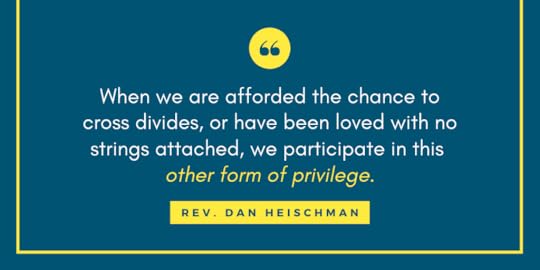
She goes on to describe two types of privilege. First, the privilege of being given a special status by virtue of race, education, or wealth. The second is entirely different: the grace-filled opportunities of being singled out for something purposeful, of “being the undeserving recipient of the gift of human connection.” For Becker—a Christian—it is a spiritual blessing, having nothing to do with wealth, education, or ethnicity. When we are afforded the chance to cross divides, or have been loved with no strings attached, we participate in this other form of privilege.
This type of privilege, she writes, “connects instead of divides, shimmers through the air like a line of light, available only if we stop counting the coins and look up.” It issues in gratitude, not presumption.
In ways very few other schools can do, Episcopal schools celebrate this second type of privilege. We can point to the blessings of human connection, of giving and receiving love, of being the recipients of God’s grace.
How do we escape the dark side of privilege? By holding up the second, enduring kind of privilege.
I’m thankful for what Rev. Heischman had to say and for the opportunities I’ve had to speak in several Episcopal Schools and churches this past year including National Cathedral School, Good Sam in Paoli, PA and several others. I hope White Picket Fences continues to spark thought, spiritual and personal connections, and loving action in the world.
If you haven’t already, please subscribe to my newsletter to receive regular updates and news. You can also follow me on Facebook , Instagram and Twitter .
The post Rev. Dan Heischman Reflects on Privilege in Episcopal Schools appeared first on Amy Julia Becker.
November 3, 2019
Geraldine Brooks’ Endorsement of White Picket Fences
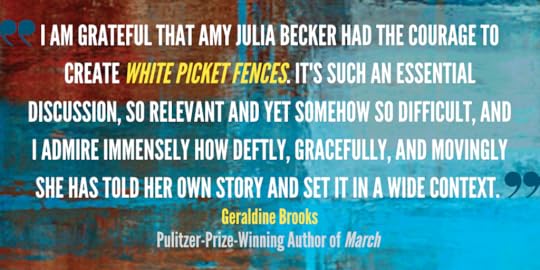
“I am grateful that Amy Julia Becker had the courage to create White Picket Fences. It’s such an essential discussion, so relevant and yet somehow so difficult, and I admire immensely how deftly, gracefully, and movingly she has told her own story and set it in a wide context.” — Geraldine Brooks
I have loved Geraldine Brooks’ writing for years. I remember reading her Pulitzer Prize winning novel, March, in the wee hours of the morning while trying to rock William back to sleep. I’m amazed that even in my sleep-deprived state, I can still, eleven years later, recall some of the details of her characterization of Rev. March, the father from Little Women. I went on to read all her other books, both the historical fiction and the riveting People of the Book.
So you can only imagine how fangirly I felt (yes, I’m a nerdy fangirl but a fangirl of authors nonetheless) when I had a chance to meet Geraldine Brooks a few years ago. She’s a lovely person, and I cannot be more grateful for the words she wrote after reading my most recent book. As a part of this month’s focus on the one-year anniversary of launching White Picket Fences into the world, I want to share her kind words of support here.
If you haven’t already, please subscribe to my newsletter to receive regular updates and news. You can also follow me on Facebook , Instagram and Twitter .
The post Geraldine Brooks’ Endorsement of White Picket Fences appeared first on Amy Julia Becker.
November 1, 2019
Celebrating 1 Year Anniversary of White Picket Fences!
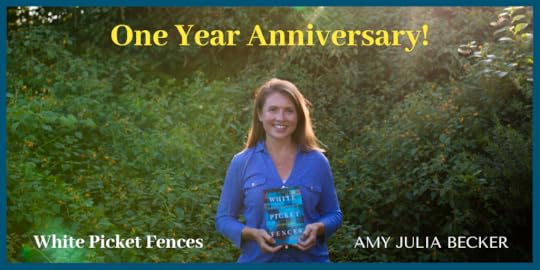 Today I am celebrating the one year anniversary of the publication of White Picket Fences. It’s hard to believe it only came out a year ago because I have learned and grown so much since it first rolled off the presses. (Truth be told, it was a little more than a year ago that it came out, but I wanted to focus on Down syndrome awareness in October!)
Over the course of the past year, I traveled to states throughout the country, including the South, the North, the Midwest, and as far as Colorado. In all those places, I’ve learned that lots of people want to talk about privilege but are scared to do so. I’ve learned that honesty and vulnerability leads to human connection. I’ve learned that action is possible in response to the harm of privilege. And I’ve learned about so many beautiful people taking healing action in their local communities.
I have a lot in store this month as a part of celebrating this anniversary. I’ll be sharing a brand new website (more on that very soon). I’ll be offering a new free ebook that is an action guide for people who want to respond meaningfully to the harm of privilege. I’ll be writing blog posts that connect gratitude to themes related to privilege. I’ll be doing a giveaway of White Picket Fences. And I will be sharing other people’s stories about how White Picket Fences has allowed connection and change within their local communities.
For now, take a moment and celebrate with me in one (or more) of three ways:
If you haven’t read or listened to it already, buy White Picket Fences (or ask your local library to buy it for you!)
Review White Picket Fences on Amazon or Goodreads
And/or tell a friend about White Picket Fences on social media.
White Picket Fences covers hard topics, with the purpose of moving towards healing. What a gift is has been to participate in that healing process with so many of you. Thank you.
If you haven’t already, please subscribe to my newsletter to receive regular updates and news. You can also follow me on Facebook , Instagram and Twitter .
The post Celebrating 1 Year Anniversary of White Picket Fences! appeared first on Amy Julia Becker.