Amy Julia Becker's Blog, page 128
December 16, 2019
#17: Ordinary Hard Stuff

Episode #17 — Ordinary Hard Stuff: Today’s reflection comes from a time when our kids were little, our cat was alive, and I was in a hard spot personally. A time when I needed to learn about expecting God to show up not only when our life is in crisis but also in the every day.
Ordinary Hard Stuff – Please Listen!
I’d love for you to listen to this podcast episode about ordinary hard stuff. You can listen via the player above or on your favorite podcast platform. Visit my podcast page for all of this season’s episodes. And you can read along with the entire Prepare Him Room podcast season by downloading my FREE ebook!
If you haven’t already, please subscribe to receive regular updates and news. You can also follow me on Facebook , Instagram , and Twitter, and you can subscribe to my podcast on Apple Podcasts , Google Podcasts , and Spotify , as well as other platforms.
The post #17: Ordinary Hard Stuff appeared first on Amy Julia Becker.


Teaching Students About Inclusion and Belonging

Teaching students about inclusion and belonging gives them a more expansive view of humanity. Because of advances in special education, many kids today are growing up with more openness to disability than in the past.
When I was a kid, I didn’t know anyone with Down syndrome. If I thought about people with disabilities at all, it was mostly from a position of polite superiority.
Penny, on the other hand, has been in classrooms with typical peers from the time she was 18 months old and first started going to a daycare center two mornings a week. I get questions from adults all the time about whether she’s in “regular” school. Those questions, I’ve come to realize, aren’t comments on Penny’s capabilities.
They are questions about inclusion and belonging, about whether the public schools welcome students with intellectual disabilities. A few decades ago, kids with intellectual disabilities were sequestered. That’s not always the case now.
Inclusion and Belonging
When Penny was in fourth grade, she decided to learn about Down syndrome for a school project. Her teacher told me later that after Penny presented what she had learned, some kids in the classroom wondered out loud why Penny would be interested in the topic. They had no idea that she had Down syndrome. They didn’t see her as different.
Growing Up Side by Side
There are plenty of ways this generation of kids is perpetuating the social divisions and distrust of their parents, and social media doesn’t help us to move beneath the surface to the depths of our common humanity. And yet, growing up in school side by side with individuals of all abilities provides a different foundation for a future in which typical kids can expect to work and live alongside people with disabilities.
Growing up side by side helps us all imagine a world in which people with disabilities aren’t simply tolerated or included, but where people with disabilities belong as vibrant and crucial members of our communities.
Students and the Spectrum of Welcome
Last month, I had a chance to speak to a group of 8th graders in Charlottesville before they worked alongside people with disabilities in their community. I told them about having Penny and learning about Down syndrome for the first time after she was born. I told them about learning to value different gifts. And I talked with them about what I’ve called the spectrum of welcome, moving from exclusion to tolerance to inclusion to belonging.
At the end of my time with them, one girl (pictured above) introduced herself and held out an origami bird. “It’s for Penny,” she said. She embodied what we had been talking about with that simple gesture of welcome.
Hope for the Future
Kids like her are growing up with a more expansive view of humanity. They give me hope for a future where more and more people experience belonging, where people with and without disabilities lean on each other, celebrate each other, and build a more just and caring society together.
If you haven’t already, please subscribe to receive regular updates and news. You can also follow me on Facebook, Instagram, and Twitter, and you can subscribe to my podcast on Apple Podcasts, Google Podcasts, and Spotify, as well as other platforms.
The post Teaching Students About Inclusion and Belonging appeared first on Amy Julia Becker.
December 15, 2019
#16: George Bailey and the Secret to Being Content {Part Two}

Episode #16 — George Bailey and the Secret to Being Content {Part Two}: Today’s episode is for all of us who think we need impressive resumes and accomplishments in order to prove our worth to the world.
I’d love for you to listen to this podcast episode on what I learned from George Bailey about being content. You can listen via the player above or on your favorite podcast platform. Visit my podcast page for all of this season’s episodes. And you can read along with the entire Prepare Him Room podcast season by downloading my FREE ebook!
If you haven’t already, please subscribe to receive regular updates and news. You can also follow me on Facebook , Instagram , and Twitter, and you can subscribe to my podcast on Apple Podcasts , Google Podcasts , and Spotify , as well as other platforms.
The post #16: George Bailey and the Secret to Being Content {Part Two} appeared first on Amy Julia Becker.
December 14, 2019
#15: George Bailey and the Secret to Being Content {Part One}

Episode #15 — George Bailey and the Secret to Being Content {Part One}: In today’s episode I give you a glimpse of when I was grumpy for a few years. Maybe not every day. But most days. And at the core of my being, deep inside my heart, lay a stone, a slowly growing bitter stone of resentment and self-pity.
I’d love for you to listen to this podcast episode on what I learned from George Bailey about being content. You can listen via the player above or on your favorite podcast platform. Visit my podcast page for all of this season’s episodes. And you can read along with the entire Prepare Him Room podcast season by downloading my FREE ebook!
If you haven’t already, please subscribe to receive regular updates and news. You can also follow me on Facebook , Instagram , and Twitter, and you can subscribe to my podcast on Apple Podcasts , Google Podcasts , and Spotify , as well as other platforms.
The post #15: George Bailey and the Secret to Being Content {Part One} appeared first on Amy Julia Becker.
December 13, 2019
#14: Love Hates

Episode #14 — Love Hates: In today’s episode, I look at Mary’s song and an uncomfortable truth about who God is. Yes, God is love. But what God’s love looks like as it enters a world filled with injustice and abuse and oppression isn’t always what we expect. Love hates.
Mary bursts into song after Elizabeth affirms her pregnancy, but the song isn’t what I would expect. It isn’t about Jesus as a wise prophet or as a sacrificial love offering or a peaceful and humble servant. It’s about God’s justice, which involves overthrowing rulers and punishing the rich and scattering the proud. It seems violent and lopsided and out of keeping with the Jesus I know.
Some of Mary’s song (also known as the Magnificat) emerges out of her particular historical situation. She’s a Jewish peasant girl living under the rule of an oppressive regime. But Mary’s song taps into an uncomfortable truth about who God is, about who Jesus is. Yes, God is love. But what God’s love looks like as it enters a world filled with injustice and abuse and oppression isn’t always what we expect. Some of the many things Mary’s song shows us are that love waits, love hates, and love costs.
Love Waits
Love waits. Love is patient, writes the Apostle Paul in 1 Corinthians 13. God doesn’t rush in to change our circumstances when He is inviting a change of heart. Similarly, God doesn’t rush in to save the world or change our communities. Here we see that God’s salvation depends upon one girl saying yes.
God will wait and wait and wait for us to recognize ourselves as His beloved ones. God will wait and wait and wait for us to turn to Him, to turn away from the things in our lives that keep us from Him.
This doesn’t mean God’s love isn’t active. Rather, God’s love is patient in that He will offer it to us again and again, no matter how much we refuse it. In Advent, we are invited to join in God’s patient love by reaching out to those who have wounded us in the past, by giving ourselves to those who do not reciprocate, and by caring for those who have not cared for us. In Advent, we are called to remember that this is how God has loved us.
Love Hates
Love hates. I know it sounds contradictory, but God hates injustice. God hates the suffering experienced as a result of corruption and self-centeredness. God hates the deceptions that keep us from understanding His love for us. Here’s where the overthrow of oppressive regimes and honoring the poor and humble comes in.
In Advent, we are invited to cry out against injustice, to use whatever power we have—time, money, words, relationships—to protest the oppression of the most vulnerable among us.
In Advent, we are called to remember that this is how God has loved us.
Love Costs
Love costs. Every act of love is an act of self-sacrifice. I sacrifice my sleep for my kids when I get up in the night to soothe them after a bad dream. My husband sacrifices personal ambition when he comes home from work to eat dinner with the family instead of crossing off a few more items on the to do list. Women and men in the armed services sacrifice their bodies to defend our nation. An employer who loves his employees sacrifices a bigger paycheck in order to share the profits. Mary sacrifices her body, her reputation, in order to welcome Jesus.
In Advent, we are invited to recognize God’s sacrificial love for us even as we are called to love others with that same kind of sacrifice.
The holiday season offers plenty of opportunities to ignore pain through parties and money and happy photos on Facebook. But the promise of Christmas is that when we take the time to recognize the ugly parts of our souls and the ugly parts of the world around us, when we take the time to engage in the pain and respond to it, when we pay attention to the depth and width and breadth of God’s loving response to that ugliness and pain, it will transform us.
Love Transforms
Love will make us into people who don’t need to ignore pain and suffering but instead can respond to it with healing and grace. Like the baby who came into the world over 2,000 years ago.
Visit my podcast page for all of this season’s episodes. And you can read along with the entire Prepare Him Room podcast season by downloading my FREE ebook! If you haven’t already, please subscribe to receive regular updates and news. You can also follow me on Facebook , Instagram , and Twitter, and you can subscribe to my podcast on Apple Podcasts , Google Podcasts , and Spotify , as well as other platforms.
The post #14: Love Hates appeared first on Amy Julia Becker.
December 12, 2019
#13: Being Elizabeth

Episode #13 — Being Elizabeth: What does it take for Mary to have hope? It takes God’s word, sure. But it also takes Elizabeth. It takes another person to affirm God’s work in Mary’s life. Today I look at how we access hope as we speak the truth of God’s promises into one another’s lives.
At that time Mary got ready and hurried to a town in the hill country of Judea, where she entered Zechariah’s home and greeted Elizabeth. When Elizabeth heard Mary’s greeting, the baby leaped in her womb, and Elizabeth was filled with the Holy Spirit. In a loud voice she exclaimed: “Blessed are you among women, and blessed is the child you will bear! But why am I so favored, that the mother of my Lord should come to me? As soon as the sound of your greeting reached my ears, the baby in my womb leaped for joy. Blessed is she who has believed that the Lord would fulfill his promises to her!”
As soon as the angel leaves her, Mary goes to visit her cousin Elizabeth. Just imagine. You’re going to see your older relative, and you’re filled with this news that might be from God and also might have been a dream and might mean the end of your marriage that hasn’t even begun, and might mean your death (you could be stoned for having sex outside of marriage in those days). So Mary has no idea how to tell Elizabeth or what she will say. Maybe Elizabeth will think she’s losing her mind. Maybe Elizabeth will shun Mary like their religion says she should. Maybe however Elizabeth responds will be a signal of how the rest of the world will respond.
Elizabeth’s Affirmation
So Mary gets there, and she doesn’t say anything to Elizabeth about being pregnant. She simply says hello. As soon as she says hello, Elizabeth says, “Blessed are you and blessed is the fruit of your womb!” Elizabeth, without knowing that an angel has visited, without knowing any of the details, echoes the words the angel has spoken.
Only now, only after Elizabeth has given affirmation to the angel’s words, does Mary rejoice. She proclaims what she has only dared hope up to this point: that God is actually going to do something beautiful and merciful and just and right and true in and through her, through the birth of this unexpected baby.
Hope
So what does it take for Mary to have hope? It takes God’s word, sure. But it also takes Elizabeth. It takes another person to affirm God’s work in Mary’s life. Hope depends upon God’s promises, but the way we have access to hope is as we speak the truth of those promises into one another’s lives.
Being Elizabeth
This Christmas season, let us be Elizabeth to one another. Let us see what God has promised through Jesus and name that. Let’s call it forth. Let’s remind each other of what is true.
That the God who is just and right and good hates injustice.
That the God who is grace and mercy and light loves all people.
That the God who spoke creation into being can handle our sins and sorrows.
That the God who came to us as a baby helpless in a manger can handle our helplessness.
Once Elizabeth speaks that affirmation, Mary rejoices. And then she goes on to fulfill the purpose for which she has been chosen. She gives birth to a little boy, the light who shines hope for all the world to see.
Visit my podcast page for all of this season’s episodes. And you can read along with the entire Prepare Him Room podcast season by downloading my FREE ebook! If you haven’t already, please subscribe to receive regular updates and news. You can also follow me on Facebook, Instagram, and Twitter, and you can subscribe to my podcast on Apple Podcasts, Google Podcasts, and Spotify, as well as other platforms.
The post #13: Being Elizabeth appeared first on Amy Julia Becker.
December 11, 2019
#12: When Mary Says “Oh Crap” to God

Episode 12 — When Mary Says “Oh Crap” to God: In today’s episode I focus on Mary’s humanness. We know Mary was frightened. We know Mary was confused. If Mary could come to God with fear, with confusion, with her real self, well, so can we.
The New International Bible translation says that when the angel appears Mary feels “greatly troubled.” Translating that into what I might say inside my head if I were her is something along the lines of, “Oh, crap.”
Then the angel tells Mary she’s going to have a baby, and Mary says, “Who, me? Are you sure you have the right person? I, um, I haven’t had sex yet and even though we don’t have sex-ed here in Nazareth, I’m pretty sure I can’t have a baby unless I, um, you know… with someone?” And then the angel says, “Yep. That is correct. But in this case, God’s going to make it happen. That’s what you get to do when you’re God. Congratulations!” And Mary says, “Um, okay. I’m not going to disagree with God.”
Mary’s Humanness
I read that story one morning last week, and then we watched The Best Christmas Pageant Ever as a family. In this movie, a group of delinquent kids, the Herdmans, take over the Christmas pageant from the typical cast of characters. So instead of Mary being an angelic, blonde-haired, blue-eyed and rather self-righteous doll of a girl (Alice Wilkerson), she becomes a scared and confused girl who yells and cries and has dirt on her cheeks and under her fingernails (Imogene Herdman). All of a sudden Mary is a kid who is desperately…
There’s More!
I’d love for you to listen to this podcast episode via the player above or on your favorite podcast platform. Visit my podcast page for all of this season’s episodes. And you can read along with the entire Prepare Him Room podcast season by downloading my FREE ebook!
If you haven’t already, please subscribe to receive regular updates and news. You can also follow me on Facebook , Instagram , and Twitter, and you can subscribe to my podcast on Apple Podcasts , Google Podcasts , and Spotify , as well as other platforms.
The post #12: When Mary Says “Oh Crap” to God appeared first on Amy Julia Becker.
December 10, 2019
#11: Shame and Glory

Episode #11: Shame and Glory — In the moment, which we now call “the Annunciation,” Mary said “yes” to both shame and glory, writes poet Luci Shaw. I don’t think Mary is alone in being invited into God’s glory at the cost of her own shame.
“How will this be,” Mary asked the angel, “since I am a virgin?”
The angel answered, “The Holy Spirit will come on you, and the power of the Most High will overshadow you. So the holy one to be born will be called the Son of God. Even Elizabeth your relative is going to have a child in her old age, and she who was said to be unable to conceive is in her sixth month. For no word from God will ever fail.”
“I am the Lord’s servant,” Mary answered. “May your word to me be fulfilled.” Then the angel left her.
Luke 1:34-38 (NIV)
In this moment, which we now call “the Annunciation,” Mary said “yes” to both shame and glory, writes poet Luci Shaw.
Shame and Glory
I imagine that Mary did not feel any shame in saying “yes” to the Spirit. There was no shame before God in bearing Jesus, no shame within her soul as she responded to God. And yet she risked public shame as an unwed mother. She risked the shame of Joseph’s rejection of her. And even once Joseph stayed with her, she risked the shame that she would be cast out of her family, out of her religious community, out of her town.
I don’t think Mary is alone in being invited into God’s glory at the cost of her own shame. She gets to bear witness to the love of the universe. She also suffers for it. There are a host of other Biblical figures who endured public shame for the sake of knowing God. Even now, when we say yes to God, when we receive the work that God is doing in our lives, we often face public shame.
Sometimes that shame comes in the explicit forms of judgment, criticism, and rejection. Often it is more polite. But when we say yes to God’s invitation to bear love in this world, we are a little bit like Mary, willing to endure misunderstanding at best and abuse at worst. We are a little bit like Mary, invited to participate in God’s love for the whole world.
A Small Taste
Because of having a child with Down syndrome, we’ve tasted this shame and glory a little bit. We feel no shame in having Penny as our daughter. And yet there is a public perception and experience of shame associated with having a child with a disability. On a personal level, when Marilee and William were little, I got comments about how “brave” we were to have more children, as if we would have tried to avoid having Penny in our lives if we could. Most media outlets use words like “suffer” and “burden” to describe life with Down syndrome, even when they are describing people with Down syndrome as they thrive in the world.
And one of the few slurs still tolerated (even among people who care about political correctness) is the word “retarded.” There is a public assumption that as parents we should be ashamed of our daughter, when in fact we could not feel more proud.
Saying Yes
I could list her accomplishments and explain why I feel proud of her. But pride is not the point. Receiving Penny into our lives didn’t just bring pride. Saying yes to this child God gave us brought blessing. In opening our hearts to the unexpected work God was doing in our daughter, we began to enter into a broader understanding of God’s love for us and for those around us.
Mary endured shame when she said yes to God. But God’s blessing fell upon Mary too, as the God-bearer, the Mother of God. And as we look ahead to the celebration of his birth, once again I am grateful that she bore the public shame for the blessing that went forth to us all.
If you haven’t already, please subscribe to receive regular updates and news. You can also follow me on Facebook , Instagram , and Twitter, and you can subscribe to my podcast on Apple Podcasts , Google Podcasts , and Spotify , as well as other platforms.
The post #11: Shame and Glory appeared first on Amy Julia Becker.
December 9, 2019
#10: Anxiety and the Prince of Peace

EPISODE #10: Anxiety and the Prince of Peace —Mary had good reasons to be anxious. Anxiety comes up throughout the Bible, and over and over again God offers peace.
Mary had good reasons to be “greatly troubled.” She was young, unwed, and about to learn that she would be a teenage mother. I have never had nearly such reason to worry, but worry has plagued me still. It’s only been in recent years that I’ve been able to see that I have medicated my worry with wine.
Anxiety and Wine
On a Monday night, when Marilee was ready for dinner and Penny needed help with homework and William wanted me to listen to him practice piano, a glass of wine inserted a little tranquility into the chaos of the situation. Or when Peter and I headed out to a party with a group of people I didn’t know, or a group of people who I thought wouldn’t be interested in the same topics I like to talk about, a glass of wine (or two) softened my sharp edges. I could float through the conversations without feeling bored or insecure.
It was these nights when I was tempted (and often succumbed to the temptation) to drink too much, when I woke up at 1 a.m. in sweaty sheets, with a dry mouth and a slightly queasy feeling in my gut. It was these nights when wine did not deliver, when the peace it promised turned to guilt and grumbling.
Anxiety and Peace
Not all of us respond to anxiety with wine, but all of us face anxiety and look for peace. Becoming anxious is easy. Name a topic, and we will be able to come up with reasons to worry about it: cars, houses, jobs, national security, global conflicts, kids, health, fitness, the weather. I could go on. Even though by many measures we live in a world with greater stability and longevity than ever before, the number of people who report feeling anxious has doubled in the past few decades. Unless we do something to interrupt it, we will naturally live in a place of anxiety most of the time. And when we do, we live in fear, we live in anger, and we live for ourselves.
Although statisticians tell us that levels of anxiety are on the rise, it’s not a new problem. Anxiety comes up throughout the Bible, and over and over again God offers peace…
There’s More!
I’d love for you to listen to the rest of this podcast episode via the player above or on your favorite podcast platform. Visit my podcast page for all of this season’s episodes. And you can read along with the entire Prepare Him Room podcast season by downloading my FREE ebook!
If you haven’t already, please subscribe to receive regular updates and news. You can also follow me on Facebook , Instagram , and Twitter, and you can subscribe to my podcast on Apple Podcasts , Google Podcasts , and Spotify , as well as other platforms.
The post #10: Anxiety and the Prince of Peace appeared first on Amy Julia Becker.
Why We Need Both the Pastoral and the Prophetic
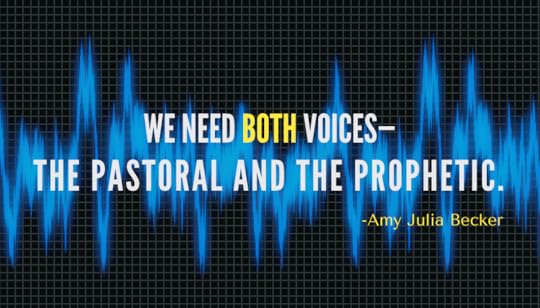
What’s the difference between pastors and prophets?
For me, prophets conjure up images of bearded men of old, pronouncing doom upon society if we don’t pay attention and change our ways. Pastors conjure up something more contemporary and more gentle. A pastor waits and listens and accepts people where they are. A prophet insists on change and speaks and challenges people to move where they need to be.
Pastoral and Prophetic Voices
We’ve still got both pastors and prophets, though I hadn’t thought much about the two types of voices or their distinctions until my friend David Bailey pointed it out to me. David is an African American Christian man who works to equip churches to become reconciling communities. After he read White Picket Fences, we had a number of long conversations. At one point he said, “Many books out there about race and justice right now use a prophetic voice, and that’s important. But you use a pastoral voice, and we need that too.”
I hope David is right that White Picket Fences is pastoral in tone, and I hope my work supports the more prophetic voices out there also advocating for love as the way to combat injustice and distorted humanity in our society. Because we need both of these things.
A Story of Change
I think back to the story of Derek Black. Black was a teenager who hosted a prominent radio show sharing his white nationalist views. He decided to hide this part of himself when he attended a liberal arts college in Florida. Eventually, he was exposed and many people on campus rejected him for his views. But Matthew Stevenson, an orthodox Jewish student on campus, decided to continue to invite Derek to his weekly Shabbat dinner. Derek had been attending these dinners before people knew of his white nationalism, and Matthew decided to welcome him back to the table. And Derek came back. Over time, Derek changed his views, rejected white nationalism (which meant a major break with his family–his godfather is literally David Duke), and became an advocate for a very different way of seeing the world.
Pastoral and Prophetic Presence
When I first heard his story through an article in the Washington Post, it seemed like a simple story of the importance of a pastoral presence. Matthew, alongside other students at this dinner, loved Derek despite his views. They never condoned his views. But they listened. They broke bread together. They persevered in love.
But then I heard an interview between Derek, Matthew, and Krista Tippett for On Being and the story got a little more complicated, and a little more interesting. At one point, Tippett sums up the story as a story of friendship, as if friendship was what changed Derek’s mind.
He interjects and says it wasn’t just the friendships. It was also the people who were protesting his presence on campus, holding placards and shouting about the injustice of his point of view. In other words, it wasn’t just the pastoral voice that changed him. It was also the prophetic. What changed him was the combination of both people who would break bread with him and people who called out the injustice of his position.
Pastors and Prophets
Which leads me back to White Picket Fences and David Bailey’s observation. I’m hopeful that White Picket Fences can and does serve a pastoral role, especially for white people who are taking some hesitant first steps towards examining the role unearned social advantages have played in their lives. I hope it gives people time and space to learn and listen and love. But I’m also grateful for the prophetic voices out there—Kathy Khang, Christena Cleveland, Ekemini Uwan, Austin Channing Brown—who call us to make change now, who name injustice in stark terms, who make some of us feel uncomfortable. I hope and pray that this combination of pastoral and prophetic voices will bring lasting change and healing.
If you haven’t already, please subscribe to receive regular updates and news. You can also follow me on Facebook , Instagram , and Twitter .
The post Why We Need Both the Pastoral and the Prophetic appeared first on Amy Julia Becker.