Amy Julia Becker's Blog, page 124
March 12, 2020
How Can We Love Our Neighbors in a Time of Coronavirus?
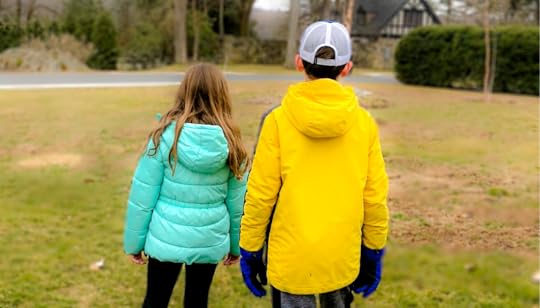
What does it mean to love our neighbors in a time of coronavirus? Like many Americans, I’ve paid increasing attention these past few days to reports about the spread of the coronavirus. Our son William, who is 11 years old and home on spring break, has been tracking reports with me. We’ve puzzled over a series of infographics that convinced me of the efficacy of social distancing when it comes to slowing the spread of the virus. We listened together to two episodes of The Daily, where we learned about why the United States’ efforts have not yet been particularly effective.
Love, Not Fear
But we’ve also wondered about how this pandemic should affect our own decisions. We want our lives to be marked by love, not fear. So we don’t want to take self-protective measures motivated by fear. We aren’t at high risk for serious suffering as a result of the virus. And even if we were, living in fear only breeds self-centeredness, anxiety, and a blindness to the needs of others.
But we do want to live out of love. We have plans for the days ahead, including, in William’s case, a service trip through church to a community in Mexico. Penny, Marilee, and I have tickets to see Wicked on Broadway next week. We took a walk this morning, and William puzzled through his options. He said something like, “On the one hand, if I go to Mexico, I love God, myself and my far-away neighbors. I want to go, and if I go I get to help other people. On the other hand, it’s possible I would bring the virus with me to those people and hurt them, or that I would bring it back with me and hurt elderly people in our church. So the most loving thing might also be to stay here and not get to go.”
Loving our Neighbors and the Coronavirus
What does it mean to love our neighbors? How do we not just serve ourselves and our own desires but participate in the flourishing of our local communities? Vulnerable people will suffer as a result of social distancing. Vulnerable people will also suffer without it.
Under some circumstances, love could mean buying tickets to performances and traveling to distant lands and building houses and sharing meals. Taking measures like closing schools can help to stem the spread of germs. It also can mean that whole groups of kids go without lunch for weeks on end. It also can mean that parents are out of work.
Under other circumstances, love can mean “social distancing,” staying at home, choosing not to participate. Love could mean not panicking. Love could mean not hoarding resources but looking for ways to share and give.
We didn’t come to a conclusion. But we did remind ourselves of a commitment to live in love and not in fear.
Update: William’s trip was postponed and Broadway is closed so we will be loving our neighbors by staying put!
If you haven’t already, please subscribe to receive regular updates and news. You can also follow me on Facebook , Instagram , and Twitter .
The post How Can We Love Our Neighbors in a Time of Coronavirus? appeared first on Amy Julia Becker.


March 8, 2020
Almost-Forgotten Women and Undoing Injustice
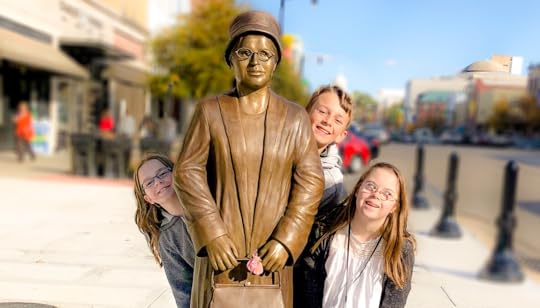
Most Americans will never know their names, yet many women, through their actions, have contributed to the undoing of injustice.
When we traveled to Montgomery, Alabama a few months ago, we learned that nine months before Rosa Parks was arrested for her refusal to give up her seat on a city bus to a white passenger, a young woman named Claudette Colvin had done the same thing.
Women and the Undoing of Injustice
Claudette Colvin, however, did not become a household name in the undoing of injustice, nor did her act of civil disobedience spark a movement that led to the Montgomery bus boycott and, arguably, to the March on Washington and other seminal events in the Civil Rights movement of the 1960s. Claudette Colvin was a pregnant teenager when she refused to stand up, and although her arrest was equally unjust as Rosa Parks, local civil rights leaders decided she wasn’t the right person to represent the movement.
I recently learned from the podcast Scene on Radio about another black woman from Montgomery who could be credited, in historical terms, with sparking the Civil Rights movement. Six years before the bus boycott, Gertrude Perkins was raped by two white police officers in Montgomery. She told her story, and it became national news.
I recommend learning more about the history of both these women in and of themselves—they are both exemplars of courage in the face of tyrannical power. But I also recommend considering their almost-forgotten role in changing the history of this nation. Most Americans will never know their names, and yet their actions contributed to the undoing of injustice. These women remind me that even the stories that seem to be unnoticed have far-reaching impact. Very few of us will become icons who get written about in history books. But every one of us may have a small part to play in shaping and forming our local communities and even our world.
If you haven’t already, please subscribe to receive regular updates and news. You can also follow me on Facebook , Instagram , and Twitter .
The post Almost-Forgotten Women and Undoing Injustice appeared first on Amy Julia Becker.
March 4, 2020
A Community’s Work to Participate in Healing
It was a dreary night outside, and a warm welcome inside the library of Trinity Episcopal Church in Southport, CT Tuesday night. After a winter of traveling south to talk about race, justice, privilege, and the lines that divide us, I loved being able to gather with people here in Connecticut to address these topics and discuss how to participate as a community in the work of healing.
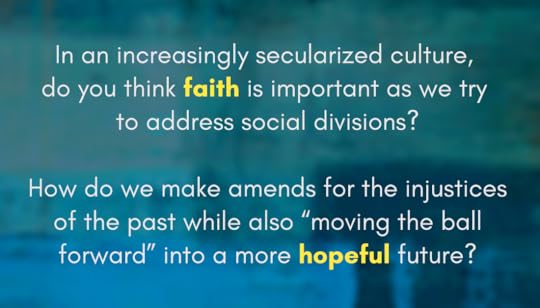
Some of the questions they asked about participating in their community’s healing included:
In an increasingly secularized culture, do you think faith is important as we try to address social divisions?
How much are anxiety and fear causing us to stay divided?
Have you seen differences in response to your message in different parts of the country?
How do we make amends for the injustices of the past while also “moving the ball forward” into a more hopeful future?
We had a great conversation, and once again I felt honored to get to play a small part in one community’s work to acknowledge the harm of social divisions, reach out for help, and participate in healing.
If you haven’t already, please subscribe to receive regular updates and news. You can also follow me on Facebook , Instagram , and Twitter .
The post A Community’s Work to Participate in Healing appeared first on Amy Julia Becker.
March 3, 2020
How to Receive God’s Love

I wrote earlier this week about what a difference it makes when we pay attention to the right things, when we pay attention to love instead of fear. I’m particularly aware of the good things that happen in me if I pay attention to the love of God. Still, love can seem very abstract, so I also wanted to share with you five practical steps you can take to receive God’s love in your own life:
1. Pay prayerful attention to the reality of God’s love.
Read through passages in the Bible about God’s love (four of the hundreds of options available: John 15, 1 Corinthians 13, Ephesians 3:14-21, 1 John 4:7-21). Or read passages about Jesus, the embodiment of God’s love (the podcast Contemplative at Home might be a help in this). Or use your spiritual imagination to envision yourself as a beloved child, climbing up onto God’s lap, being welcomed and received just as you are. (You can also try this Be Loved prayer.)
2. Let other people love you.
For many people (and women in particular), it is easier to give love to others than to receive it yourself. And yet the nature of love is reciprocal and relational, so love is incomplete when we don’t allow it to come to us. Look at John 13, when Jesus insists on washing his disciples’ feet. They have to admit their need for his cleansing touch. They have to allow him to humble himself and love them. Similarly, we receive God’s love by allowing other people to care for us.
3. If you are a churchgoer, take the Eucharist.
Receiving the bread and the wine—the body and blood of Christ—whether you think of it symbolically or literally, offers a physical reminder of God’s love for you. For Protestants and Westerners, we have a tendency to live in our heads. Rituals that involve our physical selves can offer a physical reminder of God’s loving action in our lives and for the world.
4. Look for God’s love all around you.
Paul writes in 1 Corinthians 13, “Love is patient. Love is kind.” Every time you see patience or kindness, you are seeing God’s love. You can receive the actions and words of other people—even those who do not believe in God—as a gift from the God of love acting in and through us.
5. Practice loving other people.
Love is relational, which means not only do we receive it as we open ourselves to God’s love and to the love other people offer us, but we also receive it even as we offer it to others. When we are patient and kind, when we are forgiving, when we sacrifice time or sleep or desire not out of grudging resentment but freely, we are participating in an eternal wellspring of love. Our giving is also our receiving.
I hope these thoughts help you become more “rooted and established in love” (Ephesians 3:17) as you receive God’s love.
If you haven’t already, please subscribe to receive regular updates and news. You can also follow me on Facebook , Instagram , and Twitter .
The post How to Receive God’s Love appeared first on Amy Julia Becker.
March 1, 2020
What Having a Baby with Down Syndrome Taught Me About Distraction, Fear, and Love
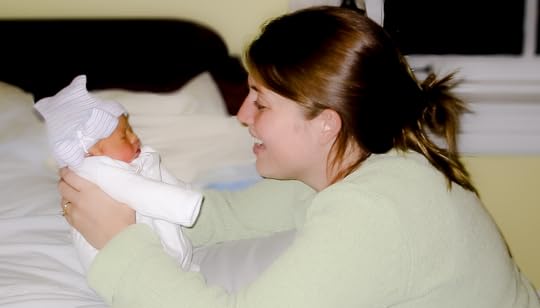
When our daughter was diagnosed with Down syndrome, we felt fear for her future, but love carried us all.
I’m increasingly convinced that one of the things that keeps us from receiving and participating in God’s love is distraction. Or at least, we miss the invitation to love and be loved because far too often we are paying attention to the wrong things. My attention flits from a text message to a tv show to the to-do list to my concerns about our kids’ eating habits, and God becomes abstract, love becomes vague and sentimental, and the future becomes a place crowded with worry and busyness rather than hope.
Down Syndrome, Fear, and Love
When thinking about the way my attention can so easily go to frivolous, meaningless, or harmful things, I was reminded of the first few days after Penny was born and diagnosed with Down syndrome. Throughout that time, Penny was often taken out of the room for tests. Whenever she was away, we were flooded with fear for her future, doubts about our capabilities as parents, and even questions about our love for her. But we noticed that every time she was in our arms, the fear dissipated.
When Penny was out of the room, she became an abstract diagnosis, a set of fears and scary possibilities on a list about Down syndrome. When she was in the room, she was simply our baby girl. Our adorable, big-eyed, sweet, needy, baby girl. When we paid attention to her in the present moment, love carried us all.
Love Counters Fear
I’ve returned to that time in the hospital on every occasion when I get scared about Penny’s future. Those moments taught me to counter fear by returning to who she is right now, returning to our love for her right now, returning to her delightful, friendly, witty, gentle presence right now, and even returning to the challenges and worries we have right now. Turning my attention to who she is instead of what might happen helps me return to love instead of fear.
There’s a truth embedded in this story that goes beyond advice for other parents who get trapped in worry about the future. For me to love Penny instead of fearing for Penny means I need to pay attention and be present to her.
Pay Attention in Order to Love
For me to love any human being in my life means I need to pay attention:
I need to pay attention to my own needs for rest, for food, for friendship, in order to love myself.
I need to put down my phone and listen to Marilee talk about her day in order to love her.
I need to listen to the needs of my community in order to love my neighbor.
Similarly, for me to receive and participate in the love of God means I need to pay attention and be present to that same love. My phone, my to-do list, my worries and doubts—they invite me to pay attention to fear. But God invites me to pay attention to love, to receive love, to return, day after day, moment after moment, to the constant and eternal reality of God’s relentless love for us.
If you haven’t already, please subscribe to receive regular updates and news. You can also follow me on Facebook , Instagram , and Twitter .
The post What Having a Baby with Down Syndrome Taught Me About Distraction, Fear, and Love appeared first on Amy Julia Becker.
February 27, 2020
Love: Sentiment or Commitment
“Love is not a sentiment. It is a commitment…” As I drove home from a beautiful weekend in Richmond at St. Mary’s Episcopal Church, I was listening to an interview between Bishop Michael Curry and Jen Hatmaker. Bishop Curry is the Presiding Bishop of the Episcopal Church, but he is most well known for preaching the sermon heard ‘round the world at Prince Harry and Megan Markle’s wedding. In keeping with that sermon, Bishop Curry spoke a lot about love, and his words resonated with what I had been trying to say with the congregation in Richmond. He said, “Love is not a sentiment. It is a commitment…”
Love is a Commitment
Love is a commitment God has made to us. Love is a commitment we are invited to make to one another, even and especially to those who might go overlooked or seem unlovable. The time I had at St. Mary’s was too short to get into all the implications of the love of God, but it was a wonderful few days to share some of these thoughts with this congregation about what it means to live in love.
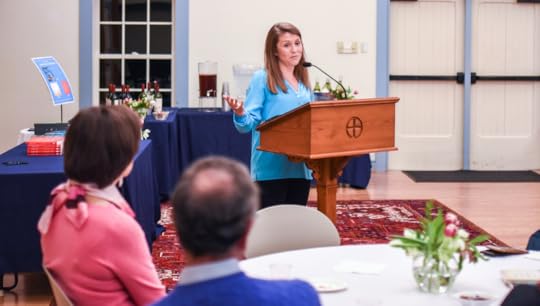
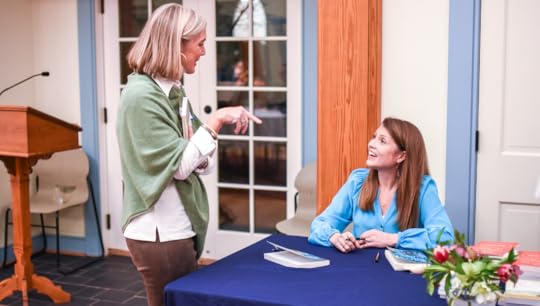
On Friday night, the church hosted a book signing and reception where I spoke and read from White Picket Fences about what happens when we see every human life as a gift.
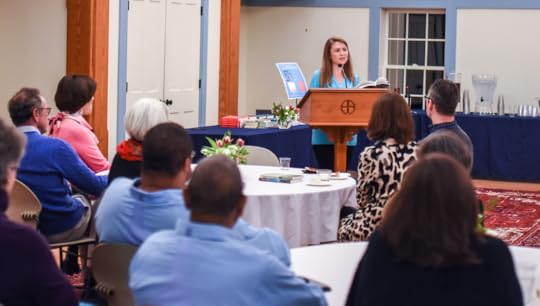
On Saturday morning, women and men gathered for a workshop about privilege, harm, and healing. Using the format I’ve laid out in my ebook companion to WPF, Head, Heart, Hands, I spoke about what privilege is, what it is not, how it harms, and how we can participate in healing.
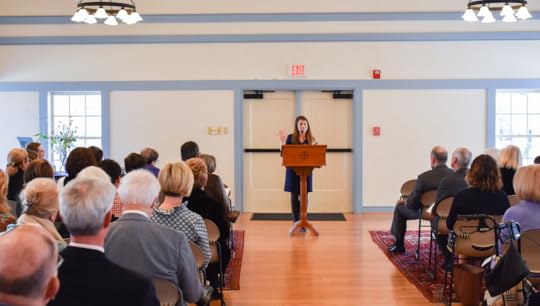
Each table discussed questions and shared with the rest of the group about what questions they want to answer (How did the Confederate monuments come to be erected in our city? and Did the construction of I-95 harm the African American community here? for example), what spiritual and personal connections they want to make (this list included starting a supper club for white and black adults to form friendships, joining a Bible study with women outside of my social group, practicing centering prayer), and what action they want to take on an individual, influential, and institutional level.
Distinction Between Sentiment and Commitment
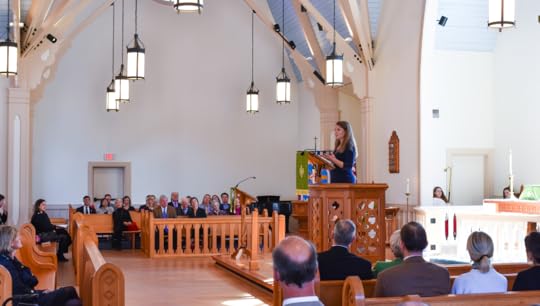
On Sunday morning, I had a chance to preach about the belovedness of Jesus and how we can understand our own belovedness by looking to him. And I also taught the adult forum with five spiritual practices that help us receive the love of God. (I only wish I had Bishop Curry’s words from above to share with that group. I did mention that when we talk about the love of God, we aren’t talking about Valentine’s Day warm fuzzies. But I love his distinction between sentiment and commitment, and I want to be someone who knows deep in my soul the commitment of love God has made towards me, and, from that, to be equipped and empowered to make that same commitment towards others.)
It was a weekend of grace, hope, light, and love, with participants who came from all over the city, women and men, young and old, white and people of color. Once again, it gave me hope for the small, messy, local work of healing.
If you haven’t already, please subscribe to receive regular updates and news. You can also follow me on Facebook , Instagram , and Twitter .
The post Love: Sentiment or Commitment appeared first on Amy Julia Becker.
February 25, 2020
Jean Vanier and Abuse: Is His Work Discredited?
 Jean Vanier, founder of the L’Arche community, beloved author, speaker, teacher, and mentor to thousands, winner of the Templeton prize—sexually abused multiple women over the course of many decades, according to an internal investigation. Until this past week, Vanier’s legacy seemed to be a simple testimony to the power of love. He lived among people with intellectual disabilities, and 154 communities developed across the world under his leadership. L’Arche communities stood as signs of what could be, signs that living out an ethos of love, of giving and receiving between typical people and people with intellectual disabilities, was possible.
My First Response
My first response to this news was to think about Vanier, and about people like me who have been shaped and formed by his thoughts. (I’ve written before about the influence Jean Vanier has had upon me as a writer, a thinker, and as the mother of a child with Down syndrome.)
But my first response should have been to think about these women, to acknowledge the depth of their pain, to cry out against the injustices they suffered, to pray for their healing. The suffering, pain, and emotional and spiritual turmoil and trauma these women endured under Vanier’s spiritual care now sit in the center of this legacy of love.
Vanier’s legacy has been part of my work. His words comprise the epigraph for White Picket Fences. His words of endorsement sit on the back cover of A Good and Perfect Gift. On Saturday morning, just moments before I first read about these allegations, I was teaching a group of women and men in Richmond, Virginia and wrote his name on a whiteboard as one of three authors to pursue on the topic of human dignity and belovedness.
I don’t expect men like Vanier to be perfect. But I expect him—and others who preach and write and teach about community, and honoring our vulnerable humanity, and following in the way of Jesus—I expect him to live with integrity. A pattern of abuse over the course of many decades is not a mistake. It is sin. It separates us from the love of God. It is sin, sin with teeth that bite and wound.
Do Actions Discredit Words and Work?
Do Vanier’s actions discredit his words? Vanier wrote words like:
“[People with disabilities] are crying for what matters most: love. And God hears their cry because in some way they respond to the cry of God, which is to give love”
(from Living Gently in a Violent World)
and
“We human beings are all fundamentally the same. We all belong to a common, broken humanity. We all have wounded, vulnerable hearts…”
(from Becoming Human)
Do we now reject these words?
Do Vanier’s actions diminish the very real work of love that has flourished in L’Arche communities across the globe?
Thomas Jefferson and Jean Vanier
On Saturday, after I heard this news about Vanier, I sat in the dome room of the Rotunda at the University of Virginia. This building, like the University, was designed by Thomas Jefferson—founding father, writer of the declaration of independence, owner of hundreds of enslaved people, including his own children.
I was there to hear Dr. John Perkins speak. John Perkins is a legend of the Civil Rights movement. He was beaten within an inch of his life by police in Mississippi and responded to the abuse and violence with an ethic of love and forgiveness that eventually became the Christian Community Development Association, an organization that has prompted Christians across the nation to work towards racial reconciliation through redistribution of resources and relocation of black and white people into community with one another.
Perkins sat on stage in the dome room, and he began by quoting Thomas Jefferson: “We hold these truths to be self-evident, that all people are created equal.” Perkins was gracious and gentle towards Jefferson when he said, “I believe he believed those words. He just didn’t know how to live them.”
Jefferson’s words, his ideals, his hopes and dreams for this country, don’t need to be dismissed just because he didn’t live them out. And holding on to those poetic and prophetic words does not require us to whitewash Jefferson’s own lived legacy of injustice.
My Hope for Jean Vanier’s Words and Ideals
I’m not ready to say the same about Jean Vanier, but I suppose that is my hope—that his words and ideals prove to be more enduring, and far more true, than his abuse of power and position. I hope and pray that the flourishing lives within L’Arche communities continue to bear witness to what Vanier’s abuse of power does not: that all human beings are vulnerable and broken, beautiful and gifted. That all human beings are worthy of the dignity and protection of love.
If you haven’t already, please subscribe to receive regular updates and news. You can also follow me on Facebook , Instagram , and Twitter .
The post Jean Vanier and Abuse: Is His Work Discredited? appeared first on Amy Julia Becker.
February 19, 2020
The Truth About Disability and Siblings

“How do your other children react to having a sister with Down syndrome?”
People ask this question frequently, both out of curiosity and also from concern about the long-term impact on their typical kids of having a sibling with a disability. There’s a part of me that wants to answer with a nonchalant dismissal of the question itself, as if having a child with Down syndrome makes no difference to our family dynamics. I worry that I will betray Penny to even think about her presence in her family as a potential liability to her siblings. And I know that a big part of the family drama we experience is just the typical sibling rivalry every family with multiple kids experiences.
Disability is Sometimes Different, Sometimes Harder
Still, having Down syndrome is, at least in some ways, different. And it is, sometimes, harder.
So here’s the stuff that’s harder for us: Penny has more doctor’s appointments than other kids. She takes more time to do almost everything. It takes more time and more teaching for her to learn anything. (There are other things that could be included on this list, but these are the broad strokes.)
Disability and Siblings
William tends to take an analytical approach. Penny has more needs than he does, so she gets more time from me than he does. This equation makes sense to him. He says he believes what I say, that more time is not the same as more love.
Marilee tends to respond with her emotions. She has told me for years that she thinks it is very unfair and upsetting that I spend more time driving Penny places (namely, the doctor, but also to ballet class) than I do driving her places. This whole “I don’t give you my time equally, but I give you my love equally” does not convince her of anything.
The fact of our family life is that Penny gets more of my time. And I don’t blame our other kids for feeling resentful or even hurt by that reality. I also don’t think it would be right to change that equation. Each of our kids has needs that we try to meet. Meeting Penny’s needs often takes longer.
What Can I Do as a Parent?
But what can I do, as a parent who loves all three kids equally? How do I approach the family dynamics of disability and siblings?
I love knowing that William’s lower lips get chapped whenever I’m away because no one else reminds him to put on Aquphor. I love knowing that Marilee will spend an hour folding her clothes and organizing her drawers while listening to The Land of Stories on Audible for the fifteenth time. I love knowing that Penny can only sleep with the hallway and bathroom lights on.
I love them each for who they are. I understand why and how resentment could build up between them. I understand why resentment could build up towards me.
Practical Care for Siblings
On a practical note, I approach the dynamics of disability and siblings in three different ways.
One, I address this ongoing concern by communicating with them about it. It’s different with each of them because they are different people, but we do want Marilee and William to voice any resentment, frustration, or anger without me trying to explain the disparity away, without trying to change their feelings, without trying to make them understand.
Two, I pray a lot about it.
And three, I look for specific ways to spend one-on-one time with Marilee and William even if they will never “equal” the one-on-one time with Penny.
Our Flaws and Our Beauty
On a less practical note, I trust that this is the family we have been given. Marilee offers us an invitation to feel our feelings. William offers thoughts and questions about the world we live in. Penny slows us all down. We are the people given to one another, in all our flaws and all our beauty, in our very real limits and our very real gifts.
If you haven’t already, please subscribe to receive regular updates and news. You can also follow me on Facebook , Instagram , and Twitter .
The post The Truth About Disability and Siblings appeared first on Amy Julia Becker.
February 16, 2020
Is Not Wearing a Bikini an Act of Modesty or Shame

Is not wearing a bikini an act of modesty or shame? I really don’t like wearing bathing suits. I’m not even talking about bikinis. One-piece bathing suits. Bathing suits with little skirts to provide additional coverage. No matter what the style, and pretty much no matter what type of crowd is around me, I’m not a big fan of me in a bathing suit.
I don’t like what I think about myself when I’m in a bathing suit, and I don’t like what I think about other people. The last time we were on vacation where most people were wearing bathing suits, I found myself constantly assessing the women (very rarely the men, and what’s up with that!?!). My internal monologue: Wow, that’s a lot of tattoos! Or, I did not need to see quite so much of your behind. Or, Are you really okay with exposing all of that flesh to the whole world? Or, I wish I could look so comfortable in a bathing suit…
Modesty or Shame
I’m expressing judgment towards other women and towards myself with every one of those thoughts. I might think these are judgments about modesty (or lack thereof). But what I’ve realized recently is they are actually judgments that arise out of a sense of shame. I have inherited a set of cultural norms about what bodies should look like, and when I don’t measure up to those norms (straight, flat, thin), I feel shame about myself. When other women do measure up to those norms, I judge them for flaunting their bodies. And when other women challenge those norms by showing their bodies even if they don’t “measure up,” I judge them for exposing too much flesh.
These thoughts came up for me again when my friend Niro Feliciano and I were talking last week about the Super Bowl halftime show. For many years, I’ve confused shame with modesty, and I’m trying to sort it all out.
We don’t talk a lot about modesty in our culture. Modesty, according to the dictionary, is not thinking too highly of oneself or one’s accomplishments. Modesty, when it comes to how we dress, similarly means dressing in a way that does not call attention to the self. Dressing with modesty also usually implies dressing to avoid sexual attention. And here’s where it gets tricky.
Modesty is an Act of Love
First, modesty, on a deeper level, is an act of love, towards self and towards others. It emerges out of respect, not out of shame.
I believe that there’s a place for modesty, but my way of living—with shame and judgment—might look modest without being modest.
Modesty is Culturally Determined
Second, modesty in dress is culturally determined. What I call my granny bathing suits (a black skirt and a separate, full-torso-covering top) would have scandalized people 100 years ago. As Niro explained in our conversation, formal attire in her Sri Lankan culture includes women—of all shapes and sizes—wearing saris, which includes exposing the midriff, and is not considered immodest or sexual.
As someone who has grown up as a white, affluent woman in New England, I bring my own cultural assumptions to what I wear, what I think about what other people wear, and whether or not I pass judgment.
Modesty for the Sake of Love
I might think I dress modestly, but my judgment of my own body and my judgment of other women’s bodies suggests I actually dress with a sense of shame. I want modesty to emerge out of love, not shame.
Love for the beautiful, valuable human beings God has created us to be.
Love for the bodies we’ve been given.
Love for the people all around us.
I want to live (and dress) modestly, and I want to teach my kids to live (and dress) modestly, but only for the sake of love.
If you haven’t already, please subscribe to receive regular updates and news. You can also follow me on Facebook , Instagram , and Twitter .
The post Is Not Wearing a Bikini an Act of Modesty or Shame appeared first on Amy Julia Becker.
February 12, 2020
The Ethics of Abortion
The ethics of abortion. Twice a year, I Skype with a class of high school students at the Riverdale School in New York City during their unit on abortion in a bioethics class. They read an old essay I wrote for the Philadelphia Inquirer about prenatal testing and Down syndrome. I then appear in class via the computer and tell them our story about Penny’s diagnosis of Down syndrome and the subsequent decisions we made about prenatal testing with my other pregnancies. Each student comes prepared with a question, and I am always grateful for the chance to talk with them.
There are new questions every time, and I always get a chance to talk about themes that run through much of the work I do.
I talk about the difference between tolerance, inclusion, and belonging.
I talk about our common humanity.
I talk about my own prejudice against people with intellectual disabilities before Penny was born.
And I talk about abortion.
Ethics and Abortion Considerations
There are two things that come up as it pertains to abortion almost every time we talk.
One, that there is a difference between the ethics of abortion and the legality of abortion. Just because an action is legal doesn’t mean it is ethical (take the example of the Westboro Baptist Church’s hateful rhetoric—unethical and legally protected).
And just because an action is illegal doesn’t mean it is unethical (the protests during the Civil Rights movement stand as the most obvious example of ethical protest against unjust laws). Often the conversation around the ethics of abortion gets superseded by the conversation around the legality of abortion, which has led to political polarization that either disregards the vulnerable humanity of the fetus or the vulnerable humanity of the pregnant woman. (Caitlyn Flanagan has a great piece for The Atlantic about The Dishonesty of the Abortion Debate that touches on these points too.)
Two, that American individualism deceives us into thinking that abortion is simply an individual choice rather than an individual choice in the context of a social system.
Abortion rates rise and fall due to a variety of factors. Soft data suggests that women who have social networks (i.e. families, friends, and local communities) who will support them not only financially but also emotionally when their baby comes and throughout that child’s life are more likely to choose to give birth to that baby.
I Believe…
As I told the class recently, I believe that God is love and that every human being—born and unborn—is created in the image of God, the image of love.
I believe that the inherent value of every human life—from the baby with Down syndrome to the elderly woman with dementia to the refugee to the Wall Street banker—comes forth in the ability to give and receive love.
I believe it is our calling and responsibility as a society to do everything we can to create social conditions and make individual choices that will welcome vulnerable lives from birth to death and throughout the years in between.
I believe we need a greater understanding of collective responsibility, and I believe compassionate but honest conversations about the ethics (and not the politics) of abortion, will help us acknowledge the complexities without overlooking what Caitlin Flanagan states as a simple reality:
“these are human beings, the most vulnerable among us.”
I Hope…
Many of the students sitting in bioethics classes haven’t faced decisions around pregnancy personally. But it helps to think through ethical issues before they become personal. I hope these conversations help these students recognize the complexity of the ethics of abortion and have compassion for people on both “sides” of the debate.
I also hope these students will develop ethical frameworks that will help them make decisions for themselves and within communities that welcome the vulnerable into lives marked by love.
If you haven’t already, please subscribe to receive regular updates and news. You can also follow me on Facebook , Instagram , and Twitter .
The post The Ethics of Abortion appeared first on Amy Julia Becker.