
Discover new books on Goodreads
Meet your next favorite book
Listopia > Best Nineteenth-Century British and Irish Novels


Liora
179 books
29 friends
29 friends

Andrew
980 books
80 friends
80 friends

Themis-Athena (Lioness at Large)
545 books
363 friends
363 friends
Beanie
586 books
40 friends
40 friends
Katrina
90 books
5 friends
5 friends
Nancy
1816 books
34 friends
34 friends

Bindzus
2489 books
24 friends
24 friends

Thom
6022 books
293 friends
293 friends
More voters…
Comments Showing 1-31 of 31 (31 new)
date newest »
newest »
 Is "The Life of Charlotte Bronte" a novel? I was under the impression it was a biography.
 100 is not enough!
 You could make your own list of 100 with the best one from each year of the 19th century. I think that might be too complicated to set up here, though.
 Sadly, the edition of "Tess of the d'Urbervilles" on here is the Macmillan Intermediate Reader, which means it's an abridged version for the kiddies.
That should probably be separated out. I'll look at it.
Sadly, the edition of "Tess of the d'Urbervilles" on here is the Macmillan Intermediate Reader, which means it's an abridged version for the kiddies.
That should probably be separated out. I'll look at it.ETA: I can delete the current Tess and then have people vote for the other one? Only thing I can think of.
 Susanna wrote: "Is "The Life of Charlotte Bronte" a novel? I was under the impression it was a biography."
It is ... I deleted it.
ETA: Would also second the suggestion re: "Tess."
Alright, I'll delete that version and vote for the real one.Would have no problem with Heart of Darkness, for those who like it enough to vote for it (I'm not in that category).
Deleted Little Women and The Tell-Tale Heart -- neither Alcott nor Poe were British.Not sure what to do about Shaw's Plays Pleasant. Is drama welcome on this list? Liora, you created it ... your call, first and foremost!
 Oscar Wilde and Bram Stoker aren't British, but Irish.
 Great Gatsby? I thought this was a list of British novels? There are several other things on this list that are not even novels.
Removed The Great Gatsby (neither British or 19th century).
Also, there are plays and short stories here. Keep or delete?
Novels are novels; they aren't plays and they aren't short stories.
Susanna, why remove some non-British novels but not others? Dracula was written by an Irishman.
Ireland was a part of Great Britain in the 19th century, so I don't feel comfortable to delete those, as the books are from the right century.
Susanna - Censored by GoodReads wrote: "Ireland was a part of Great Britain in the 19th century, so I don't feel comfortable to delete those, as the books are from the right century."
Great Gatsby? I thought this was a list of British novels? There are several other things on this list that are not even novels.
Removed The Great Gatsby (neither British or 19th century).
Also, there are plays and short stories here. Keep or delete?
Novels are novels; they aren't plays and they aren't short stories.
Susanna, why remove some non-British novels but not others? Dracula was written by an Irishman.
Ireland was a part of Great Britain in the 19th century, so I don't feel comfortable to delete those, as the books are from the right century.
Susanna - Censored by GoodReads wrote: "Ireland was a part of Great Britain in the 19th century, so I don't feel comfortable to delete those, as the books are from the right century."It's not physically possible for Ireland to have been part of Great Britain. Great Britain and Ireland are two separate islands. I think what you mean is that Ireland was part of the British Empire, which is true. This does not, however, mean that the Irish people were "British" any more than it means that the Maori people were British. Books written by Irish authors shouldn't be included in a British list in the same sense that Maori, Kenyan and Indian authors wouldn't be included. Is that so difficult to understand?
Well, I don't feel comfortable taking them off, is what I was attempting to say. You don't like them, take them off yourself.
Unfortunately, I can't take them off because I'm not a librarian and I am afraid I must press you on this issue. You haven't given me any valid reason as to why you won't remove Irish authors from a British list. I notice that this has happened on other lists you've moderated. It should be your duty as a librarian to maintain accuracy. If you could explain why you won't remove them with a more valid reason than "I don't feel comfortable", then perhaps we can work this out.
If you are not a librarian, why does your profile say "#42 top librarians"?
 Darren wrote: " It should be your duty as a librarian to maintain accuracy."
GR librarians are not GR employees.
Anna, nobody said that. Susanna, I see that you seem unable to explain yourself.
Darren, you have posited that the Irish need removing, but not proved it. What is your justification for this demand? At any rate, Oscar Wilde is routinely taught in classes on 19th century British novel. Prove your contention, and I'll be glad to remove them. (And if the list creator requests that they remove them, that's fine, too. Liora, do you have a view on the presence of the Irish?)
 The British Isles include the whole of Ireland. The United Kingdom does not include Eire, that which is known as Southern Ireland.
The title of this listopia mentions 'British'.
Bettie: The term "British Isles" is not used by the Irish. It is actively discouraged by the Irish government and is being used less and less by international organisations, eg National Geographic. The reason for this is that "British" is not a neutral word. When a UK citizen opens their passport, their nationality states "British". When an Irish citizen opens their passport, they find "Irish". This is because these two people come from two different countries. To then group them together under the term "British" is wrong.It suggests the Irish are British, which is not true. Imagine if it were "The Irish Isles" - then would a British person be happy to be described as an Irish author? The term is left over from when Britain was an empire and ruled over Ireland. But it's time to let go now. Britain is not an empire anymore and these islands are not "British". It would be nice if our closest neighbours would eventually stop being so ignorant about the country right next to them.
Susanna, I've already done that. I'm done with this conversation now. Thank you for addressing my points.
Darren wrote: "Bettie: The term "British Isles" is not used by the Irish. It is actively discouraged by the Irish government and is being used less and less by international organisations, eg National Geographic...."Both ancient Greeks and Romans lumped all the islands together as a geographical value-free destination at a time considerably earlier than politically value-laden modern minds. It could be argued that they were just as clumsy because they were overlords themselves. To most of the world the group of isles off continental europe has a collective term.
Skipping aside all the prickly pears though, GR is a global site so tolerance is the way forward. Great discussion though. :O)
Excellent point. I'll nab it.
 Again, I haven't read it, but Gothic Tales (#78) by Elizabeth Gaskell sounds more like short stories than a novel. (I think my own book is similar, Tales of Mystery & the Macabre and I haven't added that one simply because it's not a novel).
In a Glass Darkly (#79) by J. Sheridan Le Fanu is definitely not a novel, according to the description given on GR.
Plays Pleasant (#88) by George Bernard Shaw seems to be a play and not a novel, judging by its title and description.
Oscar Wilde only wrote one novel, as far as I know, so apart from The Picture of Dorian Gray, none of his other works should be part of this Listopia....
Intentions (#100) is a collection of essays, De Profundis (#102) seems to be a letter, The Happy Prince and Other Fairy Tales (#104) is, like the title indicates, a collection of fairy tales, A House of Pomegranates(#111) is a collection of 'whimsical short stories', Wilde V. Whistler: Being an Acrimonious Correspondence on Art Between Oscar Wilde and James A. McNei (#113) is, according to its title, correspondence, in other words: letters, Aristotle at Afternoon Tea: The Rare Oscar Wilde (#115) is a collection of newspaper clippings, criticisms and other papers, Selected Journalism is, once again, not a novel but shows Wilde's journalistic efforts, and Oscar Wilde Epigrams (#120) is not a novel either. Phew.... ;-)
The Brownie of the Black Haggs (#106) by James Hogg is, according to the description, a short story, not a novel.
Juvenilia: 1829-1835 (#123) by Charlotte Brontë is a collection of her creative writings.
The Waverly Novels: The Chronicles of the Canongate (#126) consists of three short stories.
Sorry about the above, but 19th century British (and Irish) lit is my favourite... I haven't mentioned any of the novella's on this list, as it is a grey area between a novella and a novel. Personally, I'd leave them on here, as it's debatable whether something is or isn't a novella.
 Very pleased that Elizabeth Gaskell is on this list. She is one of the best and often underrated.
Related News
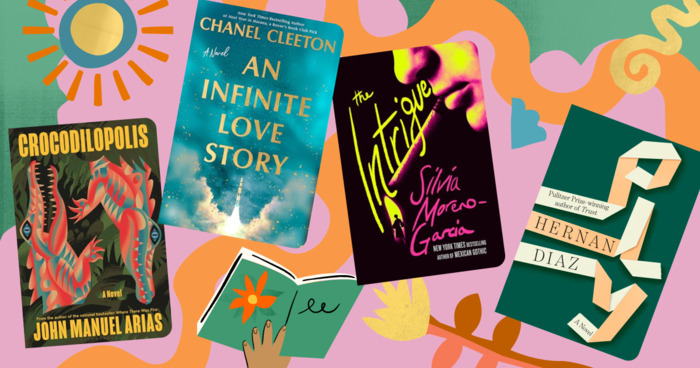
To celebrate this year’s National Hispanic Heritage Month, which runs from September 15 through October 15, we’ve compiled a great selection of...
Anyone can add books to this list.
:O))