Aidan Moher's Blog, page 19
July 11, 2014
Marc Simonetti’s Astounding Discworld Art
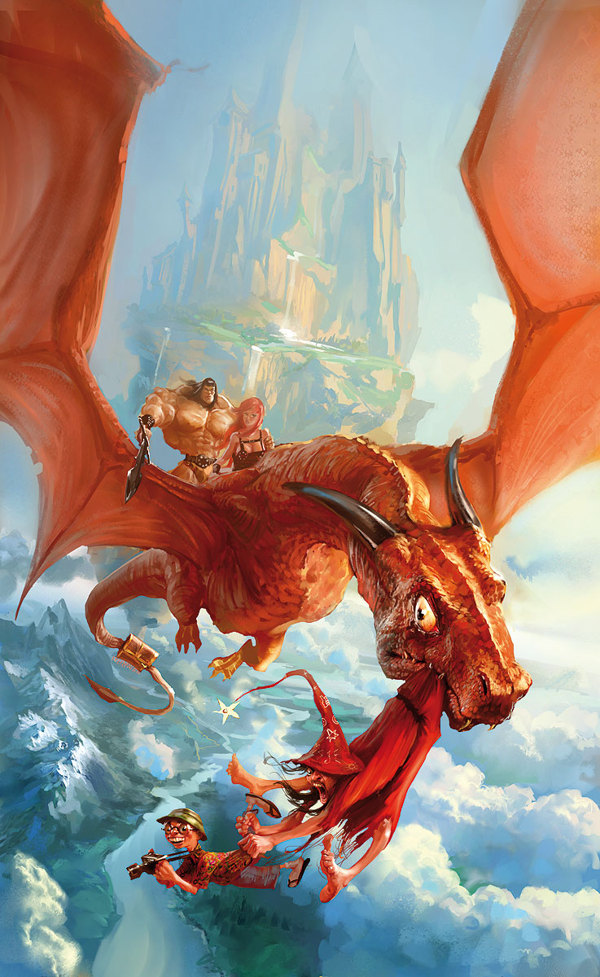
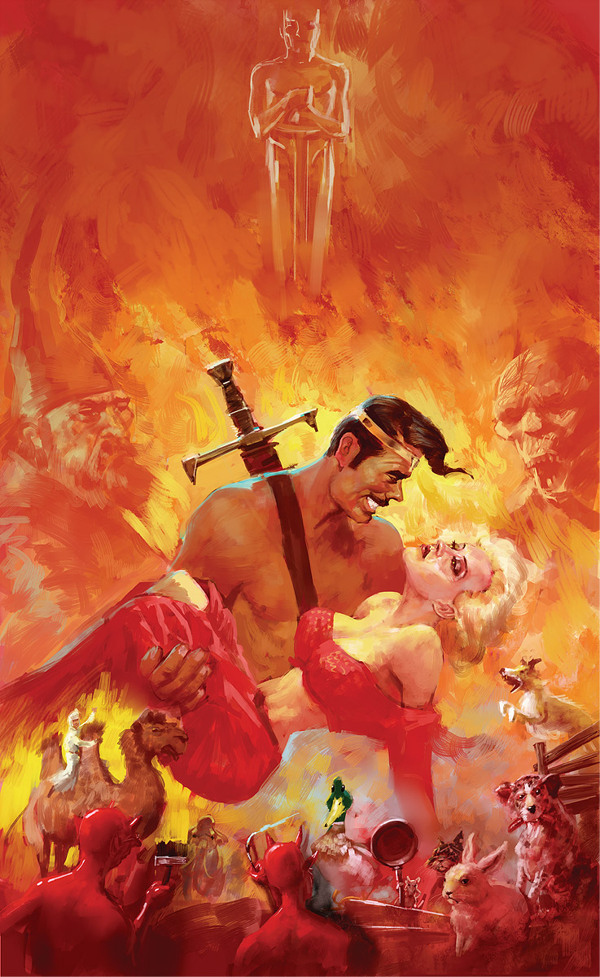
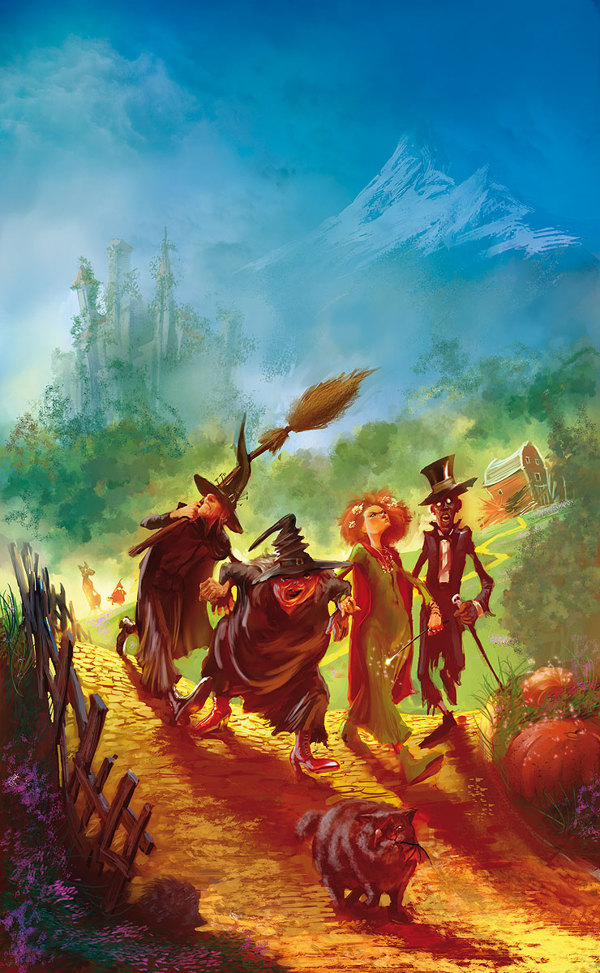
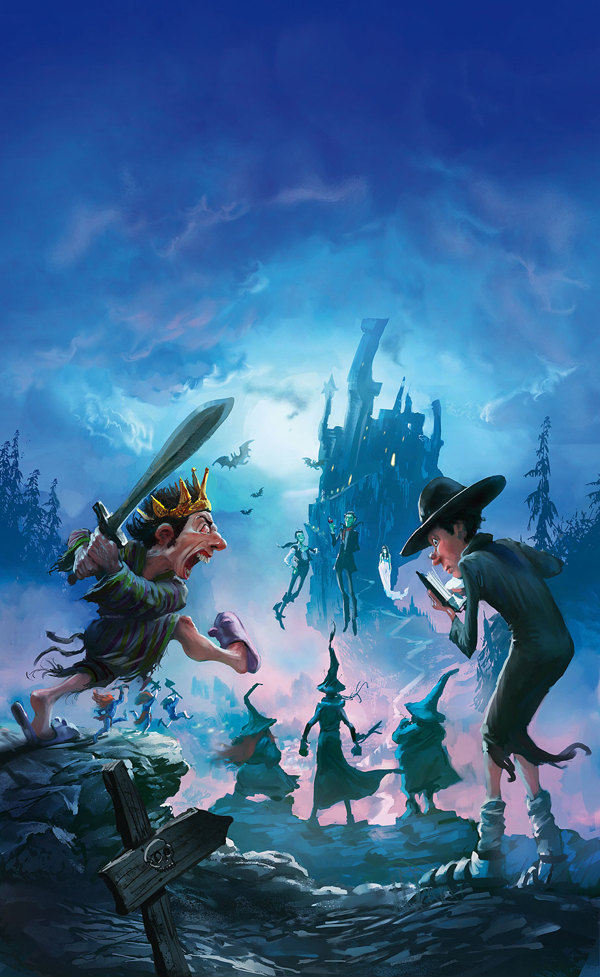
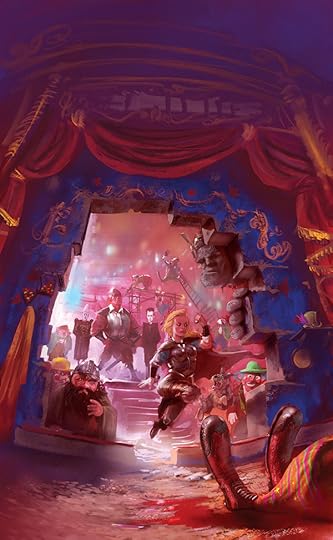
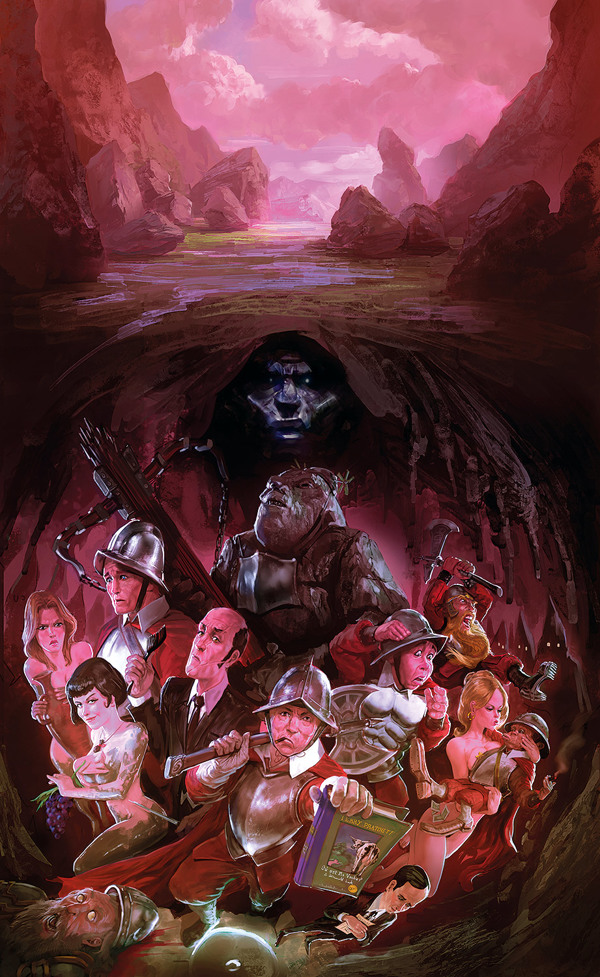
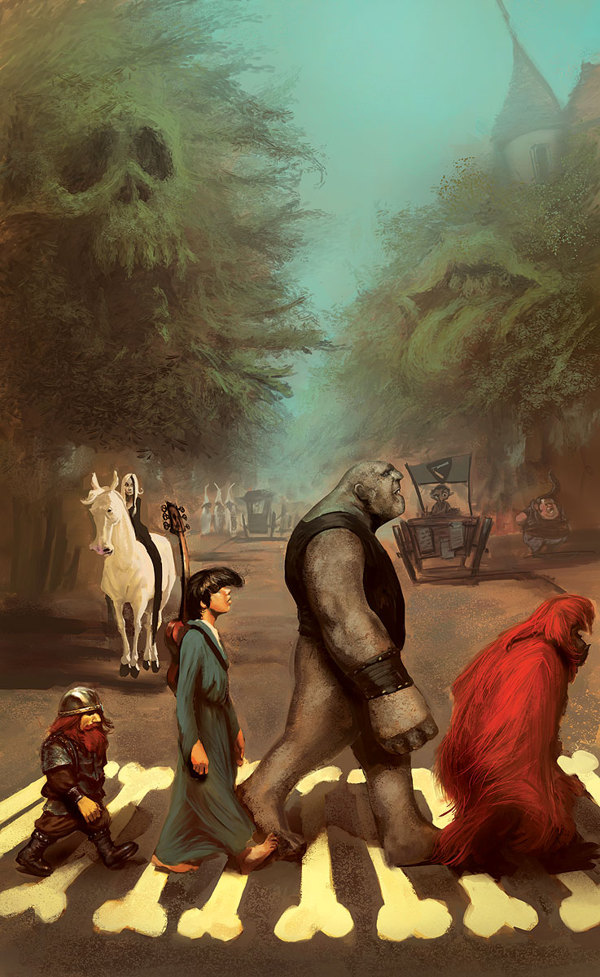
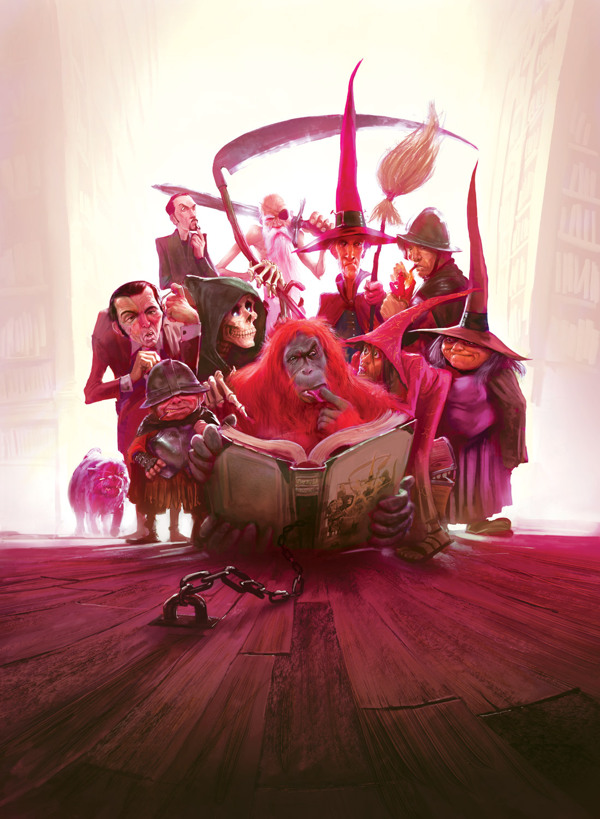
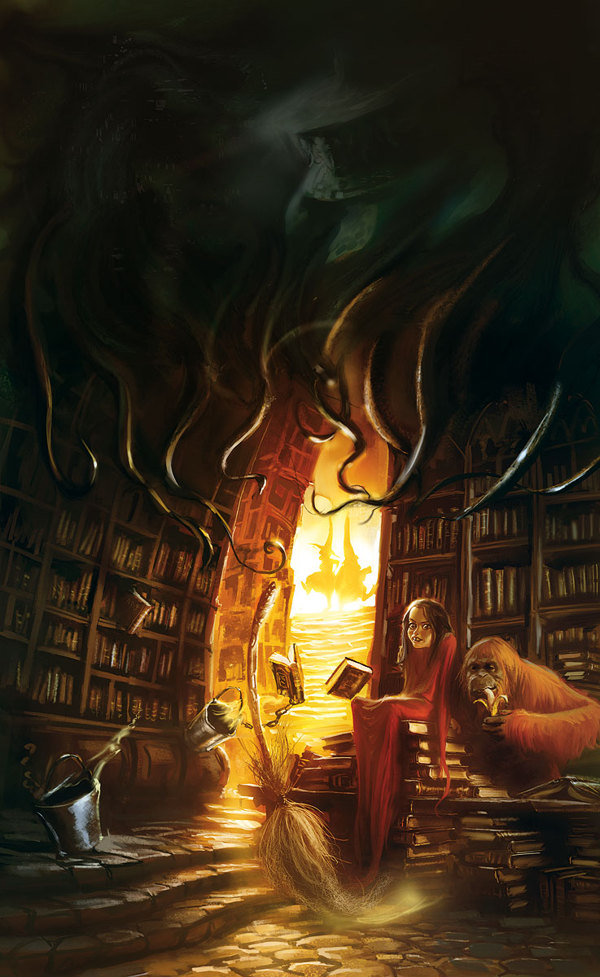
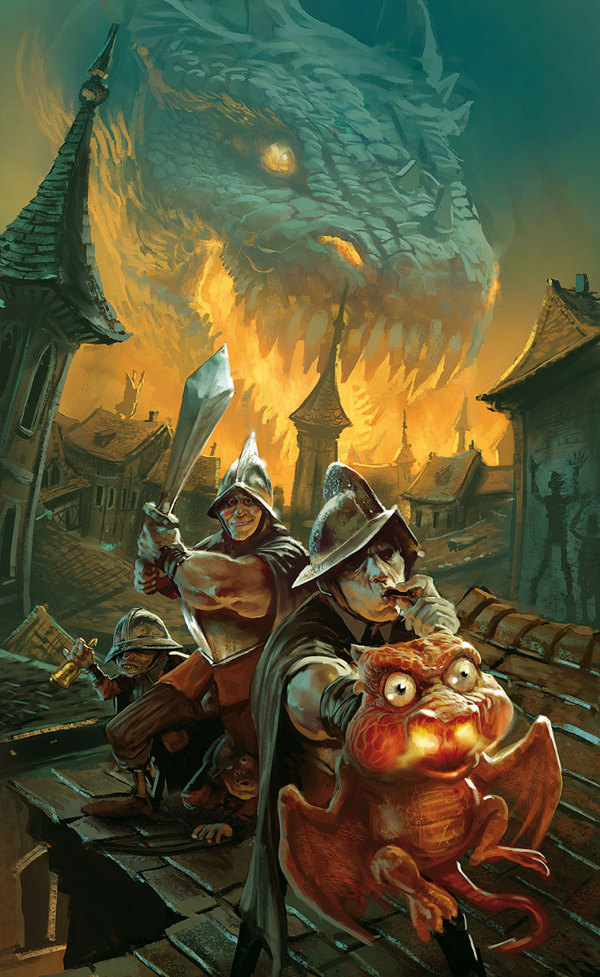

Since the passing of Paul Kidby in 2001, Pratchett’s series has gone through a long search for a new artist that could match the verve and energy of the legendary artist’s interpretation of Pratchett’s beloved world. At long last, it looks like we’ve found the answer: French artist Marc Simonetti. From Gone with the Wind, to Abbey Road, to The Wizard of Oz, Simonetti’s artwork features the same level of tribute and sophisticated satire that makes Pratchett’s work such a joy. If there’s ever been so perfect a pairing of author and artist, I’m unaware.
Above is just a small part of Simonetti’s Discworld art collection, and many more paintings, which are used for the UK covers, are ava on Simonetti’s website. Whether you’re familiar with Discworld or not, Simonetti’s art is an achievement in itself, and well worth spending some time with.
The post Marc Simonetti’s Astounding Discworld Art appeared first on A Dribble of Ink.


July 10, 2014
My LonCon 3 (2014 WorldCon) Schedule

Unexpectedly, I’ll be attending LonCon3, this year’s WorldCon, hosted in London, England. The convention administrators were foolish kind enough to schedule me on some panels during the convention, and so my schedule for the weekend is posted below. If you’re at LonCon3 (and it seems that half of the SFF fans in the world will be there), I hope you’re able to come by for the panels. They’re all very interesting, and my panel-mates include some humblingly intelligent and amazing people. (And some guy named Justin Landon…)
Outside of these panels, I’ll be around the convention floor (well, wherever they allow you to drink beer, at any rate.) So, if you see me, come say “Hi!”
Note: The listed panelists are preliminary and subject to change.
Schedule
Friday
Exuberance and Experience
18:00 – 19:00
Our societies are full of truisms about age: youth is seen as beautiful and vital, or feckless and short-sighted; old age is thought to bring wisdom and perspective, or intolerance and resistance to change. Are our genre’s characters similarly subject to stereotype? Are there particular types and the kinds of stories that older and younger protagonists tend to be associated with? How do factors like race and gender reinforce or cut across this?
Anna Davour (M)
Wendy Metcalfe
Aidan Moher
Tricia Sullivan
Caitlin Sweet
Sunday
My Opinions, Let Me Show You Them
16:30 – 18:00
There are many different approaches to book blogging: some focus on news and announcements, running author interviews and ARC giveaways supported by publishers; others concentrate on reviewing and opinion pieces; still others are devoted to raising awareness of certain types of writing, like SF Mistressworks or the World SF Blog. Our panel discusses how they chose their blogs’ format and focus, how the blogs evolved over time, and how they found their ‘voice’ and their audience.
Foz Meadows (M)
Thea James
Justin Landon
Aidan Moher
Adam Whitehead
The Art of Reviewing
18:00 – 19:00
John Clute is one of the people who lifted reviewing in the field to an art form. What makes the difference between a workmanlike review that tells us what we need to know, and a review which becomes a text worth studying in its own right? Under what circumstances does a review transcend its immediate subject, and become part of the wider conversation about genre? Who are reviews for: readers, authors, industry, other reviewers?
Alvaro Zinos-Amaro (M)
Elizabeth Hand
Paul Kincaid
Aidan Moher
The post My LonCon 3 (2014 WorldCon) Schedule appeared first on A Dribble of Ink.

July 9, 2014
A Shannara Family Tree
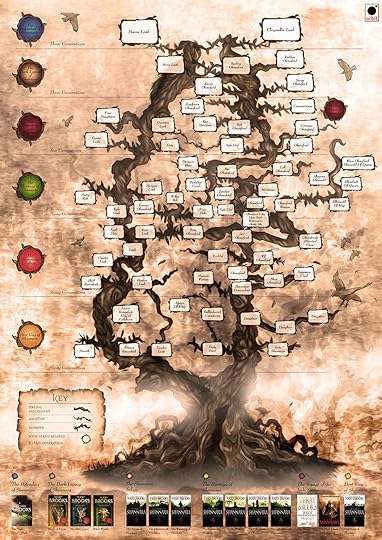
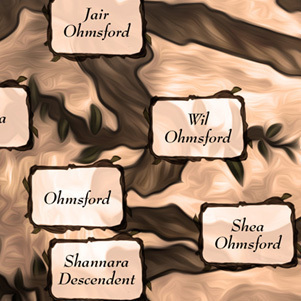
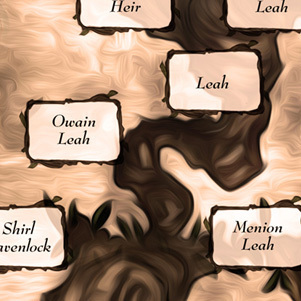
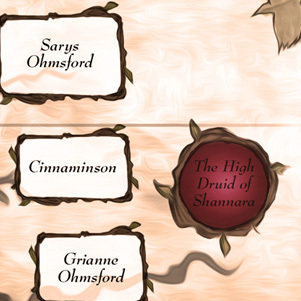
One of the most unique aspects of Terry Brooks’ Shannara series is its unerring dedication to following the Ohmsford and Leah family lines as each new generation finds trouble for themselves in the Four Lands (and beyond, in some cases.) Since I first discovered Brooks, the Ohmsfords and the Leahs have held a special place in my heart, and the hearts of many fantasy readers like me. So, it makes perfect sense that Orbit Books, Brooks’ UK publisher, would create such a loving family tree to illustrate the labyrinthine connections between the two families.
You find a high resolution (like, really high resolution) version of the family tree on Orbit’s Facebook page, where you can also enter to win a gorgeous print by voting for your favourite Shannara generation. Fun stuff, great series.
The post A Shannara Family Tree appeared first on A Dribble of Ink.

July 8, 2014
New Covers for Robin Hobb’s Farseer Trilogy
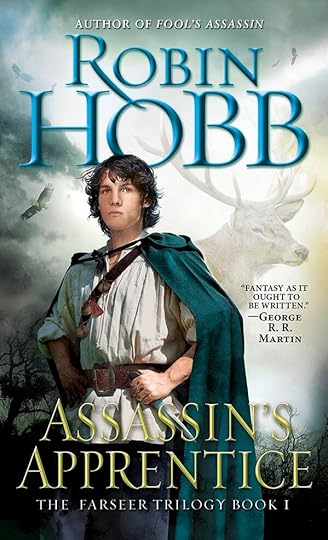
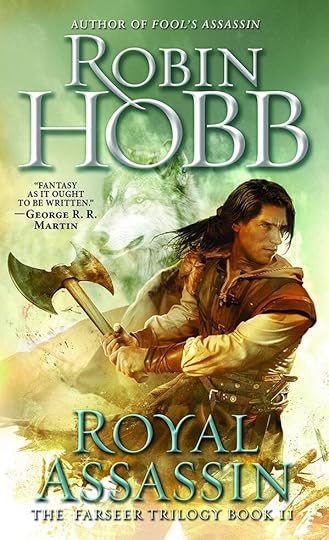
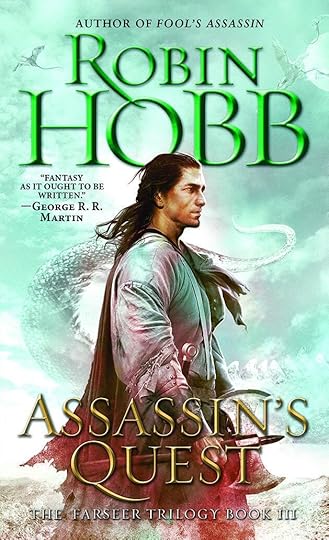
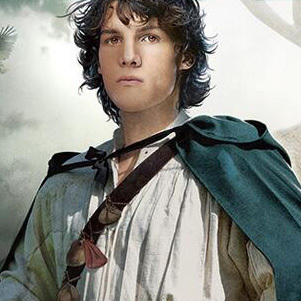


I’ve ragged on a lot of covers with sultry-looking dudes in LARPing gear, but there’s something about these character-centric Robin Hobb covers that works for me. While not quite the homerun that the new covers for Hobb’s Liveship Traders trilogy are, the aging of Fitz, from young adult to weathered, handsome dude is a great touch for past fans of the series. Plus Fitz has an axe, so… yay.
Incidentally, young Fitz is the perfect draw for a young adult audience, who will be attracted by the bright colours and familiar design conventions. I discovered and loved Hobb’s work as a teenager, and I can see these new covers opening a lot of doors for a new generation of readers.
I could have done without the floating animal head ghosts, though. (JK, Nighteyes, I still love you.)
The post New Covers for Robin Hobb’s Farseer Trilogy appeared first on A Dribble of Ink.

July 7, 2014
“Hey! You Got Your 21st Century in my Historical Authenticity” by D.B. Jackson
Tomorrow marks the release of A Plunder of Souls, the third instalment in my historical urban fantasy, the Thieftaker Chronicles. For those who are unfamiliar with the series, the books are set in pre-Revolutionary Boston, and feature a conjuring thieftaker (sort of an eighteenth century private investigator) named Ethan Kaille.
I have a Ph.D. in U.S. History and so I take my historical research seriously; I’ve done my best to portray accurately the real-life events from the 1760s that coincide with my fictional narratives. I have taken care in my portrayal of historical figures, and I have made every effort to create a Boston that is true to its purported time while also being accessible to twenty-first century readers.
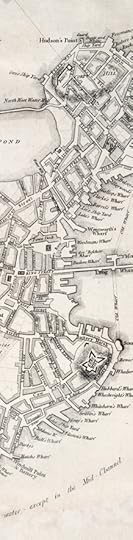
That last phrase, though — “accessible to twenty-first century readers” — is where all of this gets a little tricky.
That last phrase, though — “accessible to twenty-first century readers” — is where all of this gets a little tricky. What exactly does that mean? In some respects, it’s merely a stylistic decision that I have to make in my writing. My point of view character is a man of the eighteenth century, as are all of the people with whom he interacts. I could have Ethan and my other characters talk and think in precisely the vernacular used in the 1700s — that would be the historically accurate thing to do. But doing so would render my books all but incomprehensible to today’s readers. This was a period during which word meanings and rules of common syntax bore little resemblance to our own, and when even spelling was different from what we’re used to today. (For example, “s” was often written as “f.”) Historical authenticity is fine, but I want people to read my work; it’s hard for me to make a living if they can’t.
My approach to dealing with this has been to write the books in a way that nods toward the historical period without going overboard. Or, put another way . . . My solution has been to compose the books in a manner that harkens to the period in question, without producing a result so at odds with the customs of our own time that it becomes indecipherable. (See what I did there?)
In other respects, though, that social and temporal gulf between my subject matter and my audience creates more difficult issues. Boston in the 1760s was a fairly homogenous city, and the North American colonies in the mid-to-late eighteenth century were not exactly notable for offering scads of professional advancement opportunities to women. It would have been easy — and again, historically faithful — for me to populate the Thieftaker books with nothing but white male characters, making just a few exceptions, perhaps for Ethan’s love interest, a few female crime victims, and some serving girls in Boston’s taverns. Everyone who reads the books will notice immediately that I didn’t do this.
Ethan’s nemesis in the Thieftaker books is Sephira Pryce, a rival thieftaker who is brilliant, cunning, ruthless, corrupt, skilled with a blade and with her fists, fearless, and strikingly beautiful. She is modelled after a historical figure, a thieftaker named Jonathan Wild, who worked in London in the early 1700s. He, too, was brilliant and ruthless and corrupt, and I wanted to have a Wild-like character who would work at cross-purposes with my honest but down-on-his-luck hero. I chose, though, to make this nemesis a woman because I thought that doing so would add a bit of sexual tension to their rivalry, making their interactions that much more compelling and fun for my reader. I will admit though that I also did this because I didn’t want my books to be top-heavy with male characters.
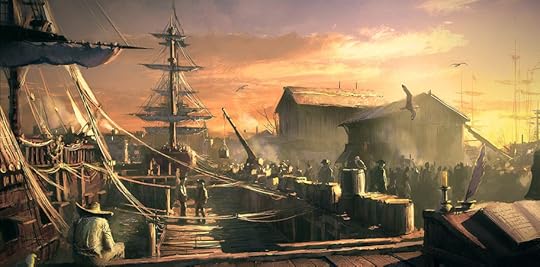
There can be no mistaking the fact that she is a person of color in a book — and in a city — that has few others. There were, in fact, free people of African descent in Boston in the 1760s, and there were many women who owned taverns.
In addition to Sephira, Ethan also interacts with a woman named Janna Windcatcher, a conjurer who hails from the West Indies, and who owns a tavern on the Boston Neck. Janna is irascible and a fun character to write. She is also the most knowledgable and accomplished conjurer Ethan knows, and he often goes to her for help when working on a difficult investigation. But there can be no mistaking the fact that she is a person of color in a book — and in a city — that has few others. There were, in fact, free people of African descent in Boston in the 1760s, and there were many women who owned taverns, although most were widows who inherited their establishments from their deceased husbands. But Janna is another character who could just as easily have been male and white. I chose to make her otherwise.
The other prominent female character in the series is Ethan’s love interest, Kannice Lester, who is also a tavern owner who came to own her establishment as so many female innkeepers did. Her husband died in the 1761 smallpox epidemic. Of the three female characters I’ve mentioned in this post, Kannice is probably the one who conforms most closely to historical realities (Sephira is the one who conforms the least). Still, she is strong-willed, independent, and someone who challenges Ethan often, despite being in love with him.
Why did I choose to create characters who are, in certain key ways, at odds with the historical norm for the period in which I’m writing? That’s a more complicated and difficult question than it might seem. I can see where some might accuse me of bending to the pressures of “political correctness.” Diversity, multi-culturalism, inclusiveness — call it what you will — I suppose one could make the case that I was striving for it in a way that compromises the historical realism of my books. Others might say that I was catering to the marketplace. Women read in far greater numbers than do men. By surrounding my male protagonist with strong, engaging, and entertaining female characters, I’ve probably helped my sales.
The truth is I did it for both of those reasons. I did think that the book would be more marketable if it had strong female characters. And I also wanted to write a book with a more diverse cast than a strict adherence to historical realities might have allowed. It wasn’t necessarily that I was trying to be PC, but I did want to write about different sorts of characters. Ultimately, I chose to include these particular characters in the hope that doing so would make the books more fun for my readers as well as for me. But I’m not going to deny that I made a “modern” choice, perhaps even a somewhat anachronistic choice.
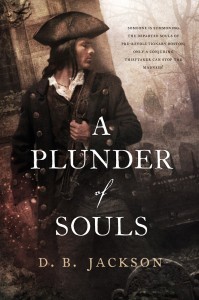
Buy A Plunder of Souls by D.B. Jackson: Book/eBook
In the end, I was writing a piece of fiction, one that reflects my values and those of the culture in which I live every bit as much as it does those of my lead character and the society in which I placed him. I expect some will say that’s a flaw in the books, and in me as a writer. I’m willing to accept that. Because to my mind, making my characters relatable for a twenty-first century audience is not all that different from making my prose and dialog more understandable for those same readers. I’m not trying to create a historical document. I’m writing a novel. Do I want the historical elements to be accurate? Sure. And to the extent that my narrative and characters and magic system allow this, I believe they are. But I’ve inserted thieftakers into pre-Revolutionary Boston, even though they were not actually active in the colonies in the 1760s. I’ve also inserted conjurers, fictional murders, ghosts, and a host of other story elements that have no place in a “realistic” portrayal of Colonial Boston. In that context, giving a somewhat broader role to female characters and characters of color seems like a pretty modest stretch of the imagination. More, I believe that those characters bring personality, originality, and even a bit of charisma to the Thieftaker books and stories, more than making up for any loss in historical verisimilitude that they might have cost me. And that’s a trade this author will make any day of the week.
The post “Hey! You Got Your 21st Century in my Historical Authenticity” by D.B. Jackson appeared first on A Dribble of Ink.

July 3, 2014
Cover Art for The Twilight Dragon by Shawn Speakman
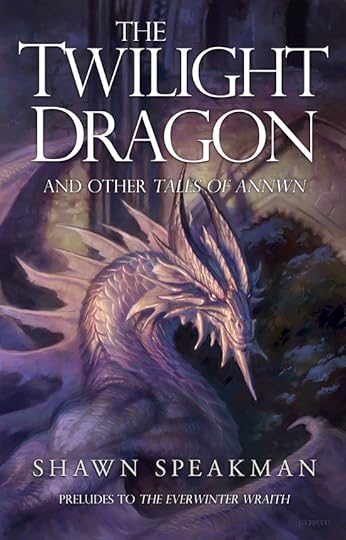
Shawn Speakman, good friend of this blog, has been carving out a pretty nice niche for himself in the wild west of self-published fantasy. Writing in the vein of classic ’90s fantasy, Speakman’s Annwn cycle mixes the best of Terry Brooks’ adventurous epic fantasy and the otherworldliness urban fantasy of Jim Butcher’s The Dresden Files. The Twilight Dragon is a collection of short stories that bridge the gap between Speakman’s debut novel, The Dark Thorn, and its sequel, The Everwinter Wraith.
It’s no secret that I’m a Todd Lockwood fanboy and his work on the cover for The Twilight Dragon is gorgeous. Lockwood’s art alone is keeping dragons interesting and relevant to fantasy fiction these days. (Okay, maybe not, but he’s the species’ best ambassador.) Lockwood also provided the cover art for The Dark Thorn and the Unfettered anthology, edited by Speakman.
The Twilight Dragon will be released in October, 2014 by Grim Oak Press.
The post Cover Art for The Twilight Dragon by Shawn Speakman appeared first on A Dribble of Ink.

July 2, 2014
Heather Theurer breathes life into your favourite Disney heroines
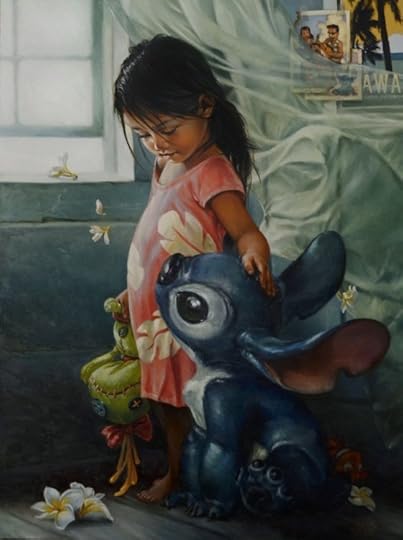
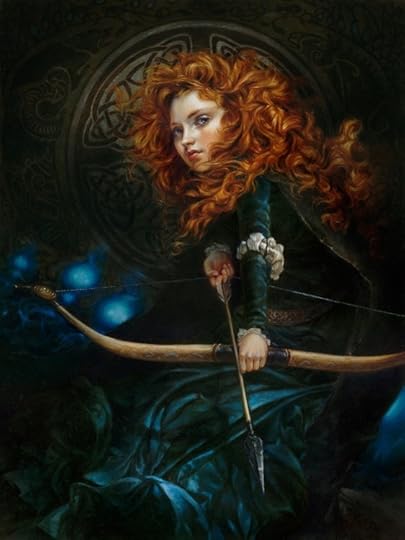
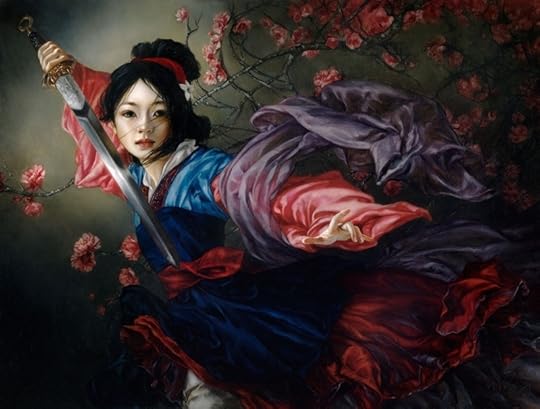
Disney films were a fixture of my childhood (and still a regular occurrence in my adult life), so these Disney portraits by Heather Theurer are a sublime meeting of childhood favourites and a sophisticated art style that ticks all the right boxes. I’m particularly smitten by Lilo and Stitch, and Theurer’s lovely ability to catch the soft light of an early morning.
“Heather’s paintings are the product of decades of observation of people, of environments, of animals and of textiles, as well as the convergence of every scrap of knowledge that came attached to them,” reads Theurer’s official biography on Disney Fine Art. “The wonder and magic of Disney movies, both the imagery and the music, also helped cultivate the ideas that began to take form in painting, and now, boldly recreating Disney characters in a way that brings them into the realism of our world has become an exciting new passion.”
You can find more of Theurer’s art, including some astounding fantasy art, on her official website. Prints of these portraits are available through Disney Fine Art
The post Heather Theurer breathes life into your favourite Disney heroines appeared first on A Dribble of Ink.

July 1, 2014
A Tale of Two Worlds
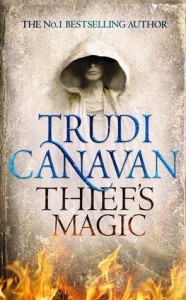
The first book in the Millennium Rule trilogy, Thief’s Magic is set in a different world – or worlds, rather – to Canavan’s previous works, and as such makes a good entry point to her writing for any new readers. In the interests of full disclosure, Trudi is a friend, which means I’m potentially biased; that being said, Thief’s Magic is definitely a book which kept me engrossed on its own merits.
When Leratian history student Tyen Ironsmelter discovers Vella, a sentient, magical book, while on an expedition with the notorious Professor Kilraker, he knows he should turn such a valuable artefact over to the Academy. Instead, rather than see Vella doomed to decades of neglect and obscurity by those who don’t appreciate her – or worse, destroyed – Tyen keeps her for himself. But Vella, as the creation of a legendary magician, knows magical secrets, and when her powers are discovered by Tyen’s masters, their treachery forces him to flee. Meanwhile, Rielle, a dyer’s daughter from the city of Fyre, struggles to conceal her ability to see Stain, the shadowy absence of magic. Men who can see Stain become priests, using their powers to serve the Angels, but for women, such work is forbidden. After being attacked by a tainted, an illegal magic user, Rielle is pushed into the company of Isare, a handsome artist, and exactly the sort of person her family doesn’t want her to marry. But as her connection to Isare grows – and as her ability to see Stain forces her to keep secrets from him – Rielle’s position becomes more and more dangerous. What is the true nature of magic? What does it mean to travel between worlds? And how does it change those who do?
Fyre and Leratia are both deeply flawed societies whose social norms restrict the agency of women, and whose authorities are riddled with corruption.
Though the two separate narratives never directly intersect, the journeys of their respective protagonists both parallel and complement each other in a number of interesting ways. Superficially, our heroes are two very different characters: Tyen is a white, working-class man from an imperial nation whose commonplace use of magic is technological to the point of being industrial, while Rielle is a privileged woman of colour from a setting where the use of magic is highly restricted and spiritual. Crucially, both settings are constructed with equal care. For all their individual strengths and differences, Fyre and Leratia are both deeply flawed societies whose social norms restrict the agency of women, and whose authorities are riddled with corruption. It is this latter fact which ultimately provides the main impetus behind Tyen and Rielle’s adventures, as both characters are betrayed by systems – and by individuals within those systems – they implicitly thought they could trust, which forces them to question their place in things.

There’s a strong tendency for Western narratives to assume that passive characters somehow equal bad storytelling: that the hero must always be instigating, not reacting.
What makes their steady transition so effective is the fact that neither character is, by nature, rebellious. From the outset, Tyen and Rielle are both hardworking and obedient, albeit within very different social contexts, but for all this, they’re not wholly complacent, either. Tyen resents the class differences which separate him from his richer friends at the Academy, while Rielle – whose family, though rich and respected, are dyers rather than nobles – suffers a similar stigma among her temple classmates, as well as chafing at the limits of acceptable behaviour for a young woman. Their steady realisation that things are not as they seem – and that they themselves are in charge of their own destinies – provides the story with a solid emotional core.
Canavan has a particular knack for telling internal narratives in ways that feel active rather than passive, fluid rather than purely introspective. At every turn, we understand exactly why Tyen and Rielle are making this decision or that, even if, from our position as objective readers, we’re better placed to see the ways things can go wrong for them. This, I think, is Canavan’s real strength as a writer, and a prominent factor in her widespread popularity: her ability to construct an engaging, fast-paced story based on how her characters think. As Aliette de Bodard has pointed out, there’s a strong tendency for Western narratives to assume that passive characters somehow equal bad storytelling: that the hero must always be instigating, not reacting, even when this results in their making arguably stupid decisions for the sake of continuous action. And yet, precisely because this trope is so ubiquitous, we are often trained to read more passive, internal narratives as slow or pointless, or as having started too early; as though the inclusion of any sort of dramatic build up is just so much irrelevant faffing. Canavan, though, delivers the best of both worlds: thoughtful, intelligent characters who are both active and reactive, and whose internal decision-making drives the story without ever becoming stagnant or self-indulgent.
Buy Thief’s Magic by Trudi Canavan: Book/eBook
Her worldbuilding works along similar lines. There’s a pleasing sense of detail in her descriptions of the arts of bookbinding, dyeing and painting, and yet these sections never feel like infodumps. By contrast, the magical technology of Tyen’s world, with its railsleds, aircarts and magical automata, was described so sparingly as to provoke, rather than restrict, the reader’s imagination. For me, these scenes felt positively Miyazaki-ish, and a pleasure to visualise.
Thief’s Magic is an enjoyable, engaging book from an accomplished author
My only real complaint concerns the ending, which felt a bit rushed: Rielle’s section ends, if not abruptly, then with the sudden introduction of new information we’re not quite given time to digest before the story changes again, while Tyen’s climax feels a bit too simplistic. But this is a small concern in a novel which otherwise held my attention throughout, and whose overall themes – of culture, consumption, history and trust – are otherwise neatly mirrored between two different stories. In the end, Tyen and Rielle are both the titular thief of magic: Tyen is forced to steal Vella in order to keep her safe, while Rielle has been taught all her life that using magic means stealing from the Angels. Thief’s Magic is an enjoyable, engaging book from an accomplished author, and as such, I look forward to seeing what happens next.
The post A Tale of Two Worlds appeared first on A Dribble of Ink.

June 30, 2014
“Insects are People Too” by Adrian Tchaikovsky
I get the question “Why insects?” quite a lot. My stock response depends on how flippant I’m feeling at the time, but comes in two flavours. One is all about lofty literary ideals and exploring the human condition via the chitinous mirror that is insects. The other is “I just like insects.” Both are true1.
The lofty literary business is a thing, though. There is a genuine tradition, mostly a Central/Eastern European one, of using insects to examine human nature. Kafka’s Metamorphosis, of course, but also the Insect Play by the brothers Capek, and Viktor Pelevin’s Life of Insects. Even the ant section in T.H. White’s Sword in the Stone is worth a mention2.
These are all great works, but for me – the lover of insects – they share a problem. Their portrayals are all very negative. When Samsa wakes up as a cockroach3, it is both to the revulsion of his family and peers, and to considerable physical difficulty just getting around in a human world4, and the various insects in Pelevin and Capek are shown as human, but the worst of what humanity has to offer – selfish, rigid, murderous, warlike. They are an object lesson in where we’ve gone wrong as a species.
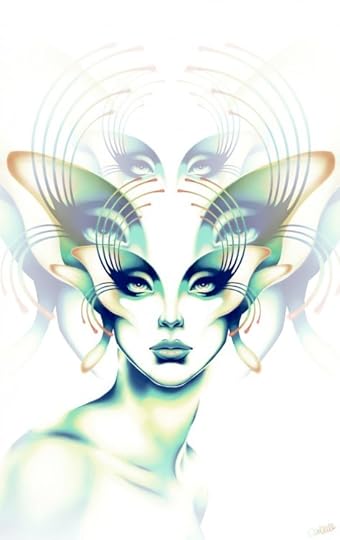
Art by Chris Hill
They are the swarming hordes, whose purpose is no more than to overwhelm and devour – and we, the heroic humans, are free to slaughter them in their thousands.
Elsewhere in genre fiction insects and their kin are simply a convenient shorthand for the worst possible evil. They are the swarming hordes, whose purpose is no more than to overwhelm and devour – and we, the heroic humans, are free to slaughter them in their thousands, because they come in their millions, and they all look the same, and they come over here, taking our jobs and ogling our women, and… Well yes, just like stormtroopers, zombies and killer robots, insects are a perfect way of dehumanising the Other until you can kill them without conscience or remorse. Who cares about insects, after all? For a perfect illustration, look at the poor bloody Geonosians in the Star Wars prequels. These are the insect guys in Attack of the Clones who have that arena thing where the big fight takes place, and they are also the ones who manufacture their cannon-fodder surrogates, the battle droids, for the Trade Federation. The Phantom Menace already substituted battle droids for living enemies to make the mass slaughter of the baddies more palatable, and when Anakin & co arrive on Geonosis they pick up with the Geonosians exactly where they left off with the robots. The insect-people (many of whom are unarmed and protecting their home) are simply fair game. There’s no Sand People moment of Dark-sidedness in hacking the crap out of them, they’re just there to die.
World of Warcraft has used insect-like races three times now to signify ultimate evil – detailed and nuanced insect races, in fact, but in the end they always reduce down to the nihilistic swarm. Tolkien – well, seriously, Tolkien I can only assume to be an arachnophobe5. Orcs will kill you, but the spiders, with their webbing and poisoning of the dwarves, promise a fate worse than just being hacked about – not just evil but unsportsmanlike too – un-British. I could go on.
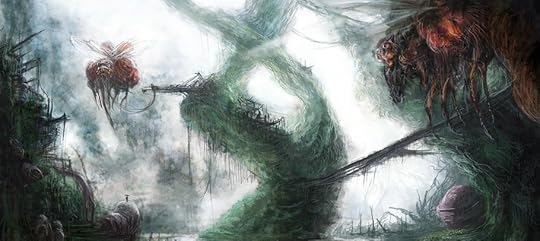
Art by Matthias Utomo
It’s worth pointing out Starship Troopers here, as a film that subverts the trope – the subtext is very plain about who’s invading who, and who the real monsters are, and highlights the ludicrous double standards of the Space Marine/Spartan etc. style archetype – in that it turns the human protagonists into exactly what is being demonised, a vast horde of identical emotionless Perfect Killing Machines. Leonidas and Master Chief and Leman Russ know their followers are individual heroes. Nobody thinks to consider that Insect Monster Queen S’zzzzrrptjk might think exactly the same about her myriad brood.
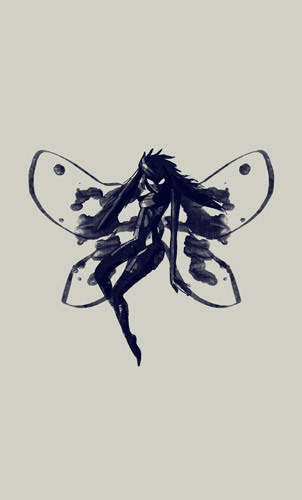
Art by Amelia
For some reason, the world of superheroes appears to be gratifyingly ‘colour-blind’ towards insect symbology. Spiderman, Blue Beetle, Ant Man, Wasp, all heroes, and nobody bats an eyelid. And of course the general insect-phobia I’m talking about is a very western thing. Plenty of New World, African and Asian cultures, for example, are full of positive insect role models, but for the progeny of Europe – that continent most free of actually threatening invertebrates – insects (other than bees, butterflies and ladybirds, I guess) are basically the Devil.
So this is where I came in. Because I liked the Geonosians and the Silithids and those wretched bad guys in Star Fleet, whatever they were actually called. I wanted to write a version of Metamorphosis where Gregor Samsa wakes up as a cockroach and it’s aces, best thing ever. I wanted to do insects that weren’t slaves to a hive mind67. And so, for my fantasy series, Shadows of the Apt, I came up with the insect-kinden – human nature being explored through insect nature8.
I’m not talking about the Art – the ability the kinden use to take on insect powers like flight. What that lends to the narrative is a whole different story, mostly to do with how your world changes when magic (not that the kinden think of it as magic) is a universal. However, each of the kinden has a particular nature that has developed under the influence of its arthropod patron. Individual characters may conform or kick against it, but there is certainly an archetype, for better or worse.
And that last is the key: better or worse. I can be as pro-bug as I like, but being rose-tinted about it would harm the narrative. Each of the kinden has its good and bad side, inextricably intertwined. Each has its own identity, but in a sufficiently flexible and nuanced way that, I hope, they avoid the ‘fantasy/SF race trap’ where alien or fantastic species basically have one personality trait and one thing they’re good at, and every one of them is like that, and does that. If there is a key to why the series – and the world – has found its readership, it’s probably this.
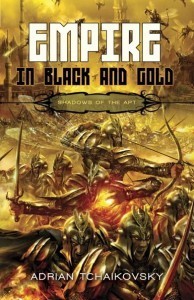
Buy Empire in Black and Gold by Adrian Tchaikovsky: Book/eBook
Beetles endure, for example. That’s an in-setting proverb, even. Just as beetles are found everywhere in enormous variety, the Beetle-kinden adapt and thrive – inventive, tough and flexible… the flip side of which is that there are plenty of examples of that becoming a moral flexibility – greed and self interest promoting the survival and profit of the individual no matter what9. Ant-kinden are cohesive and loyal, strong and self-sacrificing, but only if you’re one of them. Their cities tend towards martial isolationism, their technology towards reliance on the tried and tested rather than allowing innovation from outside. Spiders are elegant, creative, deceptive and often too clever for their own good. Wasps, the main antagonists, are militaristic, intolerant and parasitic, but also courageous, passionate and ambitious. And as noted, these are just the stereotypes. There are plenty of renegade Ants, noble Wasps, loyal Spiders and rigid Beetles in the books.
But things come full circle. I do go one darker and play with the most negative associations of insects and their kin, having firmly established my credentials as a champion against that. In a sense, the trope would be incomplete if I didn’t acknowledge the stereotype somewhere and put my own spin on it. And so we come to Seal of the Worm, in which the worst is made plain, and is revealed to be not just an invertebrate characteristic, but a human one. To write of the need of the swarm to destroy everything that isn’t itself is to hold the mirror up to humanity and reflect its own intolerance and xenophobia. In the world of the kinden, insects are people too, but sometimes people are insects…
From a certain point of view (waves hands mysteriously).
Don’t remember the ant section? Then you probably read the other version. In the original version it wasn’t included, but formed part of another book, the Book of Merlyn which was not published in White’s lifetime – he salvaged the ant section, amongst others, for a revised later printing of Sword in the Stone.
Or not a cockroach – the original translates, I’m informed, as “vermin”, which actually brings the human alienation point over much more sharply. The description of his physical difficulties certainly shows some sort of beetle or roach, though.
Metamorphosis as a parallel to the way people are treated when disabled is not something I’ve seen discussed, but surely it must have been.
Not an arachnophone, as originally typed. Tolkien as The Spider Whisperer is, however, a perversely attractive idea.
Please consider the tiny, tiny minority of insects that actually live in a caste-structured hive society.
Also, that’s not how ant nests and the like actually work, of course, but, like I say, convenient shorthand. We look at ants and see ourselves.
There was a mad moment when the whole series very nearly turned into Redwall with woodlice, with actual insects as the protagonists, but thankfully I came to my senses and wrote something that had at least a tiny chance of anyone wanting to read it.
And if that’s not one in the eye for the ‘faceless devouring swarm’ I don’t know what is.
The post “Insects are People Too” by Adrian Tchaikovsky appeared first on A Dribble of Ink.

June 26, 2014
Lee Harris leaves Angry Robot Books, joins the Tor.com Imprint as Senior Editor

Tor.com announced this morning that Lee Harris, Senior Editor at Angry Robot Books, will be joining their new short fiction imprint as Senior Editor. Harris will join Publisher Fritz Foy, Associate Publisher Irene Gallo, and Editorial Assistant Carl Engle-Laird at the imprint. They are still searching for a Publicity Manager, Marketing Manager, and Designer.
“The Tor.com role is full-time,” Harris revealed to me. This means that his time as Senior Editor at Angry Robot Books is coming to an end. This news comes just days after Osprey Media announced the closure of two of Angry Robot Books’ sister imprints: Strange Chemistry and Exhibit A. Harris maintained through his website that the timing is entirely coincidental. “The new role is an amazing opportunity for me, and if it had been advertised six months ago, or six months from now, I would still have applied. In a note to my authors I said that in many ways it’s the role that Angry Robot had been preparing me for over the last five years.”
Harris has been a part of the Angry Robot Books team since its earliest days, and leaving the imprint was not an easy decision for him. “Handing in my notice to Angry Robot was one of the hardest things I’ve ever done. It was a genuinely emotional meeting – Angry Robot is more than just my job, it’s my baby, and it always will be.”
With Harris moving to Tor.com in August, Angry Robot Books ison the search for a new Senior Editor. “Marc will need to find a replacement for me at Angry Robot. And you know what? Whoever gets that gig is going to have the time of their life.” Do you have what it takes?
For the past five years, Harris has acquired and edited full-length novels from many of genre’s most exciting voices, like Lauren Beukes, Madeline Ashby, Chuck Wendig, and more. The move from novel-length material to shorter fiction is a challenge that Harris is looking forward to, and Tor.com offered an opportunity that he couldn’t pass up.
“I love novellas – they’re my preferred format for my own leisure reading,” he said on his website. “And Tor? Tor is the best Big 5 SF imprint in the world! So, you know – I applied. And had a chat with the powers-that-be, and then flew to New York for another chat and a meet and greet. And after a great deal of discussion, Tor.com offered me the role, and I accepted.”
Starting a brand-new imprint for a world-class publisher, publishing novella-length stories? Working with some of the best in the business? What’s not to love?
More of Harris’ thoughts on the transition can be found on his personal blog.
So, what does a Lee Harris story look like? His impact on the Angry Robot Books catalogue is clear, but his taste in novella-length works is still a work-in-progress. “It’s more than a month until I officially join Tor.com so it’s a little early to say what shape the stories will take,” Harris told me when I asked him what he’s looking for. “I’m aiming for a broad mix of science fiction and fantasy (of all flavours), and I have a few… interesting ideas… that I want to run past Carl (the imprint’s Assistant Editor) and the Publishers. Until we’ve had a proper planning meeting – and until we see what people are going to send us – it’s too soon to tell.”
Tor.com is excited to get (another) Hugo-nominated editor on their roster, and the excitement is mutual. His enthusiasm was clear when I asked Harris to describe what he’s most looking forward to with the new gig. “Starting a brand-new imprint for a world-class publisher, publishing novella-length stories? Working with some of the best in the business? What’s not to love?”
The post Lee Harris leaves Angry Robot Books, joins the Tor.com Imprint as Senior Editor appeared first on A Dribble of Ink.