Aidan Moher's Blog, page 16
September 17, 2014
Cover Art for The Spider’s War by Daniel Abraham
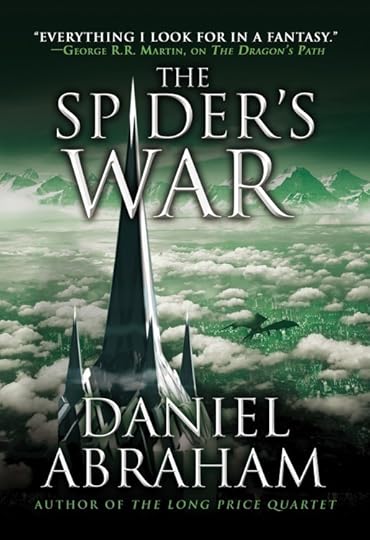
I’ve got one response for this:

(Okay, I actually have more than one response, natch, so bear with me. Orbit Books is one of the few big SFF publishers that understands the value in building a brand for its authors. When they weren’t happy with Brent Weeks’ cover for The Black Prism, they recovered the whole series and created an eye-catching and instantly recognizable series on bookstore shelves. They’ve done so with James S.A. Corey’s The Expanse, and Ann Leckie’s Imperial Radch series. The packaging and branding for Daniel Abraham’s The Dagger and the Coin was never their finest work, but it was bold and the emblematic weapon (sword, axe, torch, shield and spear) were consistent and matched scale.
And, now, suddenly, here’s a generic fantasy landscape with a lifeless dragon and a repeating cloud pattern, with the same handful of buildings cut and paste beneath them.
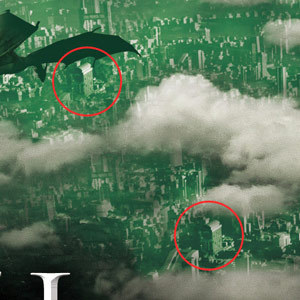
Not only that, they’ve doubly burned the branding on the series by using the tower’s peak as the “i” in the title, something that’s unprecedented in the previous covers.
Come on, Orbit. You can (and have) done better.
This isn’t the fifth book in an ongoing series that needs a kick in the sales pants, it’s the final volume of an attractive series from an author with a lot of diehard fans. Rebranding a series can be a powerful tool for introducing a series to a new set of readers, or giving sales a kick in the pants. However, the cover of the fifth and final volume in a series certainly isn’t going to sell more copies of the preceding four volumes, and, if they’re trying to bump themselves up a few notches on the scale of epic awesomeness, presumably to match the climax of the trilogy, they’ve stumbled over the finish line in a race they led the whole way through.
Disappointed doesn’t even begin to describe my feelings.)
The post Cover Art for The Spider’s War by Daniel Abraham appeared first on A Dribble of Ink.


September 16, 2014
Polyamorous Pacifists and Sentient Plant-monsters Collide in The Mirror Empire
In the world of Kameron Hurley’s The Mirror Empire, where magic users draw their power from one of three heavenly satellites, a dark star is rising, one whose ascendance heralds a time of cataclysmic change and war between realities. For Lilia, who crossed from one world to another in childhood, fleeing the wrath of an alternate, militaristic version of the peaceful Dhai culture she now inhabits, this means discovering her mother’s hidden legacy before it can destroy her. For Akhio, the younger brother and now unexpected heir of Dhai’s deceased leader, Oma’s rise brings politicking and treachery, both from Dhai’s traditional enemies and from within his own state. For Zezili, the half-blood daijian general of matriarchal Dorinah, charged by her alien empress with exterminating the nation’s daijian population, it means an uneasy alliance with women from another world; women whose plans are built on blood and genocide. For Rohinmey, a novice parajista who dreams of adventure, Oma brings the promise of escape – but at a more terrible cost than he could ever have imagined. And for Taigan, a genderfluid assassin and powerful omajista bound in service to the Patron of imperial Saiduan, it means watching cities burn as invading armies walk between worlds with the aim of destroying his. How many realities are there? Who can travel between them? And who will survive Oma’s rise?
The Mirror Empire hooked me in from the very first page.
The Mirror Empire, the first volume of the Worldbreaker Saga, is Hugo Award-winning writer Kameron Hurley’s fourth novel, and from the minute I first saw the blurb, I knew I had to read it. The entire concept – backstabbing politics, polyamorous pacifists, violent matriarchs, sentient plant-monsters, doors between worlds – is basically my personal catnip, and when you throw in my enjoyment of Hurley’s first novel, God’s War, my expectations at the outset were understandably high. Which is ordinarily a risk factor: the more I invest in a story beforehand, the more likely I am to wind up disappointed. But The Mirror Empire, with its sprawling, fascinating mix of original cultures, political wrangling – both within the narrative and as cultural commentary – and vivid, brilliant worldbuilding, hooked me in from the very first page. The only reason it took me so long to read, in fact, was a personal reticence to have the story end: I’ve been drawing it out over weeks and months, prolonging the inevitable.
Though portal fantasies are undergoing something of a resurgence right now – hell, I’ve written one myself – there’s nothing predictable or typical about The Mirror Empire, and I mean that in the very best possible way. In this setting, invaders from a parallel reality are using blood-magic to push at the boundaries between worlds – but once a gate is open, the only way to cross from one reality to another is if your doppleganger on the other side is either dead, absent, or non-existent. Though the logic behind this conceit is never really explained – like much epic fantasy magic, it can ultimately be reduced to Because Reasons – Hurley explores the implications in fascinating ways, using her premise to underscore and inform the already unsettling and, at times, downright devious political machinations of her characters. There’s a reason the book has been described elsewhere as resembling the product of “an angry, feminist George R. R. Martin dropping acid and using steroids,” and violent political shenanigans is only part of it.
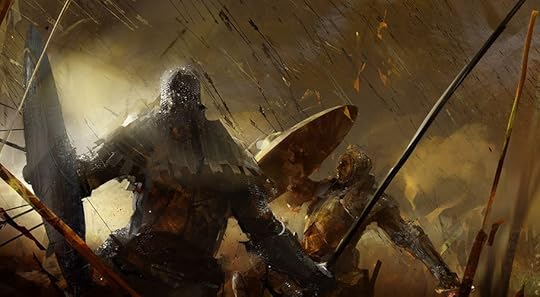
Art by Richard Anderson
It won’t come as a shock that Hurley is willing and able to write a broad spectrum of aggressive, complicated, narratively unconventional women with skill and nuance.
Which brings me to the book’s portrayal of women – and, more specifically, to the question of female violence. For anyone familiar with Hurley’s previous work, it won’t come as a shock that she is willing and able to write a broad spectrum of aggressive, complicated, narratively unconventional women with skill and nuance; what is nonetheless striking about her work, and particularly when viewed in a feminist context, is her penchant for writing about women as the perpetrators of both institutional and sexual violence against, not only each other and contextual outsiders, but men. And this is something I want to unpack, because one of the more luridly unsubtle genderflips of classic pulp SFF – and therefore of the collective geek unconsciousness – is the idea of, to mangle a phrase from Shakespeare, a bevy of bouncing Amazons, buskined mistresses and warrior-loves lording it over the lads, for which crime they are invariably situated as either a male sexual fantasy (strong women just want stronger men!) or the worst sort of radfem strawgirls (behold the misandrist, Dworkinite utopia!).
The idea being, of course, that female violence exists either to be fetishized by straight guys who still win out in the end, even if only sexually (“Death by snu-snu!”), or as a hypothetical, scaremongering perversion of “natural” womanly norms, the stereotype so deeply ingrained in culture that we rarely see it explored with any degree of intelligence or imagination, let alone empathy. What Hurley does, by contrast, is extend to women the same flawed humanity the rest of us customarily extend to men, bypassing the tired-yet-still-apparently-ubiquitous cliché that a country run by ladies would be inherently pacifistic in favour of treating women as people, which is to say, as persons as equally capable of bigotry, bias, ruthlessness, sexual aggression, violence and calumny as any other gender, and extending that thought to the creation of an entire culture. And thus the importance of Dorinah, whose matriarchy was founded (we can contextually infer) as a direct reaction to the historical oppressions of Saiduan, and of her general, Zezili – a character who would, in many ways, be archetypal if male, but who is nonetheless complex enough to defy being pigeonholed.
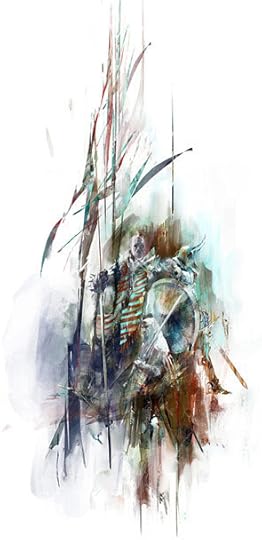
Art by Richard Anderson
Zezili has a pretty young husband, Anahva, whose actions are sharply constrained by the culture in which he lives – men wear binders to keep them weak, cannot travel alone, are married and sold as sexual ornaments – and, by our standards, does not treat him well, though she also (in her own way) cares deeply for him, if not always about him. Arguably, in fact, he is a victim of marital rape, and while we’re given this information in a way that doesn’t exonerate Zezili, we are still invited to view her as a complex character, one whose actions are dictated as much by her cultural upbringing as by her personal circumstances. Which is, in one sense, shocking; as much as I enjoyed her chapters, I was also deeply conflicted about my reactions to them. And yet the exact same narrative courtesy – that of offering absolution, or at least narrative sympathy, to the perpetrators of objectively horrific crimes – is routinely extended to popular male characters, such as, to press the Martin comparison, Jaime and Tyrion Lannister, whose acts of rape, abuse and murder are somehow never seen as reasons not to view them as interesting, or worthy of redemption.
Zezili, with her gruff, brutal affection for Anahva, her resentment at being ordered to commit an effective genocide against her own caste, and her competence, cleverness and complexity, is a direct challenge to everything that this forgive-men-their-sins mentality represents. Simultaneously, she forces us to ask ourselves, If I can sympathise with violent men, why can’t I sympathise with violent women? and, If I cannot sympathise with violent women, then why should I sympathise with violent men? This is the point and power of Zezili: she sits at the intersection of several of our strongest cultural biases, and therefore cannot help but press us to examine them. Are we too forgiving of violence generally, and of certain types of violence in particular? Or is it just that we’re too forgiving of men, regardless of what they’ve done? Either way, how should we strive to react to women who commit violence in stories – with acceptance and desensitisation, regardless of questions of gender? With a contextual awareness and comparison of gender roles both within the narrative and our own, real-world culture? Or with the revulsion we should arguably strive to feel for all such atrocities and those who commit them? Though many female characters in The Mirror Empire both commit and are subject to violence, it is Zezili who most thoroughly personifies these questions – and who, as a consequence, I cannot help but want to see more of.
Are we too forgiving of violence generally, and of certain types of violence in particular?
Nor is Zezili the only politically engaging character on offer – far from it, in fact. Though Hurley’s writing is not didactic, in the sense of forcing the protagonists to engage in endless philosophical debates (in the manner of, for instance, Terry Goodkind), she nonetheless manages to effect a powerful political commentary through a potent combination of worldbuilding, asides and gracenotes. Consider this early exchange, for instance:
‘I wonder,’ the sanisi said, ‘what does a pretty parajista with a fiery interest in death have to say to a plain-faced crippled girl?’
‘You have a weird way of seeing people,’ Roh said. ‘I don’t know why being plain matters. She’s very smart.’
‘I suppose when you don’t seek to own a thing,’ the sanisi said, ‘its beauty matters less.’
The Mirror Empire is full of such moments, some with more brevity than others, but all thought-provoking. But it is also, in the most imaginative sense, an original epic fantasy. The Dhai lands, where much of the action takes place, are home not only to one of many unique and richly described cultures, but a physical environment that feels like something out of the Final Fantasy franchise (and as an FF fan of many years’ standing, I mean that in the best possible way). And yet Hurley never overwhelms us with too many details: the mental pictures the story allows us to paint are creations of negative space, evoked through concept and language rather than infodumping, as per this example:
A great snuffling, crackling sound came from the forest. She poked her head above the poppies. Immense white bears with jagged black manes broke through the trees. Forked tongues lolled from their massive, fanged mouths. Their riders wore chitinous red and amber armour and carried green-glowing everpine branches as weapons, the sort imbued with Tira’s power. Lilia knew those weapons well – her mother used them to kill wolverines and walking trees.
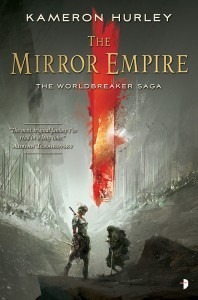
Buy The Mirror Empire by Kameron Hurley: Book/eBook
The Mirror Empire is one of the best books I’ve read this year, and I cannot wait to see where the rest of series takes us.
In every sense of the word, therefore, and on every meaningful level, The Mirror Empire is a wholly ambitious novel – and overwhelmingly, it succeeds. Though there are times when the number of POV characters – or POV switches, rather – feels excessive, instances where the same information could have been conveyed more concisely or in a different way, in the end, any faults are minor compared to its virtues. It is exceedingly well-characterised, narratively gripping, compellingly worldbuilt, and politically powerful. Without a doubt, The Mirror Empire is one of the best books I’ve read this year, and I cannot wait to see where the rest of series takes us.
The post Polyamorous Pacifists and Sentient Plant-monsters Collide in The Mirror Empire appeared first on A Dribble of Ink.

September 15, 2014
“Conversations with My Favorite Author” by Johanna Staveley
“Guess how long the space ships are in this book!”
“Guess how long the space ships are in this book!”
The conversation often starts something like this. Sometimes it’s, “Guess how many different genders are in this world!” or, “Guess what Gwenna just discovered about Annick!”
I’m not the person asking. My husband poses these questions, and it is my job to answer them. If I don’t guess correctly, I’ll get another opportunity in a few minutes, a few hours, a day or two. When he’s reading a new book, each masterful bit of world-building is fodder for a conversation like this one. When he’s writing a new scene, each plot point or moment of character development is an opportunity for a pop-quiz.
“I don’t know,” I reply. “Half a galaxy long?” I think this is a plausibly impressive size, given his enthusiasm, given the volume and intensity with which he has asked the question. He knows that I cannot tell a furlong from a parsec, but he refuses to believe that a person can live in the world without understanding basic measurement and scale.
“What!? Half a galaxy! That’s absurd! That wouldn’t even make sense to write a story about. So how long do you really think the ships in this book are?” He looks at me expectantly. There is an answer to this question – a discrete, easy-to-articulate answer – and he believes it will delight me as much as it delights him.
“Ummm….”
Art by Cyril Rolando
I bet we can agree that the sleeping / eating / bathing / drinking / sartorial regimens of most authors are, at best, absurd.
We who choose to cohabitate with authors of fiction and fantasy love our authors for a wonderful multiplicity of reasons, but if we were to reduce our loves to bullet points, I bet some of us might agree that we love them at least partly because they conjure magic from the mundane, because they bestow meaning on minutiae that we may not even pause to consider. We marvel at their insight, their creativity, their alchemical prose. We love our authors because their imaginations transform the world.
They can also be total pains in the ass. While each author is obviously his or her own special snowflake, there are things about living with an author that we, the cohabitants, might agree are… challenging. For instance, I suspect other author-lovers might agree that spending the morning in a coffee shop researching the world’s most awesome volcanic black lava calderas – just in case the visual and statistical information might be helpful for one small scene – well, it just doesn’t seem like work. I bet we can agree that the sleeping / eating / bathing / drinking / sartorial regimens of most authors are, at best, absurd. I’m guessing that we might see eye to eye on our authors’ increasingly obsessive relationship with Twitter.
Art by Andrew Hou
Perhaps we can also agree that sometimes it can be challenging to just shoot the shit with someone who is constantly thinking about setting the scene, clarifying character motivation, moving the plot. Sometimes it gets tiring trying to hammer a conversation into something that takes the shape of a story, something that has a clear beginning, middle, and end, that reveals true and lasting personal growth. Certainly, my natural conversation is devoid of massive starships.
I am no author of epic fantasy – I’m not even a very good teller of basic campfire stories – but I’ve been known to string together a narrative of at least a few coherent sentences. Before my husband spent every day all day writing, or planning to write, or thinking about writing, we used to have normal conversations, by which I mean, conversations with no particular point. Conversations where we talked just in order to talk to each other. These days – the days when he may spend hours clutching his head trying to plausibly reconcile Annurian politics with Intarran theology in 6,000 words or less – such conversations tax his psychic reserves. Aimless chatter, questions that don’t have clear answers, stories without resolution, these are anathema to my dear writer.
Now, clearly it’s a good thing that Brian is the writer in the family. If the other adult Staveley in this house were penning a trilogy, you might have ended up with The Chronicle of This Thing that Happened When I Was Trying to Parallel Park Downtown rather than the Chronicle of the Unhewn Throne.
Furthermore, it sometimes seems that the wonders of the real world pale in comparison to the fictions my husband creates. Rarely does the cool thing that our toddler found on a hike turn out to be a portal to another dimension, or a four-headed lioncrab with molten metal claws, or the Sword of Eternal Reckoning. Usually, the cool thing is a clump of blackberry bushes, a speckled rock, or a neat patch of lichen. It’s also true that the things that happen around here on a day-to-day basis do not have particularly well-paced action or satisfying closure. No one would write a book, or even a short story, about what goes on in my day, but it really is a lovely life.
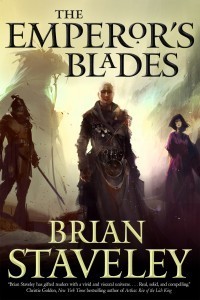
Buy The Emperor’s Blades by Brian Staveley: Book/eBook
I wonder if the talent for crafting fascinating characters, rich imaginary worlds, and well-paced plots distorts our understanding of the real world. I’m always a little suspicious of people at dinner parties who can tell stories that are hilarious and touching and have a beginning, middle, and end; I’m usually pretty sure that these people have, at least partially, made their stories up. As entertainment, that kind of thing is fine, but as intimate conversation it’s worthless. The messy stuff, the boring stuff, the stuff that is neither useful nor revelatory, that’s often the stuff that makes memories, the stuff that makes our lives what they are. Maybe sometimes it’s our job to remind our writers that – Guess what! – those things are pretty cool, too.
The post “Conversations with My Favorite Author” by Johanna Staveley appeared first on A Dribble of Ink.

September 12, 2014
Spend the weekend in Wonderful Bounds of Allison Strom’s Art

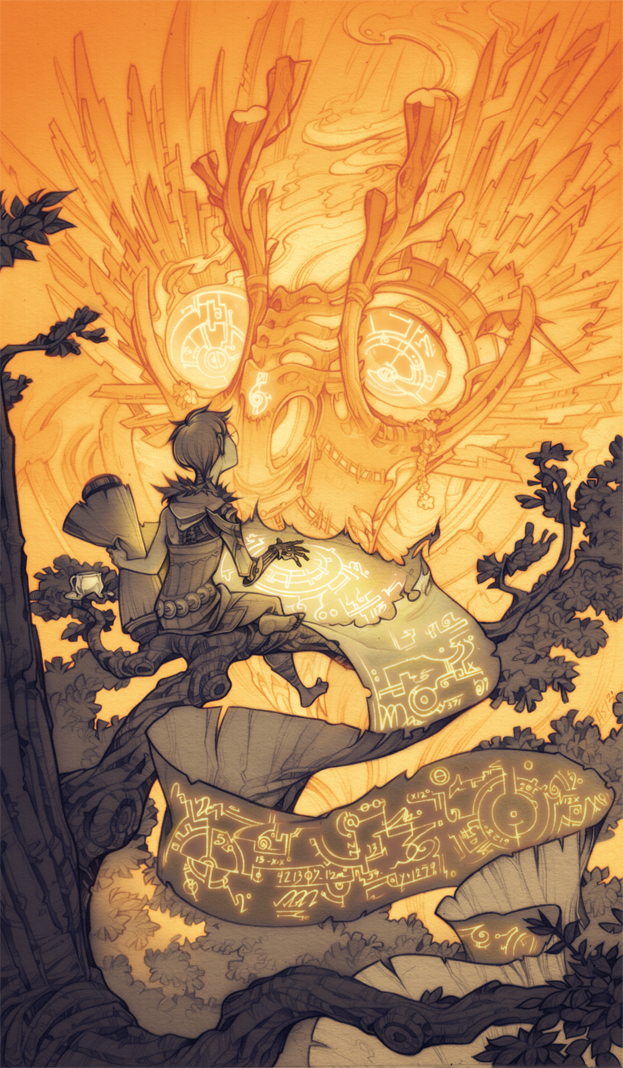
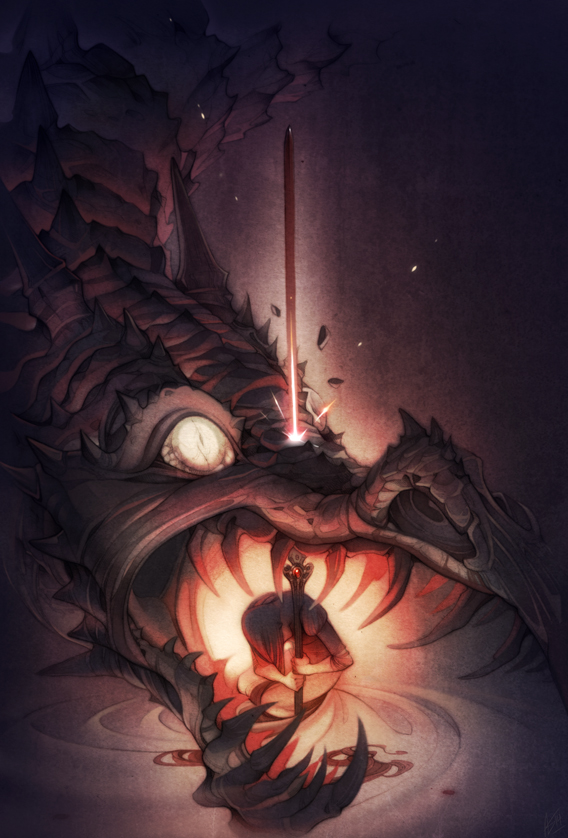
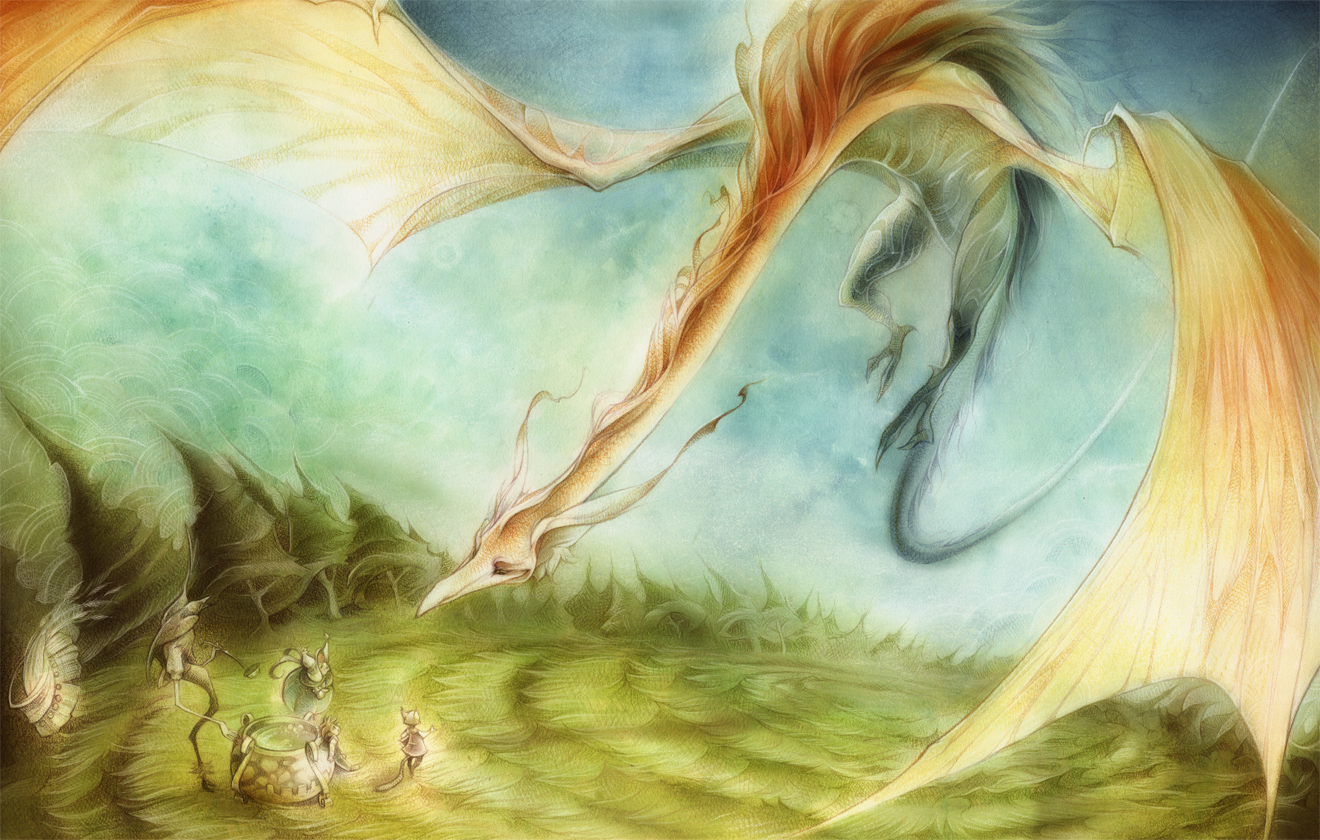
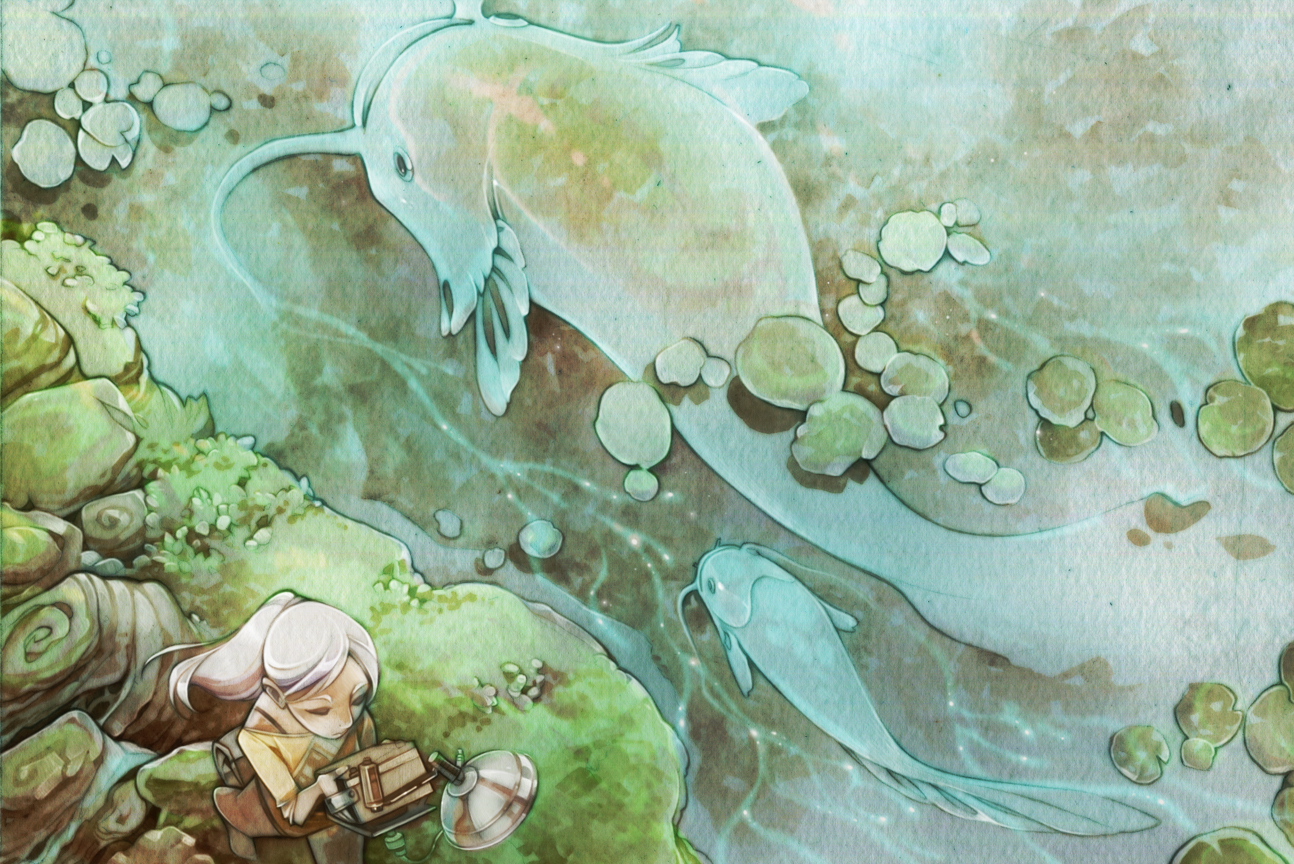
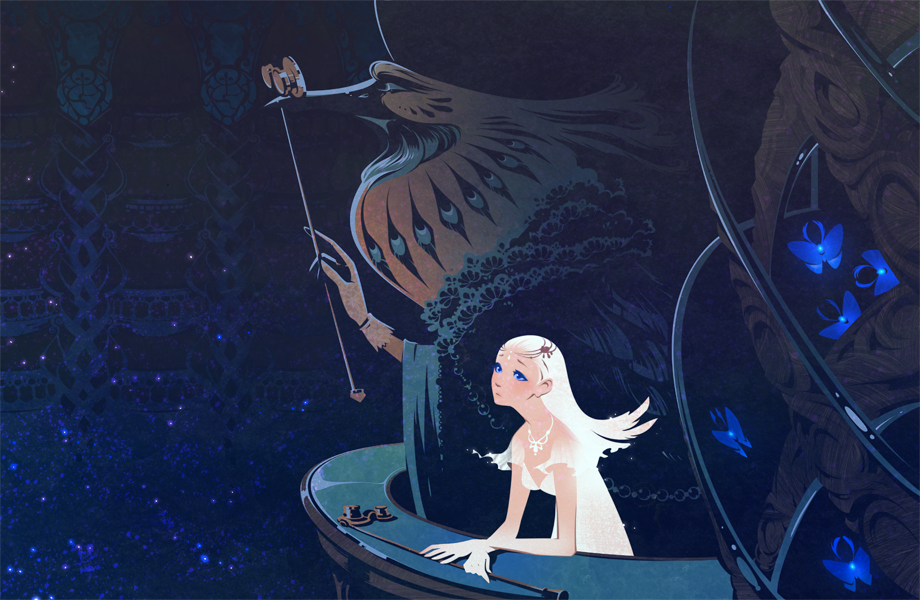
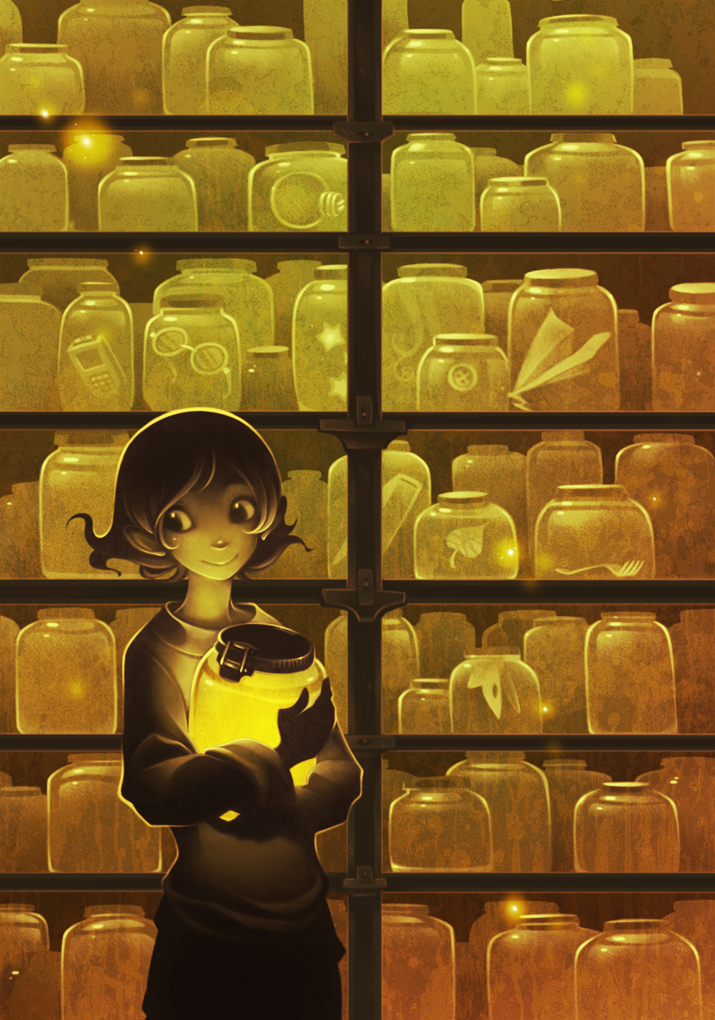
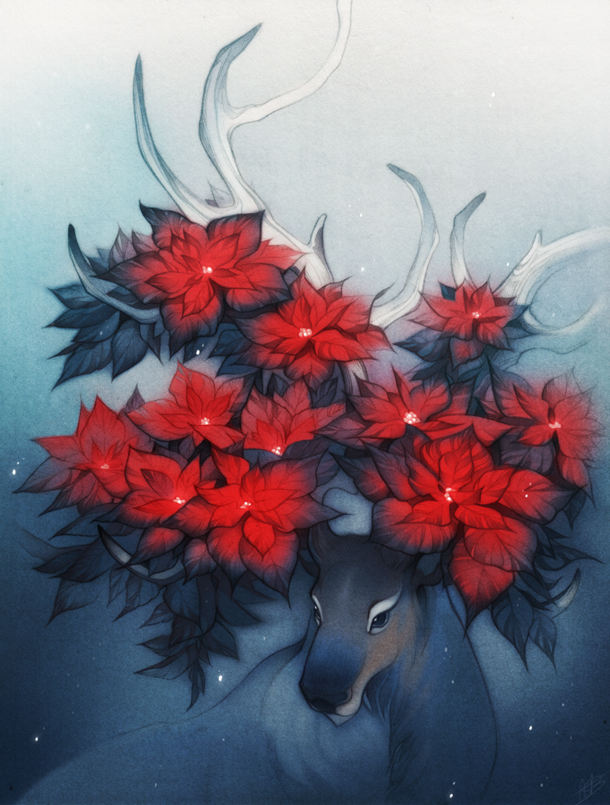
“Allie Strom has spent her entire life drawing things,” says the official website of the American artist, and that lifelong devotion to her art certainly paid off, with a diverse and imaginative portfolio of art. I think what stands out most about Strom’s art is that no piece looks like the last. From tone, to composition, to subjects, they’re unique and individual glimpses into the worlds of the artist’s imagination. Beautiful stuff.
You can find more of Strom’s art on her DeviantArt page, her personal portfolio, and on her progress Tumblr. I recommend spending some time this weekend with all the talented young artist has to offer. Her imagination is boundless.
The post Spend the weekend in Wonderful Bounds of Allison Strom’s Art appeared first on A Dribble of Ink.

September 11, 2014

September 10, 2014
Progress Update for The Last King of Osten Ard by Tad Williams
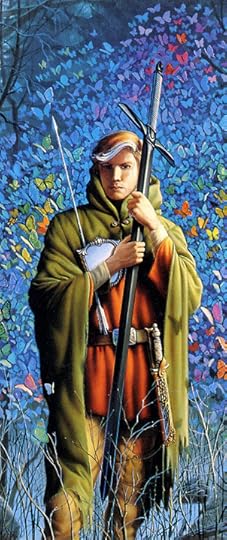
If forced to choose an upcoming release that I’m most excited for (because on the Internet we’re binary and drastic), Tad Williams’ upcoming trilogy, The Last King of Osten Ard, would likely be the answer. Yeah, over Ancillary Sword or The Thorn of Emberlain or The Doors of Stone. Williams’ original Memory, Sorrow and Thorn trilogy means so much to me that a return to that realm comes with my highest levels of excitement and expectation. No matter what happens, I’ll be jumping in with both feet and it will be an experience worth savouring (as with all of Williams’ novels.)
So, naturally, I troll the Internet looking for updates and speculation about The Last King of Osten Ard, and Williams recently gave fans a peek at his progress on the series. Williams recently reported to his message board that work on the novel had slowed down due to a family emergency and “work pressure,” but that work is now continuing on the first volume of the trilogy, The Witchwood Crown. “I’m only at about page 400 of the book,” he said. “But I’m back into a stretch where I can work on it full-time again.”
Returning to the beloved world of Osten Ard is exciting for long-time fans of Memory, Sorrow and Thorn, but Williams believes the new series will be just as enjoyable for entrenched fans and newcomers alike. “I believe I can now write a story worthy of those much-loved settings and characters,” he said in the series FAQ, “one that people who haven’t read the originals can enjoy, but which will of course mean more to those who know the original work. More than that, I feel I can do something that will stand up to the best books in our field. I have very high hopes. I’m excited by the challenge. And I’ll do my absolute best to make all the kind responses I’ve already had justified.”
Further updates will no doubt emerge when Williams does an AMA (Ask Me Anything) with Reddit’s /r/fantasy forum on September 18th. So, if you have anything you want to pick his brain about, mysteries of Memory, Sorrow, and Thorn, if he realizes that The War of the Flowers is his secret best work, or what it’s like to have been a direct influence on the biggest fantasy series of the decade (Martin’s A Song of Ice and Fire), now’s your chance!
The Witchwood Crown is still on track for a 2015 release from DAW Books. If you’re looking to join in the fun, now would be a perfect time to discover Tad Williams’ seminal Memory, Sorrow and Thorn trilogy, beginning with The Dragonbone Chair.
The post Progress Update for The Last King of Osten Ard by Tad Williams appeared first on A Dribble of Ink.

September 8, 2014
“Put On Some Pants and Get Out: Writing a Book Without Destroying a Marriage” by Brian Staveley
“The thing is,” I pointed out, “It’s all work. This is work.”
“The thing is,” I pointed out reasonably, “I’m working even when my fingers aren’t physically pressing the keys.” I pointed helpfully at my head, trying to indicate the furious labor going on inside. “Writing is not a linear process. It’s all work. This is work.”
My argument might have been more compelling if I hadn’t been standing in my boxer shorts at 2 o’clock on a Tuesday afternoon drinking an IPA and watching the local porcupine trying to snag that last apple without falling out of the tree.
“You may be working,” Jo replied, “but I want to punch you really hard in the neck.”
It seemed like an uncharitable thing to say to a man who was hard at work writing his second novel. It seemed doubly uncharitable given that Jo is my wife, and that our division of labor – the very division that led me to be standing on the porch in my boxers in the first place – was something we had hammered out together, something we had both happily embraced.
I pointed this out. The things she said next were even less charitable.
The problem, as it turned out, was my trying to write from home. When Jo and I moved to Vermont, newborn baby under one arm, newborn three-book deal under the other, I had a romantic notion of writing out on the deck while my infant son happily puttered about my feet. Jo, who works part-time, imagined ample opportunity to grow beets or trim roses or massage the local deer, all while our son puttered happily about under her feet. At the end of each day we would gather around a rustic table, break bread, and regale one another with the day’s adventures. The infant? He would be still happily puttering, we thought.
I had a romantic notion of writing out on the deck while my infant son happily puttered about my feet.
Art by Sixtine Dano
Funny thing: infants do not happily putter about one’s feet.
Funny thing: infants do not happily putter about one’s feet. At least, my infant did not. My infant was excellent at squirming, fairly decent at screaming and puking, and utterly remedial in the “happily puttering” category. Trying to write while watching my son was like trying to read while wrestling an octopus in the water at night. Jo was hard pressed to find time to massage a single deer. Our house was a wonderful, warm place, but very chaotic, very loud. Not an environment terribly conducive to writing.
And yet, the thing was, I still wanted to be around. Puking and screaming notwithstanding, I love my son more than I realized it was possible to love anything, and he was never going to be two months (or four months, or eight months) old again. The solution seemed clear – work from home and come downstairs to read kid books or snuggle during the writing breaks. I could get the book done, see Jo and Felix, and help out around the house more than I’d be able to if I was working in town.
This was a terrible idea. I’d start upstairs, writing happily away, until I hit a snag. This usually took one to three minutes. In another situation I’d soldier on, bang my head against the keyboard a few dozen times, and solve the problem. When I could hear my family laughing out in the yard, however, it was easy to close the laptop (for just a few minutes, mind you!), head outside, and start roughhousing in the clover. Bucolic bliss! Domestic intimacy! Momentary co-parenting!
Anyone reading closely will have paused at that last ejaculation. Momentary co-parenting, seductive as the notion might seem, is not a thing. Not only is it not a thing, the thought that it might possibly be a thing is utterly infuriating to the parent doing the lion’s share of the parenting, in this case, Jo. Seeing me playing with the baby, she’d seize the chance to do some other task: maybe something crucial to our continued survival, like calling the propane company, maybe something crucial to her continued sanity, like reading a few pages of a book. So far, so good.
The writing engine, however, never really quits – it just goes into neutral for a while. Sooner or later, while cavorting in the leaves with my son (I realize the season just changed from summer to fall. This went on for a while.) I’d have the (hopefully) brilliant idea that would solve the most recent plotting (or character, or historical) problem, leap up, start to go to my computer, then realize that I was the only parent in sight.
I’m embarrassed to say I often felt aggrieved.
This was my job. Tor had paid me to write three novels, and I needed to deliver those novels on time. And then, of course, there’s all the ancillary activity that comes with writing: tweeting, responding to tweets, blogging, doing interviews, writing guest posts, going to readings, blurbing other books, and the rest of it. I thought of myself as a person working nine-to-five six or seven days a week, even if I was working from home. These little breaks were, in my mind, the equivalent of stepping away from a desk in a cubicle to spend a few minutes chatting at the water cooler. Everyone takes breaks at work; that doesn’t mean you’re not working.
As Jo pointed out to me, however, you can usually tell when other people are working because they are at fucking work. A break at the water cooler looks different from a guy still in pajamas going sledding with his son or cracking open a beer with his wife at noon. While everyone in a traditional workplace understands what’s happening (or at least, what’s intended to happen) inside the office, the expectations inside a home are far more fluid. I felt fine – I felt happy – sliding fluidly between my three roles of writer, husband, and father. Jo, however, felt baffled.
“It’s impossible to tell,” she protested, “if you’re working, or hanging out, or playing. I don’t know when you’re done for the day or planning to keep writing all night. You might come down and play with Felix for two minutes or an hour, and it’s not fair to expect me to know.”
And she was, as she usually is, right.
Art by Eyedea Studios
“You may be working,” Jo replied, “but I want to punch you really hard in the neck.”
I believe as firmly now as I did then that the creative process is non-linear. I usually have my best ideas when I finally slam the computer shut and go for a run. Which, of course, leads me scurrying back to my computer to type furiously for an hour. From inside the walls of my own head, it makes perfect sense, but from the outside, from where my wife is sitting, it looks like selfish insanity: We’re chatting. I’m playing with the baby. I HAVE TO GO RIGHT NOW THIS VERY SECOND I HAVE A GREAT IDEA. It is a process built for one.
The solution, as most good solutions are, has been simple: I go away to write. I spend a lot of my time in the public library in town. I also drink what is probably an unhealthy volume of coffee at our local coffee shop. There is just one rule that Jo and I have agreed upon: writing happens somewhere else.
Our rule has been crucial in keeping me from getting punched in the neck, but it’s been tremendously valuable to me in other ways. The great thing about writing, as a profession, is that you can do it anywhere, anytime. The awful thing about writing, as a profession, is that you can do it anywhere, anytime, which means that I, at least, am always tempted to be working, to be writing. When I was single, this didn’t matter. Writing was probably a better use of my time than trying to beat Elder Scrolls III using only pillows as weapons.
Buy The Emperor’s Blades by Brian Staveley: Book/eBook
Now that I have a family, however, the order of priorities is all topsy-turvy. I love writing, I am contractually obligated to write, and it’s the main source of our income. And yet most days, it’s very, very hard to pull myself away from my son and my wife, to go to the library when they’re cooking pancakes, or going to the farm, or just reading books on the couch. Without a clear line of demarcation between family life and writing life, I’d constantly be trying to do both at the same time, and fucking up both.
Hence the rule: I go away to write. Which is why I need to write like a banshee right now. I’m breaking the rule. I’m home. My wife is upstairs putting my son to bed, and when she comes down, I’m closing this computer, shutting off all thoughts of plot and character, and drinking a bottle of wine with the woman I love.
The post “Put On Some Pants and Get Out: Writing a Book Without Destroying a Marriage” by Brian Staveley appeared first on A Dribble of Ink.

September 7, 2014
Congratulations to the Winners of the 2014 British Fantasy Awards

Via Tor.com, the 2014 winners of the British Fantasy Award:
Best fantasy novel (the Robert Holdstock Award):
Winner: A Stranger in Olondria, Sofia Samatar (Small Beer Press)
Between Two Thorns, Emma Newman (Angry Robot)
Blood and Feathers: Rebellion, Lou Morgan (Solaris)
The Glass Republic, Tom Pollock (Jo Fletcher Books)
The Ocean at the End of the Lane, Neil Gaiman (Headline)
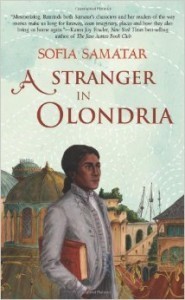
Buy A Stranger in Olondria by Sofia Samatar
Best horror novel (the August Derleth Award):
Winner: The Shining Girls, Lauren Beukes (HarperCollins)
House of Small Shadows, Adam Nevill (Pan)
Mayhem, Sarah Pinborough (Jo Fletcher Books)
NOS4R2, Joe Hill (Gollancz)
Path of Needles, Alison Littlewood (Jo Fletcher Books)
The Year of the Ladybird, Graham Joyce (Gollancz)
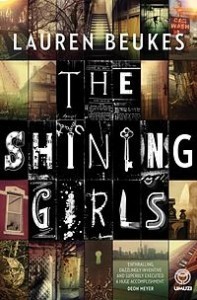
Buy The Shining Girls by Lauren Beukes
Best novella:
Winner: Beauty, Sarah Pinborough (Gollancz)
Dogs With Their Eyes Shut, Paul Meloy (PS Publishing)
Spin, Nina Allan (TTA Press)
Vivian Guppy and the Brighton Belle, Nina Allan (Rustblind and Silverbright)
Whitstable, Stephen Volk (Spectral Press)
Best short story:
Winner: Signs of the Times, Carole Johnstone (Black Static #33)
Chalk, Pat Cadigan (This Is Horror)
Death Walks En Pointe, Thana Niveau (The Burning Circus)
Family Business, Adrian Tchaikovsky (The Alchemy Press Book of Urban Mythic)
The Fox, Conrad Williams (This Is Horror)
Golden Apple, Sophia McDougall (The Lowest Heaven)
Moonstruck, Karin Tidbeck (Shadows & Tall Trees #5)
Best anthology:
Winner: End of the Road, Jonathan Oliver (ed.) (Solaris)
Fearie Tales, Stephen Jones (ed.) (Jo Fletcher Books)
Rustblind and Silverbright, David Rix (ed.) (Eibonvale Press)
Tales of Eve, Mhairi Simpson (ed.) (Fox Spirit Books)
The Tenth Black Book of Horror, Charles Black (ed.) (Mortbury Press)
Best collection:
Winner: Monsters in the Heart, Stephen Volk (Gray Friar Press)
For Those Who Dream Monsters, Anna Taborska (Mortbury Press)
Holes for Faces, Ramsey Campbell (Dark Regions Press)
North American Lake Monsters, Nathan Ballingrud (Small Beer Press)
Best small press:
Winner: The Alchemy Press (Peter Coleborn)
The Alchemy Press (Peter Coleborn)
Fox Spirit Books (Adele Wearing)
NewCon Press (Ian Whates)
Spectral Press
Best comic/graphic novel:
Winner: Demeter, Becky Cloonan
Jennifer Wilde, Maura McHugh, Karen Mahoney and Stephen Downey (Atomic Diner Comics)
Porcelain, Benjamin Read and Chris Wildgoose (Improper Books)
Rachel Rising, Terry Moore (Abstract Studio)
Saga, Brian K. Vaughan and Fiona Staples (Image Comics)
The Unwritten, Mike Carey and Peter Gross (Vertigo)
Best artist:
Winner: Joey Hi-Fi
Adam Oehlers
Ben Baldwin
Daniele Serra
Tula Lotay
Vincent Chong
Best non-fiction:
Winner: Speculative Fiction 2012, Justin Landon and Jared Shurin (eds) (Jurassic London)
Gestalt Real-Time Reviews, D.F. Lewis
Doors to Elsewhere, Mike Barrett (The Alchemy Press)
Fantasy Faction, Marc Aplin (ed.)
“We Have Always Fought”: Challenging the “Women, Cattle and Slaves” Narrative, Kameron Hurley (A Dribble of Ink)
Best magazine/periodical:
Winner: Clarkesworld, Neil Clarke, Sean Wallace and Kate Baker (ed.) (Wyrm Publishing)
Black Static, Andy Cox (ed.) (TTA Press)
Clarkesworld, Neil Clarke, Sean Wallace and Kate Baker (eds) (Wyrm Publishing)
Interzone, Andy Cox (ed.) (TTA Press)
Shadows & Tall Trees, Michael Kelly (ed.) (Undertow Books)
Best film/television episode:
Winer: Game of Thrones: The Rains of Castamere, David Benioff and D.B. Weiss (HBO)
Doctor Who: The Day of the Doctor, Steven Moffat (BBC)
Game of Thrones: The Rains of Castamere, David Benioff and D.B. Weiss (HBO)
Gravity, Alfonso Cuarón and Jonás Cuarón (Warner Bros)
The Hobbit: The Desolation of Smaug, Fran Walsh, Philippa Boyens, Peter Jackson and Guillermo del Toro (Warner Bros)
Iron Man 3, Drew Pearce and Shane Black (Marvel Studios)
Best newcomer (the Sydney J. Bounds Award):
Winner: Ann Leckie, for Ancillary Justice (Orbit)
Emma Newman, for Between Two Thorns (Angry Robot)
Francis Knight, for Fade to Black (Orbit)
Laura Lam, for Pantomime (Strange Chemistry)
Libby McGugan, for The Eidolon (Solaris)
Samantha Shannon, for The Bone Season (Bloomsbury)
The British Fantasy Society Special Award (The Karl Edward Wagner Award):
Farah Mendlesohn
Congratulations to all the winners!
Though, I’d like to point out that both Jared Shurin and Justin Landon, editors of Speculative Fiction 2012, which beat out Kameron Hurley’s “We Have Always Fought”, are Americans and there is a scandal afoot and I demand a recount and how could they possibly win (isn’t this the “British” fantasy award?) and… oh, who am I kidding,those guys, and their collection full of amazing writers, rocks. Well deserved!
Also, I’m very pleased to see Joey Hi-Fi, one of the best artists working science fiction and fantasy, walk away with the award. He’s amazing. And, of course, the wonderful and amazing Ann Leckie.
The post Congratulations to the Winners of the 2014 British Fantasy Awards appeared first on A Dribble of Ink.

September 4, 2014
Grim Oak Press’ Unveils a New Name for its Upcoming Follow-up to Unfettered
Earlier this year, Grim Oak Press announced Neverland’s Shadow, edited by Shawn Speakman and Roger Bellini, a follow-up to the publishers successful first anthology, Unfettered. “All of the stories are told from the point of view of the villain/antagonist,” said Publisher Shawn Speakman of the new anthology. “I’ve always felt like the villain doesn’t get enough time on the page from his/her/its point of view. Well, now we will have an entire book and I simply can’t wait to bring it to you!”
And now, Neverland’s Shadow has a new name: Unveiled.
(Oh the deliciousness of the pun I was able to use in the title of this post.)
“After asking for suggestions from the internet(s),” Speakman says on the Grim Oak Press website, “more than 1300 titles were sent into the website. I culled them down to 10 favorites. Editor Roger Bellini did the same from those 1300.”
“I am tired of heroes winning and writing history the way they choose,” Speakman said. “The stories within Unveiled are told from the point of view of villains and, finally, their stories will be “unveiled” for all to read. No matter what the heroes think!”
“I am tired of heroes winning and writing history the way they choose,” Speakman said.
Honestly, I’m not crazy about the new name. Neverland’s Shadow was punchy and interesting, though it’s difficult to separate the connection to Peter Pan’s youthful island. Unveiled is thematically on point, and pairs nicely with Unfettered, but I can’t help but feel like it loses a bit of the impact, a bit of the mystery. Also, a theatre background just puts images of raising curtains in my head. Because, you know, everyone has the same cognitive patterns and connections as this blogger, right?
Whatever the title, Speakman and Grim Oak Press did a wonderful job with Unfettered, and I’m looking forward to seeing the villainous tales collected in Unveiled. The list of contributing authors was *ahem*… unveiled in July. The anthology features some heavy hitters of the science fiction and fantasy genres:
Terry Brooks (introduction)
Ann Aguirre
Piers Anthony
R. Scott Bakker
Jim Butcher
Glen Cook
Tang Fei (Chinese tranlsated work)
Mark Lawrence
Tanith Lee
Ken Liu
Scott Lynch
John Marco
Tim Marquitz
Peter Orullian
Kat Richardson
Anthony Ryan
Shawn Speakman
Michael J. Sullivan
Adrian Tchaikovsky
Unveiled is due for release by Grim Oak Press in February 2015. Preorders begin soon.
What do you think of the lineup for Unveiled? What about the new name?
The post Grim Oak Press’ Unveils a New Name for its Upcoming Follow-up to Unfettered appeared first on A Dribble of Ink.

September 3, 2014
Cover Art & Details for The Awakened Kingdom by N.K. Jemisin
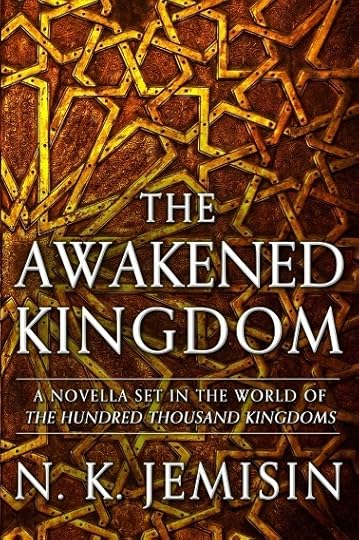
Via the official Orbit Books blog, we are now privy to the gorgeous cover art and a synopsis for N.K. Jemisin’s upcoming sequel novella to her popular Inheritance trilogy. The Awakened Kingdom tells the tale of the first godling born to the world of the Hundred Thousand Kingdoms in thousands of years, and “Shill’s got big shoes to fill.”
As the first new godling born in thousands of years — and the heir presumptive to Sieh the Trickster — Shill’s got big shoes to fill. She’s well on her way when she defies her parents and sneaks off to the mortal realm, which is no place for an impressionable young god. In short order she steals a demon’s grandchild, gets herself embroiled in a secret underground magical dance competition, and offends her oldest and most powerful sibling.But for Eino, the young Darren man whom Shill has befriended, the god-child’s silly games are serious business. Trapped in an arranged marriage and prohibited from pursuing his dreams, he has had enough. He will choose his own fate, even if he must betray a friend in the process — and Shill might just have to grow up faster than she thinks.
If Jemisin’s other work is anything to go by (and it is!), readers have a lot to look forward to when The Awakened Kingdom releases later this year.
The Awakened Kingdom is a novella that takes place after the conclusion of The Kingdom of Gods, the concluding volume of Jemisin’s Inheritance trilogy. It will be included in all print and eBook editions of the Inheritance trilogy omnibus that is set for release on December 9th, 2014.
The post Cover Art & Details for The Awakened Kingdom by N.K. Jemisin appeared first on A Dribble of Ink.