Aidan Moher's Blog, page 25
March 20, 2014
Gollancz reveals Ancestral Night, a new Space Opera from Elizabeth Bear

Gollancz announced today that they have acquired a two-volume Space Opera from award-winning author (and A Dribble of Ink-favourite) Elizabeth Bear. The first volume is titled Ancestral Night.
“I’m thrilled to be writing long-form SF again,” Bear told me when I reached out to her to find out more about the novels.
“I’ve been looking for the opportunity to get back into science fiction for some time,” she continued. “Ancestral Night is in its own mode, but deeply beholden to the work of Iain Banks, Andre Norton, and C. J. Cherryh. Expect sprawling conflicts, politics, and ancient alien technologies, all wrapped up in a package of gritty, grounded personal drama.”
Details are scant at the moment, but the Gollancz announcement about the acquisition contained an early peek at what readers can expect.
Combining a unique concept with a compelling plot, Elizabeth Bear’s novels imagine the invention of The White Drive: an easy, nonrelativistic means of travel across unimaginable distances. The gripping story follows salvage operators, Haimey Dz and her partner Connla Kurucz, as they pilot their tiny ship into the scars left by unsuccessful White Transitions, searching for the relics of lost human – and alien – vessels.
“We’re always looking for exciting new voices in SF,” said Simon Spanton, Associate Publisher at Gollancz, “Sometimes that voice is already there but hasn’t broken through in a particular market. Elizabeth’s novels have always fizzed with ideas, passion and character. The chance to publish a new SF novel from her and welcome her to Gollancz is one I absolutely relish.”
Ancestral Night is currently scheduled for a late 2016 release.


March 18, 2014
Dance, George, Dance — The future of George R.R. Martin’s Game of Thrones
If the books and TV show seem to be revelling in the worst aspects of human nature, that’s partly because those aspects are what Westeros helps us to recognize in ourselves.
In a recent interview with Vanity Fair, George R.R. Martin discussed the past, present, and future of his mega-popular series, A Song of Ice and Fire, and its television adaptation, Game of Thrones. Some of the most interesting moments in the interview concern the future of HBO series and the potential that it might catch up with Martin’s work on the novels.
“The minute you have a series [of books] and a book comes out,” Martin explained (surprising no one), “people immediately begin asking, ‘Where’s the next book?’ And the more successful the series is, the more people ask that question, and the more pressure you begin to feel.”
Martin’s struggle against that pressure is one of the most publicized and scrutinized stories to hit SFF fandom is the past decade. Here’s a creator working on a seminal work of fantasy, adored by millions of people around the world, who is also crushed under the weight of his fame, criticized for his own fannish activities (such as watching football, or attending conventions) and condemned for not writing fast enough. As if works the calibre of those he’s producing can come over night.
Prominence of this issue hit its peak when Neil Gaiman, another writer who understands the intricacies of dabbling in many mediums, wrote an open letter to Martin’s detractors. “George R.R. Martin is not your bitch,” he famously said. “This is a useful thing to know, perhaps a useful thing to point out when you find yourself thinking that possibly George is, indeed, your bitch, and should be out there typing what you want to read right now.
“People are not machines. Writers and artists aren’t machines.”
However, at this point in time, some are wondering if it isn’t beginning to look like George R.R. Martin is HBO’s bitch — as the show catches up to Martin’s progress on the series of novels (which Martin has been working on for over 18 years, so far), the pressure rises. “The fact that the show is catching up to me has really doubled-down on that and made me feel the pressure a lot more,” Martin admitted to Vanity Fair. “The truth is, some writers thrive on that. I don’t really. I don’t like deadlines. I’ve spent most of my career trying to avoid deadlines.”
Describing Martin’s work, Charlie Jane Anders of io9 said, “If the books and TV show seem to be revelling in the worst aspects of human nature, that’s partly because those aspects are what Westeros helps us to recognize in ourselves.” Too true, Charlie. Too true, indeed.
So, with all this pressure, and deadlines looming for the season-a-year series, where do Martin and HBO go from here?
“Ultimately, it’ll be different. You have to recognize that there are going to be some differences,” Martin told Vanity Fair. “We have Gone With the Wind the movie and we have Gone With the Wind the book. They’re similar but they’re not the same.” Recognizing that the HBO adaptation, which already began to stray dramatically from the structure of the novel in the third season, is its own interpretation of Martin’s story helps to illuminate why the television series catching up to Martin’s progress on the novels isn’t such an earth-shattering problem. The beginning of the story is the same, the broad strokes at the end might be the same, but the different mediums require that a lot of the middle parts be drastically different. Where Martin has the luxury of a limitless canvas, HBO has the luxury of foresight and can plot calmly within the expectations of what they see ahead. Picture a ship navigating through fog towards an idea of a destination, and another on clear seas travelling towards a beacon on the horizon.
Martin’s plan, or hope, anyway, is that HBO isn’t as close to catching up to him as they appear. He explains:
I’m hopeful that I can not let them catch up with me. The season that’s about to debut covers the second half of the third book. The third book [A Storm of Swords] was so long that it had to be split into two. But there are two more books beyond that, and A Dance With Dragons. A Dance With Dragons is itself a book that’s as big as A Storm of Swords. So there’s potentially three more seasons there, between Feast and Dance, if they split into two the way the did [with Swords]. Now, Feast and Dance take place simultaneously. So you can’t do Feast and then Dance the way I did. You can combine them and do it chronologically. And it’s my hope that they’ll do it that way and then, long before they catch up with me, I’ll have published The Winds of Winter, which’ll give me another couple years. It might be tight on the last book, A Dream of Spring, as they juggernaut forward.
However, disappointment at seeing the end to the series on television instead of as ink on a page aside, I’m not entirely convinced that the show catching up with the book is a doomsday scenario for most fans.
Martin admits that “[The producers of Game of Thrones] know certain things. I’ve told them certain things. So they have some knowledge, but the devil is in the details. I can give them the broad strokes of what I intend to write, but the details aren’t there yet.” That devil, of course, being the overbearing weight of the fan expectations and immense depth of the series thus far. If Martin’s A Song of Ice and Fire becomes the novel equivalent of Lost — bloated, meandering and entirely off key by its conclusion — then isn’t it to the benefit of viewers for showrunners Benioff and Weiss to approach the future of the television project with an understanding that they should work towards their own satisfying version of Martin’s conclusion?
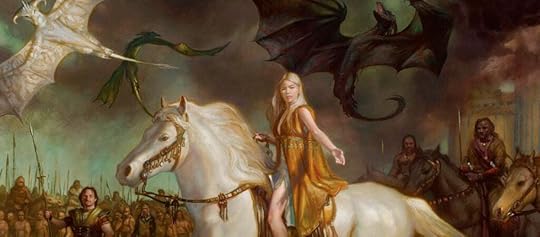
Brandon Sanderson recently said that he believes “we haven’t hit what epic fantasy is really capable of doing yet.”
Brandon Sanderson recently said that he believes “we haven’t hit what epic fantasy is really capable of doing yet.” I agree. There’s enormous potential in the human imagination, and we often yearn for escapism, two aspects that form the foundations of epic fantasy. Martin, above almost most other authors, is pushing the scale of how expansive, how epic fantasy can be, and the genre’s still trying to catch up to him. Sixty years after Tolkien published Lord of the Rings, modern epic fantasy is only just now in its toddler phase, with Tolkien’s tropes (themselves stolen from other writers, poets, and myths thousands of years old) still permeate the genre. It’s a playground that even the most celebrated writers are still working to escape from. Now, consider that epic fantasy on television stretches back to, well… about as far down the road as the burger joint I can see from the window of the office where I write this essay. If George R.R. Martin has spent nearly two decades wrangling his story into a medium with thousands of years of precedent, how can Game of Thrones‘ David Benioff and D.B. Weiss hope to keep pace? They can’t. So, instead of biting off more than they can chew, to push the boundaries of what epic fantasy is capable of, they replace breadth with agility and foresight.
“I don’t know what it is, but it seems like we’re back in a place where epic fantasy is something taking off,” Sanderson continued. “And it’s probably a mixture of us as writers evolving and having this history of reading while adding our own spin on it mixed with the genre kind of saying ‘hey we want some more this. We haven’t had it in a while.’”
Game of Thrones delivers fantasy to those genre eager fans who will never pick up a book in their lives. In many ways, HBO’s adaptation is a clean foil to Peter Jackson’s The Hobbit trilogy. “The Desolation of Smaug stumbles under the weight of its legacy and cannot recover from the overambitious airs of its director,” I said in my review of the film. “[The Desolation of Smaug's] ultimate success rides too heavily on the viewer’s ability to reconcile their affections for Tolkien’s novel with Jackson’s bombastic adaptation.” Where Tolkien’s tale was being bloated beyond recognition, Benioff and Weiss have Martin’s epic on a treadmill, shedding fat.
“Seven gods, seven kingdoms, seven seasons. It feels right to us,” said Benioff.
“Seven gods, seven kingdoms, seven seasons. It feels right to us,” said Benioff. So, with that in mind, what sort of body weight might the show be shedding as it moves forward with its plan to wrap up the series in just seven seasons? Let’s take a look.
Just to be clear, there are major spoilers for the both the show, the novels, and popular theories ahead.
Ahem. Well, then, here we go.
Without too much thought, it’s easy to come to the conclusion that A Song of Ice and Fire‘s finale will be a climactic engagement between Aunt-and-Uncle-slash-future-awkward-lovers Jon Snow, of the Night’s Watch, and Dany, of Meereen’s Despots & Dragons® fan club, and the White Walkers, et al. Martin’s been taking the slow way around to this conclusion, what with Dany sitting around in her palace for a couple of novels, putting on a clinic about why children shouldn’t have empirical rule over a group of people, and Jon being, well… killed. But HBO’s Game of Thrones is telling a different story. And, for the vast majority of fans, that’s the only story that matters.
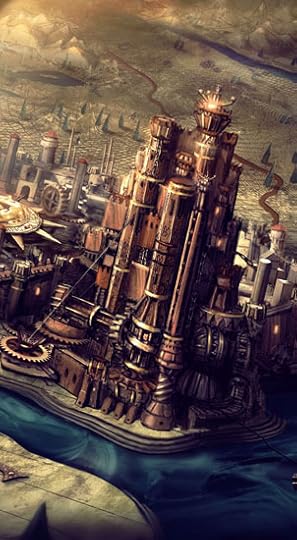
Does Game of Thrones need half a season of Tyrion bathing with turtles? Is the reappearance of Aegon Targaryen necessary? And what about the ill-fated adventures of Quentyn Martell? Are these stories necessary for bringing Dany and Jon together under the banners of the Seven Kingdoms of Westeros and the Free People of the North, against the White Walkers? Explored at the depth that George R.R. Martin has convinced us all is necessary in the novels, perhaps, but as a Sunday serial? I’m not quite convinced.
Who’s to say that Tyrion can’t spend an episode fleeing King’s Landing and arriving at the doorstep of Dany’s desert kingdom? And another episode or two convincing her to mobilize her army and sail it across the sea to dismantle his treacherous family members (and position her for a convenient meeting with her nephew) in season six, en route to a showdown with the icy northerners in season seven?
The best dramatic television is lean and packed with storytelling in every frame. So far, HBO’s Game of Thrones has managed to accomplish this despite its source material. How long could that last if they continue with a faithful adaptation Martin has written himself into a corner, created so many plotlines that require at least partial tying off, characters that need to resolve into some worthwhile plotline, that he has no choice but to continue on at the pace he’s been working at for years. He’s telling a tale that’s bigger than deadlines, and, well… Hollywood just doesn’t work that way.