
Jonathan Chait's Blog, page 9
August 15, 2011
Obama Economic Team: Get Out of Town
[Guest post by Kara Brandeisky]
In The New York Times, Binyamin Appelbaum and Helene Cooper report that the Obama camp is split on how to move forward on economic issues:
Mr. Obama’s senior adviser, David Plouffe, and his chief of staff, William M. Daley, want him to maintain a pragmatic strategy of appealing to independent voters by advocating ideas that can pass Congress, even if they may not have much economic impact. These include free trade agreements and improved patent protections for inventors.
But others, including Gene Sperling, Mr. Obama’s chief economic adviser, say public anger over the debt ceiling debate has weakened Republicans and created an opening for bigger ideas like tax incentives for businesses that hire more workers, according to Congressional Democrats who share that view. Democrats are also pushing the White House to help homeowners facing foreclosure.
Even if the ideas cannot pass Congress, they say, the president would gain a campaign issue by pushing for them.
To me, this section reads a bit like a recent Onion article (imagine a headline like, “Obama Advisors Debate Whether to Try to Aid Faltering Economy or Not”). But alas, Appelbaum and Cooper report:
So far, most signs point to a continuation of the nonconfrontational approach — better to do something than nothing — that has defined this administration. Mr. Obama and his aides are skeptical that voters will reward bold proposals if those ideas do not pass Congress.
While President Obama’s “nonconfrontational approach” is well-documented, I suspect the weird bubble that is Washington, D.C. is also having a big impact on advisers like Plouffe and Daley. An interesting Gallup poll released today shows that D.C. not only leads the nation in the “economic confidence index”—it is literally the only territory with a positive confidence score.

Gallup creates the index after asking consumers to rate their perceptions of current economic conditions and then asking them if economic conditions are “getting better” or “getting worse.” Consumers in D.C. were the only ones in the country to believe the economy is “getting better,” giving D.C. a economic confidence index of +11. The state with the next highest economic confidence index is North Dakota, with an economic confidence index of -13. The state with the lowest economic confidence index is West Virginia, with an economic confidence index of -44.
Surprisingly, the unemployment rate in D.C. is actually higher than the country at large. But there are many more public sector jobs. Furthermore, D.C. is the most-educated metro area in the United States, and unemployment among workers with advanced degrees is significantly lower. As a result, D.C. is pretty isolated from the deep economic pessimism in the rest of the country.
Luckily, Obama is leaving Washington today, beginning a three-day bus trip through the Midwest. But a word of advice to Sperling: If you really want to change Obama’s mind, perhaps finish the trip in West Virginia.


Rick Perry: If At First You Don't Secede...

On the face of it, it's pretty remarkable that Rick Perry would impugn President Obama's patriotism (the country should have a president "in love with America") after having threatened secession. Kaili Joy Gray remarks, "nothing says 'I love you, America" like threatening to leave it."
But maybe the defense for Perry is that his angry threats to secede sprang from a deep love of country. The opposite of love isn't hate, it's indifference. Rick Perry is the volatile boyfriend who screams about leaving his girlfriend but always comes back because he can't quit her, baby. And now in 2012 we Americans can marry that boyfriend, which will surely make him want to stay for good.
If Staying in the Republican Primary Race Were Easy, Everybody Around The World Would Stay in the Republican Primary Race
[Guest post by Nathan Pippenger]
Turns out Jon was right about being wrong: He “massively overestimated” Tim Pawlenty, whose campaign ended with a whimper after a third-place finish at the Iowa Straw Poll. Pawlenty always struck me as he did Chait: the candidate who could appeal to both the base and the elites. His candidacy was the next-best thing to voting in an alternate universe where Mitt Romney never supported universal healthcare.
But that reasoning never caught on—or at least it didn’t among the few thousand Iowans who tanked Pawlenty’s campaign over the weekend. It’s a testament to the media-presidential campaign complex’s ability to utterly upend reality that a molecular portion of Iowa’s Republican voters, who often are more-or-less bribed to attend this ridiculous event, can lend credence to no-shot campaigns (Ron Paul finished second), while torpedoing credible candidates. TNR’s Walter Shapiro has thoroughly documented just how damaging the straw poll can be to the GOP’s national prospects—as he concludes, it’s an “ersatz election,” “as scientific as sorcery,” and “one of the most insidious events in politics.”
For all these reasons, then, Pawlenty’s early exit from the race is a little confounding. (My colleague Simon van Zuylen-Wood speculates, probably correctly, that he’s out of money. Losing the Straw Poll did cost Pawlenty’s campaign about a million dollars.) But it’s also amusing when you recall one of the early ads of Pawlenty’s campaign: a baffling, fascinating 86 seconds of melodramatic music and B-roll called “Courage to Stand.” The ad contains footage of sunrises over the National Mall; the fall of the Berlin Wall; clouds speeding over the Statue of Liberty; serious-looking, suit-wearing men gazing into the distance; small children staring meaningfully into the camera; a formation of fighter jets; and more. With only the most tenuous of a thematic connection among these otherwise-random images, it’s the political equivalent of Chris Dane Owens’s “Shine on Me” music video (also a YouTube sensation). Watch for yourself:
Throughout the ad, Pawlenty compares the work of his campaign to Valley Forge, the moon landing, and the settling of the Western frontier. The ad repeats a rhetorical formula: If X were easy, everybody around the world would be X. “If prosperity were easy, everybody around the world would be prosperous! If freedom were easy, everybody around the world would be free! If security were easy, everybody around the world would be secure!” Pawlenty finishes the list with a sharp declaration: “They are not!” “None of this is gonna be easy,” he tells a transfixed audience. “It takes an extraordinary effort. It takes extraordinary commitment!” It’s odd to hear from someone who quit after getting third place at an unrepresentative poll held six months before the first primary votes are scheduled to be cast. Courage to Stand is one thing. I guess it takes more courage to run.
Some Things To Read Today
I'm on vacation, but I've had a little time to read the news. Here are a few interesting takes you should check out if you haven't already:
1. The emergence of religious radicals Michele Bachmann and Rick Perry is a kind of Michelle Goldberg Full Employment Act. Read her latest today.
2. The Republican estbalishment starts to organize in response to Bachmann. Read National Journal and today's Wall Street Journal lead editorial, the former a description of the phenomenon and the latter an example of it.
3. I think Ross Douthat's pining for Chris Christie at the end of his column today is a little nutty, but this diagnosis of the GOP field is spot-on:
No one doubts Romney’s intelligence or competence, but he has managed to run for president for almost five years without taking a single courageous or even remotely interesting position. The thinking person’s case for Romney, murmured by many of his backers, amounts to this: Vote for Mitt, you know he doesn’t believe a word he says.
But his phoniness would remain a weakness even if he won the presidency. He’s a born compromiser pretending to be a hard-liner, and the hard-liners know it — which means he would enter the Oval Office with conservative knives already sharpened and ready for his back.
Rick Perry has many of the qualities that Romney seems to lack: backbone, core convictions, a killer instinct and a primal understanding of the right-wing electorate. He also has the better story. Where Romney has to run away from his Massachusetts health care bill and downplay his years as a downsizing artist at Bain Capital, Perry can spend the campaign reminding voters that almost half of the new jobs in Obama’s presidency were created on his watch in Texas.
What Perry doesn’t have, though, is the kind of moderate facade that Americans look for in their presidents. He’s the conservative id made flesh, with none of the postpartisan/uniter-not-a-divider spirit that successful national politicians usually cultivate.
Imagine if the Democratic Party nominated a combination of Al Franken and Nancy Pelosi for the presidency, and you have a sense of the kind of gamble Republicans would be taking with Perry.
4. Matthew Yglesias on Perry's desire to raise taxes on the bottom half of America. Also Yglesias has more thoughts on Perry after reading his book.
5. Warren Buffett on why the rich should pay higher taxes. He apparently hasn't been informed they now have to be called "job creators."
August 12, 2011
Things I Wish I Said On Charlie Rose

Any time you go on a live program, especially one with multiple guests, there are things we want to respond to but never get a chance to say. Two spring to mind from my appearance on Charlie Rose:
1. Drew Westen said that I painted him as a person who had never been to Washington. I never said that. Read my item responding to Westen.
2. I defended President Obama's position on stimulus because he can't get Congress to pass any more stimulus. Fareed Zakaria defended it by arguing that further stimulus is unwise. I think that's very, very wrong.
&c
-- More on Michele Bachmann's favorite theologian.
-- Jonathan Cohn on the most recent health care court decision.
-- Tyler Cowen takes a look at the two potential Fed nominees. And an overview from Dylan Matthews.
-- Felix Salmon: buy stocks!
I'm going to be away on Monday and Tuesday. But fear not, dear readers, there will be a crack gang of guest bloggers to see you through the beginning of the week.
What Does Rick Perry Believe?
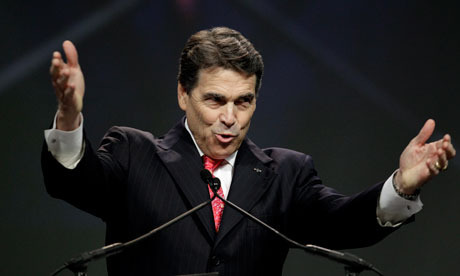
I have to admit I don't know very much about Rick Perry yet. I don't have a strong feel for how radical his beliefs are, and how far to the right he intends to position himself in the campaign. Andrew Romano has a good scoop on Perry's total opposition to Medicare and Social Security, at least as federal programs:
I spent the better part of an hour talking to Perry about his political philosophy and policy prescriptions back in the fall, right before he released Fed Up!, his first book. At the time, Newsweek chose to print only a short excerpt from our interview; few readers knew who Perry was, or cared. But now that he’s running for president, it makes sense to publish a longer version of the conversation, which reveals a lot about Perry’s politics. (For the full transcript, click through.)
In the interview, Perry hints that he would do more to limit the power of the federal government—or at least attempt to do more—than any president since Calvin Coolidge. His argument is basically that we should dismantle most of the last 75 years of national policy and relinquish even Washington’s least controversial responsibilities to the states.
Perry believes, for example, that the national Social Security system, which he calls a “failure” that “we have been forced to accept for more than 70 years now,” should be scrapped and that each state should be allowed to create, or not create, its own pension system. “I would suggest a legitimate conversation about let[ting] the states keep their money and implement the programs,” he says.
Perry also includes Medicare in his list of programs “the states could substantially better operate,” suggesting that each governor should be “given the freedom from the federal government to come up with his own innovative ways [of] working with his legislature to deliver his own health-care innovations to his citizens.”
Is this a case of the mask slipping? Perry never contemplating at the time that he'd have to run for office outside of Texas? An actual plan to run a far-right campaign? I don't know.
Here's another puzzling thread of the Perry ideology. During his public prayer remarks, he said this about the economy:
I tell people, that "personal property" and the ownership of that personal property is crucial to our way of life.
Our founding fathers understood that it was a very important part of the pursuit of happiness. Being able to own things that are your own is one of the things that makes America unique. But I happen to think that it's in jeopardy.
It's in jeopardy because of taxes; it's in jeopardy because of regulation; it's in jeopardy because of a legal system that’s run amok. And I think it's time for us to just hand it over to God and say, "God, You’re going to have to fix this."
This reminds me of an old line of right-wing Christian thought that discouraged efforts to mend injustice and instead place faith in God. It was a notion mocked in the old radical song "The Preacher and the Slave":
Long-haired preachers come out every night,
Try to tell you what's wrong and what's right;
But when asked how 'bout something to eat
They will answer in voices so sweet
Chorus
You will eat, bye and bye,
In that glorious land above the sky;
Work and pray, live on hay,
You'll get pie in the sky when you die
Now, this isn't exactly what Perry is saying. His ideology seems to reflect the fusion between right-wing Christian thought and economic libertarianism, the market as the reflection of God's perfect plan. Dave Levinthal reports that the right-wing filmmaker working for Perry is an atheist, and doesn't seem to mind:
Minnesota filmmaker Michael Wilson — best known for his 2004 documentary film “Michael Moore Hates America” — told POLITICO that Perry “built a part of his announcement speech around it, which is amazing – I had no idea it would turn into this.”
In the video, a man, woman and two tow-headed children, eyes closed, fold their hands and pray around a table as a narrator says, “No matter what they’re raised to believe, my children should know that faith is none of the government’s business.”
The video, with an Independence Day theme, also talks of financial prosperity, limited government, health care choice and the “simple beauty of free markets.”
Again, I don't know enough about Perry to separate out conviction from message. It seems like the perfect Republican synthesis, free markets as an extension of Christian belief.
The Taylor Rule
Jackie Calmes has a good story in today's New York Times describing the near-consensus among economists that we should be increasing short-term deficits in order to stimulate (or at least not deflate) consumer demand, while reducing long-term deficits. This prescription runs directly against the grain of the policies advanced by House Republicans:
The boasts of Congressional Republicans about their cost-cutting victories are ringing hollow to some well-known economists, financial analysts and corporate leaders, including some Republicans, who are expressing increasing alarm over Washington’s new austerity. ...
macroeconomists and private sector forecasters were warning that the direction in which the new House Republican majority had pushed the White House and Congress this year — for immediate spending cuts, no further stimulus measures and no tax increases, ever — was the wrong one for addressing the nation’s two main ills, a weak economy now and projections of unsustainably high federal debt in coming years.
Instead, these critics say, Washington should be focusing on stimulating the economy in the near term to induce people to spend money and create jobs, while simultaneously settling on a long-term plan for spending reductions and tax increases to take effect only after the economy recovers.
Calmes proceeds to note, correctly, that the consensus is not absolute:
Of course, Republicans can point to support among some conservative economists.
When I read that sentence, I thought to myself, "John Taylor." John Taylor, as I've written, is the GOP's go-to economist, the man who will lend his prestige to whatever position they hold, and he's been willing to do this even as the Republican position has changed dramatically. And sure enough:
John B. Taylor, a professor at Stanford and an adviser to Republicans presidents and presidential candidates, said in an interview that temporary stimulus measures were counterproductive, and for long-term debt reduction, “I would try very hard to make it work without revenues.”
Let me make a prediction: If Republicans win the White House, they will discover the need to run up short-term deficits in order to boost demand. They won't do it the way Democrats would -- there will be a lot of goodies for rich people -- but they'll do it. And John Taylor will be there to support them.
Watch Chait on Charlie Rose
Jonathan appeared last night on Charlie Rose with Drew Westen and Fareed Zakaria to discuss rhetoric and reality in the Obama presidency. Watch the entire clip below:
Matt Bai Goes Awry
[Guest post by Isaac Chotiner]
New York Times political writer Matt Bai's almost pathological need to appear evenhanded, even when writing analytically, is nicely captured by his blog post today. He focuses on a moment in the debate, already mentioned below by Jon, when every Republican candidate refused to agree to a deal that included "one dollar in new tax revenue for every 10 dollars’ worth of reductions." This, as Jon says, is "anti-tax mania." And here is Bai:
If this were merely a Republican phenomenon, the party would be alone in suffering the wrath of the average American voter. But it isn’t. You could have put a lot of Washington Democrats up on that stage, and asked them if they would have accepted $10 in new taxes or new stimulus in exchange for $1 in cuts to Social Security, and you probably would have gotten much the same response: hell, no.
Ah yes: except of course that President Obama offered the Republicans a deal with much less favorable ratios, at least as far as liberals are concerned. Now, I am sure Bai could find a few Democrats that would say "hell, no" to this deal. These Democrats do not run Washington. These Democrats do not control their own party. These Democrats would never make up the entire party's presidential field.
Jonathan Chait's Blog
- Jonathan Chait's profile
- 35 followers

