
Jonathan Chait's Blog, page 145
December 3, 2010
Helen Thomas Lets The Mask Slip
 When Helen Thomas said that Israel's Jews should just GTFO and return to Germany and Poland, I suggested her comments were not anti-Semitic per se but merely very blunt anti-Zionism. But her latest comments suggests that, no, she really has a problem with Jews:
Thomas, who grew up in Detroit the daughter of Lebanese immigrants, was in Dearborn today for an Arab Detroit workshop on anti-Arab bias. ...
In a speech that drew a standing ovation, Thomas talked about "the whole question of money involved in politics."
"We are owned by propagandists against the Arabs. There's no question about that. Congress, the White House, and Hollywood, Wall Street, are owned by the Zionists. No question in my opinion.
I prefer to hold off on imputing motives of bigotry without strong proof, but there's not a whole lot of doubt remaining here.


Wehner For The Win

National Review's John Derbyshire writes, in a post entitled "A Smug Op-ed from George W. Bush":
The subsidizing of expensive medications (the biggest part of our AIDS-relief effort, though not all of it) in fact has long-term consequences more likely to be negative than positive. The high incidence of AIDS in sub-Saharan Africa is caused by customary practices there. What is needed is for people to change those customary practices. Instead, at a cost of billions to the U.S. taxpayer, we have made it possible for Africans to continue in their unhealthy, disease-spreading habits.
Perhaps the future of sub-Saharan Africa would be brighter if the people of that place changed some of their customs; but now, thanks to us, they don’t have to. (A similar point can be made about domestic AIDS-relief funding, currently around $20 billion a year.)
Bush administration Minister of Propaganda Pete Wehner, this time bringing some persuasive argument rather than mere propaganda, replies:
Here are a few facts that undermine Derbyshire’s case: (a) Africans have fewer sex partners on average over a lifetime than do Americans; (b) 22 countries in Africa have had a greater than 25 percent decline in infections in the past 10 years (for South African and Namibian youth, the figure is 50 percent in five years); and (c) America’s efforts are helping to create a remarkable shifts in how, in Africa, boys view girls — reflected in a decline of more than 50 percent in sexual partners among boys.
So Derbyshire’s argument that our AIDS efforts are “more likely to be negative than positive” because they will continue to subsidize and encourage “unhealthy, disease-spreading habits” is not only wrong but the opposite of reality. ...
Derbyshire seems to take an almost childish delight in advertising his indifference to the suffering of others, at least when the others live on a different continent and come from a different culture. Back in February 2006, when more than 1,000 people were believed to have died when an Egyptian ferry sank in the Red Sea, Derbyshire wrote:
In between our last two posts I went to Drudge to see what was happening in the world. The lead story was about a ship disaster in the Red Sea. From the headline picture, it looked like a cruise ship. I therefore assumed that some people very much like the Americans I went cruising with last year were the victims. I went to the news story. A couple of sentences in, I learned that the ship was in fact a ferry, the victims all Egyptians. I lost interest at once, and stopped reading. I don’t care about Egyptians.
Cultivating what Adam Smith (in The Theory of Moral Sentiments) called “sympathy” and “fellow feeling” is a complicated matter. Suffice it to say that very few of us care about the suffering and fate of others as much as we should. Yet most of us aren’t proud of this fact; we are, rather, slightly embarrassed by it. Not John Derbyshire. He seems eager to celebrate his callousness, as if it were a sign of manliness and tough-mindedness. I haven’t a clue whether this is a pose, done for shock value or some such thing, or real. All we can do is judge Derbyshire by his public words. And they are not only unpersuasive; they are at times downright ugly.
Nice. It's fair to say I'm not a huge fan of Wehner's work in general. But in the narrow field of defending George W. Bush against unfair attacks, he's quite effective. And Bush did have a couple decent policy initiatives -- his Africa aid policy, and his general policy of attempting to split most Muslims against radical Islam rather than demonize the entire religion.
Obama's Next Move On The Deficit
So now that President Obama has given up on his campaign pledge of ending the Bush tax cuts on income over $250,000, what is Plan B? The first element of it is to negotiate some extension of all the tax cuts through 2012, ideally in return for something, though signaling their weakness has given the Democrats very little ability to ask for anything.
Beyond that, it seems to me that Obama has to hope he wins reelection (obviously) and then just plan on letting all the tax cuts die. He'll still probably have to campaign in 2012 on extending the middle-class tax cuts. But Republicans in Congress are still going to block any extension that doesn't provide a huge regressive tax cut -- for them, tax cuts on income under $250,000 are the price they have to pay in order to get the tax cuts for the top 1%, which is what they actually care about.
If Obama is reelected, he simply has to veto any extension of the upper-bracket tax cuts. If it means all the tax cuts die, so be it. Why, you might wonder, would he be willing to do that then but not now? Well, hopefully the economy will be in better shape. (If it isn't he probably won't be reelected anyway.) On top of that, canceling all the Bush tax cuts would have a real depressing effect on the economy, which in turn would also harm his reelection chances.
In sum, assuming he does win, he'll be in much stronger position on taxes two years from now. And it's worth keeping in mind that eliminating the Bush tax cuts would reduce the deficit by $4.6 trillion over ten years, considerably more than the $3.8 trillion that the Bowles-Simpson plan would save. And from a liberal perspective, restoring Clinton-era tax rates is a vastly better way to shore up the nation's finances than the Bowles-Simpson plan.
Obama and the Democrats blew a huge political opportunity by failing to pick a fight on the middle-class tax cuts. But they do have a chance to gain a long-term policy win.
Are Democrats Bad At Politics?
I think liberals massively overestimate the degree to which poor messaging contributed to their difficulties. That isn't to say, though, that Democrats don't have a problem here. NBC's First Read:
Want another example of how Republicans play political hardball better than Democrats do? Just look what happened after yesterday’s House vote extending only middle-class tax cuts. We noticed only a few Democratic press releases accusing Republicans of voting against tax cuts for 98% of Americans (and thus accusing them of raising these folks’ taxes). If the shoe had been on the other foot, however, Republicans would have mercilessly pounded Democrats for weeks -- if not months. The recent Charlie Rangel and John Ensign stories are instructive here, too. Republicans were relentless that the news of Rangel’s wrongdoings never got dropped. On the other hand, Democrats essentially gave up on Ensign’s woes. And lo and behold, it now looks like Ensign is no longer a Justice Department target. And Rangel's been censured on the House floor. Republicans just play the political message game better than Democrats do.
Jobs Report Shows Americans Still Insufficiently Desperate
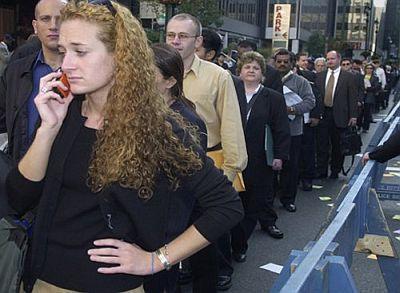
The job market is extracting an awful human toll:
For those who have been searching for work for more than six months, this is a discouraging prospect. “I have looked high and low,” said Melissa Barone, who was laid off from a job in technical support 14 months ago. “I have a college degree and a ton of technical skills, but I can’t find a job.” Ms. Barone, 42, lives in St. Clair Shores, Mich., near Detroit, a particularly hard hit area. She has applied for hundreds of jobs but has yet to receive an offer.
I'm sure the real problem here is that unemployment benefits have sapped her incentive to find work.
Why You Can't Negotiate With Paul Ryan
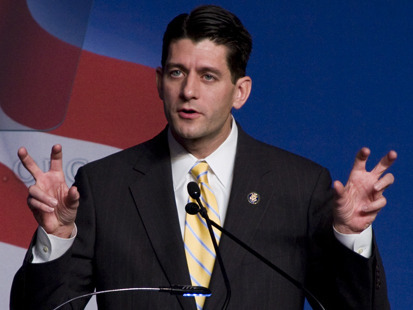
Paul Ryan is going to vote against the Bowles-Simpson deficit reduction plan. because Ryan has gained iconic status among Republicans on fiscal policy, this dooms the proposal.
His opposition shouldn't come as a surprise. Ryan's record is mostly (but not consistently) anti-government, consistently opposed to to downward redistribution of income, and absolutely rock-solid consistent against anything that reduces the deficit. Ryan favored all the Bush tax cuts and Medicare benefit, favors the unpaid-for permanent extension of those tax cuts, and opposed the Affordable Care Act. The fact that Bowles-Simpson builds upon the Affordable Care Act is, in fact, the basis for Ryan's opposition:
Ryan and Hensarling say that there are many good things about the Bowles-Simpson plan, but complained that its health care reforms conflicted with plans by House Republicans to try to repeal aspects of Obama’s health care reform plan passed earlier this year.
This is why it's so difficult to negotiate with Paul Ryan. The Affordable Care Act is a serious attempt to reduce medical inflation, which is the largest driver of the long-term federal budget crisis. It may fail, but if it does, it will be because opponents in Congress managed to hamper its cost-saving devices.
Ryan, like many conservatives, prefers to reside in an alternate universe in which the Affordable Care Act is not a budget saver but a massive drain on the federal budget (like, say, the prescription drug entitlement he supported.) The Bowles-Simpson commission examined the issue and sensibly concluded that building up the cost-saving devices in the PPACA would save money, and tearing them down would cost money. Ryan can't accept that. You can negotiate with somebody who has different preferences than you do. But negotiating with somebody who inhabits a different reality is very difficult.
Strange Bedfellows Against Ethics
The Congressional Black Caucus is ticked off at the House Ethics Committee, and Republicans never liked it in the first place. Will the two team up to kill it off? Suzy Khimm has the story:
Back in the spring, a group of twenty CBC members signed onto a resolution to rein in the OCE and curtail its authority to make investigations public, arguing that the office was destroying political reputations and victimizing black lawmakers. But soon they may have the chance to do more than just neuter the OCE. Having vocally opposed the creation of the panel, incoming House Speaker John Boehner and other top Republicans are quietly discussing ways to kill the OCE when it comes up for mandatory reauthorization next year—and it looks like at least a handful of Democrats could be on board.
Who says bipartisanship is dead?
Republican Activists' Favorite Pundits
1,152 Republican activists were asked to list their favorite opinion pundits. The list is about as depressing as you'd guess:
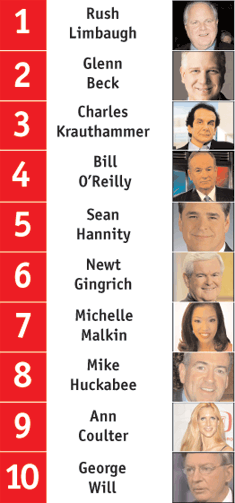
I guess I was hoping they'd be listening to Ross Douthat. Oh well, that's the price he pays for being well-informed and non-crazy.
December 2, 2010
How Chipotle Is Like The Federal Government
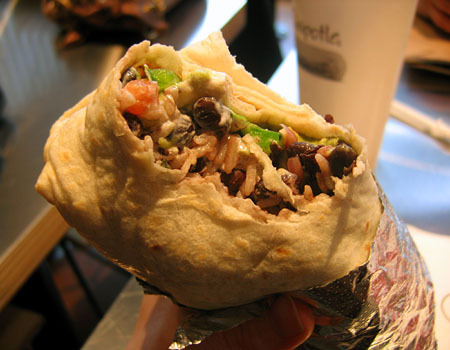
Spencer Lund dispenses advice on how to get your money's worth when you order from Chipotle:
This is the proper way to go about ordering from the second (and generally final) station. This is also where you really come into your own and they’ll respect you more for it.
“I’d like some corn." Wait until the corn as been added.
“And some tomato." Wait until the tomato has been scooped and added. Your burrito should look pretty monstrous already, but we have more to add.
“Some hot sauce please…”
This is where things get emphatic.
“LOTS OF CHEESE.”
“SOUR CREAM TOO, LOTS OF IT."
Cheese and sour cream are the two things you must ask for extra. There’s no clearly defined rule about this, so take advantage of their ambiguity and ask for more. I do this with the meat as well, but then beg off when they inform me it will cost extra. Some day they will not mention this and I will get free extra meat. ...
After everything has been added, your chipoista (I just made that up) should have trouble fitting everything into the burrito. If the burrito tears and they have to add a second tortilla, CONGRATULATIONS, you ordered the proper way.
This is a pretty useful metaphor for the federal budget, is it not? The flaw he's exploiting in the Chipotle system is that you don't have servers listing all the ingredients beforehand and then deciding how to fit them into a tortilla. Instead each decision about fillings is made independent from the others.You can loudly demand more cheese, more sour cream, and whatnot, and the asymmetry of interest (you really want more cheese, your server doesn't really care) ensures that the amount of every topping will be on the high side of the plausible.
Likewise, in the federal budget, we have discussions about each issue divorced from the others. Defense and homeland security? Nobody wants to be accused of "not being interested in the security of America," so they dollop on as much funding as needed. Entitlements? They run on autopilot. Taxes? Think of the poor families trying to get by on a mere $1.2 million a year! Then, finally, the federal spending is oozing out of the tax tortilla.
Stephen Solarz (1940–2010)
The memory of Stephen Solarz, who died this week, should serve as a rude reminder of a time, not long ago but nonetheless ancient, when Capitol Hill was deeply immersed—when it led—in American foreign policy, and a congressman could become a significant figure on the world stage. The honorable gentleman from Brighton Beach had an impact upon the fate of nations. From his perch on the Foreign Affairs Committee, with a nimble and ferocious grasp of all the instruments of policy available to him, Solarz helped to end the genocide in Cambodia and offered crucial support for the forces of democracy in the Philippines. In South Korea, in Lebanon, in Taiwan, he was a force for political liberalization. He was relentless in his efforts to end apartheid in South Africa. He staunchly kept the pressure on Rhodesia and explored diplomatic possibilities with North Korea. At a time when liberal support for Israel seemed to be fraying, he was stalwart. Although he entered Congress in the post-Vietnam, post-Watergate cohort of 1975, Solarz’s tireless agitation for human rights around the world steadily inculcated in him a new and somewhat heterodox appreciation for America as a beneficent force in the world, and in 1991 he committed the heresy of supporting the Persian Gulf war for the emancipation of Kuwait from the occupying forces of Saddam Hussein. He was the rare figure who was outraged by all abuses and atrocities equally: he was empirical, not ideological, about injustice. He was a hawkish dove or a dovish hawk, but mainly he believed in the progress of freedom, and in the responsibility of the United States to assist in that progress. After he lost his seat in a primary in 1992, his humanitarian activism did not abate, and he played a leading role at the admirable and innovative International Crisis Group.
He never lost his reformer’s faith in argument and, after argument, in action. He was ebullient and indefatigable and optimistic and almost unconscionably youthful. In the range of his travels and his thoughts, he was global before globalization—a genuinely cosmopolitan man, who exemplified many of America’s finest inclinations to many corners of the world. His mind was greedily inquisitive, and he deepened his diplomatic experience with a vast reading. He was a politician, but he did not like the smallness of political life, until he risked his local base with his international crusades. (The championing of Benigno Aquino was generally not regarded as a form of constituent service on Coney Island Avenue.) He was also a friend of this magazine, and a close friend of some of its editors. In these petty and introverted and dangerous times, we pray that we will look on Steve Solarz’s like again, so that American government, and also American liberalism, will once more be animated by a grander feeling for history, and by a sense of what we can do with our power to alter its course for the good.
Below are four of Solarz' finest contributions to TNR:
"Last Chance for the Philippines," April 8, 1985.
"Next Stop, Angola," December 2, 1985.
"The Stakes in the Gulf," January 14, 1991.
"Next of Kim," August 8, 1994.
Jonathan Chait's Blog

- Jonathan Chait's profile
- 35 followers

