
Jonathan Chait's Blog, page 141
December 14, 2010
Wrong Jonathan
Ben Smith credits Jonathan Cohn for my health care commentary. (He has since corrected it.) It's a common mistake, yet, sadly, Smith is taking it very hard, and seems to be sinking into existential despair:
Correction: That song is by The Smiths, not Ben Smith. I will try to keep them straight from now on.


Lowry Goes Sistah Souljah On Conservatism
Rich Lowry has a surprising riff on the stagnating middle class:
At the moment, American politics offers two separate, distinct ways not to address these issues: Either the brain-dead populism of the Left that blames it all on trade and the decline of unions, or the brain-dead populism of the Right that extols the working class without taking serious note of its agony. We’ll have to do better: There’s a crisis in the middle.
The left he's describing is a small chunk of the left wing of the Democratic Party along with some farther-left critics of the Ralph Nader variety. The right he's describing is the vast majority of the Republican Party. Did the editor of National Review just endorse mainstream liberalism?
Will Conservatives Revolt Against The Tax Deal?
Jonathan Bernstein predicted the other day that House Republicans might suddenly turn against the tax deal en masse. This morning, Mitt Romney has an op-ed denouncing the deal:
President Obama has reason to celebrate. The deal delivers short-term economic stimulus, and it does so at the very time he wants it most, before the 2012 elections. But the long term health of our great engine of prosperity will remain very much in doubt.
Is this a straw in the wind? Certainly if anybody has reason to oppose a deal that will increase economic growth in 2012, it's the guy who hopes to be running against the incumbent in 2012. Charles Krauthammer's column on the deal made a similar point:
In the deal struck this week, the president negotiated the biggest stimulus in American history, larger than his $814 billion 2009 stimulus package. It will pump a trillion borrowed Chinese dollars into the U.S. economy over the next two years - which just happen to be the two years of the run-up to the next presidential election. ...
At great cost that will have to be paid after this newest free lunch, the package will add as much as 1 percent to GDP and lower the unemployment rate by about 1.5 percentage points. That could easily be the difference between victory and defeat in 2012.
Notice that neither Romnmey nor Krauthammer quite say that the growth-boosting effects of the deal are a reason to oppose it. Rather they argue that the higher growth isn't worth the budgetary cost, making it surely the first time either one of them has rejected a debnt-financed tax cut on the basis of its effects on the national debt. It will be interesting to watch anti-deal Republicans try to make their case by hinting at electoral ramifications without coming out and saying so directly.
December 13, 2010
Richard Holbrooke (1941-2010)
Richard Holbrooke, Obama’s special envoy to Afghanistan and Pakistan, died Monday evening after undergoing heart surgery and surviving the weekend in critical condition. He was 69. Holbrooke’s service in the Obama administration was the last in a long line of foreign policy posts under Democratic presidents, beginning in the Johnson administration. He is best-known for crafting the Dayton Accords in 1995, which ended the war in Bosnia. He also contributed several articles to The New Republic, reviewing books on foreign affairs, conflict, and international violence. In his 1984 review of the book The Quality of Mercy: Cambodia, Holocaust, and Modern Conscience, Holbrooke wrote, “The central lesson is that people must care, that extraordinary efforts are required to rouse people from their comfortable good time in order to do something to help those living, in George Steiner's phrase, in the ‘enveloping folds of inhuman time.’ If people do care, miracles can happen.” Here, we have gathered several TNR articles written about Holbrooke or by him during his distinguished career.
“Dicks” by Matthew Cooper
“Cold War” by Warren Bass
“Demolition Man” by Ryan Lizza
“Conscience and Catastrophe” by Richard Holbrooke
“Front Man” by Richard Holbrooke
IN MEMORIAM >>
The Health Care Ruling Doesn't Worry Me
Read here for Jonathan Cohn on why we shouldn't freak out about the ruling.
Conservatives are jubilant that a Republican judge in Virginia has agreed with their contention that the individual mandate, formerly a pillar of Republican health reform proposals, is unconstitutional:
“Today’s ruling is a clear affirmation that President Obama’s health care law is unconstitutional,” Virginia Rep. Eric Cantor, the presumptive House majority leader next year, said in a statement. ...
“Today is a great day for liberty,” Utah Sen. Orrin Hatch proclaimed.
Richard Epstein writes, "Obamacare Is Now On The Ropes."
But it's not on the ropes. First of all, the mere fact that one Republican judge, Henry Hudson, has agreed with the party does not mean that all five Republican justices on the Supreme Court -- one of whom, Anthony Kennedy, does not always tow the party line -- will do so. Hudson is also a very Republican kind of judge:
Hudson's annual financial disclosures show that he owns a sizable chunk of Campaign Solutions, Inc., a Republican consulting firm that worked this election cycle for John Boehner, Michele Bachmann, John McCain, and a whole host of other GOP candidates who've placed the purported unconstitutionality of health care reform at the center of their political platforms. Since 2003, according to the disclosures, Hudson has earned between $32,000 and $108,000 in dividends from his shares in the firm (federal rules only require judges to report ranges of income).
I don't think Hudson ruled as he did for financial reasons. I think his financial interests are a window into the fact that he's unusually likely to bend over backward to accept Republican arguments.
Second, even given the above, Hudson conceded that striking down the individual mandate would not invalidate the whole Patient Protection and Affordable Care Act. If you strike the individual mandate but leave the rest, you have a system that could easily be patched up with a better mechanism to avoid free-riding. The real loser here is the health insurance lobby. Health insurers would have preferred to avoid any health care reform at all. But the health insurance lobby's second-highest priority would be a working system with an individual mandate. A world in which they cannot discriminate against sick people but in which healthy people can avoid buying insurance until they're sick is a nightmare.
The health insurance lobby spent tens of millions of dollars to defeat health care reform. They have a lot of pull among Republicans. A system that gouges the health insurers but keeps in place the subsidies and regulations liberals want is not a status quo I see lasting very long.
A Poet, Not A Fighter?
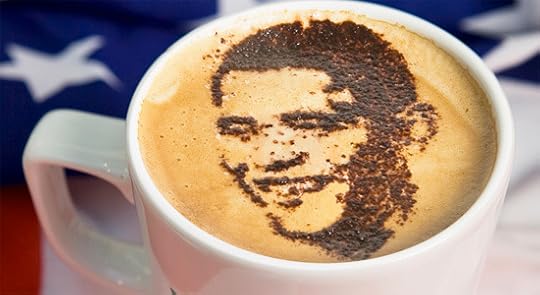
In February of 2008, machinist union president Tom Buffenbarger unleashed a rip-roaring endorsement of Hillary Clinton combined with an even rip-roaring-er assault on Barack Obama:
I've got news for all the latte-drinking, Prius-driving, Birkenstock-wearing, trust fund babies crowding in to hear him speak! This guy won't last a round against the Republican attack machine. He's a poet, not a fighter.
In the wake of Obama's tax deal, some liberals are hailing Buffenbarger as a prophet -- or, in Keith Olbermann's phrase, a "Nostradamus":
President Obama‘s decision not the just to agree to Republican demands on the tax deal but to shot out congressional Democrats of the negotiations then tell them to take it or leave it, has revived claims by some of his critics on this news hour and elsewhere that the president does not put up enough of a fight, at least not against Republicans.
So I guess Buffenbarger was right: we really needed the tough-fighting Democrat who couldn't spell "Birkenstock" and whose blood type is "Budweiser."
The wee problem with this logic, however, is that Clinton's chief political advisor -- who has been berating Obama for two years for his insufficient deference to business and the rich -- is applauding the deal:
Democrats should move quickly to back the president on the tax bill or risk turning themselves into a minority party in Congress for a long time to come. By becoming reverse tax protesters (chanting "raise taxes"), the liberals are sending out all the wrong messages to a country that overwhelmingly backs the key elements of the bipartisan deal the president struck.
Obama took the first step this week in seeking to save his floundering presidency by moving to the center. His execution was far from perfect but his actions were sound.
When Penn says Obama's "execution was far from perfect," I'm guessing he meant Obama was too critical of the merits of tax cuts for the rich in defending his compromise. Also, Bill Clinton took the rare step of holding a joint presidential news conference to defend the deal.
In sum, Buffenbarger was not right at all.
Two Charts That Explain Obama's Great Or Horrible Tax Deal
My line on the Obama-Republican tax deal is that it's too soon to tell whether it's a good thing -- it's either a huge victory or a massive defeat. There's an easy way to show this in chart form. The White House has a graph depicting what it won against what the Republicans won:
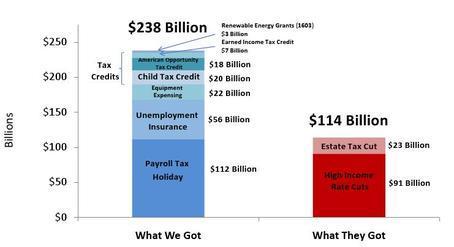
Looks pretty good! And that doesn't even include the Bush tax cuts on income under $250,000 , which is definitely something the administration wanted.
Of course, that chart assumes that the Bush tax cuts on income obver $250,000 truly will expire after two more years. What if they don't?
Moveon has made a chart of its own to depict what that outcome looks like:
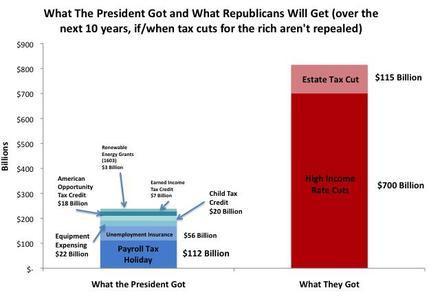
That's pretty bad! And that shows why Obama and the republicans made the deal -- because they have different views about which chart will eventually prevail. The administration thinks it bought time, to get past the economic crisis and its reelection, and it will ahve a much stronger position from which to veto any extension of the upper-bracklet tax cuts. The Republicans think that they won this fight in 2010 and they can win it again. Essentially, Republicans antied up some unemployment benefits and progressive tax cuts in order to keep the Bush tax cuts for the rich alive for two more years, and win another chance to make them permanent.
From the perspective of the first chart, the liberal revolt against Obama is crazy. He prevented mass economic suffering by winning a second sgtimulus that Republicans would otherwise never have agreed to. On the other hand, they can't be sure he really will hold the line in 2012. But the liberal revolt does help demonstrate the costs the administration will pay if it capitulates on the upper-bracket Bush tax cuts in 2012. In that sense, their complaining is quite helpful.
Triumph Of the Will
George Will, continuing his role as defender of conservative judicial activism, devotes his Sunday column to a defense of Bush v. Gore. Will devotes much of the space to a pretzel-like defense of the merits of the decision, which held that any attempt to ameloriate the unequal treatment of voters across counties (some of which used vote-counting systems with far higher error rates than others) would itself constitute a violation of equal protection. What's interesting is trhe sociological observation Will begins with:
The passions that swirled around Bush v. Gore, the Supreme Court case that ended 10 years ago Sunday, dissipated quickly. And remarkably little damage was done by the institutional collisions that resulted when control of the nation's supreme political office turned on 537 votes out of 5,963,110 cast in Florida.
This does point to one of the most remarkable aspects of the episode, which is how little protest ensued. Will attributes this to the wisdom of the decision, which the five majority members find so embarrassing they shout down any attempts to diuscuss it and have never invoked it as precedent. I attribute it to the pervasive liberal defeatism of the period.
Imagine the circumstances of the period were reversed. Democrats had held the presidency, despite losing the popular vote, because the candidate's brother ran the state, his highly partisan Secretary of State made a series of partisan decisions in consultation with Republicans, culminating in a partisan 5-4 Supreme Court decision to halt a statewide recount. I maintain that republicans would have erupted in massive and perhaps violent demonstrations, rather than suliong off as liberals did.
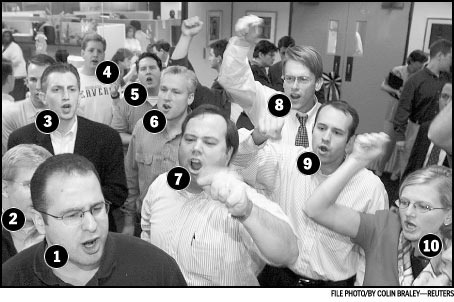
I can't prove this. I can point to one suggestive event during the period, though. At one point, Miami-Dade County was conducting a recount thought by both sides to contain enough uncounted votes to put Al Gore ahead. Republicans stormed the country building and successfully disrupted the recount. It is the only time I'm aware that a federal political decision was influenced by mob rule. It was a shocking moment.
The liberal psyche at the time was highly dispirited. Democrats had defended President Clinton against impeachment because the punishment was so wildly out of scale to the crime, but few of them came away feeling enthusiastic about Clinton, the Democratic Party, or politics itself. The Florida recount and Bush v. Gore was a case of a movement inflamed with passion and imposing its will at every level, from grassroots activism through political machinations through a partisan Supreme Court majority.
December 10, 2010
Nixon Disallowed Jewish Advisors From Discussing Israel Policy
New documents released today about Nixon and the Jews:
Documents released today by the Richard Nixon presidential library contain fresh details on the former president’s antipathy toward Jews, his interest in exposing more details of John F. Kennedy’s policy on Cuba and Vietnam, and his approach to the office that he was eventually forced to resign.
Mr. Nixon ordered his aides to exclude all Jewish-Americans from policy-making on Israel, according to formerly classified notes taken by then-chief of staff H. R. “Bob” Haldeman on a meeting with the president in July 1971. “No Jew can handle the Israeli thing,” the notes read. Later in the one-page excerpt, Mr. Haldeman writes, “Forget the Jews — they’re against” the administration.
That stipulation explicitly includes then-national security adviser Henry Kissinger, with accompanying plans to keep him out of the loop: “get K. out of the play — Haig handle it,” says one note, referring to then-aide Alexander Haig.
You do see a fainter echo of this view today on the fringes of the debate among the likes of ultra-Nixonian realists like Stephen Walt, but even Walt believes that Americans Jews can prove their loyalty by adopting a sufficiently left-wing line on Israel. It's hard to imagine any president today refusing to allow his own national security adviser to participate in Israel-related debates on account of being Jewish.
Meanwhile, Kissinger has pathetically defended Nixon against charges of anti-Semitism despite being excluded by Nixon from formulating Israel policy on the basis of his ethnicity.
Noam on Bloggingheads
Noam has some smart thoughts (and not just smart because some of them involve quoting me, though it helps) on the Republican socialism freak-out.
Jonathan Chait's Blog
- Jonathan Chait's profile
- 35 followers

