
Jonathan Chait's Blog, page 140
December 15, 2010
Only Twenty Four Percent!
Reason's Nick Gillespie has a sprightly video touting how easy it would be to balance the budget without raising taxes:
The video is touting a Reason article he co-authored with Veronique de Rugy. It's a revealing expression of the vacuity of mainstream libertarian fiscal thinking.
In the video, Gillespie chirps, "it's so incredibly simple that virtually any elected official should be able to pull it off." The hook is that, under their plan, "you only need to trim 3.6% of each year's budget."
Gillespie displays a piece of pork, which symbolizes the federal budget, divided into ten slices, representing each of the next ten years. He trims a tiny bit of fat off each slice ("all we need to do is cut this little piece of fat right here.") Voila!
But, of course, the visual is completely misleading. He is representing a plan to cut 3.6% of the budget every year. His actual plan is to cut 3.6% the first year, then another 3.6% the next year, then another 3.6% the following year, and so on.
Another way of putting this is that, to maintain the current level of services in the federal budget, we would need to spend $5.5 trillion. Gillespie and de Rugy would propose instead to spend $4.2 trillion in 2020. That's their prerogative. I'm sure they could find at least $1.3 trillion in spending that they don't like. But the point is that you would have to eliminate a lot of functions of the federal government, and/or reduce a lot of social benefits.
The specific claim that you only need to cut 3.6% of the budget, and the broader claim that you just need to trim a little bit of fat here and there, are utterly false. The idea that the budget can be balanced without any increase in tax revenues and without imposing substantial pain is one of the most debilitating pathologies of right-wing thought.
Meanwhile, in National Review, de Rugy goes all Laffer Curve and argues that the Bush tax cuts caused the rich to pay higher taxes:
The main impact the rate reduction had in the first place was to make the rich pay an even bigger share of taxes that they paid before.
Look at these tables from the Tax Foundation. They provide some very good data about taxes paid by income levels, including the percent of federal income tax paid by each income group.
Table 6 in particular is interesting. In 2001, the top 1 percent of income earners paid 33.89 percent of all income taxes collected. In 2008, they paid 38.02 percent, down from the 2007 level of over 40 percent.
The real story here is that the proportion of pre-tax income earned by the top 1% has been rising since the late 1970s. The rich paid a higher share of the tax burden in 2008 than in 2001 because they earned a higher share of the income. If de Rugy was right that the Bush tax cuts caused the rich to pay a higher share of the taxes, then the share of the taxes paid by the rich should have fallen during the Clinton era. In fact the opposite occurred.
I understand that libertarians have different philosophical beliefs than I do about the proper size of government. I don't understand why they can't find somebody who expresses their philosophy without committing elementary errors.


Studiously Avoiding An Acknowledgement
Glenn Greenwald yesterday morning:
I just want to flag what his "last words" were according to his family members, which he uttered as he was being sedated for surgery: "You've got to stop this war in Afghanistan."
Ironically, Holbrooke was the author of one of the volumes of the Pentagon Papers -- which revealed that government officials knew of the futility of the Vietnam War at the same time they were falsely assuring the public they could win -- and Afghanistan seems to be no different. As official Washington rushes forward to lavish praise on Holbrooke's wisdom and service, undoubtedly they will studiously avoid acknowledging his final insight.
Amanda Terkel, yesterday afternoon:
Administration officials sought to clarify that, according to people who were present, Holbrooke's final words, "You've got to stop this war in Afghanistan," were part of a jovial back-and-forth with the medical staff. "At one point, the medical team said, You've got to relax," State Department spokesman P.J. Crowley told reporters on Tuesday, relaying what he said he had heard from people who were in the room with Holbrooke at George Washington University Hospital. "And Richard said, I can't relax, I'm worried about Afghanistan and Pakistan. After some additional exchanges, the medical team finally said, Tell you what, we'll try to fix this challenge while you're undergoing surgery. And [Holbrooke] said, Yeah, see if you can take care of that, including ending the war."
I don't know if Greenwald is "studiously" avoiding acknowledging this fact, but he is avoiding acknowledging it.
Mike Pence Sees Around Corners
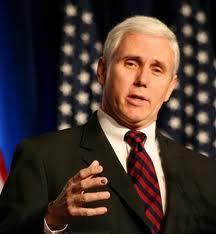 Weekly Standard publisher Terry Eastland spent some time with Mike Pence and is blown away by the depth of his thinking. Here's how the puff-piece begins:
It may be startling to imagine the American presidency as a train that “has run off the rails.” But that’s the metaphor Indiana Republican Mike Pence chose in a speech he gave at Hillsdale College on September 20 titled “The Presidency and the Constitution.” Elected last month to his sixth term in the House of Representatives, Pence also delivered a version of the speech in mid November to the Federalist Society in Washington. His sober thoughts on the presidency have been gaining notice in conservative circles, and it’s easy to see why.
If you're blown away by a politician analogizing the other party's administration to a train that's run off the rails, then you're probably not very hard to impress. What metaphor will this brilliant man think of next? A football team that's losing at halftime? A frog in boiling water?
CONGRESS >>
Juan Williams And The Lucre Of Right-Wing Martyrdom
I opposed firing Juan Williams from NPR over his remark about Muslim terrorism. (Firing him for vapidity would have been totally justifiable.) But, let's face it -- getting fired from NPR was the best thing that ever happened to Williams' career:
The commentator fired by National Public Radio in October for his remarks about Muslims has a deal to write two books.
Crown Publishers announced Tuesday the first book by Juan Williams will "focus on free speech and the growing difficulty in America of speaking out on sensitive topics."
Being a black guy who complains that liberal political correctness is stifling conservative opinion is an incredibly lucrative niche. There can simply never be a large enough supply of commentators to meet the demand for that product. I doubt Crown publishers knows (or needs to know) the topic of the second book it bought. He's set for life.
December 14, 2010
Life Imitates "Spaceballs"
From the WSJ:
Readers of Gizmodo, Lifehacker and other Gawker Media sites may be among the savviest on the Web, but the most common password for logging into those sites is embarrassingly easy to guess: “123456.” So is the runner-up: “password.”
Why Obama has No Judges
Ryan Grim has some pretty shocking statistics on the GOP's success in blocking President Obama's judicial nominees, along with Obama's complicity in the problem:
As the first congressional session of Obama's presidency draws to a close, what began as a slow process of confirmation has ballooned into a full-blown judicial crisis. The Senate has overseen the slowest pace of judicial staffing in at least a generation, with a paltry 39.8 percent of Obama's judges having been confirmed, according to numbers compiled by Senate Democrats. Of the 103 district and circuit court nominees, only 41 have been confirmed.
By this time in George W. Bush's presidency, the Senate had confirmed 76 percent of his nominees. President Clinton was working at a rate of 89 percent at this point in his tenure.
While the confirmation process is slower now (a function of a packed legislative calendar and Republican obstruction), Obama's nominating pace also lags behind his predecessors. His 103 total nominations compare to 142 by Clinton and 131 by Bush at this same juncture.
Ronald Reagan had twice as many judges confirmed by this time in his presidency, with his 87 confirmations dwarfing Obama's total. George H.W. Bush had moved 70 judges through the Democratic-controlled Senate.
Jonathan Bernstein has been banging this drum for a while and has a good summary of the politics. Obstruction has played a major role, but so has the failure of the Democrats to play their hand as well as they could:
All in all, and excepting the two Supreme Court nominations, both the White House and the Democrats in the Senate have simply not placed any kind of priority on filling the bench. That's encouraged Republicans to use low-cost methods to block those nominations that have been ready for final confirmation, and Republicans, no fools they, have taken full advantage.
It's still probably not too late for some action. A serious commitment to use every last minute available could probably get at least all—not most, but all—of the non-controversial nominees confirmed. It's a little hard to tell how much else is possible at this point (a lot depends on whether floor time is needed for other priorities), but as I've said before, leaving anything that could get done on the table would, indeed, be a real betrayal of the Democrats who worked hard to get Barack Obama and the 111th Senate elected.
The odd passivity toward nominations is one place where the left has an airtight complaint against the Democrats -- they accomplished less than they could have through simple laziness, lack of attention or unwillingness to fight.
Shame on People Who Don't Support Michael Steele, Says Michael Steele
[Guest post by Isaac Chotiner]
RNC chair Michael Steele has decided to run for another term, and on a conference call last night he said the following to RNC members:
“I believe the worst thing we can do now is to look backwards. Who you elect as our next chairman will speak volumes about our willingness to truly be the party of Lincoln.”
This is not exactly equivalent to saying people who oppose Steele are all racists, but its close. How amusing that the conservative moment, which goes into hyperventilation mode every time false accusations of racism are made, chose this guy to run the RNC.
For more Michael Steele quotes, from the bizarre to the confusing to the just plain incorrect, check out TNR's slideshow of his greatest gaffes.
Roger Simon Attacks Insidious, Imaginary Rich-Hatred
There is never a shortage of pundits willing to stand up against mindless hatred of the rich among the political class, however nonexistent the phenomenon may be. Here is Politico conventional wisdom-monger Roger Simon against insidious prejudice against the most fortunate people in the country:
The rich are different from you and me. They are swine.
So say many of the Democrats in the House of Representatives who would rather that jobless people lose their unemployment checks and middle-class people lose their income tax breaks than that the rich get a dime extra.
Note that Simon's column consumes 871 words, but none of those words is a quote of a Democrat expressing hatred of the rich. I'll leave it to my readers to decide whether this is because no such quotes could be found, invalidating the premise of Simon's column, or because he simply couldn't bear to steal any space for them away from precious anecdotes like this:
I got a job and slowly, without noticing it much, I put money in the bank every week and a small amount accumulated. I bought a black-and-white TV and a used Fiat 850 Spyder. (They were about the same size.) And I began hearing about things like IRAs and certificates of deposit, which seemed like pretty good deals.
I paid taxes, but I never went crazy with resentment over them. I was not pleased that my taxes were being used to fund the Vietnam War, but I was pleased that they were being used to fund the Peace Corps and VISTA.
Interest accrued. I bought a color TV that had a remote control, and I traded in the used Fiat for a new Toyota, because I learned that Toyotas ran during all four seasons. Every now and then I would see people driving Mercedes-Benzes, BMWs and Jaguars.
Fascinating stuff. Tell us more about this color television, because it really helps us understand the tax debate.
Simon proceeds to advance some novel arguments against progressive taxation. For instance:
Only half of the wealthiest people in America inherited their wealth. The rest earned it. But whether their wealth is earned or inherited, I just want the rich to pay their fair share of taxes, not some kind of punitive share.
Isn't it great how you can use words like "only" to do the entire work of your argument for you? Another way to phrase that first sentence would be, "Only half of the wealthiest people in America earned their wealth. The rest inherited it." I'm especially tickled by Simon's disclaimer that he wants the rich to pay a fair" share of the taxes, not a "punitive" share. Right -- that's the whole debate. What is a fair share? Are Clinton-era tax rates on the rich fair or punitive? Simon has nothing to say about this at all.
Perhaps the most unintentionally funny part of the column is this:
Don’t like the way wealth is distributed? Then you can join congressional Democrats and grump about it, or you can get some wealth for yourself.
I honestly have no idea how to respond to this point.
Can't Anybody Here Play This Game?
 First the drafters of the Affordable Care Act failed to include a"severability" clause, which would ensure that if any portion of it was ruled unconstitutional, the rest would remain in effect. Fortunately, judge Henry Hudson's ruling against the individual mandate didn't endeavor to toss out the entire law. It did, however, seem to be premised entirely on a simple misreading of the Constitution:
The key portion of the ruling reads:
"If a person's decision not to purchase health insurance at a particular point in time does not constitute the type of economic activity subject to regulation under the Commerce Clause, then logically an attempt to enforce such provision under the Necessary and Proper Clause is equally offensive to the Constitution."
[GWU law professor Orin] Kerr notes that this is all wrong. The Necessary and Proper Clause allows Congress to take steps beyond those listed in the Constitution to achieve its Constitutional ends, including the regulation of interstate commerce. Hudson's argument wipes a key part of the Constitution out of existence. Kerr says Hudson "rendered [it] a nullity."
Kerr's co-blogger, Case Western Reserve University Law Professor Jonathan Adler agreed, though he cautioned that Hudson's error doesn't necessarily imply that the mandate is constitutional.
In an interview with TPM this morning, Timothy Jost of Washington and Lee University, a supporter of the mandate, called the logic on this point "completely redundant."
"In Hudson's opinion he basically conflates the Commerce power and the Necessary and Proper power and says that each provision in a statute has to be looked at independently from every other provision, and each provision has to be independently authorized under the Commerce Clause," Jost said. "And if it isn't, the Necessary and Proper Clause doesn't grant any more authority."
Even in the context of concocting arguments that the Constitution forbids Congress from enacting policies that you hate, this seems remarkably inept.
So Is Roger Altman Replacing Larry Summers or Not?
[Guest post by Noam Scheiber:]
Anyone interested in this question has no doubt read about Altman's multiple White House visits to discuss relieving Larry Summers as head of the National Economic Council (NEC). And yet, here we stand, just days from Summers's planned departure--NEC staffers have been busy writing exit memos, as I understand it--without an announcement about his replacement. Here's how White House press secretary Robert Gibbs summed up the state of play at Monday's briefing:
Q And just a question -- Larry Summers gave a farewell speech today at a think tank, and I’m just wondering how the decision-making is going on his replacement. Do you still hope to do that before the end of the year?
MR. GIBBS: Look, I will say that it is -- I’m not sure that that’s going to get done by the end of the year. Obviously, a whole host of legislative -- lots of legislative work around the lame duck with a budget, taxes, START, “don’t ask, don’t tell,” the DREAM Act -- there are a whole host of things that have taken up a bunch of bandwidth and a bunch of time. And it’s unclear to me whether that will get done before the end of the year.
What's going on here?
My sense from talking to administration officials who work on economic policy is that, while no one at the White House really dislikes Altman, no one is particularly smitten with him either. (That apparently describes Summers's views, too.) Altman lacks an internal advocate willing to go to the mat for him.
Of course, this wouldn't necessarily be a problem if the guy making the final decision were super-high on Altman. But that doesn't appear to be the case either. "I’ve heard that the president didn’t like his short list, so they're going back to round up people," one official told me recently.
For what it's worth, that doesn't mean Altman is without passionate advocates, including some you might not expect. "I worked with him. Altman is a remarkably able guy," says Paul Begala, the former Clinton aide. "He's really fair. Would not put his thumb on the scale… I hate Wall St."--Altman's current place of employment--"not as much as next guy, even more. But if you could get a guy with that kind of talent..."
My guess--and it's really just a guess, no one has told me this explicitly--is that Altman could end up with the job if the next phase of the search doesn't turn up anyone the White House feels more strongly about and the clock just runs out. But, as I say, he doesn't appear to have wowed anyone in a position to influence the decision.
P.S. The Huffington Post has a piece up today saying the field has narrowed to three candidates: Alman, Treasury counselor (and former Clinton NEC director) Gene Sperling, and Yale president Richard Levin. I hadn't heard Levin's name before, but Sperling may have a shot, depending on who you talk to.
My sense is that Sperling's situation is a little different from Altman's. Unlike Altman, there are people on the economic team who think he's terrific; the hesitation here is more among the political people in the White House, who wonder if he's got the right kind of public profile, that ill-defined mix of star-power/charisma/gravitas, etc. (I wrote about this a bit while trying to game out the successor to Peter Orszag at OMB, where Sperling was also considered. It must be a maddening question for him to face given that he's actually done the job before--and very successfully...)
There's one thing I did want to correct about the HuffPo piece though. The author writes:
The appointment of either Sperling or Altman would cement the administration's symbolic ties to the financial sector. ... Judging by Sperling's record in government and on Wall Street, he would likely favor a policy of lenient regulation of the banking sector. Like Summers, Sperling has ties to Robert Rubin, the former Treasury Secretary, Goldmanite and, more recently, chairman of Citigroup, who pushed for deregulation under President Clinton.
After serving as deputy NEC director, Sperling took the commission's top spot in 1996, overseeing a policy of deregulation of Wall Street. Under Sperling's watch, Congress repealed the Glass-Steagall Act, a rule-easing that many believe contributed to the financial crisis less than a decade later. ...
Etc.
This strikes me as pretty misleading. Everything I've seen and heard covering administration economic policy over the last two years suggests that Sperling has been one of the more hawkish voices within the adiministration when it comes to Wall Street--and on a range of issues, from bonuses/executive pay to the terms of the various financial rescues (to the extent he was involved). Granted, he's not someone who wants to completely level the financial sector, and he has a relatively sophisticated understanding of how it works. But the image of him as a Wall Street tool is just contrary to fact.
WHITE HOUSE >>
Jonathan Chait's Blog

- Jonathan Chait's profile
- 35 followers

