
Jonathan Chait's Blog, page 144
December 7, 2010
The Uncertainty Canard
Republicans have spent two years chanting that "uncertainty" is responsible for the problems of the economy. How can business plan for the future when they don't know what their tax rates will be?
The current tax fight was a perfect experimental study of the party's actual commitment to that principle. Republicans wanted to end uncertainty by making the Bush tax cuts permanent. Democrats wanted to end uncertainty by making the tax cut on income below $250,00 permanent, while returning to Clinton-era tax rates on the rich. Neither had the votes for a permanent victory.
So, Republicans had a choice. They could accede to certainty with Clinton-era rates on the rich, or uncertainty with Bush-era rates on the rich. They chose uncertainty. The Bush-era rates will live on for two years, after which nobody knows if they'll be extended or not.
For those still clinging to any naive notion that Republicans meant this as anything more than a slogan, the answer is now clear. They want low tax rates for the rich. They don't care about certainty.


The Tax Deal: Who Won?
Supposedly Zhou Enlai was asked about whether the French revolution succeeded, and he replied, "It's too soon to tell." That's my view of the tax deal between President Obama and Congressional Republicans.
The most important policy question at stake is the future of the upper-income Bush tax cuts. If Obama had made absolutely clear that August that he would not extend them under any circumstances, then Democrats could have forced Republicans to stand against the popular tax cuts for families earning less than $250,000 a year. But the exhausted, demoralized, fractured Congressional Democrats simply couldn't move, an astonishing political failure.
The Republican Party's chief objective is to maximize the chance of eventually making the upper-income portion of the Bush tax cuts permanent. Republicans would have preferred a permanent extension, but a temporary extension gives them a chance to fight another day. The Republican Party has been organized around the goal of reducing upper-income tax rates, and was willing to surrender a great deal merely to preserve the chance of winning this fight in 2012 or 2013.
Ironically, liberals have been complaining that the Obama administration is too interested in fiscal restraint and insufficiently interested in fiscal stimulus. (Katrina vanden Heuvel today: "On the economy, the president has abandoned what Americans are focused on - jobs - to embrace what the Beltway elites care about - deficits.") This deal does the opposite. It's essentially a second stimulus, with loads of tax cuts (some of them actually stimulative) and an extension of unemployment benefits.
The basic trade then, is that Obama got a fair amount of short-term fiscal stimulus, and Republicans kept alive their dream of preserving Bush-era tax cuts for the highest-earning 1%. Whether this deal is a win for them depends entirely on what happens in 2012. Obama will be in a better position to draw a line in the sand on refusing to extend tax cuts that only benefit the very rich. Spending the election year of 2012 hanging tough on his refusal to sign an upper-income tax cut, while championing middle-class tax cuts, is a good campaign issue. The prospect of middle-class tax cuts expiring in 2013 -- when the economy is stronger, and Obama's reelection is behind him -- will not be nearly as terrifying as the prospect of having them expire in 2011. Indeed, it would be an outright perk, as the full expiration of the Bush tax cuts would nearly solve the medium-term deficit without any painful spending cuts at all.
On the other hand, if Obama caves again, or if Republicans win the White House and push through another tax cut extension, this deal will go down as a huge blunder for Obama. The good news for Obama is that the deal probably increases the chance that he'll get that second term. If so, he'll need to handle this issue better than he did the first time around.
December 6, 2010
How Obama Got The Tax Cut Deal
It appears that President Obama got more out of Republicans, in return for extending all the Bush tax cuts, than I expected he would. Of course he also gave up more, agreeing to an extension of a low estate tax rate, which is apparently crucial as an incentive for rich people to, uh, die.
Why were Republicans so flexible? They are willing to deal away a lot if they're getting tax cuts for the rich. President Clinton got Republicans to establish a Childrens' Health Insurance Program in 1997 in return for a capital gains tax cut. Now Obama got a fair amount of stimulus in return for upper-bracket tax cuts. Unfortunately, it tends to be terrible policy. But it's the party's core policy goal, and if you help them attain it they can be surprisingly reasonable.
Don't Call It A Bush Comeback
 Politico's James Hohmann, last seen repeating nutty Republican anti-tax talking points in Politico news stories, has a piece today about the George W. Bush comeback:
George W. Bush’s job approval rating as president has spiked to 47 percent, according to a Gallup poll released Monday.
That’s 1 point higher than President Barack Obama’s job approval rating in a poll taken the same week.
This is the first time Gallup asked Americans to retrospectively rate Bush’s job performance. And it was a stunning turnaround from his low point of 25 percent in November 2008.
Stunning? Let's look at the poll in question, which surveyed Americans about a number of ex-presidents:
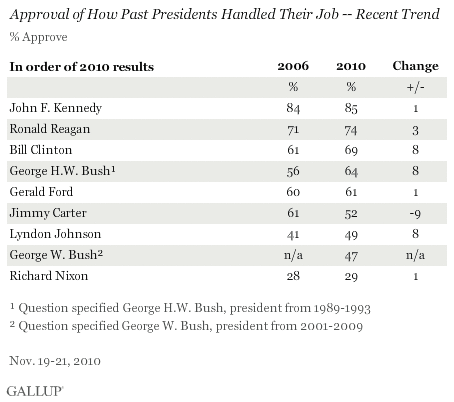
This seems to show that every former president who wasn't forced to resign will eventually become popular --and, indeed, that Bush is currently less popular than all of them, including Jimmy Carter. This certainly doesn't vindicate Hohmann's conclusion that "Bush’s rebound gives some credence to what he has long said — that history will eventually judge his presidency." Or, I suppose, if you thought opinion polls were the same as "history," then you'd think that history will eventually vindicate every non-Nixon president.
Indeed, it's pretty obvious that being removed from the partisan debate makes you popular, and being involved in it makes you unpopular. That's why Bill and Hillary Clinton currently enjoy very high approval ratings, and Michelle Obama has astronomical favorability.
Chart Of The Week
This fascinating chart from Ezra Klein explains a lot of the skew of the economic policy debate:
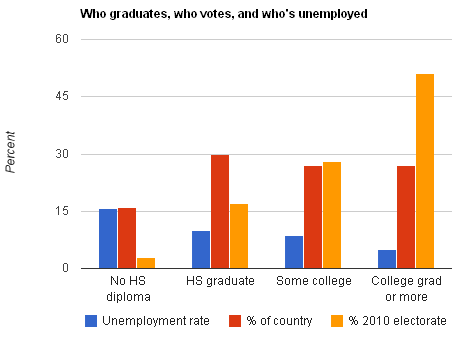
There are more Americans with only a high school diploma than Americans with a college degree. But in the 2010 electorate, the latter outnumbered the former by more than 3-to-1. The unemployment rate among college graduates, meanwhile, is a small nuisance, while the unemployment rate among workers with no college education is catastrophic. That explains a lot about the state of the political debate.
McConnell: Bush Tax Cuts Prevented Awful Decade From Being Even Worse
Did anybody else find it hilarious that Mitch McConnell defended the Bush tax cuts on the grounds that the the economy since 2001 would have been worse without them? Here's the exchange:
MR. GREGORY: Well, but you've had these tax rates in place since 2001. What's been the impact on jobs?
SEN. McCONNELL: Imagine, imagine how much worse it would been if we'd had the, the higher tax rate.
Of course, this is the same logic Obama has used to justify the stimulus -- the economy has been bad, but it would have been worse without the stimulus. McConnell has been ridiculing that argument. But now he wants to use this argument to defend an entire decade's worth of terrible economic performance! How much more time do the Bush tax cuts need in order to work?
The GOP's Latest Scheme To Repeal Health Care Reform
Republicans have come up with another one of their patented plans to undermine the Affordable Care Act. The plan is to take funding out of the program to pay for physician reimbursement:
Republican Senate aides familiar with the issue told POLITICO they are seriously looking at the new law's $15 billion public health commitment to finance a one-year doc fix in the next session of Congress.
Let me explain what this means. In 1997, Congress adjusted the formula by which doctors are reimbursed under Medicare, with the intention of imposing a tiny cut. But Congress bungled the formula, and accidentily imposed a huge cut. Because that huge cut is on the books, Congress has to appropriate funds to bring doctors' reimbursement back to the normal level. Congress has been doing this regularly since 1997, a ritual known as the "doc fix."
The Republican plan, described in the Politico article linked above, is to demand that the doc fix start including spending cuts to offset the "cost" of the doc fix. And where will they get the spending cuts? Well, by taking money out of the PPACA.
I see a couple problems here.
First, the article only identifies one source of funding that Republicans propose to cut:
As for which part of the health reform law to pull funds from, Republicans have long derided the multibillion Prevention and Public Health Fund as wasteful spending, scoffing at its investment in bike paths and farmers' markets. One Republican Senate aide quipped that it was a "slush fund for jungle gyms."
The fund, which began this year with $500 million, will grow to a $2 billion per year allocation by 2015. Totaling $15 billion over the next 10 years, the fund would be nearly enough to offset an entire, yearlong doc fix.
So they want to eliminate a decade worth of public health fiunding in order to finance one year of higher physician reimbursement. At that right, they're going to run out of funding sources pretty quickly. Later in the article, Republican economist Douglass Holtz-Eakin is quoted proposing to cut subsidies for health care for the poor. That's a larger pool of monmey but still runs into the same problem of requiring more years of cuts than years of doc fixes.
A second problem is that President Obama will veto any doc fix that relies on cutting the PPACA. So then the question is, what happens? The procedure for the last thirteen years has been to pass doc fixes without any offsetting costs, in part because the costs were an accounting fiction. If Republicans insist on offsetting the cost out of the PPACA, and Obama vetoes the plan, and doctors start getting massive pay cuts, what happens? I think the answer would be that doctors would get furious at Republicans for tying their salaries to a political demand that Obama would never accomodate. Then Republicans would back down and pass a doc fix. Which means the crusade to repeal the PPACA would be back to the starting point again.
George Will Redefines The Conservative Judicial Philosophy
George Will's Sunday column has introduced one of the finest semantic innovations in modern political propaganda. For decades, conservatives have defined their judicial philosophy as minimalism. The liberal postwar courts had expanded social rights by aggressively interpreting the Constitution, and conservatives painted this, not altogether incorrectly, as using courts to win victories that could not be won at the ballot box. In the last couple decades, though, conservatives have increasingly been tempted to use their newfound judicial majorities to do the same.
The two conservative impulses sat side by side a bit uncomfortably, like a moralizing televangelist who was conducting an affair on the side. What the movement needed was some way to reconcile the two beliefs. Now Will has supplied it:
"There is," Willett explains, "a profound difference between an activist judge and an engaged judge." The former creates rights not specified or implied by the Constitution. The latter defends rights the Framers actually placed there and prevents the elected branches from usurping the judiciary's duty to declare what the Constitution means.
Do you understand the distinction? An activist judge is one who is overturning laws that conservatives approve of. An engaged judge is completely different -- he's overturning laws that liberals approve of. There's no comparison between the two.
Fourth Branch has more.
December 3, 2010
Can Silvio Berlusconi Sink Any Lower?
[Guest Post by Isaac Chotiner]
Julia Ioffe has a report on the Putin-Berlusconi friendship that includes this charming anecdote:
Their favorite activity, however, seems to be holding joint press conferences. At one of their most memorable appearances together, in Moscow, in 2008, a Russian journalist named Natalia Melikova asked Putin about his apparent marital trouble and rumored romance with the young and indecently plastic gymnast-cum-parliamentarian Alina Kabaeva. When asked about the liaison, Putin’s face hardened. “There is not a word of truth in this story,” he said. Berlusconi, giggling, regarded the exchange. When Putin had finished answering, Berlusconi cocked his hands, and, imitating a gun, fired with a silent “Pow! Pow!” at Melikova. It had only been a year and a half since Anna Politkovskaya, an investigative journalist, had been shot in her Moscow elevator, and Melikova was reduced to tears. On the dais, Berlusconi laughed, and Putin nodded.
Boss Hogg, The Mystery Revealed
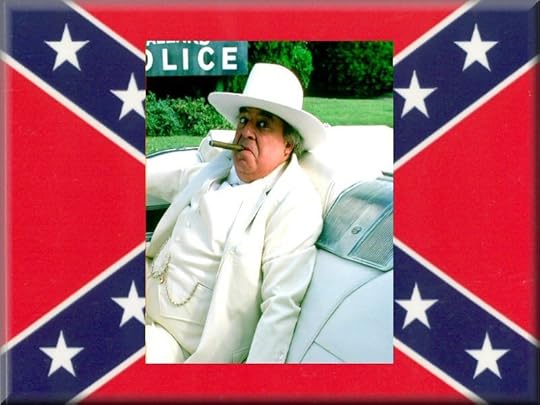
Longtime readers know that I've been continually puzzled by the Washington press corps' insistence on treating Haley Barbour as a plausible presidential nominee. The idea of nominating the physical embodiment of the worst stereotypes of the Republican Party strikes me as so baffling I wonder every time I read one of those stories if I'm the only sane man on Earth or if all these reporters have lost their minds.
Lloyd Grove, in a profile of Barbour's cozy relationship with the media, inadvertently furnishes an answer:
The 63-year-old Mississippi governor, who’s considering a 2012 White House run, enjoys the friendliest relations with the Washington media elite of any prospective candidate vying for the Republican nomination. He comes by this enviable position honestly, albeit lubricated by tumblers of good Kentucky bourbon, after toiling for three decades as an adviser to Ronald Reagan’s political operation, as a corporate lobbyist, as a candidate for Senate, as a GOP spin doctor, as a cable television talking head, and as the wildly successful chairman of the Republican National Committee who helped take back the House and Senate in 1994. ...
As a political reporter for The Washington Post back in the mid-1990s, I too fell under Barbour’s spell, growing to appreciate his apparent openness, tactical savvy, self-deprecating charm—and generous supply of Maker’s Mark in his handy RNC liquor cabinet.
Okay! So they're not crazy, they're merely drunk. It does explain it.
Jonathan Chait's Blog
- Jonathan Chait's profile
- 35 followers

