
Jonathan Chait's Blog, page 138
December 20, 2010
Perles Of Wisdom
Uber-hawk Richard Perle opposes the Start Treaty, which, he argues, is a pale imitation of the great Ronald Reagan's INF Treaty:
Ronald Reagan knew that in arms control, the United States should play to win. To do that, it had to be prepared to reject an inadequate deal until a useful one could be achieved. The contrast between his negotiating approach and the current administration’s approach to New START could not be more striking.
Ratified in the spring of 1988, the INF Treaty was a watershed: the first accord to actually reduce nuclear arms. It eliminated all nuclear-armed ground-launched ballistic and cruise missiles with ranges between 500 and 5,500 kilometers, together with their infrastructure.
INF negotiations dealt with the most important issue in the U.S.-Soviet strategic relationship from the late 1970s into the mid-1980s: Soviet deployment of SS20 missiles aimed at NATO forces in Europe. These Soviet deployments led NATO to prepare to deploy Pershing and ground-launched cruise missiles. The resulting treaty zeroed out this threat, entirely eliminating a whole class of nuclear missiles.
But what did Perle think of Reagan's treaty at the time? Not too much:
The INF treaty under consideration in the Senate is flawed enough to require renegotiation with the Soviets despite concerns that such a move could kill the pact, Richard Perle and other former government arms control experts said today.
Perle, former assistant secretary of defense and President Reagan's one-time chief arms control expert, and four other members of the American Enterprise Institute, a conservative-leaning "think tank," released a detailed study of problems they see with the intermediate-range nuclear forces treaty.
They said the treaty does not do many of the key things the Administration says it does, including eliminating production of all stages of Soviet SS-20 missiles and doing away with their launchers.
The Soviets have said they will use the launchers for civilian purposes after rendering them incapable of carrying SS-20s as required by the treaty.
"I'm just a little bit suspicious by nature" of that pledge, said Perle, who will testify on the treaty before the Senate Armed Services Committee Thursday.
I'm constantly amazed that people who refer back to a previous event don't bother to look up what they wrote about it at the time.


Being Strong And Wrong Does Not Always Work
There's a tendency among liberal Democrats to believe that the Republican Party is tougher and meaner and more effective. I think it's true that the GOP is more ideologically cohesive and less bound by social norms (the filibuster should be rare, impeachment is a response to extremely serious crimes, etc.) that might constrain their power.
On the other hand, ideological intransigence very frequently backfires on Republicans. Matthew Yglesias lists ways that the GOP could have prevented the Affordable Care Act but, out of sheer radicalism, failed:
before the right goes all-in on an ad hoc constitutional change driven by dislike of the Affordable Care Act, that different conservative behavior could have avoided this outcome. For example, Tom Davis would have been a formidable contender for a Senate seat in 2008, but the right decided he wasn’t conservative enough so they’d let Mark Warner win in a landslide. Then they decided Arlen Specter wasn’t conservative enough, so they drove him from the party and gave Democrats 60 votes in the United States Senate. Then they steadfastly refused to offer any compromise proposals that might have peeled the Ben Nelsons and Mark Pryors and Evan Bayhs of the world away from the pro-ACA coalition. I recall that after Scott Brown’s election there was mass panic in Democratic circles and lots of people wanted to abandon the ACA. For a while, I thought that those of us urging continued action might lose the argument to those who favored passing a “scaled-down” health care bill. But in the end we got a bailout from the GOP, which refused to offer any indication that it would actually accept such a bill.
One common thread here is the GOP's tendency to push for all-or-nothing outcomes -- rather than settle for a moderate Senator or bill, they make the choice between a pure conservative one and total defeat. If the Republican Party had more tactical flexibility in its candidate selection and legislative strategy, nothing like health care reform would have succeeded. Luckily, as Yglesias notes, the structure of the conservative movement is such that it is only able to criticize left deviation and never right deviation, even when right deviation created a worse outcome by conservatives' own terms. The primary challenge against Specter, in particular, was an utter disaster, yet you simply never hear Republicans admit this,
Who Will Dissent From The Dissenters?
Joe Nocera takes apart the Republican narrative of the financial crisis:
The F.C.I.C. commissioner who has complained loudest about Fannie and Freddie is Peter Wallison, a former Reagan-era Treasury official who for the last two decades or so has been a fellow at the conservative American Enterprise Institute. Long before it was popular to criticize Fannie and Freddie, they were Mr. Wallison’s bugaboo. Back then, he was a lonely — indeed a brave — voice arguing that the enormous portfolios of mortgages of the G.S.E.’s — combined with their quasi-governmental status — created systemic risk.
He was right about this, though it’s worth nothing that his precrisis prognosis of Fannie and Freddie’s ills was wrong in a number of key ways. Like most Fannie and Freddie critics at the time, he believed the risk they posed was interest-rate risk, rather than credit risk, which is what actually brought the two companies low. He also argued that Fannie and Freddie were consistently ignoring their mission to help make affordable housing available to Americans.
As he wrote in 2004, “Study after study have shown that Fannie Mae and Freddie Mac, despite full-throated claims about trillion-dollar commitments and the like, have failed to lead the private market in assisting the development and financing of affordable housing.”
After the crisis, his tune changed considerably — as did that of many other Republicans, who tended to follow his intellectual lead on this issue. Now, he said, it was government policy aimed at increasing homeownership that essentially forced the private sector to make bad subprime loans.
December 19, 2010
Belated Thoughts On The End Of Don't Ask, Don't Tell
I've been a bit remiss in commenting on the (ultimately successful) battle to repeal Don't Ask Don't Tell. What I like to do is analyze and engage in argument, and there just wasn't much argument over this issue. The merits of allowing gays in the military are obvious and widely accepted, and opponents barely put up a fight. (Just about the only passion displayed by proponents of the ban on gays in the military came from John McCain, and his anger appears to be displaced rage at the 2008 presidential election.)
I suppose the lack of argument is itself the story. The progress of gay rights in the United States over the last generation has been intoxicatingly rapid. It's happening so fast that opponents, rather than fomenting a successful backlash, have mainly lost their desire to fight. In part this reflects changes in the Republican Party, which is now dominated almost entirely by defenders of the economic prerogatives of the rich and barely pretends to care about the Christian right's agenda any more. In part it's a wildly successful effort by Hollywood to normalize homosexuality.
In any case, it was only six years ago that Republicans used the bogeyman of gay marriage to help win a presidential election. Does anybody expect that to happen again? I don't.
December 17, 2010
&c
-- William Galston drafts Obama's next State of the Union address.
-- Paul Ryan's health care reform would turn Medicare into...Obamacare!
-- Yet another study confirms that Fox News viewers are most likely to be misinformed.
How Cynical Is Krauthammer? Answer Inside...
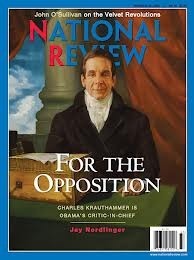 The other day I was pointing out the trickiness of conservatives following Charles Krauthammer and opposing the tax deal because it will improve economic growth in 2012:
[N]either Romney nor Krauthammer quite say that the growth-boosting effects of the deal are a reason to oppose it. Rather they argue that the higher growth isn't worth the budgetary cost, making it surely the first time either one of them has rejected a debnt-financed tax cut on the basis of its effects on the national debt. It will be interesting to watch anti-deal Republicans try to make their case by hinting at electoral ramifications without coming out and saying so directly.
So, how did Krauthammer's subtle case for economic sabotage play with Republicans? Apparently it wasn't subtle enough, reports Glenn Thrush:
Senate Majority Leader Mitch McConnell (R-Ky.) — who recently claimed his goal was to deny Obama a second term — reportedly reacted with disgust when he read Washington Post columnist Charles Krauthammer’s recent suggestion that he oppose the package because it would lower unemployment “and easily be the difference between victory and defeat in 2012.”
Said one person close to McConnell: “We’re not going to bet against the economy. If it helps Obama, so be it. We’ll do it. Who gives a s--t?”
Wow, when Mitch McConnell is disgusted by your cynical obstructionism...
Mitt Romney As Arch-Ironist
A couple years ago I wrote a column explaining why I actually like Mitt Romney despite (indeed, because of) his transparent fakery. But David Frum has now made basically the same case in brilliant fashion:
I sometimes imagine that Romney approaches politics in the same spirit that the CEO of Darden Restaurants approaches cuisine. Darden owns Olive Garden, Longhorn steakhouses, and Red Lobster among other chains. Now suppose that Darden’s data show a decline in demand for mid-priced steak restaurants and a rising response to Italian family dining. Suppose they convert some of their Longhorn outlets to Olive Gardens. Is that “flip-flopping”? Or is that giving people what they want for their money?
Likewise, the “pro-choice” concept met public demand so long as Romney Inc. was a Boston-based senatorship and governorship-seeking enterprise. But now Romney Inc. is expanding to a national brand, with important new growth opportunities in Iowa and South Carolina. A new concept is accordingly required to serve these new markets. Again: this is not flip-flopping. It is customer service.
You may say: But what does Romney think on the inside? Which of his positions is the “real” Romney? I’d answer that question with another question. Suppose an Olive Garden customer returns to the kitchen a plate of fettuccine alfredo, complaining the pasta is overcooked. What should the manager do? Say “I disagree”? Explain that it’s a core conviction to cook pasta to a certain specified number of minutes and seconds, and if the customer doesn’t like it, she’s welcome to take her patronage elsewhere? No! It doesn’t matter what the manager “really” thinks. What matters is satisfying each and every customer who walks through the door to the very best of the manager’s ability.
Jonathan Cohn, Matthew Ygelsias and Ezra Klein all raise sensible objections, all missing the point (I think) that Frum is arguing at least partially tongue-in-cheek.
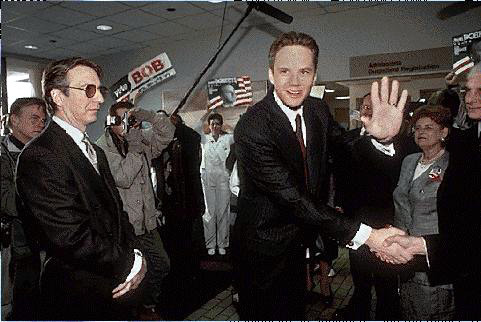
My affection for Romney is rooted in the fact that his efforts to woo conservatives reveal a genuine contempt to the constituency he is trying to placate. He does not look like Bob Dole pretending to be a hard-core conservative. He looks like Tim Robbins pretending to be a hard-core conservative:
Last year, The Boston Globe obtained his campaign strategy document laying out what it called "Primal Code for Brand Romney." "Primal" is a perfect description for Romney's view of the GOP base. He approaches conservatism not as a respectable ideology but as a series of (in Lionel Trilling's famous phrase) irritable mental gestures. The strategy memo suggests he drive home the message "Hillary = France." Romney has promised to "double Guantanamo" and demanded that Mike Huckabee apologize for criticizing President Bush's foreign policy. This is like a Hollywood parody of a right-wing Republican--think "Bob Roberts," or Tom Cruise's character in Lions for Lambs--but more clever.
If Romney's public sentiments were more intelligent than this, I'd fear he actually believed it. Giuliani's conservatism, to offer up one contrast, is intelligent enough for me to think he genuinely buys into it but still dumb enough for me to fear for the future of our country if he manages to win the election. The mindless tribalism of Romney's pandering is paradoxically reassuring. The form his pandering takes is a measure of the contempt in which he holds the electorate in general and Bush-era Republicans in particular.
Sadly, I think Romney has virtually no chance to win the nomination. He is trapped in the position of both desperately needing to repudiate his signature achievement and being unable to risk another flip-flop. It's a real loss for American politics, and irony.
Nick Gillespie Responds, And His Point Is... I Have No Idea
[image error]
Reason.com editor Nick Gillespie has a response to my item gently pointing out his mathematical illiteracy and that of his co-author Veronique de Rugy. A good chunk of it seems to be tonal posturing whose purpose is to show that Gillespie is cooler than me. I'll stipulate the point, because:
1. Everybody is cooler than me, and
2. Gillespie wears a black shirt and black leather jacket in virtually all his public appearances, and obviously you can't get cooler than that.
As for the substance, Gillespie offers very little. Let me review my main point. He wrote an article, with de Rugy, suggesting that the federal budget could be balanced by 2020 without raising taxes from their Bush-era levels merely by cutting spending by 3.6% a year. He illustrated this with a video portraying the federal budget as a piece of pork (get it?) divided into ten slices, each slice representing a year. In the video, Gillespie slices off a small bit from each year, representing the tiny 3.6% of waste that would have to be trimmed.
As I showed, and Gillespie does not deny in his response, the claims he made in the video were false. The plan would require cutting the budget by 3.6% the first year, an additional 3.6% the next year, until the 2020 budget was 24% lower than it would be. In other words, Gillespie's plan would not be slicing one little 3.6% off of each year. It would be slicing one piece off the first year, two pieces off the next year, three pieces off the third, and so on.
Reading Gillespie's response, I don't think he was being deliberately misleading. I think he genuinely does not understand the article he co-authored:
While the Warner Wolf in me wants to say "Let's go to the videotape" (watch above!), let's instead look at the main figure from the piece Veronique and I wrote. This lays out, in pretty clear detail I think, how you can make small, systematic cuts to bring projected total federal outlays in 2020 into line with 19 percent of expected GDP (the amount the CBO says will be in play).
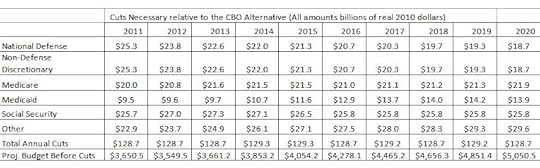
In the above, we lay out what 3.6 percent annual cuts in each of the next 10 budgets would come to if applied across the board to major spending areas (note that debt payments are included in the "other" category).
Right. This... does not reply to my critique at all. And that, honestly, is the closest anything in his article comes to addressing my objection. The vast majority is just word salad.
After another diversion into the totally Republican talking point that revenues never stay for long above 18% -- which I don't need to debunk here because it's utterly unrelated to the dispute at hand -- Gillespie rambles on to a generic libertarian rant:
don't forget that the $1.3 trillion that we're talking about cutting over the next decade comes out of budgets that are projected to increase every year from 2012 on (see above) and that total federal spending over the next decade will come to over $42 trillion. I wonder if Chait is willing to name anyfunctions of the federal government that he thinks we can live without? Maybe the two ongoing wars that his magazine happily supported (at least until recently). Maybe the Medicare prescription drug benefit, which gives relatively wealthy seniors free or reduced-price drugs regardless of ability to pay? Indeed, why not take a longer look at Medicare in toto, a program that former Obama adviser Christina Romer has said wastes 30 percent of its funds?
The passage begins with a factual claim that's simply wrong. The federal budget in 2020, if it continues to provide current services, would spend $5.5 trillion. Balancing the budget in 2020 solely with spending cuts means cutting that by $1.3 trillion -- not over ten years but in 2020. I don't doubt that Gillespie and de Rugy could identify that much in cuts they'd support. My point is that this is not a 3.6% cut. It is a 24% cut. It involves significant changes in the scope of the government, not just trimming tiny bits of waste. The ideological merit of those cuts is not what I'm disputing.
Gillespie wants to rally Team Libertarian to his side by broadening the question into the the wars TNR supported (boo!) and all them wasteful government programs. Gillespie wants this to be a debate between freedom-lovin' rebel Nick Gillespie and Big Government-coddlin', irrational rich people-hatin' Jonathan Chait. It's not. It's a debate between Nick Gillespie and the laws of arithmetic.
Likewise, Gillespie defends his co-author de Rugy's National Review post. In that post, she argued that the Bush tax cuts for the rich did not reduce federal revenue, because the top 1% paid a higher share of federal taxes in 2008 than in 2001. If this voodoo economics were true, and Bush's tax cuts on the rich caused the rich to pay more in taxes, then it would necessarily be true that Bill Clinton's tax hike on the rich would cause the rich to pay a lower share of federal taxes, right? But, in reality, the rich paid 29% of federal taxes in 1993, and 37% in 2000. So clearly de Rugy's statistic does not prove that the Bush tax cuts caused the rich to pay a higher share of federal taxes.
In response, Gillespie offers more hand-waving:
Yes, it's true that the wealthy have been getting a bigger share of income growth for a long time. Nobody disputes that (and indeed, I pointed out as much in my post). But Chait then goes into a "does not compute" spasm: The rich couldn't be paying a higher share under Bush because... because... because... because...
Oh Gale Gordon, oh humanity!
But the rich were paying a bigger share, and what Veronique pointed out was that "the main impact the rate reduction had in the first place was to make the rich pay an even bigger share of taxes that they paid before."
You can argue that the projected $70 billion a year that won't clang in federal coffers over the next couple of years by extending the Bush tax rates is a tragedy because, I don't know, we need to keep waging war in Afghanistan or buying obsolete weapons systems or bailing out big banks or repaving highways and extending stimulus funds that have worked out so well.
I don't know how to wade through this word salad and extract an argument. He begins by restating something I explained in my previous response. I realize that the rich paid a higher share in federal taxes in 2008 than in 2001. As I said, this is entirely because of a long secular trend toward greater concentration of income. It does not prove that the Bush tax cuts caused this result. Indeed, de Rugy's voodoo economics hypothesis is disproven by the fact that the share of taxes paid by the rich rose even faster following Clinton's tax hikes on the rich. Gillespie does not address this at all. He simply retreats to sputtering about government programs he hates.
Like I said, I obviously have different ideological preferences than Gillespie and other libertarians. But he isn't serving his audience very well. He's a pretty good writer, but he doesn't understand these issues at all. He thinks he can make up for his lack of understanding by relying on a co-author who, by dint of her total fealty to libertarian dogma and the ability to throw around a few numbers, has him convinced she knows what she's talking about. In reality she's a total hack. I really advise Gillespie to confine himself to subjects he understands (motorcycles? picking up chicks with a snap of the fingers?) and find a fiscal writer who is able to make the libertarian case from factual premises.
Reviving The Favorite Insult Of the Bush Era
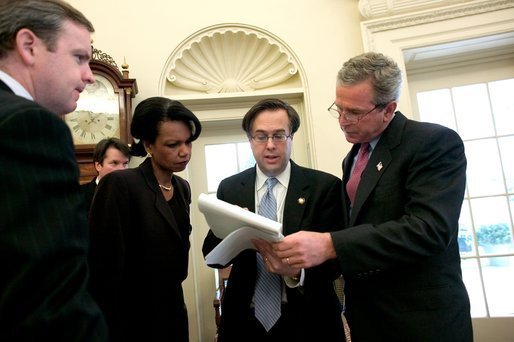
George W. Bush was a fairly easy act to follow for President Obama, except in the eyes of people like George W. Bush idolater/speechwriter Michael Gerson, for whom Bush was the hardest act in the world to follow. And sure enough, Obama has extraordinarily high personal favorability ratings, but Gerson really, really doesn't like him:
He is alternately defiant, defensive, exasperated, resentful, harsh, scolding, prickly. He is both the smartest kid in class and the schoolyard bully.
Well, nobody ever accused Bush of being the smartest kid in the class.
December 16, 2010
The GOP's Secret Senate Plan
One of the oddities of the debate over repealing Don't Ask Don't Tell is that Republican moderates seem far more interested in procedure than substance. They favor repeal, but they oddly seem to care more that the Senate hew to Mitch McConnell's run-out-the-clock timetable than they care about the outcome of the issue:
Here's what Sen. Susan Collins (R-ME) told Senate Majority Leader Harry Reid that she needs to support a full Senate debate on the defense authorization bill (the vehicle for Don't Ask, Don't Tell repeal): 15 guaranteed votes on amendments (10 for Republicans, and 5 for Democrats), and somewhere around four days to debate the bill.
Senate Majority Leader Harry Reid already promised her the 15 amendments, but his initial offer was for a day or two of debate. Here's her response to reporters tonight, after a Senate vote.
"The majority leader's allotment of time for to debate those amendments was extremely short, so I have suggested doubling the amount of time, assuring that there would be votes, and making sure that the Republicans get to pick our own amendments as opposed to the Majority Leader."
"If he does that I will do all that I can to help him proceed to the bill. But if he does not do that, then I will not," she added.
Is this some bizarre kind of Senate-ism, where process trumps all? Possibly. I think it's something different.
Earlier this summer, Joe Biden claimed that several Republican Senators told him that they had promised to hold together on every procedural vote:
"I know at least 7 [GOP] senators, who I will not name, but were made to make a commitment under threat of losing their chairmanships, if they did not support the leadership on every procedural vote," Biden said at a fundraiser Monday night.
I can't prove that Biden isn't making this up. But it sure would explain a lot. It would explain the fact that Republicans consistently gave up the chance to trade their vote in return for wielding significant influence over major legislation. It would explain Olympia Snowe's odd to decision to vote against cloture on the health care bill on the Senate floor (a procedural vote) after voting for essentially the same care bill in the Finance Committee (not a procedural vote.) It would also explain how Snowe and other Republicans negotiating the bill refused to lay out conditions for supporting it other than extending the negotiations indefinitely.
McConnell's pitch to the moderates appears to revolve around the need to negotiate together, and thus that all Republicans needed to threaten to filibuster everything in order to force Democrats to negotiate with McConnell:
“We came in shellshocked,” said Senator Lindsey Graham of South Carolina. “There was sort of a feeling of ‘every man for himself.’ Mitch early on in this session came up with a game plan to make us relevant with 40 people. He said if we didn’t stick together on big things, we wouldn’t be relevant.”
The end result was that moderate Republicans ceded enormous power to McConnell, whose overriding goal was not to advance centrist legislation but to defeat Obama. In any case, I think Republicans did promise to hold together on all procedural votes, and I think this promise was the whole key to the 2009-10 legislative session.
Jonathan Chait's Blog

- Jonathan Chait's profile
- 35 followers

