
Jonathan Chait's Blog, page 134
January 3, 2011
&c
-- Jon Cohn chimes in on playing chicken with the debt ceiling.
-- What would-be RNC leaders read.
-- Obama's approval rating hits 50% - the highest in eight months.


The Debt Ceiling Phony War
Republicans and Democrats are already posturing over a vote to raise the debt ceiling. As you watch Democrats lacerate Republicans for risking the full faith and credit of the U.S. government, keep in mind that they all voted against raising the debt ceiling when Republicans held the White House:
Democrats in control of Congress, including then-Sen. Obama (Ill.), blasted President George W. Bush for failing to contain spending when he oversaw increased deficits and raised the debt ceiling.
“Washington is shifting the burden of bad choices today onto the backs of our children and grandchildren,” Obama said in a 2006 floor speech that preceded a Senate vote to extend the debt limit. “America has a debt problem and a failure of leadership.”
Obama later joined his Democratic colleagues in voting en bloc against raising the debt increase.
The difference is that Democrats were merely posturing, while Republicans seem to be trying to extract substantive policy concessions. In any case, the posturing is over whether the minority gets to merely embarrass the president, as has been the case before, or actually gets to force the president to give them something tangible.
Tea Party Nation? Not So Much.
A Vanity Fair poll asks which "first step" people would favor to balance the budget. It seems we are all Dennis Kucinich now:
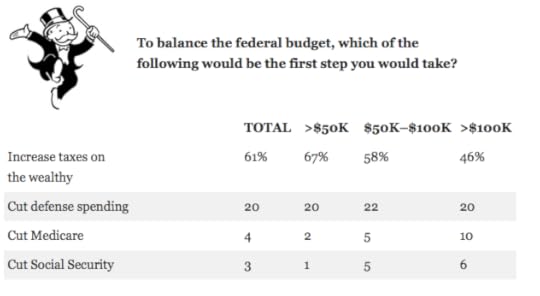
This is worth keeping in mind if the United States reaches a point of near insolvency. Imposing any kind of political pain may be unpopular, but the right's preferred fiscal adjustment is vastly less popular than the left's. The constituency for entitlement cuts -- which is the sine qua non of any serious reduction in the size of government -- is 7% of the population. Which is to say, actual small government conservatism -- as opposed to opposition to unspecified waste or a misunderstanding of the size of the foreign aid budget -- is essentially nonexistent at the popular level.
The GOP 2012 Field's Secret Climate Shame
Mitt Romney is in a terrible position because he moved right to run for president in 2008 while defending the then-respectable Republican position that regulate-subsidize-individual mandate was a sensible approach to health care reform. That position has since become The Death Of Freedom in the conservative mind.
Another issue where Republicans have gone mad since 2008 is carbon emissions. In 2008, cap and trade was also considered a sensible Republican position. You know who's caught having endorsed the old, sane party status quo and is now on the wrong side of the new, insane party status quo? Everybody:
It may be heresy to conservatives, but a trip down memory lane shows nearly all of the top-tier Republican presidential contenders want to save the planet from global warming.
On the campaign stump, in books, speeches and nationally-televised commercials, aspiring GOP White House candidates such as Tim Pawlenty, Mike Huckabee and Mitt Romney have warned in recent years about the threats from climate change and pledged to limit greenhouse gases. Some have even committed the ultimate sin, endorsing the controversial cap-and-trade concept that was eventually branded “cap and tax.”
Now, as they prepare for a wide-open primary season, many of the Republicans are searching for ways to explain themselves to a conservative voting base full of hungry tea party activists and climate skeptics who don't take kindly to environmental issues so closely linked with Al Gore.
"They're in an odd place," Grover Norquist, president of Americans for Tax Reform, told POLITICO. "They better have an explanation, an excuse or a mea culpa for why this won't happen again."
The good news for Republican candidates trying to conceal their previous acceptance of scientific consensus is that there are so many transgressors they have a kind of mutually assured destruction. Perhaps Norquist could arrange some kind of Galileo-esque heresy recantation ceremony for all of them.
Why Do Good Conservative Economists Endorse Pseudoeconomic Nonsense?
Former Bush economic advisor Greg Mankiw urges President Obama to stop "spreading the wealth:
Ever since your famous exchange with Joe the Plumber, it has been clear that you believe that the redistribution of income is a crucial function of government. A long philosophical tradition supports your view. It includes John Rawls’s treatise “A Theory of Justice,” which concludes that the main goal of public policy should be to transfer resources to those at the bottom of the economic ladder.
Many Republicans, however, reject this view of the state. From their perspective, it is not the proper role of government to fix the income distribution in an attempt to achieve some utopian vision of fairness. They believe, instead, that in a free society, people make money when they produce goods and services that others value, and that, as a result, what they earn is rightfully theirs.
Like AEI President Arthur Brooks, Mankiw makes a fundamental arror here is assuming that there are two approaches toward income distribution: believing either that the market is perfectly fair and all attempts to mitigate market inequality therefore fundamentally unjust, or believing in total equality. Obama and the Democrats are not pursuing anything even vaguely resembling a "utopian vision of fairness." The tax code is very slightly redistributive:
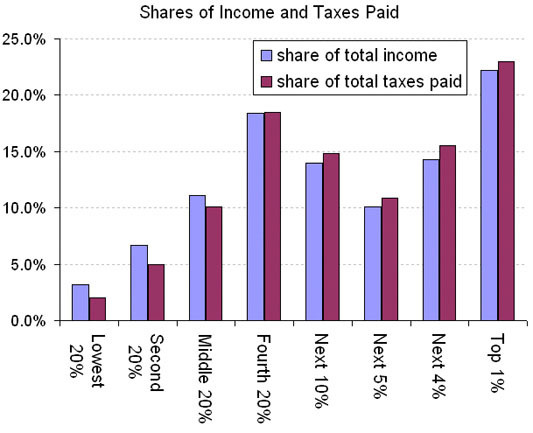
Democrats propose to make it ever more slightly so. But restoring Clinton-era rates on the rich is not a utopian left-wing plan.
Mankiw's argument serves the useful, if inadvertent, purpose of showing how it is that at least some legitimate economists support the GOP. Republican economic policy is dominated by a debt-financed tax cuts, a policy that has no economic support. (To the extent that conservative economists can back up support for tax cutting, it is for tax cuts matched by spending cuts, which has no relation to actual Republican policy.) Mankiw is an acclaimed economist, and actually wrote a textbook describing those who claim tax cuts can increase revenue as "charlatans and cranks," despite the fact that the president he worked for repeatedly made that very argument.
So why is it that conservative economists like himself can lend their name to Lafferism and other nonsense? They're driven by their political philosophy, not their economic beliefs. Mankiw is willing to overlook the crankery of Republican economics because it furthers his philosophical beliefs. When he advocates Repiublican policies, it is generally Mankiw the amateur political philosopher speaking, not Mankiw the economist.
Democrats Whine On Health Care Vote
Republicans are going to hold a vote on repealing the Affordable Care Act. Here's the Democratic response:
Democrats said they plan to aggressively defend Obama's legislative accomplishments, chief among them the health-care bill.
"They're talking about wasting time repealing health care, when they know that the Senate and administration won't go along with it. Don't waste time. Create jobs," Rep. Steve Israel(D-N.Y.), chairman of the Democratic Congressional Campaign Committee, said on CNN's "State of the Union."
Wow, is this weak. The point of this vote is to set the precedent for the future. Right now, Republicans understand they can't repeal health care reform. It's a meaningless vote at the moment. their hope is that, at some point in the next few terms, they will control the government. At that point, they want to repeal health care reform. The purpose of holding a vote now is that anybody who casts a yes vote can be pressured into doing the same when it counts lest they be seen as posturing.
If you shrug it off as a meaningless symbolic vote, then why not go ahead and vote yes? Moderate Democrats may not objectively have much to fear -- anybody who survived the 2010 tidal wave can probably survive anything -- but it's the politician's nature to fear. You need to give them a reason to vote against repeal.
In fact, Democrats have a strong response. Republicans are voting to open up the donut hole for Medicare recipients and charge them higher rates, allow insurance companies to turn away anybody whose family has a preexisting condition, and all sorts of awful things.
There's a reason Republicans robotically insisted during the health care debate that they wanted to "start over" when their real position was to do nothing. It's because doing nothing was wildly unpopular. Now they're voting for the wildly unpopular do nothing plan, stripping away the pretense of having an alternative. Why not make them pay? Disingenuous whining about how we should be focused on jobs is not the way to do that.
Detroit's Lost Civilization
The Guardian has a wonderful slide show of Detroit's cultural and architectural treasures in ruins:
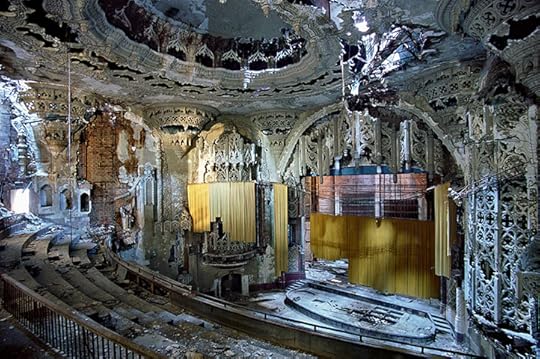
My sense is that people who never lived in the region understand neither of how great the city once was nor the state of disrepair into which it has fallen.
December 30, 2010
Is Palin-mania A Liberal Plot?
A Gallup poll finds that the only contemporary Republican political leader who makes the Republicans' list of "most admired people" is Sarah Palin (who is cited as "most admired woman" by 26% of Republicans -- no other current politician cracks 3% among Republicans.) Ezra Klein notes:
The closest thing the GOP has to a Dole or a Gingrich is Sarah Palin, whose interests and messages frequently diverge from those of the Republican Party and who polls very poorly among the broader populace.
Perhaps the idea that you need a leader to deliver your message is outdated in an age when Fox News and other outlets that are willing to create and push the message on their own. But I rather doubt it, particularly as Obama's brand remains surprisingly strong and the Republican brand surprisingly weak despite the results of the 2010 election. One reason for that strength, I think, is the absence of a viable alternative.
This has Jennifer Rubin miffed:
Ezra does not point to any empirical or anecdotal evidence to support this assertion. Indeed, recent events suggest otherwise. Her advice was not heeded on the tax deal. Her numbers are sinking as a potential 2012 candidate. ...
So who but liberal elites, who pine for a ready made target (in precisely the same way they defined Rush Limbaugh as the leader of the GOP after Obama's election), consider Palin the voice of the right?
Yes, what Republicans (aside from, according to Gallup, Republicans as a whole) consider Palin the voice of the right? Well, there's Jennifer Rubin just last August:
Palin has proved by example that a woman politician need not spout the pro-big government, pro-abortion, pro-welfare-state line. “Ms. Palin has spent much of 2010 burnishing her political bona fides and extending her influence by way of the Mama Grizzlies, a gang of Sarah- approved, maverick-y female politicians looking to ‘take back’ America with ‘common-sense’ solutions.” She sure did, and she proved herself to be the most effective female politician in the country. Sorry, Hillary — while you have been playing errand girl for the Obama foreign-policy train wreck, Palin has ascended to the throne. ...
Palin not only trumped the left on style but she also managed to connect on nearly every issue — ObamaCare, bailouts, Israel, taxes, American exceptionalism, and the stimulus plan — in a way the president and his liberal supporters could not. For all of her supposed lack of “policy muscle,” it was she who defined the debate on ObamaCare and she who synced up with the Tea Party’s small-government, personal-responsibility, anti-tax-hike message. Who’s short on policy muscle — the White House or Palin?
and in her infamous "why the Jews hate Palin" treatise last January:
For her conservative admirers, she continues to exemplify independence, moxie, common sense, the superiority of the common American over the nation’s elites, and the embodiment of modern womanhood and Christian faith.
Palin knows what to look for in candidates because she is in sync with the center-right zeitgeist. If she knows what the country is about and what makes it successful, the argument would go, she might possess, as Dickerson explains, “a special light to guide the country out of the muck.” (This was the secret to Ronald Reagan, by the way. It didn’t matter what the issue was — he would get it “right” because he instinctively understood the superiority of free markets, the destiny of America, and the character of his fellow citizens. Yes, all caveats apply, and Palin is not Reagan.)
It’s not clear whether Palin will run in 2012 or could even win the nomination, but her potential opponents and the media underestimate her at their peril. And if she doesn’t win, whichever Republican does would be crazy not to take her counsel and guidance. The lady knows a thing or two about how to win races.
and in September of 2008:
Palin has energized the GOP base, driven women and independent voters into McCain’s camp, and flummoxed the MSM, but her greatest accomplishment has been to unveil the Democrats’ true liability.
That basic liability has nothing to do with the fact that they are ultra-liberals and lack credibility on national security issues. Their biggest problem is that they have never led, never managed, never navigated during a crisis, and as a result never demonstrated calm under fire. It is one thing for the GOP candidates to state that in a speech — as many did at the Republican National Convention — but it is quite another to see it being played out before your very eyes.
Like water dumped on the Wicked Witch of the West, Palin’s popularity has melted the façade of professional competence and personal stability which cloaked her opponents’ weaknesses.
Now, I realize all those comments are a few months old. During (and in the wake of) the 2008 election, Republicans considered Palin a rising star and likely candidate, and devoted their energy to touting her credentials. In recent months, Palin's polling numbers among the general electorate have plunged to terrifying levels, and Republicans now realize they desperately need to stop her from getting the nomination.
Still, it's just a little soon for Rubin to turn around and accuse anybody who deems Palin a Republican leader to be perpetuating a liberal plot.
Why I Care About Ayn Rand
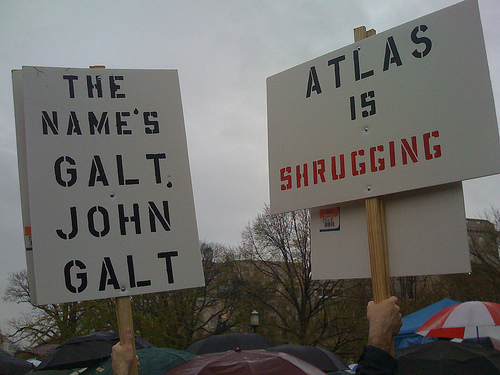
Conor Friedersdorf takes issue with my Ayn Rand obsession:
Over at The New Republic, Jonathan Chait continues his long-running jihad against Ayn Rand. One key to understanding the many people who cite her as an influence is that most of them, if forced to confront the whole of Objectivist philosophy, would reject large chunks of it and acknowledge its manifold flaws.
So why do they consider themselves fans?
The Fountainhead and Atlas Shrugged offer radical challenges to society as currently organized and morality as it is commonly taught. For that reason alone, I'd encourage everyone to read the books in high school or college, along with Marx, Freud, Mere Christianity, The Gospels, and The People's History Of The United States.
The critical reader will come away from all these works cognizent of their flaws. That doesn't mean that useful insights cannot be drawn from them. Indeed, the radical nature of the material helps the reader to question all his or her assumptions, and to come away thinking about the world differently.
We've all met people who invoke Ayn Rand to justify behaving like a sociopath in their personal relationships. I'd still recommend that any adolescent suffering from Catholic guilt read the passages about Hank and Lillian Reardon's relationship as a primer on a kind of manipulation to which they should never succumb. In typically ego-maniacal fashion, Rand use to insist that her philosophy must either be accepted or rejected wholly. Her most sycophantic devotees and her staunchest critics both make the curious mistake of believing her.
I agree with Freidersdorf that it's wrong to view Rand's philosophy as a whole that must be accepted or rejected. Huge swaths of Rand's philosophy -- her critique of science and music, various esoteric elements of her philosophy -- have virtually no influence, and it's not fair to use those elements to taint the parts of Rand's philosophy that do have influence.
But the whole point of my focus on Rand has been to call attention to those elements of her philosophy that have been absorbed by the conservative movement. Her lionization of the rich, her abhorrence of redistribution, and her general inverted Marxist political-economic model are precisely the areas of her contemporary influence. When I point out that Paul Ryan is deeply influenced by Rand's philosophy, I am not suggesting he distrusts physics or abhors Mozart. I'm trying to help explain Ryan's public philosophy.
Promote The General Something Or Other
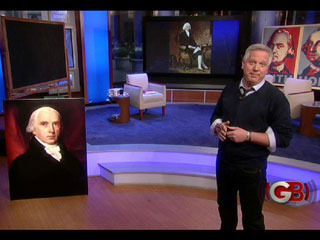
The Republicans are going to learn more about the Constitution:
When Republicans take over the House next week, they will do something that apparently has never been done before in the chamber's 221 year history.
They will read the Constitution aloud.
And then they will require that every new bill contain a statement by the lawmaker who wrote it citing the constitutional authority to enact the proposed legislation.
My favorite part is going to be when they read the word "welfare." It's in the first sentence!
Jonathan Chait's Blog
- Jonathan Chait's profile
- 35 followers

