
Jonathan Chait's Blog, page 139
December 16, 2010
Farewell, Larry King. We Knew Ye All Too Well.
Tonight is the final episode of "Larry King Live" on CNN. I don't like to speak ill of the dead, but King isn't dead yet, and come to think of it, I have no problem with speaking ill of the dead anyway. Here's a classic moment from the program in which Jerry Seinfeld disabused King of his apparent belief that Seinfeld was ending because NBC cancelled it:
It's not a crazy guess. Maybe King figured NBC executives just got tired of making huge profits off their Thursday night lineup and wanted to roll the dice with something new.
In 1994, Sam Johnson and Chris Marcil published in TNR a poem consisting of excerpts of King's USA Today column:
Dick Van Dyke is the most enduring of television superstars.
Burt Reynolds improves the screen by being on it.
Kris Kristofferson never fails to move me.
Tommy Lasorda's pasta sauce is very, very good.
The rest can be read here. And now the great poet himself rides off into the sunset.


Bob Feller's Good Sense
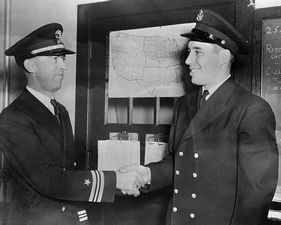 Hall of Fame pitcher Bob Feller died yesterday. The New York Times has a 2006 interview in which Feller discussed his enlistment in the Navy during World War II, which shortened his baseball career by several prime seasons. He's both level-headed and quite moving:
I went on inactive duty in August 1945, and since I had stayed in such good shape, and had played ball on military teams, I was ready to start for the Indians just two days later, against the Tigers. More than 47,000 people came to see me return — there was such a patriotic feeling, with V-J day so fresh in everyone’s minds. Even though I hadn’t pitched in the major leagues in almost four years, I struck out the first batter. I wound up throwing a four-hitter and winning, 4-2. ...
A lot of folks say that had I not missed those almost four seasons to World War II — during what was probably my physical prime — I might have had 370 or even 400 wins. But I have no regrets. None at all. I did what any American could and should do: serve his country in its time of need. The world’s time of need.
I knew then, and I know today, that winning World War II was the most important thing to happen to this country in the last 100 years.
Why Obama Is The 2012 Favorite
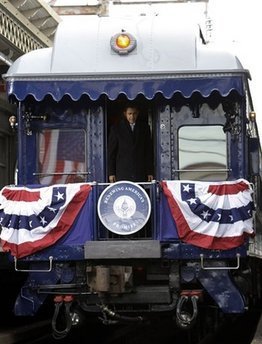 Mark Murray reads the latest WSJ/NBC poll and concludes that President Obama is in pretty strong shape:
Despite all the bad news the White House has endured over the past several months -- an unemployment rate near 10%, the BP spill, the midterm results -- the president's standing has remained steady. His job-approval rating stands at 45% (which isn't far off from where it was a year ago, when it was 47%); his economic handling is at 42% (same as it was a year ago); and 72% say they like Obama personally, even if they don't like his policies. What's more, in potential 2012 match-ups, he bests Romney by seven points (47%-40%), Palin by 22 points (55%-33%), and a relatively generic candidate like John Thune by 20 points (47%-27%). Of course, Thune and Romney both hold him under 50%.
In an accompanying article he has some pollster quotes:
“This is a president who retains very strong numbers with a political core constituency,” said GOP pollster Bill McInturff, referring to Obama’s strong standing among African-Americans (87 percent overall approval), Democrats (76 percent), Latinos (53 percent) and younger votes.
“It is really important not to lose track of his retained strength.”
Obviously, we're two years away from Obama's reelection, so the events of the next two years matter a lot. But the situation looks fairly promising for Obama at the moment. The bad economy has taken a toll on his approval ratings, but he looks as if he's hit a floor, and the floor isn't all that low. Polls consistently show that people like him personally and side with him against the Republicans -- this is paradoxically true even in an environment where the public sided strongly with the GOP in the midterm elections. Barring a double-dip recession, he's well-positioned to win a head-to-head matchup against a Republican in 2012.
Eerie

While many of us were trying to stay warm from the Arctic blast, Mother Nature was busy turning the shores of Lake Erie into a winter wonderland.
Gale force winds created monster waves which crashed on the Cleveland Harbor breakwall and West Pier lighthouse. As the resulting water spray continued to coat the structures the ice quickly accumulated.
Sunshine coming through breaks in the clouds then illuminated the ice wonders giving them a seemingly divine, otherworldly appearance.
Toward A Definition Of "Constitutional Conservatism"
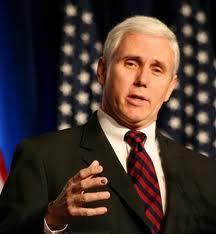 Mike Pence comes out against the tax deal, and adds this caveat:
Pence also implied that the compromise is unconstitutional, saying, "this deal was largely negotiated by leaders in the Senate and the White House, despite the fact that the Constitution clearly says that bills relating to taxes should begin in the House of Representatives."
The phrase "Constitutional conservative" has been popping up quite a bit the last few years, and figuring out what it means has been a little difficult. I think the true answer is that a Constitutional conservative is a conservative who believes any policy he disagrees with is unconstitutional.
The Individual Mandate And Right-Wing Hysteria: A Follow-Up
Conor Friedersdorf objects to my post about the individual mandate:
What does worry me is the notion that the federal government is no longer an entity of enumerated powers – that a limit on its scope purposefully established by the Founders no longer exists. It used to be a check and balance. Is it now completely gone?
If Judge Hudson’s ruling is upheld, I’ll celebrate not because I fear Obamacare – I’m cynical enough to suspect that whatever came next might well make me even worse off – but because a limit on federal power that I care about generally has been re-asserted.
Should his ruling be overturned, I’ll be disappointed because the precedent troubles me: if the commerce clause can prevent me from growing marijuana in my backyard and mandate that I buy a particular kind of health insurance that covers far more than emergency room care, what Congressional action can’t it cover?
Let me try to reiterate my point.
The legal merits of Hudson's ruling, which seem to be totally daft, are themselves piggybacked upon a policy argument which is itself highly unpersuasive at best. The political argument, endorsed by Friedersdorf, maintains that the individual mandate represents some dramatic new imposition of Congressional power. Congress's power may have grown over the years, the argument holds, but the individual mandate represents some new frontier of intrusiveness. It is forbidding an activity (or inactivity) that is more personal and less intertwined with the economy as a whole than almost any previous regulation. It is not dramatically different than a law requiring people to eat broccoli.
But this is totally incorrect. In reality, the individual mandate is much less intrusive and paternalistic than many regulations accepted as Constitutional. The rationale isn't to make people buy insurance because it's good for them. If people want to accept the risk of illness on their own, that's fine. The issue is precisely that they can't do this without forcing the rest of us to pick up the tab when they 1) show up at the emergency room, or 2) decide to buy private insurance in a now-regulated market.
Regulations to prevent people from offloading their risks onto others are extremely common and extremely necessary. So, again, the right's portrayal of this as a dramatic expansion of the scope of Congressional action is wildly misleading, and it owes itself not to any sober analysis of federal power but to the psychology of reaction.
Now, Friedersdorf is correct to point out that some libertarians who are not partisan Republicans have endorsed this argument as well. In my view this is a group of people who are deeply inclined to support limited government, and have latched onto an argument in favor of limited government that has gained a political foothold without subjecting the merits of the case to serious scrutiny. They think the case is about drawing a new line against the expansion of Congressional economic power, when in fact the line is far behind the old one.
The Rise Of Corporate P.C.
There really is something utterly bizarre about our political culture at the moment. The economy is currently experiencing an unusual combination of huge corporate profits alongside mass unemployment. A Democratic administration created the conditions for those profits by addressing the the economic crisis in a way that did the least possible harm to corporate America. And yet he finds himself called upon to repeatedly apologize to corporate America:
In a session with 20 chief executives, including the heads of Google, General Electric and American Express, Obama - whose sharp rhetoric about pay on Wall Street has annoyed some executives - declared, "I want to dispel any notion we want to inhibit your success," according to a source in the room. ...
Apparently the issue is that, despite the objectively pro-business cast of Obama's policies, he has infuriated the CEO class by occasionally pointing out that businessmen can make mistakes. You would think business would care about the bottom line, but businessmen want also to be loved.
Karl Rove again takes to the Wall Street Journal op-ed page to complain that Obama is too mean to business:
His push for health-care reform was marked by frequent attacks on insurance companies. He depicted them as gluttonous profit-seekers intent on sticking it to their customers. He went after them with loaded words: They "discriminated," "rationed care . . . denied coverage" and were "bureaucrats getting between you and your doctor."
); padding-left: 18px; background-position: 0px 50%; background-repeat: no-repeat no-repeat; ">
After his bill passed, the president kept it up. "This is no secret," Mr. Obama said in March. Health insurers are "telling their investors this: We are in the money; we are going to keep on making big profits even though a lot of folks are going to be put under hardship." Even physicians found themselves in Mr. Obama's crosshairs for ordering needless but costly tests just to enrich themselves.
Amazing. All these things Obama said about the industry are completely true. (As Obama has said, these terrible practices don't result from immorality but by a terrible system that creates an incentive to engage in awful behavior.) But business has fashioned a political correctness that stigmatizes the telling of even basic truths about it, lest feelings be hurt. Are the titans of American industry really so sensitive?
Does Peter Orszag Expose The Flaw In Liberalism?
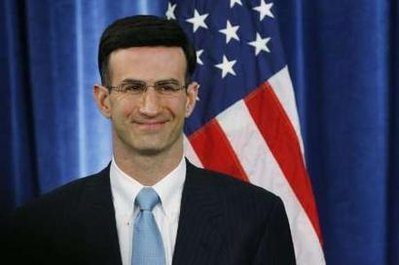
sees Peter Orszag taking a job with Citibank as evidence of deep flaws within the liberal idea:
In my opinion, the seeming inevitability of Orszag-like migrations points to a potentially fatal tension within the progressive strand of liberal thought. Progressives laudably seek to oppose injustice by deploying government power as a countervailing force against the imagined opressive and exploitative tendencies of market institutions. Yet it seems that time and again market institutions find ways to use the government's regulatory and insurer-of-last-resort functions as countervailing forces against their competitors and, in the end, against the very public these functions were meant to protect.
We are constantly exploited by the tools meant to foil our exploitation. For a progressive to acknowledge as much is tantamount to abandoning progressivism. So it's no surprise that progressives would rather worry over trivialities such as campaign finance reform than dwell on the paradoxes of political power. But it really isn't the Citizens United decision that's about to make Peter Orszag a minor Midas. It's the vast power of a handful of Washington players, with whom Mr Orszag has become relatively intimate, to make or destroy great fortunes more or less at whim. Well-connected wonks can get rich on Wall Street only because Washington power is now so unconstrained. Washington is so unconstrained in no small part because progressives and New Dealers and Keynesians and neo-cons and neo-liberals for various good and bad reasons wanted it that way. So, what is to be done? Summon a self-bottling genie-bottling genie?
A few replies:
1. I don't think private capture of public functions represent a major, recurring problem with liberal governance. Does the minimum wage result in regulatory capture? Does Social Security? The Earned Income Tax Credit? Moreover, when such capture does occur, liberals can un-capture it, something that happened with student loans, Medicare Advantage, and so on. Libertarians are very interested in the phenomenon of regulations being turned into weapons of business power, but this phenomenon seems like the exception rather than the rule.
2. I don't see any evidence that Orszag was corrupted by the prospect of private lucre during his tenure as Budget Director. His most important contribution to the Obama administration may have been a fierce insistence upon using health care reform to control the growth of health costs -- a goal that serves almost no narrow private end and opposes many.
3. As Wilkinson semi-concedes later on in his item, it's not really true that "Well-connected wonks can get rich on Wall Street only because Washington power is now so unconstrained." It's impossible to create a government weak enough that having deep knowledge of government will not be a marketable commodity. Given that fact, the only answer is to create social norms and regulatory barriers to minimize excessive special interest as best as possible.
December 15, 2010
&c
-- Remembering Richard Holbrooke.
-- CBPP's big picture on the budget and taxes.
-- Al Franken defends his vote for the tax deal.
The Individual Mandate Backlash And Conservative Hysteria
Starting in the early 1980s, up through well into 2009, the individual mandate was an eminently respectable Republican position, embraced by conservative policy wonks and leading Republicans. Since then, virtually the whole of the conservative movement has coalesced around the position that the individual mandate is not merely misguided but actually unconstitutional, a fact conservatives somehow overlooked during the previous three decades.
Indeed, conservatives now believe that the policy they once embraced (or at least tolerated) would amount to an abrogation of the very principle of limited government. The conservative argument, reflected in Republican judge Henry Hudson’s ruling against the individual mandate, is that purchasing health insurance is the ultimate individual decision, and that abridging this liberty would, in Hudson’s words, “invite unbridled exercise of federal police powers.” If the individual mandate is permissible, writes George Will, then “Congress can doanything - eat your broccoli, or else - and America no longer has a limited government.” Megan McArdle echoes, “On a reading of the commerce clause that allows the government to force you to buy insurance from a private company, what can't the government force you to do?”
This is the intellectual rationale for the hysterical conservative response to the pasaage of health care reform. By this line of reasoning, the individual mandate springs from a paternalistic desire to compel individuals to engage in behavior that effects nobody but themselves.
But of course, the decision not to purchase health insurance is the very opposite. Those who forego health insurance are forcing the rest of us to cover their costs if they exercise their right to be treated in an emergency room. They are also forcing the rest of us to pay higher insurance rates, now that insurance companies can no longer exclude those with preexisting conditions. That, of course, is exactly why conservatives supported it for so long.
Conservatism's sudden lurch from supporting (or tolerating) the individual mandate to opposing it as a dagger in the heart of freedom is a phenomenon that merits not intellectual analysis but psychoanalysis. This is simply how conservatives respond in the face of every liberal advance. At such moments the nation is always teetering on the precipice between freedom and socialism. The danger never comes to pass, yet no lesson is ever learned. We simply progress intermittently from hysterical episode to hysterical episode.
David Leonhardt wrote about this historical phenomenon in the New York Times the other day, and as he graciously notes, I described it at length last year:
In the right-wing mind, the world we live in at any given moment can be described as the free market, the American way of life, perhaps not a perfect world but a cherished and fundamentally free one. The nextadvance of liberalism will always bring socialism, tyranny, a crushing burden on industry, and other horrors. The previous liberal advances that they or their predecessors greeted with such hysteria are eventually incorporated into the landscape of the free American way of life.
That is how in forty years conservatives could progress from dire warnings about the danger of Medicare to virulent defenses of Medicare against Democratic plans to trim its waste. Conservatism's virulent turn against the individual mandate is simply a case of the normal pattern working in reverse – a sound, free market policy eventually transmutes into the Death of Freedom, rather than vice versa.
Jonathan Chait's Blog
- Jonathan Chait's profile
- 35 followers

