
Jonathan Chait's Blog, page 128
January 18, 2011
When Left-Wing Editors Fight Unions
New York has a mordantly funny piece about the effort by staffers at Harper's to unionize. The saga begins with gross mismanagement by owner Rick MacArthur, spurring the staff to organize. Then the left-wing MacArthur started to act a lot like a union-crushing boss:
MacArthur contested the staff's right to unionize. Staffers couldn’t help but chuckle at the irony: The staunch defender of unions, who in a 2009 Harper's piece called the UAW “the country’s best and traditionally most honest mass labor organization,” was now on the other side of the table as the "worst kind of factory owner," as one staffer put it to me.
MacArthur hired veteran employment lawyer Bert Pogrebin, who had previously faced off against the Village Voice union, to negotiate on his behalf. In August, the matter was taken up by the National Labor Relations Board. Pogrebin tried to get many of Harper’s' editors, including Metcalf and senior editors Donovon Hohn and Chris Cox, excluded from the union on the grounds that were in management positions. In September, the NLRB ruled that Metcalf and the others could join the union. In October, the NLRB denied MacArthur’s appeal, and the union went ahead with plans to hold elections that would certify the union. Staffers put up signs around the office and a ballot box was placed in the conference room.
On October 13, the day before elections were scheduled, MacArthur sent a letter to the staff lobbying employees to vote against the union. “I confess that I remain confused about the goal of the people seeking union representation,” he wrote, “but I have to assume it has something to do with my firing of Roger, objections to my promoting Ellen over Ben, and general insecurity about the future of the magazine.” MacArthur wrote that forming a union “will not, as some have requested, give any of you a great voice in the selection of the next editor,” and added, “Certainly, the union will not be able to solve the financial problems of the magazine or get us more subscribers, newsstand buyers or advertisers. It will, of course, be able to collect initiation fees and dues from you.”


Health Care And The Wonk Gap
One of the unusual and frustrating aspects of the health care debate is the sheer imbalance of people who understand the issue at all from a technical standpoint. Even the elite policy wonks of the right make wildly incorrect claims about the issue. Here, for instance, is National Review and Weekly Standard health care writer Yuval Levin defending the Republican Party against Paul Krugman on the "doc fix":
Krugman points to a House Republican analysis of the costs of the health-care bill and then insists that the first and foremost argument in that analysis has to do with the “doc fix” to Medicare—the fact that the support of doctors’ groups for passage of Obamacare was bought with the promise of a long-term repeal of cuts to doctor payments but the cost of that promise was not factored into the cost of the final bill.
I've written about this a million times, and it's pretty simple. In 1997, Congress enacted a change to the formula for reimbursing doctors under Medicare. The change accidentally slashed physician pay far lower than intended. Congress has been cancelling out the reimbursement cut ever since. Republicans constantly claim that the cost of continuing to do so -- which isn't really a cost, just a failure to capitalize on an unintended future saving -- is part of the "real" cost of the Affordable Care Act. Or, like Levin, they claim that Democrats "bought" the support of doctors by promising a long-term repeal of those cuts.
It's true that the House Democrats briefly considered, but ultimately declined, to include the cost of a long term doc fix in a version of the health care bill. But this has nothing to do with anything. The cost of the doc fix exists utterly irrespective of the PPACA. If you repealed the bill, the cost of the doc fix would be exactly the same. (And, indeed, the GOP repeal bill does nothing at all to change that cost.) Anybody who endorses this claim is announcing to the world either that they do not understand the issue or that they're willing to make things up to advance their cause. It's a basic litmus test of seriousness, and the number of Republican-aligned commentators or analysts who pass it could fit into a cubicle.
Levin further argues, "Even with these assumptions, neither the CBO nor the Obama administration’s own CMS actuary argues that the law will actually reduce health-care spending or the rise of health-care costs." Again, false. Let me quote the CBO:
CBO expects that enacting both proposals would generate a reduction in the federal budgetary commitment to health care during the decade following the 10-year budget window—which is the same conclusion that CBO reached about H.R. 3590, as passed by the Senate.
Likewise, CMS finds:
For 2015-19, national health spending is now projected to increase 6.7 percent per year, on average -- slightly less than the 6.8 percent average annual growth rate projected in February 2010.
So why would Levin say that those reports find that health care costs will rise faster when in fact they find that they will rise slower? It's again a very basic confusion between level and rate of growth. The Affordable Care Act provides coverage to 30 million people who don't have it. That raises the level of health care spending. But the bill also contains numerous mechanisms to reduce the rate of growth over time. Ezra Klein has a handy chart:
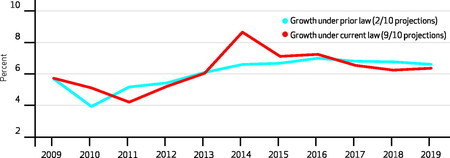
Both CBO and CMS find that cost growth continues to decline after 2019. The level of spending rises but the trajectory goes down. Levin has every right to disagree with those analyses. But his claim that they find the bill won't reduce the rise of health care costs is simply false.
Most people are not policy wonks. We really on trusted specialists to translate these details for us. This is true as well of elected officials and their advisors. Part of the extraordinary vitriol of the health care debate stems from the fact that, on the Republican side, even the specialists believe things that are simply patently untrue. As with climate change and supply-side economics, there isn't even a common reality upon which to base the discussion.
Governor Bentley Is Interested In Your Soul
Alabama Governor-elect Robert Bentley has some unusually blunt words for non-Christians:
"There may be some people here today who do not have living within them the Holy Spirit," Bentley said. ''But if you have been adopted in God's family like I have, and like you have if you're a Christian and if you're saved, and the Holy Spirit lives within you just like the Holy Spirit lives within me, then you know what that makes? It makes you and me brothers. And it makes you and me brother and sister."
Bentley added, ''Now I will have to say that, if we don't have the same daddy, we're not brothers and sisters. So anybody here today who has not accepted Jesus Christ as their savior, I'm telling you, you're not my brother and you're not my sister, and I want to be your brother."
Asked later if he meant to be insulting to people of other faiths, Bentley replied, ''We're not trying to insult anybody."
Which reminds me, it's been months since the last neoconservative column upbraiding American Jews for their inexplicable failure to vote Republican.
One More Reason for Dems to Welcome the Repeal Debate
[Guest post by Noam Scheiber:]
On Sunday, Jon Chait cited one reason Democrats should relish the debate over repealing healthcare reform: public support for repeal appears to be dropping. Two days earlier, Jonathan Cohn hinted at another reason: Repeal is likely to divide the business community--a.k.a the GOP base--a significant portion of which prefers the health reform law over the GOP's nonexistent alternative.
Today, a piece in Politico highlights a third reason Democrats should be high-fiving themselves over the repeal effort: It unifies their party, whereas the initial healthcare push divided them in a lot of ways:
The Democrats’ message is also more cohesive now than the last time they voted on the legislation. Gone is last year’s contentious intraparty fighting over the public option, tax subsidies and dozens of other issues. Now, Democrats are united in defending the law.
Only four Democrats voted with Republicans in a procedural vote on the health debate this month. Nine other Democrats — all “no” votes on the Affordable Care Act — voted with their party this time on the procedural measure, arguing that there are at least pieces of the law that they support. They said they plan to vote against repeal.
Several groups that supported reform have followed their lead, unifying around defending the legislation from repeal and sharing personal stories to encourage support.
They, too, were divided at points in the debate, sometimes pushing competing agendas. Wednesday, many plan to hold a unity event in the Capitol to support the law and let consumers share how the law has benefited them.
And, of course, that's before you get to the basic behavioral proposition that it's much easier to frighten people about losing something (say, the right to healthcare if they have a pre-existing condition) than it is to sell them on something new (as in the original health care debate).
I'm sure it wouldn't be too hard to come up with reasons five, six, and seven, but you get the idea...
The Roots Of Darrell Issa's Suspicion
[image error]Ryan Lizza's New Yorker profile of Darrell Issa has to be read in its entirety. The main upshot is that Issa, the new chairman of the House Committee on Oversight and Reform who is charged with exposing what he sees as massive corruption in the Obama White House, either has a lengthy history as a hardened criminal, or he's been the victim of an extraordinary series of coincidences. Among other tidbits is Issa's involvement (or non-involvement, depending on your view) in a car theft scam:
According to court records, on December 28, 1979, William Issa arrived at Smythe European Motors, in San Jose, and offered to sell Darrell’s car, a red 1976 Mercedes sedan. William was carrying an Ohio driver’s license with his brother’s name on it and the dealer gave William a check for sixteen thousand dollars, which he immediately cashed. Soon afterward, Darrell reported the car stolen from the Monterey airport. He later told the police that he had left the title in the trunk.
The brothers had been together in Cleveland for Christmas, and, after Darrell gave a series of conflicting statements about his brother and whether he himself had recently obtained a second driver’s license, the investigator in the case became suspicious that the two men had conspired to fraudulently sell Darrell’s car and then collect the insurance money.
The brothers were indicted for grand theft. Darrell argued that he had no knowledge of William’s activities; William claimed that his brother had authorized him to sell the car, and he produced a document dated a few weeks before the robbery that gave him power of attorney over his brother’s affairs. On February 15th, with the investigation ongoing, Darrell returned to the San Jose dealership and repurchased his car, for seventeen thousand dollars. In August, 1980, the prosecution dropped the case. Darrell insisted that he was a victim, not a criminal. William had produced evidence that he had the legal authority to sell the car, and the injured party was reimbursed.
Of course, Issa went on to make a fortune in car security devices. But before then, he collected a high (and recently increased) fire insurance settlement from an extremely suspicious blaze at his factory, which raised the question of where he got the money to start this business in the first place:
The insurance company, meanwhile, had found something peculiar about Issa, unrelated to the arson: there was no indication of where his initial capital came from. After interviewing a family member, an investigator reported, “She was unable to advise us as to his financial banking [sic] to become an officer in Quantum Inc.” A second report noted, “We were unable to find the source of his financing for the business ventures he is engaged in at the present time.”
Hmm.
Issa's background also provides a useful context for his deep suspicions of massive criminal behavior in the Obama administration. Ask yourself this: what kind of person would assume that everybody else is involved in routine criminal behavior?
Am I Too Mean To Jeb Bush?
Ezra Klein says I'm too hard on Jeb Bush:
When Bush says that "second-generation Hispanics marry non-Hispanics at a higher rate than second-generation Irish or Italians" and that "second-generation Hispanics' English language capability rates are higher than previous immigrant groups," he's directly answering a critique that has a lot of power among anti-immigration groups: that there's something different about this wave of immigrants as compared with previous waves of immigrants.
It's clearly the case that Bush is making a pro-immigration argument and that he's refuting some harsh anti-immigrant forces within his party. Ezra seems to leap from that point to the conclusion that Bush is making a perfectly benign argument about immigrants. Here, again, is what Bush said:
His insistence on engagement is not a call for multiculturalism. Quite the opposite: "The beauty of America—one of the things that so separates us [from the rest of the world]—is this ability to take people from disparate backgrounds that buy into the American ideal."
With regard to assimilation, he says, Hispanics have much to be proud of. "Second-generation Hispanics marry non-Hispanics at a higher rate than second-generation Irish or Italians. Second-generation Hispanics' English language capability rates are higher than previous immigrant groups'."
He's defending Latino immigration on the grounds that Latino immigrants intermarry and lose their identity. That's better than opposing Latino immigration on the grounds that those things won't happen. But not quite the same thing as accepting Latino immigrants as full Americans whether or not they marry white people and gradually lose their distinctive culture.
Repeal And Re-Something
Politico has an inadvertently hilarious story detailing the Republican plan to wage war on the Affordable Care Act. The story breaks down the GOP plan to repeal the law and throw sand in the gears of the machinery, planned down to every grain of sand. At the end we get this:
Craft a GOP alternative. Republicans insist they’re interested in more than just repealing the law and reverting to the status quo.
So on Wednesday, the House will also approve a resolution ordering four relevant committees to draw up alternative health care proposals.
But the leadership isn’t giving them a deadline. The open-ended process suggests Republicans won’t be rushing to push their own vision of health care through the House anytime soon.
Oh, our plan? Eh, we'll get around to it.
January 17, 2011
&c
-- Jon Cohn once again explains how health care repeal would cost money.
-- The Onion: pundits prove surprisingly adept at analyzing Jared Loughner.
Reagan And Alzheimer's
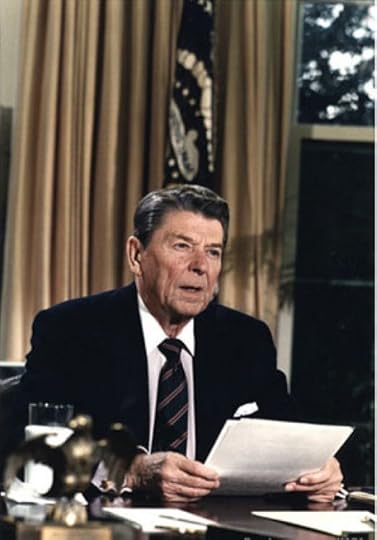 Ron Reagan's book about his father discusses the very strong possibility that he had symptoms of Alzheimer's disease during his presidency:
In his memoir “My Father at 100,” Reagan writes:
“Today we are aware that the psychological and neurological changes associated with Alzheimer’s can be in evidence years, even decades, before identifiable symptoms arise. The question, then, of whether my father suffered from the beginning stages of Alzheimer’s while in office more of less answers itself.”
Ron Reagan recounts having concerns as far back as 1984.
"Watching the first of his two debates with 1984 Democratic presidential nominee Walter Mondale, I began to experience the nausea of a bad dream coming true. At 73, Ronald Reagan would be the oldest president ever reelected...[M]y father now seemed to be giving them legitimate reason for concern. My heart sank as he floundered his way through his responses, fumbling with notes, uncharacteristically lost for words. He looked tired and bewildered."
Two years later the president expressed his own concern about his failing memory:
“My father might himself have suspected that all was not as it should be. As far back as August 1986 he had been alarmed to discover, while flying over the familiar canyons north of Los Angeles, that he could no longer summon their names.” ...
“I have since learned from a doctor who happened to be interning at the hospital when my father was brought in that surgeons involved in his care, in what my informant characterized as ‘shameful’ behavior, violated my father’s right to medical privacy by subsequently gossiping about his condition.”
The question of whether Reagan was all there during his presidency was a major controversy. Rick Hertzberg's masterful 1991 review essay summarized the evidence of Reagan's doddering obtuseness:
Reagan, as portrayed in Caninon's book and in his own is a childlike and some times childish man. His head is full of stories. He is unable to think analytically. He is ignorant. He has notions about the way things work, but he doesn't notice when these notions contradict each other. He has difficulty distinguishing between fantasy and reality. He believes fervently in happy endings. He is passive and fatalistic. He cannot admit error.
Within the White House, Reagan himself was consulted precisely as one consults a horoscope. To his frazzled assistants he had mystical power, but was not quite real. Like a soothsayer's chart, he required deciphering. "Reaganology,' Cannon writes, "was largely based on whatever gleanings could be obtained from body language." The president's pronouncements in meetings, which usually took the form of anecdotes that might or might not be relevant to the matter at hand, were open to various interpretations. When the conversation ranged beyond the handful of Animal Farm-type certainties that made up what Cannon calls Reagan's "core beliefs" (taxes bad, defense good; government bad, markets good) Reagan was lost. Though the people who served with him respected him for his occult powers — his rapport with the television audience his ability to read a text convincingly, the powerful simplicity of the core beliefs — they viewed his intellect with contempt. They thought he was a big baby, and they were right.
Conservatives have made it a point of pride to portray the Gipper as a deeply-engaged intellectual. A 2001 book of Reagan's speeches and commentaries created a huge splash among movement conservatives, who insist that Reagan was "an intellectual force" and "not only an active mind but one more engaged than the critics (and even some friends) imagined."
But, of course, Reagan's ability to craft speeches and prose during the 1970s, ands the beginning of his presidency, hardly refutes the notion that he grew progressively more addled as the disease took its toll.
Life In Ohio, A Continuing Series
ELYRIA — An Elyria man was charged with assault after allegedly punching a bartender in the eye at Pudge’s Place after she asked him to stop eating free food set out for customers who were purchasing alcoholic beverages.
Joe W. Lewis, 44, of Elyria, was charged with assault and possession of drugs after he was found at about 12:15 a.m. Saturday near the Broad Street bar.
Jonathan Chait's Blog
- Jonathan Chait's profile
- 35 followers

