
Jonathan Chait's Blog, page 132
January 10, 2011
Dems Attack On Health Care Reform
During the health care fight, Republicans understood perfectly well that the public considered the status quo totally unacceptable. That's why Republicans robotically insisted they wanted only to "start over" with a new plan, one they refused to define, that had all the good stuff and none of the bad.
Now Republicans are proposing a bill to restore the wildly unpopular status quo ante. Democrats are attacking:
In the opening days of the 112th Congress, members of the new Democratic minority have been unrelenting in their attacks on the way Republicans have begun their reign. ...
From Representative Nancy Pelosi, the party leader, on down, Democrats have heaped criticism on the new majority with some success. Republicans have been forced to answer questions about why they are not allowing amendments to the health care repeal legislation, how much it will cause the deficit to rise and what happened to their promise to pare spending by $100 billion. ...
Democrats are also accusing Republican proponents of repeal who accept federal health care insurance of benefiting from the same type of coverage they are denying their constituents.
Well, that's the way you do it. Republicans are finally coming out for a plan, and it's an incredibly unpopular plan.


Muslims In Egypt Stand Against Terrorism
An incredibly moving and encouraging story:
On New Year’s Day, a devastating terrorist bombing at a Coptic church in Egypt killed 21 people and injured 79 others. Although the identity of the culprits was not known, it was assumed that they were Muslim extremists, intent on targeting those they saw as heretics. Religious tensions immediately rose in the country, and angry Copts stormed streets, battled with police, and even vandalized a nearby mosque. The riots and heightened tensions between the Muslim and Coptic communities was likely what the terrorists wanted — to divide the Egyptian community and create sectarian strife between different religious groups.
Yet by Coptic Christmas Eve, which took place Thursday night in Egypt, things had changed completely. As Egyptian Copts attended mass at churches across the country, “thousands” of Muslims, including “the two sons of President Hosni Mubarak,” joined them, acting as “human shields” to protect from terrorist attacks by extremists. The Muslims organized under the slogan “We either live together, or we die together,” inspired by Mohamed El-Sawy, an Egyptian artist:
Egypt’s majority Muslim population stuck to its word Thursday night. What had been a promise of solidarity to the weary Coptic community, was honoured, when thousands of Muslims showed up at Coptic Christmas eve mass services in churches around the country and at candle light vigils held outside. From the well-known to the unknown, Muslims had offered their bodies as “human shields” for last night’s mass, making a pledge to collectively fight the threat of Islamic militants and towards an Egypt free from sectarian strife.
“We either live together, or we die together,” was the sloganeering genius of Mohamed El-Sawy, a Muslim arts tycoon whose cultural centre distributed flyers at churches in Cairo Thursday night, and who has been credited with first floating the “human shield” idea. Among those shields were movie stars Adel Imam and Yousra, popular preacher Amr Khaled, the two sons of President Hosni Mubarak, and thousands of citizens who have said they consider the attack one on Egypt as a whole. “This is not about us and them,” said Dalia Mustafa, a student who attended mass at Virgin Mary Church on Maraashly. “We are one. This was an attack on Egypt as a whole, and I am standing with the Copts because the only way things will change in this country is if we come together.”
The Arizona Shooting Is Not A Product Of Right-Wing Rage
Conservatives are furious that the shooting of Gabrielle Giffords is being pinned on them. Their indignation is justified. The mania of Giffords' would-be assassin may be slightly more right-wing than left-wing, but on the whole it is largely disconnected from even loosely organized extreme right-wing politics.
The rhetorical attempts to connect Jared Loughner to mainstream politics take two forms, neither convincing. One is to condemn the use of combat metaphors in politics, such as Sarah Palin's web page superimposing gunsights upon Democratic districts targeted by the GOP. Glenn Reynolds persuasively notes that this is a well-established, bipartisan practice:
Palin critic Markos Moulitsas, on his Daily Kos blog, had even included Rep. Gabrielle Giffords's district on a list of congressional districts "bullseyed" for primary challenges. When Democrats use language like this—or even harsher language like Mr. Obama's famous remark, in Philadelphia during the 2008 campaign, "If they bring a knife to the fight, we bring a gun"—it's just evidence of high spirits, apparently.
I don't believe that analogizing politics to combat encourages anybody, even the mentally ill, to take up violence. People use metaphors like this in all aspects of daily life -- sports, business, dating, and on and on.
The second form is to lump together all sorts of extremism under the broad rubric of "anger" or "hate." The New York Times news story posits "a wrenching process of soul-searching about the tone of political discourse and wondered aloud if a lack of civility had somehow contributed to the bloodshed in Tucson." NBC's Mark Murray writes, "If one word summed up the past two years in American politics, it was this: anger."
This category is far too broad. Strong feelings are a part of political discourse. This is serious business. Important things are at stake, including, at times, life and death. People have a right to get angry.
Now, I do believe there is a problem with the current political moment. Both extremes of the political spectrum can embrace apocalyptic thinking and rejection of the democratic process. The left-wing version came to the fore during the 1960s, but it is tiny and almost completely disconnected from Democratic politics. The right-wing version, on the other hand, is drawing ever more tightly into an embrace with putatively respectable Republican politics. Since the closing stages of the 2008 election, conservatives have regularly described President Obama as an alien figure and his policies a fundamental threat to American liberty. It has become normal for conservatives to hint that they will take up arms if they don't get their way politically -- a violation of the cultural norm of respecting democratic outcomes that forms the basis for the stability of our political system. Sharron Angle, not just a fringe activist but the GOP's candidate in a major Senate race, rhetorically flirted with outright sedition, and Republicans paid no attention to this, because they wanted to beat Harry Reid.
This is, I think, a serious problem. But it's also a problem that has nothing, or almost nothing, to do with the tragedy in Arizona. This was not a right-wing militia member taking apocalyptic right-wing rhetoric about watering the tree of liberty too seriously. It was a random act.
I can see why those concerned about the rise of right-wing hysteria would want to use Loughner as a cautionary tale -- even if he wasn't a product of right-wing rage, they may be thinking, he is an example of what right-wing rage could lead to. Yet they fail to understand that this will appear to conservatives as an attempt to use the emotion of the moment to stigmatize them. The mania of Sarah Palin and the Tea Party must be dealt with on their own terms.
January 9, 2011
How the Giffords Tragedy Made Me Anti-Anti-Anti Political Hate Speech
Slate’s Jack Shafer has posted a characteristically irreverent piece on “The awesome stupidity of the calls to tamp down political speech in the wake of the Giffords shooting,” as the piece’s sub-title describes it. I haven’t personally called on anyone to tamp down their political speech since the Giffords tragedy. But had I been moved to comment, I would almost certainly have joined the ranks of the awesomely stupid.
As it happens, I think Shafer’s anti-anti-hate speech position hinges on three analytical mistakes. Once you sort them out, his argument looks pretty un-compelling.
Mistake number one:
For as long as I've been alive, crosshairs and bull's-eyes have been an accepted part of the graphical lexicon when it comes to political debates. Such "inflammatory" words as targeting, attacking, destroying, blasting, crushing, burying, knee-capping, and others have similarly guided political thought and action. Not once have the use of these images or words tempted me or anybody else I know to kill. I've listened to, read—and even written!—vicious attacks on government without reaching for my gun. I've even gotten angry, for goodness' sake, without coming close to assassinating a politician or a judge.
But, of course, no one is suggesting that political hate speech incites normal, well-adjusted people like Shafer (okay, semi-well-adjusted—I’ve met the guy) to take up arms against public officials. The point is that a tiny fraction of the population isn’t so well-adjusted. That it is, in fact, teetering on the edge of maladjustment, and that particularly incendiary rhetoric may push such a person over the edge.
Now, you may or may not buy this. But that’s the group we’re talking about. Not you, me, and Jack Shafer. In fact, even Shafer concedes this point in the very next paragraph of his piece:
From what I can tell, I'm not an outlier. Only the tiniest handful of people—most of whom are already behind bars, in psychiatric institutions, or on psycho-meds—can be driven to kill by political whispers or shouts.
Am I missing something or does this observation undercut the paragraph that preceded it?
Mistake number two:
Any call to cool "inflammatory" speech is a call to police all speech, and I can't think of anybody in government, politics, business, or the press that I would trust with that power. As Jonathan Rauch wrote brilliantly in Harper's in 1995, "The vocabulary of hate is potentially as rich as your dictionary, and all you do by banning language used by cretins is to let them decide what the rest of us may say."
Uh, no. A call to cool inflammatory speech can be just that—a call to cool inflammatory speech. It is by no means interchangeable with a call to ban certain words. Shafer is missing the distinction between a rule or a law, on the one hand, and a norm. I would oppose a law preventing people from uttering words like “targeting” and “destroying.” I would love to see a norm governing political rhetoric in which prominent public figures refrain from the casual, massively hyperbolic use of highly incendiary language, so as not to give ideas to the people mentioned above.
In the same way, I wouldn’t support a law requiring people to help old ladies carry their groceries across busy intersections. But a world in which such a norm exists strikes me as a marginally better place.
Mistake number three:
Our spirited political discourse, complete with name-calling, vilification—and, yes, violent imagery—is a good thing. Better that angry people unload their fury in public than let it fester and turn septic in private.
But it’s not the prospective unloaders of fury that people like me are hoping will watch their rhetoric. If Jared Loughner could have blown off enough steam fulminating against the Fed to skip his attack on a congresswoman, her staff, and several bystanders, I’d be all for it. (Unfortunately, that doesn’t appear to have helped in this case.) The people I’d like to see tamp down their rhetoric are the insincerely angry public figures (say, the Republican candidate seeking Tea Party support, or the typical Fox News anchor) who rile up the angry (and, occasionally, unhinged) for cynical political reasons or crass commercial ones.
Of course, we don’t know yet whether it was some table-pounding pol or TV personality that pushed Loughner beyond his breaking point, or whether he would have melted down in similarly destructive fashion had he spent his life in a monastery. But, as Shafer concedes, there are almost certainly some people who fall into the first category. If public figures can save a few lives by reining in their most outrageously hyperbolic rhetoric, that doesn’t seem like too much to ask. It seems irresponsible not to.
An analogy: Suppose you were running for president of your local PTA chapter, which entailed pleading your case before 100 fellow PTA members alongside your rival for the post, a longtime neighbor and respected pharmacist. Suppose you got to go first, and that you knew someone in the audience was both armed and suffered from paranoid delusions. Whether or not it should be against the law for you to refer repeatedly to your rival as a jack-booted thug bent on confiscating private property, we can all agree that it’s probably not a great idea. Certainly no one would argue that it was a responsible line of attack.
The people urging the tamp-down Shafer finds so oppressive are simply applying this norm to national politics. What’s so awesomely stupid about that?
Update: One other analytical mistake to point out, which is kind of implicit in my argument but worth saying straight-out: Shafer conveniently conflates the sort of metaphors that are a routine and accepted part of daily discourse--words like "attacking" and "destroying," which few are suggesting are problematic (certainly I wouldn't)--with the kind of inciteful, eliminationist rhetoric people like me would like to see less of. Shafer is arguing against a straw man when he argues against a clamp-down on the first kind of language.
January 7, 2011
TNR's Best Sudan Coverage
This weekend, citizens of southern Sudan will decide, in a referendum, whether or not they want to secede and form a new nation. This historic vote comes after decades of war, genocide, and repression, and the southern Sudanese are expected to choose independence by an overwhelming margin. In recent years, TNR has devoted considerable space to covering Sudan—and advocating for its people. When genocide was claiming the lives of hundreds of thousands in 2004, we demanded that the U.S. and the world “do something.” When they did not, and when they repeatedly kowtowed to the regime in Khartoum, we again demanded action and accountability. Here, we have compiled some of our best Sudan writing from the last two decades:
“War Without End,” Bill Berkeley, 1989
“Uncivil,” Michael Rubin, 2001
“Out of Beijing,” Stephanie Giry, 2004
“Do Something,” The Editors, 2004
“Again,” The Editors, 2006
“A Very Long Engagement,” Marisa Katz, 2006
“Killing Fields,” The Editors, 2007
“The Truth Will Not Set You Free,” Richard Just, 2008
Conservative Health Care Reform, Can It Exist?
David Brooks predicts what will happen after the Affordable Care Act melts down:
When the crisis comes, Democrats will face an interesting choice — to patch the Obama system or try to replace it with something bigger. The administration may want a patch, but by a ratio of nearly 2 to 1, according to a CNN poll, Democratic voters would prefer a more ambitious law. Liberals could logically say that the mistake was trying to create a hybrid system, rather than moving straight to a single-payer one.
Republicans are going to have to move beyond their current “Repeal!” posture and cohere behind a positive alternative. One approach, which Tyler Cowen of George Mason University has written about, is to allow more state experimentation. Another approach, championed by Capretta, Yuval Levin of National Affairs and Thomas P. Miller of the American Enterprise Institute, revolves around the words “defined contribution.”
Under this approach, Republicans would say that the federal government has a role in subsidizing health insurance — a generous role, but not unlimited. The government would provide needy citizens with a predefined amount of money to spend on insurance and allow them to shop in a transparent, regulated, but not micromanaged marketplace.
Ezra Klein does a good job of explaining why the PPACA will not, in fact, melt down at all. He does concede that some parts will no doubt work less well than expected (and others probably better.)
But the key point is that, if the PPACA does encounter problems and require changes, we will now be starting from a totally different position. The most serious and elemental fight of the entire issue was over whether the uninsured should be covered at all. Many conservatives made a principled argument that being able to obtain health insurance is a personal responsibility, and if people can't do it on their own, those virtuous enough to obtain it shouldn't have to have their money confiscated to subsidize the losers. Other conservatives conceded that, in theory, covering the uninsured might be nice, but they opposed any use of resources at all that would be needed to pay for it. (Want to cut Medicare waste and use the savings to cover the uninsured? No dice -- use it to reduce the deficit instead.)
Basically throughout the entire course of American history, conservatives in political power have shown zero interest in reforming American health care and/or finding a way to cover the uninsured. If they want to get into the game and reform health care now, terrific. The good news is that we're now starting in a world in which having 50 million Americans go without coverage is no longer a given. Conservatives may change some things about the PPACA, but they won't be able to change that.
The Debt Limit Fight: Republicans Blink
You knew President Obama would cave on the Bush tax cuts when he first started saying that a deal was going to be made. In a brinkmanship fight, the most important weapon is the willingness to allow failure, or at least credibly threaten to do so.
So these comments from Paul Ryan on raising the debt ceiling are a red -- or rather, white -- flag:
Some conservative Republicans have urged their GOP colleagues to resist raising the ceiling -- which currently clocks in at $14.3 trillion -- under any circumstances. Rep. Michele Bachmann of Minnesota is collecting signatures on her PAC's website "to force our elected officials to stop spending cold turkey," and Sen. Jim DeMint of South Carolina has advocated for a "big showdown" with Democrats by blocking the raise.
But House Budget Chairman Rep. Paul Ryan says that tactic isn't viable. "Just refusing to vote for it, I don't think that's really a strategy," he said, noting that a failure to raise the ceiling could result in the nation defaulting on its debts to investors.
"Will the debt ceiling be raised? Does it have to be raised? Yes," he said at an event sponsored by economics21 and the Manhattan Institute at the National Press Club Thursday.
But Ryan suggested that Republicans can tweak some specifics of the move - how many years the increase covers, for example. And, more importantly, they can tack on requirements for deep spending cuts as a condition of passage. "I want to make sure we get substantial spending cuts and controls in exchange for raising the debt ceiling," he said.
At the end, Ryan says Republicans should attach some conditions about spending cuts. But once you've conceded that the limit is going to be raised, your ability to extract concessions is gone. My guess is that Republicans are hearing from the business lobby that even risking a default would be totally unacceptable.
January 6, 2011
The Daley Show
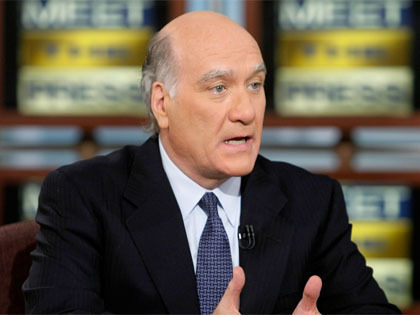
This is a post about potential White House chief of staff Bill Daley, but to understand the problem with Daley, you have to understand Mitch McConnell. Here's a bit from Josh Green's excellent profile of the Republican Senate leader:
“We worked very hard to keep our fingerprints off of these proposals,” McConnell says. “Because we thought—correctly, I think—that the only way the American people would know that a great debate was going on was if the measures were not bipartisan. When you hang the ‘bipartisan’ tag on something, the perception is that differences have been worked out, and there’s a broad agreement that that’s the way forward.”
I've long thought this is McConnell's key insight, his most important contribution to American politics. One historic restraint on Congressional partisanship has been the fear of appearing extreme or partisan -- if we all oppose the president, the public will turn against us. McConnell understands that this fear, while not nonexistent, is overblown for two reasons. First, people hold presidents and not Congress responsible for outcomes. Second, voters -- and especially swing voters -- do not understand the ideological basis for disagreement. They believe that problems ought to be solved harmoniously, and that the lack of harmony signals the process has gone badly wrong. Put these two insights together, and you have a strategy for using obstruction as a powerful tool to lower presidential popularity.
Now, on to Daley. Here is Daley's critique of Obama:
“They miscalculated on health care,” Mr. Daley said in an interview last year with The New York Times. “The election of ’08 sent a message that after 30 years of center-right governing, we had moved to center left — not left.”
And here is Ezra Klein's persuasive response:
The health-care law the president signed was modeled off of the health-care law the Republican governor of Massachusetts had signed, which was in turn modeled off of the health-care law the Republicans in Congress had proposed in 1993. That's "left"? And meanwhile, Daley thinks the country had moved substantially leftward over that period -- "after 30 years of center-right governing, we had moved to center left" -- but that even a compromise bill based on Republican ideas was too far left for the country, which would imply that the administration he served in the early-'90s, which pushed a more ambitious health-care bill when the country was further to the right, bordered on communist.
And there is the problem. I don't know what easy method there is to respond to McConnell's tactics. But Daley's method, allowing extreme positions to redefine the parameters of the debate, is almost surely the wrong way.
I think liberal criticism of some potential Obama nominees is overblown -- the fact that Gene Sperling got paid a lot of Wall Street money to run a charitable program doesn't bother me. But putting a figure like Daley in a position of strategic importance seems like a major blunder.
Bringing Back Mr. Smith
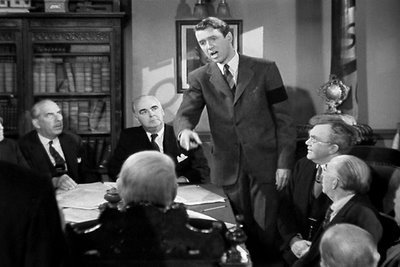
This is a shockingly bad report from Wall Street Journal news reporter Corey Boles:
If a few of Senate Democrats had their way, Jimmy Stewart’s character in the classic film “Mr. Smith Goes to Washington” would have had a harder time blocking a Senate vote.
In the 1939 movie, a Senate freshman spent all night talking in a classic filibuster, the decades-old right of any lawmaker to block legislation on the Senate floor.
But a group of Democrats believes Republicans have abused the practice. On Wednesday, they began debate on an effort to try to stamp out the filibuster.
Aides to Senate Democratic leaders say the effort won’t likely lead to a vote on such a rule change. But it is the first serious debate in years on the nuts-and-bolts of Senate operations.
The rule changes were introduced by Senate Democrats Tom Udall of New Mexico and Jeff Merkley of Oregon – both in their first terms — and veteran Sen. Tom Harkin of Iowa.
The plan would allow debate to begin on any measure with a simple 51-vote majority, rather than the 60-vote supermajority the minority party can currently insist upon. It would prevent senators from putting secret “holds” on nominations or legislation, and guarantee the minority party the right to introduce amendments to legislation on the floor of the Senate.
Under the rules, lawmakers who want to prevent a vote on final passage of legislation would be forced to take the floor of the Senate to defend their stance – and would have to remain there as long as the bill was being debated.
This echoes the hilariously incorrect attack made by Lamar Alexander the other day. It's not just wrong, it's a complete inversion of the truth.
The filibuster used to require endless debate. Under the current rules, though, the minority can block even the beginning of a debate. Filibuster proponents point to Jimmy Stewart and the history of the filibuster to paint their position as a defense of unlimited debate when they're really just defending a supermajority requirement. Because current rules allow the minority to block the start of a debate, Stewart-style filibusters with actual speeches don't happen.
What the Democrats propose to do is not to limit debate, or even to curtail the supermajority requirement. It's merely to force the minority party to actually debate. The minority would not be able to block a bill from being debated on the floor. If they wanted to require a supermajority to pass it, they would have to actually debate it.
In other words, Boles (and the Republicans) claim that Mr. Smith Goes To Washington-style filibusters currently exist and the reforms would stop them. In reality, such filibusters do not currently exist and the reform bill would create them.
Actual Potential Bipartisanship
Here is a potential -- or, at least, conceivable -- area for bipartisan support: reforming the tax code. The Wall Street Journal reports that corporate leaders are pushing and it seems to have some support from both parties:
The White House and congressional Republicans are moving from different directions toward a consensus that the U.S. corporate tax code needs a fundamental overhaul, a goal high on corporate leaders' agenda.
Specific proposals for retooling the complex corporate-tax system aren't on the table and the debate over the issue is sure to be lengthy and difficult. But President Barack Obama and Republican congressional leaders are separately sounding the same broad theme that corporate tax rates should be lower.
Here's the lay of the issue. Nominal corporate tax rates are higher in the United States than in most other countries. Conservatives complain about this endlessly, and indeed routinely break their taboo against questioning American Exceptionalism by openly demanding that we mimic Europe's policies. However, the corporate tax code has so many loopholes that effective tax rates -- the percentage of tax that corporations actually pay --are actually on the low side:
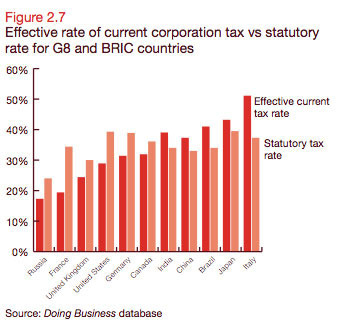
That isn't very useful. In theory, left and right ought to agree on a reform that would raise the same amount of revenue by closing loopholes and lowering rates. The trouble is, you'd have to get republicans to agree not to use it as a pretext to reduce revenue, and that could be hard:
Obstacles to a deal to revamp corporate taxes include the likelihood corporations will fight to keep tax breaks that work to their benefit, and White House concerns that any tax overhaul not result in less revenue.
A revamping of corporate taxes also could be hitched to an overhaul of individual taxes, complicating the deal-making and potentially dragging the issue into the 2012 election cycle.
Republicans, however, are unlikely to support a plan that substantially raises the government's total tax take. Rep. Pat Tiberi (R., Ohio), the incoming chairman of a House Ways and Means panel on federal revenue, says it is "unrealistic" to expect businesses to give up enough of their tax breaks to hold revenues flat.
But, like I said, in theory there's both a policy rationale and an interest-group constituency for doing this, so we'll see.
Jonathan Chait's Blog
- Jonathan Chait's profile
- 35 followers

