
Jonathan Chait's Blog, page 124
January 25, 2011
&c
-- Noam: Obama is co-opting business.
-- Why didn't the Mafia succeed in Washington?
-- Sports Illustrated on the SEC (the college football version) and oversigning.


Eric Cantor Again Commits Near-Honesty
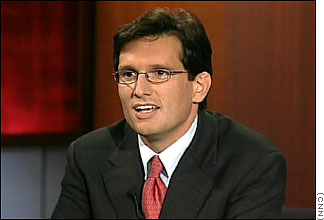
Brian Beutler flags this interesting quote from Eric Cantor about the decrepit state of the transportation infrastructure. Watch him wander into the realm of reality and then quickly scamper out:
I don't think anybody would tell you that our nation's transportation infrastructure is in a state of existence that we would accept," Cantor admitted.
We've got the aviation industry that, you know, anybody trying to fly in and out of the tri-state airports up there in New York? No. When that area gets clogged up, the whole nation, practically, is delayed. Something needs to be done in that arena trying to bring us into the new digital age here, in terms of those issues. But you look at the bridges in disrepair. The highways -- certainly, for sure, we've got to be able to address those. There are things that are occurring at the state level, some innovative ways to approach the need for financing. But at the end of the day we've got to look to see where the tax revenues are being spent, what they're being spent on, are the priorities what the American people expect. But this is the kind of analysis that's got to be undertaken. And it's going to take work. It's not some easy answer: just spend more. I mean, again, this is what the American people are tired of, this response, we just need to spend because there's no other answer. That's not good enough, because the money's not there, we don't have the money.
We don't have the money? Then why are you supporting more tax cuts?
Union Thuggery At Its Most Thuggish
The Wall Street Journal editorial page today once again frets over the prospect of union "intimidation." In this case, "intimidation" turns out to mean the possibility that a union leader could give a speech criticizing corporations from pouring millions of dollars into electioneering:
When it comes to intimidating opponents before a fight, no one does it better than New Zealand's Haka tribe, whose members, googly-eyed, stomp their feet, stick out their tongues and bark at their opponents. AFL-CIO President Richard Trumka seems to have learned a thing or two about the technique.
Last Wednesday Mr. Trumka gave a speech at the National Press Club denouncing business groups that support pro-reform Governors, calling them "shadowy committees . . . aimed at depriving all workers—public and private sector—of the basic human right to form strong unions and bargain collectively to lift their lives." He then started foot stomping, naming Rupert Murdoch, CEO of News Corp., which owns this newspaper, and Goldman Sachs CEO Lloyd Blankfein as participants "in a committee formed to raise business funds to attack public employees." ...
As they've done in the past, unions and their allies will run millions of dollars in TV ads trying to stop Mr. Cuomo's reform efforts. Without business support for ads that counter this demagoguery, the unions might prevail once again.
I actually sympathize with the right's position on the particular issue of limiting public pensions. But the idea that it's "intimidation" to make a speech criticizing corporations who are spending money to influence public policy is laughable. the poor dears!
The RSC Goes Hog Wild
Last week, the ultra-conservative Republican Study Committee released a series of proposed spending cuts that would eliminate or near-eliminate a host of government programs:
Among the items the group proposes to eliminate or decimate: the National Endowment for the Arts, the National Endowment for the Humanities, the Corporation for Public Broadcasting, Title X birth control and family planning, AmeriCorps, the Energy Star program and work on fuel efficient cars, and the United Nations Intergovernmental Panel on Climate Change.
Notice anything missing from that list? Yes -- agriculture subsidies:
As eager as they are for a fight with the White House, Republican budget cutters have a problem in their own back pasture: what to do about a system of farm subsidies that’s still pumping billions into GOP districts at a time of record income for producers.
Net cash farm income for 2010 is projected to finish near $92.5 billion — a 41 percent increase even after subtracting payments from the government. Yet conservatives are almost tongue-tied, as seen last week with the Republican Study Committee’s proposal to eliminate relatively modest subsidies for an organic food growers program without mentioning the nearly $5 billion in much larger government direct payments to farm country — including to the home districts of many of the RSC’s members.
What makes this so noxious is that farm subsidies are the largest program that has no intellectual support behind it. Nearly any policy wonk, whether liberal, conservative or moderate, would say they have no justification whatsoever. If there's any part of the federal budget that deserves wholesale elimination, this is it. Yet the RSC spares it.
Indeed, as Dana Milbank writes, the RSC proposal is budget cutting as culture war. The targets are programs associated with liberalism and the cultural elite, as evidenced by the RDC's decision to confine its agriculture cuts to a small program for organic food. (Take that, you hippies.) All in all, a remarkably hypocritical performance from the RSC.
January 24, 2011
&c
-- Car bombs, politics, and lies: Jason Zengerle charts the rise and fall of a once-promising politician.
-- The Tea Party wants your hands off their Social Security.
-- If Clarence Thomas can't understand a financial disclosure form, how's he supposed to interpret a constitution?
Eric Cantor And The Birthers
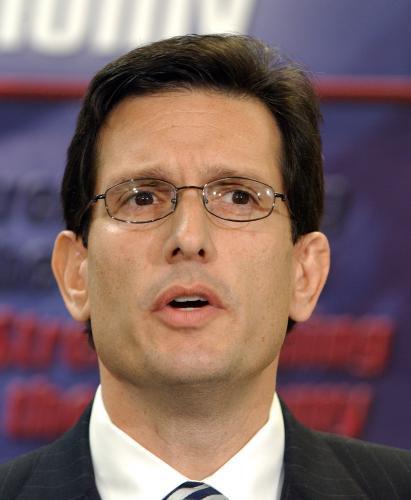 Republican leaders have a delicate task in how they treat the Birthers. They can't come too close without risking their credibility in the center, but they can't openly denounce them either, without alienating an important part of their base. The result in painful tap-dances like this from Eric Cantor:
MR. GREGORY: There's been a lot of talk about discourse, about how you all can get along a little bit better and do it a little bit more civilly. And I wonder, this is the leadership moment here, OK? There are elements of this country who question the president's citizenship, who think that it--his birth certificate is inauthentic. Will you call that what it is, which is crazy talk?
REP. CANTOR: David, you know, I mean, a lot of that has been an, an issue sort of generated by not only the media, but others in the country. Most Americans really are beyond that, and they want us to focus...
MR. GREGORY: Right. Is somebody brings that up just engaging in crazy talk?
REP. CANTOR: Well, David, I, I don't think it's, it's nice to call anyone crazy, OK?
MR. GREGORY: All right. Is it a legitimate or an illegitimate issue?
REP. CANTOR: And--so I don't think it's an issue that we need to address at all. I think we need to focus on...
MR. GREGORY: All right. His citizenship should never be questioned, in your judgment. Is that what you're saying?
REP. CANTOR: It is, it is not an issue that even needs to be on the policy-making table right now whatsoever.
MR. GREGORY: Right. Because it's illegitimate? I mean, why won't you just call it what it is?
REP. CANTOR: I--because, again...
MR. GREGORY: I mean, I feel like there's a lot of Republican leaders who don't want to go as far as to criticize those folks.
REP. CANTOR: No. I think the president's a citizen of the United States.
MR. GREGORY: Period.
REP. CANTOR: So what--yes. Why, why is it that you want me to go and engage in name-calling?
Name calling! What a great term for openly denouncing a crazy idea.
He's definitely not a birther. But he doesn't want to be seen as anti-Birther. He just wants the issue to linger out there without touching it.
A Glimpse Into The GOP's Inner Sanctum

I've always been fascinated by the way that party elites meet behind closed doors to pick a presidential candidate long before the primaries begin. The selection of George W. Bush as GOP standard bearer in 2000 occurred almost completely out of sight. Bill Kristol, in the course of urging Republicans to let the primaries play out without doing has, offers a tantalizing glimpse:
We know the superiority of spontaneous order to central planning. But too many GOP bigwigs in Washington who claim to have read Hayek have succumbed to the fatal conceit. They’re meeting nonstop trying to determine for us all now, a year before the first primary—with limited information as to relevant candidate skills and almost no knowledge of next year’s political environment—who the best presidential candidate would be.
Democratic capitalists admire Schumpeter for explaining the virtues of creative destruction. But too many donors to the party of democratic capitalism are huddling in New York this winter figuring out if there isn’t some way to short-circuit this kind of healthy—if messy, to be sure—competition among entrepreneurial candidates testing their skills and their messages.
Sadly, Kristol devotes the rest of his editorial to repeating his simple competition-is-good over and over. A more detailed glimpse into these backrooms -- which Kristol is surely privy to; having access to such backrooms is the essence of Bill Kristol -- would actually be interesting. Who are these bigwigs? What candidate or candidates do they support? What methods are they proposing to short-circuit the primaries?
Everything's Subsidized in Texas
For several years now, Texas has been the conservative model for responsibly budgeting by avoiding "big government." Here's Kevin Williamson:
Governor [Rick] Perry sums up the Texas model in five words: “Don’t spend all the money.” Here’s what a good long run of small-government, low-tax conservatism has achieved in Texas: Once a largely agricultural state, Texas today is home to 6 of the 25 largest cities in the country, more than any other state. Texas has a trillion-dollar economy that would make it the 15th-largest national economy in the world if it were, as some of its more spirited partisans sometimes idly suggest it should be, an independent country. [...] Saying no at just the right time sometimes means turning down “free” money from Washington. Texas left $556 million on the table when the federal government offered it to help modernize Texas’s unemployment trust fund, because the deal would have forced state taxpayers to pour additional revenue into the system after Uncle Sam’s bequest was tapped out.
And Rich Lowry:
In Texas in recent decades, the watchwords have been prudence and stability in the course of nurturing a pro-business environment, while California has undergone a self-immolation that Pres. Barack Obama wants to replay nationally.
And Arthur Laffer:
One would think – considering the recent budget fiasco in California – that a modern state needs a steeply progressive tax code just to survive. The case of Texas is a clear counterexample, showing that these fears are simply a myth. In the long run, there is no trade-off between healthy government finances and a competitive business environment.
And "AEI senior fellow" Newt Gingrich:
How do we reconcile America's resistance to further taxation with the dire need to overhaul a broken budgeting process in bankrupt state capitals and in Washington? Texas can serve as a pro-business, anti-waste model that could be replicated across the country. The state's long-term budgeting strategies, business incentives and wise exploitation of its natural resources have left it in sound fiscal shape.
Of course, now we know that Texas is facing a massive budget shortfall - up to $25 billion on a two-year budget of $95 billion (far larger than Rick Perry predicted), but Williamson and other conservative commentators have a backup argument:
Texas’s low-B.S. approach...also left Texas with surpluses that allowed the state to put about $10 billion in its rainy-day fund, which could come in handy now that the economy seems to be clouding up a little. Could, but probably won’t: Republicans plan to introduce a budget that comes in within current revenue without touching the rainy-day fund. Get your head around that: There’s a multibillion-dollar pot of cash sitting there in front of politicians who must be just slavering inside at the thought of it, and they aren’t going to touch it — even though they have a pretty good excuse. Imagine a Congress that could do that. They haven’t delivered yet, but Perry’s Republicans did the stand-up thing last time around and reaped the rewards. Expect them to do it again.
If by "stand-up thing," you mean "use federal money to hide your deficit," then sure:
NEW YORK (CNNMoney) -- Texas Gov. Rick Perry likes to tell Washington to stop meddling in state affairs. He vocally opposed the Obama administration's 2009 stimulus program to spur the economy and assist cash-strapped states.
Perry also likes to trumpet that his state balanced its budget in 2009, while keeping billions in its rainy day fund.
But he couldn't have done that without a lot of help from ... guess where? Washington.
Turns out Texas was the state that depended the most on those very stimulus funds to plug nearly 97% of its shortfall for fiscal 2010, according to the National Conference of State Legislatures.
Texas, which crafts a budget every two years, was facing a $6.6 billion shortfall for its 2010-2011 fiscal years. It plugged nearly all of that deficit with $6.4 billion in Recovery Act money, allowing it to leave its $9.1 billion rainy day fund untouched.
"Stimulus was very helpful in getting them through the last few years," said Brian Sigritz, director of state fiscal studies for the National Association of State Budget Officers, said of Texas.
Even as Perry requested the Recovery Act money, he railed against it. On the very same day he asked for the funds, he set up a petition titled "No Government Bailouts."
Can Republicans Tweak Health Care Reform?
 A couple conservatives today propose reforms that would replace the individual mandate with a less-coercive mechanism to prevent people from free-riding their health insurance. Here's Merrill Matthews:
It is important to understand that the mandate is merely a clumsy way to fix a bigger problem in ObamaCare: the requirement that insurers accept anyone who applies regardless of medical condition.
Congress could mitigate that moral hazard by restricting individuals buying their own coverage—employer-based plans already accept all new employees—with a pre-existing medical condition to obtain or change coverage only during a six-week, annual "open season" enrollment period. Or they could pay an increased premium the longer they wait to get coverage, or both. Those options would not eliminate gaming, but they might reduce it.
and here's Ross Douthat:
One alternative would establish limited enrollment periods (every two years, for instance) when people with pre-existing conditions could buy into the new exchanges without being denied coverage. Anyone who failed to take advantage wouldn’t be able to get coverage for a pre-existing condition until the next enrollment period arrived. This would reduce the incentive to game the system, without directly penalizing Americans who decline to buy insurance.
I think these are sensible ideas, if not perfect ones. (Paul Starr's proposal remains the best, and I've never understood why Congress didn't do it in the first place.) The truth is that it would be very easy to tweak the individual mandate to resolve the philosophical and legal objections conservatives have raised. Unfortunately, there's little reason to believe either that these objections represent the right's real problem with the Affordable Care Act or that they're willing to consider any tweak to improve the law.
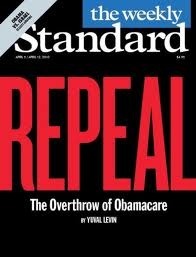
The conservative base has simply been whipped into such a frenzy on this issue that it's impossible to imagine Republicans making any change that isn't designed to lead to full repeal. There's a reason why conservative magazines and writers keep repeating the slogan "Repeal" endlessly. It's more a point of honor than policy. The Affordable Care Act has become, in the right wing mind, a monstrosity, a completely illegitimate assault on American freedom, and an emotional wound that conservative elites work very hard to ensure never heals.
Of course, it's very helpful for conservative elites like Matthews and Douthat treat the right's objections to the individual mandate (a policy tool Republicans either supported or had little objection to up until 2009) at face value. Eventually conservatives will make their peace with health scare reform, and either put their policy imprint on it or not. But in the meantime the overwhelming conservative impetus is to sabotage the law by any available means. A reform to the law that satisfies objections to the individual mandate, but that does not satisfy the urge to repeal the bill, will be seen by most Republicans as untouchable.
In Case Obama's Still Crashing His Speech
...David Frum has some pretty interesting ideas. A taste:
The right kind of focused, temporary government spending can also be a powerful job creator. Over the next generation, we desperately need to improve our road, air, and rail networks and to modernize our systems for distributing electricity. We should be doing as much as possible of this work now, to spur recovery.
Unfortunately, infrastructure investment has been a victim of our broken politics. The money does not go to the best projects. The money is earmarked by the most powerful politicians. We need a new tunnel under the Hudson. We get a bridge to nowhere.
I propose that all revenues from gasoline taxes, aviation fees, and other similar sources be placed in a fund directed by an independent infrastructure bank. The bank would be permitted to issue bonds up to a certain level, too. Instead of Congress writing a highway bill every five years, the bank would develop a list of priorities — no politics allowed. I'd suggest we have seven directors of the bank. Three would be nominated by the president and confirmed by the Senate. Two would be nominated by a conference of the Republican state governors, two more by a conference of the Democratic state governors. The directors would serve fixed and overlapping terms. When we're balancing the budget, we can move slowly through the list of bank infrastructure priorities. In a year like 2011, when it's cheap to borrow and workers need jobs, we can bring projects forward faster. Congress would always have the last word, in an up-or-down vote. And Congress would decide whether to increase or reduce the flow of future tax revenues into the infrastructure bank.
Every American will have the reassurance that these new infrastructure projects are not pork barrel. They were not chosen to reach some political deal. The money you pay at the pump or at the airport or in future taxes on carbon dioxide and other pollutants will be reinvested toward faster travel, more advanced telecommunications, and cleaner water.
Sadly, the speech is probably all done. You know that if Bill Clinton were president, he'd just be getting around to spitballing the major themes right about now, and he might well just steal Frum's whole speech. Sigh.
Jonathan Chait's Blog

- Jonathan Chait's profile
- 35 followers

