
Jonathan Chait's Blog, page 125
January 24, 2011
Bernstein Goes Post-Modernist
Jonathan Bernstein has an interesting post about why Republicans keep saying such crazy things about the budget. he decides they're against the whole notion of budgeting, which I agree with. But his attempt to understand their thinking devolves into relativism about a subject that needs to have some absolute boundaries:
To characterize conservative talk about revenues and spending, I think what I'd say is that conservatives believe that each program, and every tax, should be judged on its own merits. If a spending program is necessary, like missile defense, then it should be fully funded. If not, it should not be funded. On revenues, the justification for any sort of taxation is that citizens should have "skin in the game," and therefore everyone should pay the same, small amount. Any more taxes, and any more spending, are by this way of thinking fiscally irresponsible.
Now, you may note at this point that there's nothing in that formula to make government revenues equal government spending. As far as I can tell, that's correct; conservatives aren't interested in that question. Oh, there's plenty of lip service about "budget deficits," but the point is that they've never made sense if you read "budget deficit" as "government revenues minus government spending." It does, however, suddenly make sense if you translate "budget deficit" to mean "unwarranted spending or taxes." Regardless, that is, of how changes in that would add up.
That's why the whole concept of a fiscally sound bill that involves new spending on health care is nonsensical to conservatives who believe that individual health care just isn't the job of the federal government, a conclusion that liberals find baffling. Yes, in the trenches, some Republicans have made specific arguments about why the CBO score is wrong. But you can tell, I think, that their hearts aren't really into it—or at least, that would explain the poor quality of some of their arguments, such as the idea that the cost of "doc fix" somehow or another is both a cost of passing and of repealing ACA. Whatever, they seem to be saying; why are we even debating this, when it's self-evident that increasing the scope of government responsibilities to include some form of universal health care, even if it's structured by creating markets, is a mistake.
That still doesn't excuse shenanigans like 10/6, which is just factually wrong. And, of course, it doesn't mean that Republicans are correct. And it certainly doesn't excuse actual deficit hawks, people who really do want government receipts to equal government expenditures, from mistakenly believing that folks like Paul Ryan are their allies. All it means is that, when listening to liberals and conservatives debate the budget, remember that they're often talking past each other—because, I strongly suspect, they're just using the same words to talk about two different things.
In some sense he's correct. Except, of course, the liberal definition of "deficit" as "the difference between revenues and outlays" is actually, you know, correct, and the conservative meaning ("government programs conservatives don't like") is incorrect. This isn't one of those "What is art?" kind of questions. The answer is pretty clear-cut.


Senate Dems Throw In the Towel
Last month, every member of the Senate Democratic caucus signed a letter signalling support for reforms that would end anonymous holds and force the minority to actually mount a continuous debate if it wanted to block a bill, rather than require a supermajority vote even to begin a debate:
All Democratic senators returning next year have signed a letter to Senate Majority Leader Harry Reid, D-Nev., urging him to consider action to change long-sacrosanct filibuster rules.
The letter, delivered this week, expresses general frustration with what Democrats consider unprecedented obstruction and asks Reid to take steps to end those abuses. While it does not urge a specific solution, Democrats said it demonstrates increased backing in the majority for a proposal, championed by Sen. Tom Udall, D-N.M., and others, to weaken the minority’s ability to tie the Senate calendar into parliamentary knots.
Among the chief revisions that Democrats say will likely be offered: Senators could not initiate a filibuster of a bill before it reaches the floor unless they first muster 40 votes for it, and they would have to remain on the floor to sustain it. That is a change from current rules, which require the majority leader to file a cloture motion to overcome an anonymous objection to a motion to proceed, and then wait 30 hours for a vote on it.
What happened next? Let's see. First, Republican critics attacked the reforms for doing away with the supermajority requirement even though (sadly) they did no such thing. Then the few conservatives who actually understood what the reforms would do (which, again, was not -- NOT, Senator Alexander -- prevent the minority from obstructing legislation) admitted they actually made a lot of sense.
And, now, of course, the denouement -- Senate Democrats fold like a cheap suit:
To the dismay of a younger crop of Democrats and some outside liberal activists, there is no chance that rules surrounding the filibuster will be challenged, senior aides on both sides of the aisle say, because party leaders want to protect the right of the Senate's minority party to sometimes force a supermajority of 60 votes to approve legislation.
Instead, rank-and-file lawmakers will receive pitches from Sens. Charles E. Schumer (D-N.Y.) and Lamar Alexander (R-Tenn.), who have been negotiating more limited changes, such as with "secret holds" that allow an anonymous senator to slow legislation. In addition, some modifications could be made to the way confirmations are handled for agency nominees who do not have direct roles in policymaking.
I was pretty surprised when Senate democrats agreed to even very minor filibuster reform. They really do seem to believe that the post-1975 rule changes, which transformed the filibsuter from a rare tool of strong protest into a routine supermajority requirement, is the bedrock of American democracy.
Will this ever change? One way to change it will be for Democratic activists to start demanding support for filibuster reform as a condition of the nominating process. That will take a long time to work. Probably what will happen first is that Republicans will gain control of the House, Senate, and White House but lack a 60-vote supermajority and just change the rule themselves.
Sit On It
This year, some Senators have proposed breaking up the traditional red team-blue team State of the Union seating chart and having Democrats and Republicans intermingle their seating. It's a completely symbolic move, a cost-free way to signal bipartisanship that requires no substantive policy compromise. Who could possibly be against that? Mitch McConnell, that's who:
Senate Minority Leader Mitch McConnell isn’t looking for a date for Tuesday night’s State of the Union address.
While other lawmakers are firming up plans to sit next to members of the opposite party, the Kentucky Republican said during an appearance on Fox News Sunday that he’s “going to sit where I usually sit” – at the Republicans’ leadership table – but others are welcome to sit wherever and with whomever they want.
This is more evidence for my theory that McConnell is worried about his right flank in a primary or leadership challenge and acgtively looking to signal hostility to Democrats at every opportunity.
January 23, 2011
Paul Ryan's Other Big Idea
[Guest post by Noam Scheiber:]
We've all heard that Republican ideas man Paul Ryan--who's slated to give the GOP response to the State of the Union--has some deep thoughts on how to save the country from fiscal ruin. (Though, alas, not everyone understands that these ideas are spectacularly vague and substantively dodgy.)
Less well known is that Ryan has some equally dodgy ideas about monetary policy. FrumForum's Noah Kristula-Green unpacked them last week:
[H]e wants the Federal Reserve to set monetary policy from the price of a "basket of commodities"... A commodities basket is not a gold standard. According to some economists, it is potentially more unstable. Gold standard advocates, by definition, want a system where the currency can be exchanged for a specified amount of gold. A commodities basket would involve tying the Federal Reserve to commodities beyond just gold. At the Chicago Mercantile exchange, the commodities traded range from metals such as gold and silver to soybeans and corn, as well as natural gas and oil.
A Federal Reserve that were to set monetary policy on the price of commodities would arguably be setting policy based on the demand for commodities in emerging economies, notably China. David Beckworth, an economist at Texas State University explained to FrumForum that in addition to the price of commodities being largely determined by developing countries, the Fed would risk tying itself to prices that could change rapidly and on short notice. When demand among developing countries eventually subsided, it would alter the price of commodities: “for better or for worse, the political process can’t allow big swings in the monetary policy by outside forces.” It’s a fair question to ask why the United States and its service-based-economy, should have its monetary policy determined by the industrialization of China and other countries. One economist summarized that this policy would “imply that we would have to have consumer price deflation here in order to keep the dollar price of commodities stable.”
Hmmm...
P.S. Kristula-Green also flags some interesting thoughts on the gold standard from my favorite monetary economist, Bill Kristol. (Er, make that second favorite monetary economist.) It turns out The Weekly Standard was against the gold standard before it was for it. I wonder what could possibly explain the change of heart.
January 21, 2011
Public Concern Over Health Care Reform: Not Ideological
Republican pollster David Winston offers some pretty interesting insight into public discontent with the Affordable Care Act:
"Are [voters] unhappy with the health-care plan? Sure," said Republican strategist David Winston. "But they're more unhappy with the unemployment rate. The key thing is to make sure it's clear in their minds how it's related."
Moreover, Republicans had lambasted Democrats during the last campaign, with some effectiveness, for focusing on health care rather than on jobs and the economy. ...
They formally titled their bill "The Repealing the Job-Killing Health Care Law Act," and they almost invariably call the health law "job-destroying" or "job-crushing."
This offers a good window into public opinion. Republicans have been casting public opinion as overwhelmingly pro-repeal, which is simply not the case (the latest poll even shows the public opposing repeal by a 40-48 margin -- that's an outlier, but more evidence that the public is split.)
What's more, Republicans have been casting the opposition that does exist as motivated by ideological opposition to big government. In fact, as Winston acknowledges and the GOP's actual behavior reveals, it's a backlash rooted in poor economic conditions. One corollary is that, if and when the economy improves, public support for repeal will drop even more.
The Other First Responders
WASHINGTON—In an act that many are calling long overdue, Congress passed legislation this week to honor those Americans who were first on the scene to profit from the tragedy of Sept. 11, 2001.
The so-called 9/11 First Capitalizers Act, which passed by a wide margin in both the House and Senate, is the first measure to recognize the utter lack of sacrifice on the part of those men and women who did not hesitate to put their own personal agendas above all else when it mattered most. ...
Among those Americans recognized were "United We Stand" T-shirt manufacturer Gary Tabano, country artists Toby Keith and Lee Greenwood, Halliburton CEO David Lesar, filmmaker Oliver Stone, former president George W. Bush, and 89 members of Congress itself.
Another Talking Point Bites The Dust
A huge proportion of our political discourse is consumed by bullshit -- statements that have absolutely no bearing to the actual beliefs of the person uttering them. The other day I noticed this quote by GOP Rep. John Kline in National Review, on the subject of the House GOP's plans to mount an exhaustive attack on the Affordable Care Act:
The Republicans dismissed criticism that the GOP is focusing too much time and energy on health care, as opposed to job creation. “Just because we’re going to be looking at the impact of this health-care law doesn’t mean that committees won’t be actively engaged in other aspects of our responsibilities,” Kline said. “We don’t have limit ourselves to one subject at a time.”
I actually happen to agree with this -- of course it's possible for Congress to deal with more than one issue at a time. But Kline just threw overboard a talking point that Republicans has employed ad nauseum for two years.
Here’s Scott Brown, March 12, 2010:
When the people of my state elected me in January, they sent more than a senator to Washington - they sent a message. Across party lines, the voters told politicians in Washington to get its priorities right.
And from my travels and conversation with people throughout this country, they told me that they want their President and Congress to focus on creating jobs and reviving America’s economy. Instead, for more than a year now, we have seen a bitter, destructive, and endless drive to completely transform America’s health care system.
Haley Barbour, last January:
[I]t's interesting that the American people have been saying from the day Barack Obama got sworn in, 'Jobs are the biggest issue in the country, get our economy back going, it's the biggest issue for the country.' But for the last eight months, all I've heard about is the Democratic Party trying to ram health care down the country's throat.
Mitch McConnell, after the State of the Union:
The President talked about jobs tonight. This is a welcome change in focus after the President and his administration spent nearly an entire year pursuing a partisan health care plan that would have spent trillions of dollars we don't have rather than on a plan for getting Americans back to work.
And…wait for it…John Kline, January 8, 2010:
Unfortunately, majority leadership and the Obama Administration have chosen to rely on their failed trillion dollar so-called stimulus package and in the meantime have diverted their attention toward policies that will do greater harm to our economy. Whether it is the threat of new taxes on energy and investments or the ongoing pursuit of a government takeover of health care, Minnesotans see a majority in Washington that is out of touch with their needs and the needs of our economy.
He also said the following last August:
Today the unemployment rate continues to hover near 10 percent and 14.6 million Americans are unemployed and searching for work. I see the evidence of this every time I travel back home to Minnesota: inevitably, the first concern my constituents raise is jobs – or the lack thereof. People want to know: Where are the jobs and what is Washington doing to help create them?
And now the casual admission that, in effect, this putatively deep belief was total nonsense.
Are you surprised? Of course not. And yet the M.O. of the media is to pass on such utterly disingenuous statements without subjecting them to the slightest bit of pressure. It goes on in both parties. I think it's worse in the GOP, because that party has access to a propaganda network (Fox News, talk radio) that will repeat its talking points unconditionally, whereas Democrats have to pass muster with mainstream news organs, which have some standards about truth.
Some Actual Good Advice For Obama's SOTU
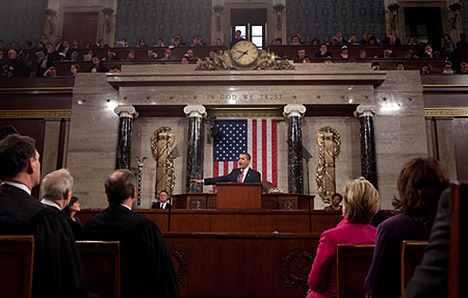
When newspapers ask a bunch of people to give advice to the president for the State of the Union address, it's a sure-fire formula for the contestants to ride their favorite hobby horses. And, sure enough, the New York Times' speech advice feature has the gay rights lobbyist who wants to him focus on gay rights, the tax cut maven who wants him to promise tax cuts for business, the deficit scold who wants him to emphasize the deficit, etc. But here from Jim Kessler is some genuinely useful advice:
“The President ought to make long term economic growth the theme of his State of the Union. He should declare that with the passage of health care reform, America’s 85-year quest to weave a strong safety net is now complete. From there he would describe a clear, tangible, and compelling destination for the nation – that of American excellence. It is a destination where America has the strongest, most vibrant, and most advanced economy on earth.”
What makes this such a good idea is that it's a highly effective way for Obama to assure moderates that he's not a big government liberal, and it's also totally accurate. There has been an enormous hole in the American welfare state, and now that the U.S. has finally joined every other advanced nation in ensuring that people won't get sick and go bankrupt or die due to lack of health insurance, that hole is filled.
Framing the issue this way would allow Obama both to defend health care reform, by placing it within the historic context of Medicare and Social Security, and to frame his pivot away from expanding the welfare state. The historic opportunity to reform health care combined with the historic challenge of the economic crisis created a situation where it was easy for moderates to interpret Obama's agenda as a voracious drive to increase the size of government wherever possible. That wasn't the case, and this is a chance for Obama to show it wasn't the case without actually changing his plans.
Another Exploration Into the Crazy Roots Of Palin Hatred
[image error]
To the growing field of conservative psychoanalysis exploring the question of what mental flaw must be present in liberals to make them not appreciate the intelligence and sound judgment of Sarah Palin, the Wall Street Journal's James Taranto has a new contribution. His thesis is that liberals dislike Palin because of the lady parts:
Why does their hatred of her burn so hot?
Ask them, and they'll most likely tell you: Because she's a moron. But that is obviously false. ...
We'd say this goes beyond mere jealousy. For many liberal women, Palin threatens their sexualidentity, which is bound up with their politics in a way that it is not for any other group (possibly excepting gays, though that is unrelated to today's topic).
Taranto's argument here is not entirely new, and it's less interesting than his corollary explanation of why a not-inconsiderable number of men seem to dislike Palin as well. Taranto argues that men who dislike Palin are either trying to impress women or are misogynists themselves:
What about male Palin-hatred? It seems to us that it is of decidedly secondary importance. Liberal men put down Palin as a cheap way to score points with the women in their lives, or they use her as an outlet for more-general misogynistic impulses that would otherwise be socially unacceptable to express.
Liberal women are the active, driving force behind hatred of Sarah Palin, while liberal men's behavior is passive and manipulative.
It's like a really bad undergraduate Women's Studies paper.
A Not-Very-Flattering Defense Of Lieberman
It's not surprising that David Brooks would devote a column to praising Joe Lieberman as a paragon of principled moderation. What's surprising is the evidence he summons to make this case:
After Barack Obama won the election, the hammer came down. Harry Reid, the Senate majority leader, told Lieberman that some Democrats wanted to strip him of his chairmanship of the homeland security committee. Lieberman, an independent, said if that happened then he might not be able to vote with the Democratic caucus. ...
If Lieberman had not been welcomed back by the Democrats, there might not have been a 60th vote for health care reform, and it would have failed.
There certainly would have been no victory for “don’t ask, don’t tell” repeal without Lieberman’s tireless work and hawkish credentials. The Kerry-Lieberman climate bill came closer to passage than any other energy bill. Lieberman also provided crucial support or a swing vote for the Lilly Ledbetter Fair Pay Act, the stimulus bill, the banking bill, the unemployment extension and several other measures.
Wow. Brooks isn't arguing that the decision to let Lieberman chair the Homeland Security Committee let him do things as committee chairman he otherwise couldn't have accomplished. He's arguing that, if Lieberman wasn't allowed the chair the committee, then he would have voted against a series of unrelated legislation out of spite. He would have let what he called the historic injustice of discriminating against gays in the military stand. He would have been indifferent to the dangers of climate change, the economic crisis, the plight of the unemployed, and so on, all because he was upset that he lost some of his power.
I suspect, though I hope otherwise, Brooks may well be right about that. I don't understand how he sees this as indicative of Lieberman's "courageous independence of mind." The picture Brooks paints is that of a power-crazed egomaniac who places his own pride above the (sometimes desperate) needs of tens of millions of people.
Jonathan Chait's Blog

- Jonathan Chait's profile
- 35 followers

