
Jonathan Chait's Blog, page 129
January 17, 2011
Democratic Wedge Issues From Spaaace!
Somebody has created a machine that reads James Carville's most pleasant dreams and turns them into reality:
One of the nation's biggest banks — JP Morgan Chase — admits it has overcharged several thousand military families for their mortgages, including families of troops fighting in Afghanistan. The bank also tells NBC News that it improperly foreclosed on more than a dozen military families.
The admissions are an outgrowth of a lawsuit filed by Marine Capt. Jonathan Rowles. Rowles is the backseat pilot of an F/A 18 Delta fighter jet and has served the nation as a Marine for five years. He and his wife, Julia, say they’ve been battling Chase almost that long.
The dispute apparently caused the bank to review its handling of all mortgages involving active-duty military personnel. Under a law known as the Servicemembers Civil Relief Act (SCRA), active-duty troops generally get their mortgage interest rates lowered to 6 percent and are protected from foreclosure. Chase now appears to have repeatedly violated that law, which is designed to protect troops and their families from financial stress while they’re in harm's way.
Talk about a wedge issue for Democrats! Meanwhile, I'm expecting any day to see news of a spaceship landing by a race of super-attractive female aliens who demand to mate with our baldest, most unintelligible Democratic political consultants.


Paul Ryan's Orphaned Roadmap
National Review's Robert Costa observes that Paul Ryan's much-ballyhooed Roadmap is being stiff-armed by Republicans in Congress:
On Capitol Hill, praise for the Wisconsin Republican comes easy and often, full-scale endorsement of the roadmap less so. Most leading first-year legislators temper their words when discussing the plan. “I think it’s a good start; it’s not perfect,” says Rep. Allen West (R., Fla.). “We have to be able to be flexible.”
Rep. Kristi Noem (R., S.D.), a member of the House leadership team, tells us she likes portions of the roadmap, such as Ryan’s caps on spending, but “beyond that, I haven’t explored too far.”
Rep. Steve Chabot (R., Ohio), who returned to Congress this month after losing his seat in 2008, takes a similar tack. “We are still studying it, what the implications might be for the budget,” he says. “I’m not ready to announce a position. I’m sure there are parts of it that we agree with — probably the vast majority of it — but there may be some things we have problems with. We need more time.”
Rep. Patrick Meehan, a freshman from Pennsylvania, is “reserving judgment.” So is Rep. Jon Runyan (R., N.J.). “It’s something we are digging through slowly,” he says. “I’m not prepared to make a statement on that.” Others point out that they like Ryan’s push to simplify the tax code and his focus on the debt, but become evasive when pressed for their opinion of its adjustments to Medicare and Social Security.
Rep. Sean Duffy (R., Wis.), a freshman and a close friend of Ryan’s, understands the nervous response by many in his class. “This is Paul Ryan’s vision,” he explains. “Many members in the freshman class would be able to tell you a few good things about Paul’s roadmap, but could they all go out there and defend it? No.”
A “wholesale endorsement” of the roadmap, Duffy adds, is likely not forthcoming: “I have not heard a swell of support saying, ‘Let’s go endorse Paul’s roadmap.’”
Ryan's plan gets way too much credit for its fiscal seriousness -- it expands the deficit over the next decade, and the real savings start to bite decades into the future, when, of course, Congress will be free to ignore the plan's draconian Medicare cuts. The fact that even distant cuts make even conservative Republicans nervous says a lot about the prospects of small government conservatism.
Confessions Of A Hippie Puncher/Ignorer

Freddie DeBoer attacks a variety of liberal bloggers for not being sufficiently left-wing:
No, the nominal left of the blogosphere is almost exclusively neoliberal. Ask for a prominent left-wing blogger and people are likely to respond with the names of Matt Yglesias, Jon Chait, Kevin Drum.... Each of them, as I understand it, believe in the general paternalistic neoliberal policy platform, where labor rights are undercut everywhere for the creation of economic growth (that 21st century deity), and then, if things go to plan, wealth is redistributed from the top to those whose earnings and quality of life have been devastated by the attack on labor. That there are deep and cogent criticisms of the analytic, moral, and predictive elements of neoliberalism is an argument for another day. That those criticismsexist, and that they emanate from a genuine left-wing position, is a point I find perfectly banal but largely undiscussed in political blogs. And that's the problem. Whatever those bloggers are, they are not left-wing, and the fact that they are the best people can generally come up with is indicative of the great imbalance. ...
I genuinely don't know what the hell happened to Matt Yglesias. I long called him my favorite blogger. I've never mistaken him for someone who shares my politics. But he was, once, part of the resurgence of pride in leftism. He was one of the voices, in the midst of the Bush-era darkness, making it plain that he was unapologetic about being a creature of the left. In the last year or so, that stand has completely disappeared. He is now one of the most vocal of the neoliberal scolds, forever ready to define the "neoliberal consensus" as the truth of man and to ignore left-wing criticism. Indeed, I'm not sure that you could even understand that he has critics from his left, judging by what he chooses to discuss on his blog. This is a particularly cruel way to erase the left-wing from the discourse: to pretend that it doesn't exist.
I'll cop to a couple things. First, I'm not a left-winger. I don't agree with the left about very much. If you're looking for genuine left-wing thought, this is not the blog for you.
Second, I don't spend a whole lot of time discussing left-wing thought because my interest in ideas is primarily, though not completely, in proportion to their influence on American politics. There's room for bringing in ideas that have little or no impact at the moment, but I don't do much of that.
One time I did argue with the left was on health care reform, where you had left-wingers making the absurd claim that the Affordable Care Act did not improve the status quo. I found this created an angry reaction and multiple accusations that I was engaged in "hippie punching" or other unfair attacks on the left. So, from my perspective, it seems like left-wingers get upset if I engage with with and upset if I ignore them. Obviously, they wouldn't be upset if I wrote about their ideas and agreed with them, but on most issues I don't agree with them.
Jeb Bush Loves Latinos, Especially The Ones Who Marry White People
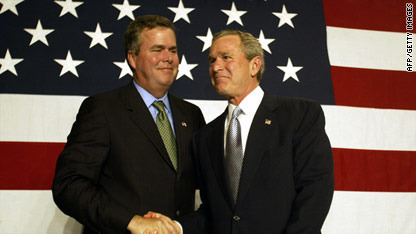
The Wall Street Journal editorial page interviews Jeb Bush, who explains who the GOP can attract Latino voters:
His insistence on engagement is not a call for multiculturalism. Quite the opposite: "The beauty of America—one of the things that so separates us [from the rest of the world]—is this ability to take people from disparate backgrounds that buy into the American ideal."
With regard to assimilation, he says, Hispanics have much to be proud of. "Second-generation Hispanics marry non-Hispanics at a higher rate than second-generation Irish or Italians. Second-generation Hispanics' English language capability rates are higher than previous immigrant groups'."
I don't mean to be oversensitive here, but it really seems as if Bush is arguing that republicans should embrace Latino immigration because Latinos are becoming less Latino and more white. Is that really a good political sales pitch?
Milton Friedman And Economic Moralism
Paul Krugman notices that the new right-wing hard money view is ideological and anti-empirical, as opposed to Milton Friedman's monetarist views:
What did I mean here when I said that Milton Friedman was on the same side of the divide as Keynes, and the other side from people like Ron Paul? I meant that Friedman-type monetarism was technocratic, not moralistic; he advocated a constant growth rate of the money supply on the basis that it works better than activist policy, not on the grounds that printing money is confiscation.
There are, broadly speaking, two kinds of right-wing economic logic. One is the argument from rights -- big government is an imposition upon freedom, the argument goes, so it is wrong regardless of its practical impact. The other kind is purely practical -- big government backfires, harms its intended beneficiaries, stifles growth, etc. Liberal economic arguments dwell almost entirely on the second grounds, while conservatives mix the two.
Ironically, Friedman himself was one of the most powerful moralists for economic libertarianism generally, arguing, "freedom in economic arrangements is itself a component of freedom broadly understood, so economic freedom is an end in itself." Likewise, former Bush economist Greg Mankiw has a paper arguing on moral grounds that the government should not redistribute income. Friedman and Mankiw are both brilliant economists. But their technocratic skill can't be viewed in isolation from their deep-seated moral beliefs.
January 16, 2011
Repealing Health Care Reform: Bring It On
Democrats have been eagerly awaiting a debate on repealing the Affordable Care Act. And they have good reason:
Ahead of a vote on repeal in the GOP-led House this week, strong opposition to the law stands at 30 percent, close to the lowest level registered in AP-GfK surveys dating to September 2009.
The nation is divided over the law, but the strength and intensity of the opposition appear diminished. The law expands coverage to more than 30 million uninsured, and would require, for the first time, that most people in the United States carry health insurance.
The poll finds that 40 percent of those surveyed said they support the law, while 41 percent oppose it. Just after the November congressional elections, opposition stood at 47 percent and support was 38 percent.
As for repeal, only about one in four say they want to do away with the law completely. Among Republicans support for repeal has dropped sharply, from 61 percent after the elections to 49 percent now.
Also, 43 percent say they want the law changed so it does more to re-engineer the health care system. Fewer than one in five say it should be left as it is.
The old health care status quo was always politically untouchable, and more people want the law expanded than want it repealed. The single biggest problem the Affordable Care Act had was the long, ungainly process of getting it through Congress. That is all done. Now it's Republicans who have to defend their health care vision.
January 14, 2011
Politics As High School
David Frum and Andrew Breitbart debate whether the former invited the latter to parties:
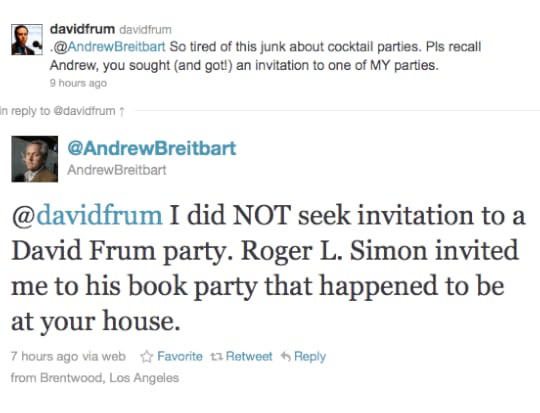
Ah, the life of the mind.
The Day In Class Warfare
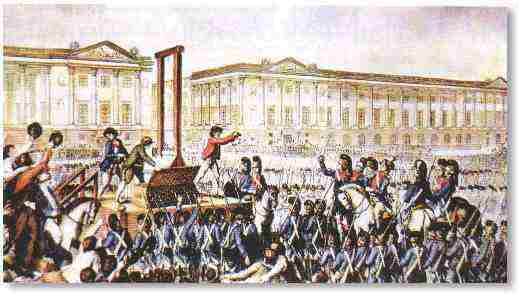
Our long national nightmare is over:
JPMorgan Chase kicked off the earnings season on Friday with news that it turned a strong $17.4 billion profit in 2010, up 48 percent from $11.7 billion the year before, as the consumer lending environment improved and commercial banking notched record results.
The rosy report could pave the way for JPMorgan to increase its dividend by as much as a dollar. Wall Street has been anxiously awaiting JPMorgan’s earnings, hoping it will signal that 2011 will be the year plump shareholder payouts return.
Thank goodness.
In other news, Wall Street remains furious at Obama for his anti-business policies:
Obama’s team is running into resistance in at least one key fundraising hub — New York City, where some of Obama’s biggest 2008 backers have bitterly protested last year’s passage of financial reform legislation and what they perceived as an unfair bad-mouthing of bankers during the debate. ...
Among the fundraising meccas that could prove most vexing is New York City, which ranked as the top metropolitan fundraising source for Obama’s presidential campaign three years ago, producing $42 million in donations, according to the Center for Responsive Politics, a nonpartisan tracker of political money.
A good chunk of that cash came from hedge fund investors who were drawn to Obama’s pledges to usher in a new way of doing things in Washington. Although the White House sent senior aides, such as Axelrod, Valerie Jarrett and Austan Goolsbee, to try to assuage the angst, not everyone has been mollified.
Daniel Loeb, founder of the Third Point Management hedge fund, wrote a scathing December rant to fellow Obama Wall Street bundlers – fundraisers who tap their own networks of friends to drive cash to the campaign — suggesting the perfect holiday gift for each of them: A book about battered wives who can’t leave their abusive husbands.
“I am sure, if we are really nice and stay quiet, everything will be alright and the President will become more centrist and that all his tough talk is just words,” Loeb wrote. “I mean when I am alone with him – at $30,000 a plate fund raisers – he’s really nice and once I got invited to the White House!”
Imagine how much money they'd be making if the president didn't abuse them so.
Newt Gingrich's Bold New Strategy
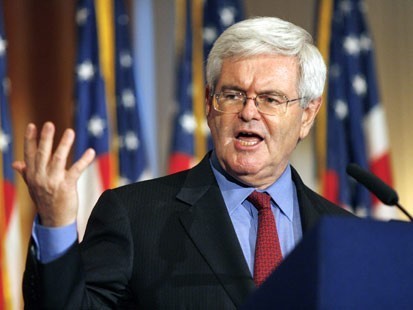
Newt Gingrich lays out a new plan to attract minorities to the GOP:
"If you're going to govern in 2013, you're going to need a really large margin," [Gingrich] said.
To do that, Republicans need to spend at least 30 percent of their time campaigning to black, Hispanic and other minority communities and emphasize lowering taxes instead of social programs such as welfare.
Ah, that's the problem -- they haven't spent enough time talking about lowering taxes.
Ignore That Koch Brother Behind The Curtain
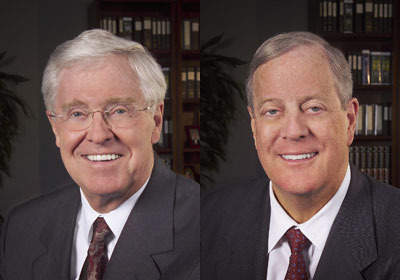
The many beneficiaries of Koch libertarian largesse bridle at their portrayal as sinister, self-interested moguls pulling strings behind the scenes. But then you read things like this:
Last week, the New York Post's Keith Kelly reported that The Daily Caller, a right-wing news site run by Tucker Carlson, had spent "several weeks" pursuing false allegations that Mayer had committed plagiarism in at least two articles. One of the allegations involved Mayer's landmark expose about Charles and David Koch -- billionaire brothers who have funded conservative organizations tied to the Tea Party movement.
Kelly tells Media Matters that the plagiarism charges were also pitched to the Post, apparently by a different source than the one that tipped off the Daily Caller. The Post investigated and ultimately reported that the allegations were untrue.
After first saying that the plagiarism story would result in an "extensive piece," The Daily Caller ultimately told both Kelly and The New Yorker that the article had been spiked.
Kelly has reported that "the person or persons behind the allegations remains a shadowy mystery," and both Carlson and Daily Caller reporter Jonathan Strong have declined to identify the original source of the smear.
The shocking and actually somewhat encouraging thing is that, while the Koch brothers or their minions got a couple reporters to investigate this smear, they didn't get anybody to actually publish it. You'd have to think they could find somebody pliable enough. Hey, I've got two kids and a mortgage. Pay me enough money and I'll swear that I was in a secret Marxist cabal with Jane Mayer
Jonathan Chait's Blog
- Jonathan Chait's profile
- 35 followers

