
Jonathan Chait's Blog, page 126
January 21, 2011
Democrats Set Up A Trap
One of the rules of thumb of this blog is that, when politicians offer political advice to their opponents, it is probably not genuine. So it is with a jaundiced eye that I read numerous leading Democrats serving up quotes about how terrified they are that Republicans will shut down the government in an attempt to de-fund the Affordable Care Act:
"I am real concerned," Rep. Charlie Gonzalez (D-Texas) said. "We do operate on yearly budgets that could exact great harm if they are dedicated to that proposition. You still have to work with the Senate. So what happens when you reach that kind of impasse? We have this gridlock ... There is no doubt in my mind that the Republican leadership ... has already charted a course. They are very disciplined and very good at what they do."
"This is only the beginning," Rep. John Dingell (D-Mich.) said. "I'm also fearful that they are going to try and eviscerate the legislation by denying it funding [and] by harassing the administration."
"I'm very concerned," Rep. Peter Welch (D-Vt.) said. "There are a lot of things that need funding in order to be implemented ... Here is the point: these guys are serious. Give them credit. They said what they were going to do with repeal and now they are doing it ... There is no ambiguity here and anyone who doesn't see [defunding] as a deadly serious effort on the part of GOP leadership is naive."
We're deeply concerned! Frightened, even! What on Earth would we do if the Republicans threw us into that briar patch?
Hey, maybe Democrats are thinking that, since polls show the public overwhelmingly thinks President Obama wants to cooperate with Republicans, and almost as overwhelmingly thinks Republicans don't want to cooperate with him, a government shutdown would create a huge backlash against the GOP?


Charles Krauthammer Laughs At Arithmetic
Charles Krauthammer writes:
Suppose someone - say, the president of United States - proposed the following: We are drowning in debt. More than $14 trillion right now. I've got a great idea for deficit reduction. It will yield a savings of $230 billion over the next 10 years: We increase spending by $540 billion while we increase taxes by $770 billion.
He'd be laughed out of town.
Uh... why? As I noted the other day, "Conservatives think the notion that a piece of legislation can spend some money to cover the uninsured, while simultaneously cutting spending and raising taxes by some greater sum, so that the overall bill reduces the deficit, is conceptually absurd." It would literally be impossible to craft a bill that provided for universal coverage and also reduced the deficit and have Republicans accept its accounting as valid.
Krauthammer holds this belief so strongly that he presents a straightforward arithmetic property -- $770 billion in revenues minus $540 billion in spending equals $230 billion in lower deficits -- as not just wrong but hilariously wrong: Why, they're increasing spending while increases taxes more, while claiming this will reduce the deficit! The morans!
Indeed, Krauthammer deems the "$770 billion > $540 billion" scoring method so self-evidently silly he doesn't even bother to refute it. The paragraph I quoted is all the refutation he deems necessary.
Now, increasing spending by $540 billion and increasing taxes by $770 billion is a ridiculous way to reduce the size of government. But, despite Republican efforts to conflate the two, the size of government is not the same thing as the debt, as even Milton Friedman recognized.
So Krauthammer, convinced that $540 billion is clearly larger than $770 billion, proceeds to recycle some familiar Republican talking points attempting to cast doubt on the CBO score. His shining example is the endlessly repeated saw that the law combines six years of benefits with ten years of revenue in order to appear revenue-neutral:
Most glaringly, the entitlement it creates - government-subsidized health insurance for 32 million Americans - doesn't kick in until 2014. That was deliberately designed so any projection for this decade would cover only six years of expenditures - while that same 10-year projection would capture 10 years of revenue. With 10 years of money inflow vs. six years of outflow, the result is a positive - i.e., deficit-reducing - number. Surprise.
That would be bad if true. But it's not true:
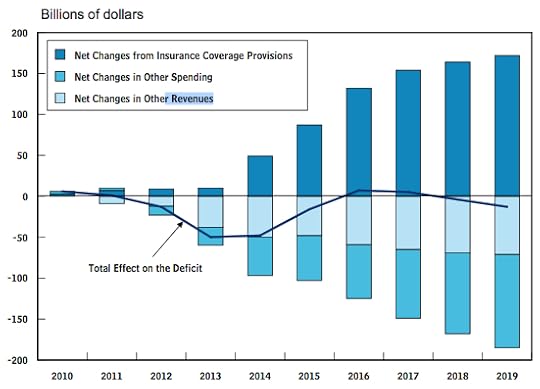
The benefits phase in slowly as do the revenues. Krauthammer's six years of benefits/ten years of revenue canard would mean that, once fully phased in, the costs dramatically exceed the revenue. That isn't the case. The law's effect deficit-reduction effect increases over the last ten years.
Health care analysts have pointed this out over and over. Yet conservatives like Krauthammer keep repeating these debunked claims. Either Krauthammer lives so deep within the right's misinformation feedback loop that he has never heard any refutation of his false claims, or else he simply doesn't care what's true.
Anyway, Krauthammer frames his entire column as a plea for concern with the deficit. If this were truly his concern, as Austin Frakt points out, why don't Republicans propose to repeal just the coverage expansions in the PPACA, and keep all the cost savings? Or even just some of them? if they refuse to violate their religious opposition to tax hikes, they could just keep in place the Medicare cuts and repeal the coverage expansions. that would undeniably shrink the deficit, and the size of government. But they won't even consider that. The bad faith at work here is just staggering.
January 20, 2011
Obama's Review of Regulations: Useful, But Not in the Way He Intends
[Guest post by Noam Scheiber:]
On one level, it’s hard not to see the regulatory review Barack Obama announced this week as a bit of a stunt. The idea, after all, isn’t to revisit the regulations his administration has supported in areas like health care, finance, or the environment. (Not something I’d like to see, to be sure.) The idea is to root out regulations from earlier eras that have either outlived their usefulness or contradict one another. This is all perfectly fine, and it could be effective politically. Still, the real surprise here isn’t that this administration is conducting a review. It’s that previous administrations haven’t conducted them on a regular basis, which seems a bit hard to believe.
Whatever the case, what’s almost always underwhelming are the presidential op-eds that accompany these gestures. Defunct statesmen are invoked and countless superlatives are expended, usually in inverse proportion to the cosmic significance of the initiative. Which is why I was pleasantly surprised to see that Obama’s rendition in Tuesday’s Wall Street Journal was actually pretty useful.
Don’t get me wrong, the piece wasn’t without trivialities. To wit:
[T]he FDA has long considered saccharin, the artificial sweetener, safe for people to consume. Yet for years, the EPA made companies treat saccharin like other dangerous chemicals. Well, if it goes in your coffee, it is not hazardous waste. The EPA wisely eliminated this rule last month.
(An aside: See, we were already doing this stuff!)
But, as a document, the Journal piece may be the clearest—and certainly most concise—statement of Obama’s economic philosophy I’ve ever seen, for both good and for ill.
First the good. In the very next paragraph, the president writes:
As the executive order I am signing makes clear, we are seeking more affordable, less intrusive means to achieve the same ends—giving careful consideration to benefits and costs. This means writing rules with more input from experts, businesses and ordinary citizens. It means using disclosure as a tool to inform consumers of their choices, rather than restricting those choices. [emphasis added.]
The bolded lines strike me as the essence of Obama-ism. Unlike New Democrats of the ‘80s and ‘90s, Obama has largely embraced both the goals of traditional liberalism and the government’s role in advancing them. But, unlike liberals of Great Society vintage, he’s made it his administration’s project to achieve these goals with the lightest touch possible. Despite all the conservative hyperbole about socialism, you see this across everything from the response to the banking crisis to health care and climate change.
And how exactly do you create an activist government that’s also minimally intrusive? Obama alludes to that in the second bolded sentence: You inform and incentivize consumers and businesses so they end up doing for themselves what earlier generations of liberals would have had the government do for them or mandate. Cap-and-trade is the most obvious example, since it decentralizes decisions that regulators would have once made themselves. But there were tons of smaller examples embedded in the administration’s health care plan, like comparative effectiveness research and incentives for coordination among health care providers. The sum total of this stuff strikes me as a pretty attractive vision of the state’s role in the economy. (For what it’s worth, Frank Foer and I took a crack at articulating this vision near the beginning of the Obama administration.)
As for the portion of Obama’s philosophy that’s sometimes problematic, this paragraph gets to the heart of it:
One important example of this overall approach is the fuel-economy standards for cars and trucks. When I took office, the country faced years of litigation and confusion because of conflicting rules set by Congress, federal regulators and states.
The EPA and the Department of Transportation worked with auto makers, labor unions, states like California, and environmental advocates this past spring to turn a tangle of rules into one aggressive new standard. It was a victory for car companies that wanted regulatory certainty; for consumers who will pay less at the pump; for our security, as we save 1.8 billion barrels of oil; and for the environment as we reduce pollution.
Implicit here is the idea that many of our biggest policy disagreements aren’t ideological but technocratic. That if you can just get the right people in the room, you can come to a reasonable understanding more often than not.
But while it’s clearly true that ideology is sometimes beside the point, I’m a bit more pessimistic than the president about how often that’s the case. For example, health care reform would appear to be a prime candidate for technocratic problem-solving—there are only so many ways to expand coverage while preserving as much of the status quo as possible and restraining costs. But, of course, a lot of conservatives flatly reject the idea that expanding coverage is desirable, at least if it involves any government role. For that matter, even the fuel efficiency example may be misleading, since a big chunk of the opposition party believes there’s nothing particularly problematic about carbon emissions, whereas government regulations are inherently unjust. (These people tend to go quiet on the national security argument.)
But these are debates for another day. For the moment, it suffices to say that, if nothing else falls out of the president’s regulatory initiative, it will have achieved a lot by distilling his worldview so clearly.
&c
-- Ed Kilgore: why the 2012 GOP primary field is narrower than you think.
-- Frank Foer makes his post-editor debut.
-- How many more children must die before Michelle Obama is stopped?!
-- Gabe Sherman profiles Deadspin EIC A.J. Daulerio.
Health Care And The Nub Of The Fiscal Problem
Former Bush economic advisor Greg Mankiw writes:
I have a plan to reduce the budget deficit. The essence of the plan is the federal government writing me a check for $1 billion. The plan will be financed by $3 billion of tax increases. According to my back-of-the envelope calculations, giving me that $1 billion will reduce the budget deficit by $2 billion.
Now, you may be tempted to say that giving me that $1 billion will not really reduce the budget deficit. Rather, you might say, it is the tax increases, which have nothing to do with my handout, that are reducing the budget deficit. But if you are tempted by that kind of sloppy thinking, you have not been following the debate over healthcare reform.
Ezra Klein takes him apart with unusual acidity.
Puzzling over the conservative objections to the notion that the Affordable Care Act reduces the deficit, it seems to me there is a common thread. Conservatives think the notion that a piece of legislation can spend some money to cover the uninsured, while simultaneously cutting spending and raising taxes by some greater sum, so that the overall bill reduces the deficit, is conceptually absurd. Now, they wouldn't put it like that. Often times their objections take the form of specific, though demonstrably wrongheaded, critiques of the CBO's methodology. But the root of the issue is that they think the idea that you can create a new entitlement while reducing the deficit is inherently ridiculous.
Chris Christie Inflames Anti-Muslim Right
Chris Christie appointed a judge who's Muslim and seems like a solid selection:
Mohammed has been a consistent advocate for increased dialogue between the Muslim community and law enforcement. The New York Times noted that Mohammed “helped arrange a law enforcement job fair at a Paterson mosque in which young Muslims were encouraged to apply for jobs with law enforcement agencies. The session also featured a question-and-answer session for mosque members with the police and prosecutors.” Mohammed has also given F.B.I. agents training sessions on Islam and Muslim culture.
Kudos to Christie. Of course, reports George Zolnick, various conservatives are flipping out:
– In a widely linked post, “Governor Christie’s Dirty Islamist Ties,” blogger Daniel Greenfield writes that “New Jersey, the Garden State, has just taken its first step toward becoming the Sharia State,” and criticized Christie for being “willing to stand up to the teacher’s union, but not to the terrorist’s union.”
– Hate blogger Pamela Gellar, in a post titled “Governor Christie’s Hamas Pick for Superior Judgeship,” declared Christie’s political career over: “Governor Christie looked and sounded like he could be presidential. He’s not. He’s in bed with the enemy. All the other stuff doesn’t matter if you don’t have your freedom.”
– At Commentary magazine, Jonathan S. Tobin wrote a post about Christie’s “troubling appointment,” and charged that Christie’s “appointment of Sohail Mohammed to the court shows that his judgment on the issue of support for terrorism is highly questionable.”
– The Investigative Project on Terrorism warned Christie’s appointment of an “Islamist” to a judgeship “betrays either naivete or calculation. Either is troubling.”
– PowerLine blog took extra pains to note that “The attorney’s name is Mohammed, first name Sohail — Sohail Mohammed.”
Perhaps we should consider the possibility that the governor himself is a secret Muslim. Let me ask you this: If you were a Muslim determined to infiltrate the U.S. government, and you decided to adopt a new name to pass as a Christian, what name would you come up with? I'll tell you what name -- Chris Christie!
Join Us For A Live Chat

Please join us at 1pm EST today for a live discussion of John B. Judis's February 3 cover story on the return of the Republicans, featuring John and Richard Just, at TNR's Livestream channel. Readers should submit questions to TNRSociety@tnr.com.
LIVESTREAM >>
Why Did Lieberman Change?
[Guest post by Isaac Chotiner]
The New York Times' analysis of Joe Lieberman's career includes this comment from John Droney, a Connecticut Democrat described as a "confidante" of the senator:
“After [the 2006 primary] happens, Joe’s very upset,” Mr. Droney said. “He says: ‘Wait a minute, I got out of Yale Law School, I was one of the youngest state senators, I was majority leader, I ran for Congress, I was the first activist attorney general, I was elected to the United States Senate in a very difficult election against Lowell Weicker, I served my country well, I ran for vice president and actually was elected by the popular vote and, now, because these people don’t like my foreign-policy position, they’re supposed to ignore 30 years? No way!’ And he resented it, and it’s been reflected ever since.”
It never ceases to amaze me that people think these sorts of explanations for behavior are exculpatory. (Since Droney has just finished lamenting the decline of centrism and the lack of a home for "Average Joe Democrats," it seems safe to assume that he meant the comment approvingly). If we take Droney at his word, Lieberman altered his vote on a whole range of issues (like tax cuts for the wealthy and a public option) not because he had a legitimate change of heart, but because that same heart was full of spite. If an opponent of Lieberman said as much, he or she would be accused of "looking for the lowest possible motive." And yet here is a Lieberman pal offering up the same excuse under the strange impression that it makes his friend look something other than vain and selfish.
The Battle Hymn Of Sarah Palin
The Battle Hymn of Sarah Palin:
Say what you will about pro-Obama kitsch, but it had high production values. This is what happens when the entire cultural elite is affiliated with one party. There has to be somebody out there who can write a better song about Sarah Palin.
Health Care And Epistemic Closure
I've noticed that conservatives still reside in a world in which the public overwhelmingly wants to repeal the Affordable Care Act. The Weekly Standard writes, "Reflecting the clear and strongly held views of the vast majority of Americans, the House has voted overwhelmingly to repeal ObamaCare."
Clear and strongly held views? Here are the actual numbers:
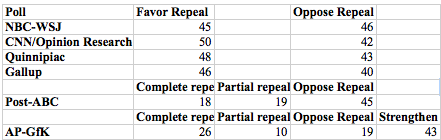
Of course, this assertion has been repeated in the conservative media so frequently that no doubt Republican partisans consider it to be an immutable property.
A recent National Review blog post does acknowledge the existence of polls showing declining support for repeal, but says they use "misleading questions." Why misleading? Here's why:
Conway also notes that when asked if they would favor a law “that would require every American to have health insurance, or pay money to the government as a penalty if they do not, unless the person is very poor,” 59 percent are opposed. “When they actually hear what the health care reform is, they’re opposed to it,” she says.
In other words, if you define health care reform as one of the few provisions in it that's actually unpopular, and ignore all the popular provisions, then it's really unpopular. That is some sound methodology right there.
Jonathan Chait's Blog
- Jonathan Chait's profile
- 35 followers

