
Jonathan Chait's Blog, page 131
January 12, 2011
More On Loughner And Right Wing Hysteria
Several friends have written in about my item arguing that Jared Loughner is not related to right-wing extremism. The objection, in a nutshell, is, don't you agree that right-wing rage is a serious problem?
I think it is a serious problem. I also think, despite the attempts of numerous Republicans to draw equivalences, that it's a far more serious problem than anything that occurred under George W. Bush. critics have focused on violent language and birtherism on the right. But there's a deeper radicalism hiding in plain sight. The whole nature of the Tea Party is a meta-message that legitimizes hysteria. The obsessive invocation of the Constitution suggests that Obama is not merely pursuing misguided policies but abrogating our basic rights. And the choice of Tea Party as metaphor suggests that this extraordinary abrogation of rights merits an extraordinary response, a response to a tyrant rather than a response to a duly elected presidency. The frequent signs at Tea Party rallies quoting Jeffrson about watering the tree of liberty with the blood of tyrants merely take this logic a tiny step further. Actual violence is just one more step beyond that, an application of the theory.
In short, yes, this is all extremely serious.
But the fact is that Jared Loughner does not grow even loosely out of this movement. He could just as easily have undertaken his rampage in 2008 or 1998 or 1988. And I continue to believe that entangling this incident with the broader problem of right-wing apocalypticism is intellectually problematic and practically unsound.


Conservatives Are From Mars, Liberals Are From Venus
It's a basic fact of politics that partisans of both sides always think their party compromises more readily than the other party. At the same time, I think it is the case that, though Democrats overstate their own party's tactical weakness, Democratic leaders really are more probe to compromise than Republican leaders. One reason is that Republicans are a homogeneous conservative party, while Democrats are a heterodox mix of moderates and liberals. Another reason is that, on economic issues, Republicans have a homogeneous business base, where Democrats must try to balance between business, labor and consumer or environmental groups.
And a new Gallup poll shows a third reason -- liberals just plain like compromise more than conservatives do:
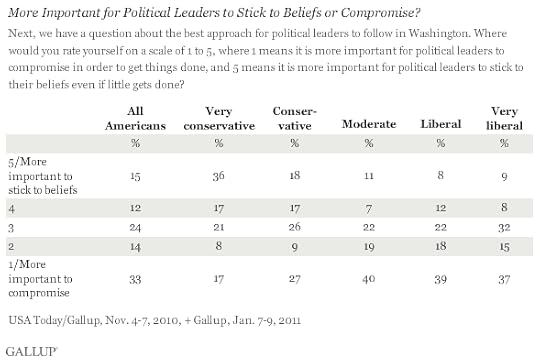
It's not actually such a surprising result. In foreign, domestic and social policy, conservatism tends to represent aggressive promotion of self-interest, while liberalism stands more for balancing out others' interests alongside your own. It's pretty interesting to see that borne out so starkly in terms of the two sides' approach to politics.
Lord Help Me, I'm Defending Palin

Okay, it's a little over the top for Sarah Palin to accuse her critics of "blood libel." But she does have a basic point. She had nothing to do with Jared Loughner. He was not an extremist who embraced some radical version of her ideas. And her use of targets to identify districts Republicans were, um, targetting is not exceptional or prone to incite anybody.
What's happening is that Palin has come to represent unhinged grassroots conservatism, and people in the media immediately (and incorrectly) associated Loughner with the far right. Moreover, the Republican establishment understands her potential candidacy as a liability and is looking to snuff it out. So you have this weird moment where Palin is on trial for something she has no connection with at all.
Republicans Denounce Republican Health Care Plan
Tim Noah on Republican outrage over high risk health insurance pools:
Of all the arguments Republicans have been waging against Obamacare as the House of Representatives prepares to vote for its repeal, none is harder to take than their criticism of the federally subsidized high-risk pools the law created to provide immediate relief to the uninsured. In May, the House Republican Conference complained that these high-risk pools would be unfair to people currently enrolled in existing state-run risk pools because the latter group was paying higher premiums. In July, the House Republican Conferencecomplained that implementation of this unfair federal program was being delayed. By January, the House Republican leadership was grousing (in a report titled Obamacare: A Budget-Busting, Job-Killing Health Care Law) that costs for this unfair-but-wrongly-delayed program were higher than expected even as participation in this unfair-but-wrongly-delayed-but-too-costly program was lower than it should be.
When you combine the GOP's intense opposition to Obama with its very weak commitment to any alternative policy architecture, you get this kind of wild, opportunistic flip-flopping.
January 11, 2011
How The Founders Hated The Senate
Rick Hertzberg has been pointing out for years that the founding fathers supporting proportional representation, and only agreed to create a Senate because such a concession was required to win support from smaller states. Following up on his excerpt of Hamilton, he has more:
Hamilton and Madison (Washington, too, by the way; I’m not sure about Jay) strongly favored what was then called “proportional representation.“ (Modern P.R., under which legislative seats are distributed roughly in line with aggregate party shares of the vote, hadn’t been invented yet.) Obama-like, they forced themselves to pay what they knew was a corrupt and immoral price in order to get a barely acceptable deal—which deal they sold, Obama-like, as a fine, public-spirited solution.
When it came time to decide who would write the essay defending the two-senators-per-state provision, Madison drew the short straw. In The Federalist No. 62, little Jemmy did not bother to conceal his lack of enthusiasm for the task:
The equality of representation in the Senate is another point, which, being evidently the result of compromise between the opposite pretensions of the large and the small States, does not call for much discussion.
Just a little discussion, in which Madison frankly admitted that the deal was a political bargain that had nothing do with high-flown republican principles or democratic theory. It would be pointless, he wrote,
to try, by the standard of theory, a part of the Constitution which is allowed on all hands to be the result, not of theory, but “of a spirit of amity, and that mutual deference and concession which the peculiarity of our political situation rendered indispensable.” A common government, with powers equal to its objects, is called for by the voice, and still more loudly by the political situation, of America. A government founded on principles more consonant to the wishes of the larger States, is not likely to be obtained from the smaller States. The only option, then, for the former, lies between the proposed government and a government still more objectionable. Under this alternative, the advice of prudence must be to embrace the lesser evil; and, instead of indulging a fruitless anticipation of the possible mischiefs which may ensue, to contemplate rather the advantageous consequences which may qualify the sacrifice.
In other words, the small states made a non-negotiable demand. Madison, Hamilton, and the other grownups realized that the only alternative to giving in was the failure of the Convention and a reversion to the Articles of Confederation, which would be even worse than a government with a screwed-up Senate. So they caved, and now they’re doing their best to stop worrying about the Senate and focus on the good aspects of the proposed new governmental setup, which will probably be less bad (“the lesser evil”) than the status quo.
Panic In Detroit
Last year, Motortrend selected the Chevy Volt as Car of the Year, driving climate science skeptics George Will and Rush Limbaugh batty.
Now the same car has at the Detroit Auto Show. Another cog in the socialist-scientist plot reveals itself.
Life Not In Ohio
University of Michigan Athletic Director David Brandon has been flying around the country looking to hire a new football coach while crazed fans (not me, of course -- ha ha!) seize on every scrap of information, including tracking his private plane. For his return trip to Ann Arbor last night, look at what state his plane went out of its way to avoid:

Smart man. You never went to be in, or even above, Ohio, if you can possibly avoid it.
January 10, 2011
Constitutionalism For Me, Not For Thee
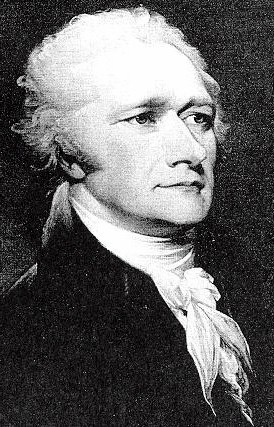 Rick Hertzberg quotes Alexander Hamilton arguing against a supermajority requirement:
What he was attacking was the premise that would one day underlie the McConnell-era filibuster—the notion that a legislature should routinely require supermajority approval for any action to be taken. For one thing,
To give a minority a negative upon the majority (which is always the case where more than a majority is requisite to a decision), is, in its tendency, to subject the sense of the greater number to that of the lesser.
That’s bad enough in itself, but it becomes positively dangerous in times of serious trouble:
In those emergencies of a nation, in which the goodness or badness, the weakness or strength of its government, is of the greatest importance, there is commonly a necessity for action. The public business must, in some way or other, go forward. If a pertinacious minority can control the opinion of a majority, respecting the best mode of conducting it, the majority, in order that something may be done, must conform to the views of the minority; and thus the sense of the smaller number will overrule that of the greater, and give a tone to the national proceedings. Hence, tedious delays; continual negotiation and intrigue; contemptible compromises of the public good. And yet, in such a system, it is even happy when such compromises can take place: for upon some occasions things will not admit of accommodation; and then the measures of government must be injuriously suspended, or fatally defeated. It is often, by the impracticability of obtaining the concurrence of the necessary number of votes, kept in a state of inaction. Its situation must always savor of weakness, sometimes border upon anarchy.
It's clear that the Constitution specified a few key areas where a supermajority would be required -- treaties, overriding vetoes, and Constitutional amendments -- with the obvious understanding that other votes would be conducted by majority rules. The filibuster simply evolved due to the imprecision of Senate rules.
It's interesting, given the right's newfound interest in hewing to the spirit of the Constitution. There are two key ways in which parts of the government have usurped power in clear violation of the intent of the Constitution. One is the filibuster. Another is the enormous war-making power of the president, who the Constitution clearly intended to constrain from initiating conflict without congressional approval. Somehow conservatives show no interest in restoring constitutionalism in either area.
Justice Delayed

Three years in prison for Tom DeLay.
I bet he comes out of this advocating prison reform. It's a cause that badly needs more high-profile conservative advocates.
Again, Right Wing Extremism Is A Problem, But It Isn't This Problem
Good point by Brendan Nyhan:
People have been having a hard time holding two ideas in their head at the same time:
1. What Paul Krugman calls "eliminationist rhetoric" is bad.
2. Contrary to his suggestion, there is no evidence that such rhetoric caused Saturday's events. Even if such evidence is later found, it would not justify the evidence-free claims that have been made in the last 48 hours.
I wrote, "I don't believe that analogizing politics to combat encourages anybody, even the mentally ill, to take up violence. People use metaphors like this in all aspects of daily life -- sports, business, dating, and on and on." Rich Lowry pulls out a recent example:

Guns do kill people. But gun metaphors don't.
Jonathan Chait's Blog

- Jonathan Chait's profile
- 35 followers

